 Skip to content


You've done the obvious jobs. Your Google Business Profile is claimed. The opening hours are correct. You've added photos, asked for reviews, maybe even posted updates. Yet when someone nearby searches for the service you sell, your business still seems to vanish.
That's a common local SEO problem in the UK. The issue often isn't that your profile is missing. It's that you're only checking visibility from one place, on one device, or with one broad keyword view. Your customers don't search that way. They search from a street, an estate, a town centre, a phone in a van, or a sofa in the next postcode.
A local search rank tracker shows what people see around your service area, not what you hope they see from a single test. For UK businesses, that matters because over 76% of consumers who perform a local search on their smartphone visit a physical business within 24 hours, and 28% of those searches result in a purchase, according to Local HQ's write-up on UK local keyword rank tracking.
If the phone isn't ringing, the first job isn't guessing harder. It's seeing where you're visible, where you're weak, and what to fix first.
Table of Contents
- Introduction Why Your Local SEO Efforts Might Be Failing
- What Is a Local Search Rank Tracker
- How Local Tracking Differs from Traditional SEO
- Essential Features Your Tracker Must Have in 2026
- From Grid Data to More Customers A Practical Workflow
- Choosing the Right Tool and Avoiding Common Pitfalls
- Frequently Asked Questions About Local Rank Tracking
Introduction Why Your Local SEO Efforts Might Be Failing
A plumber in Leeds can look well set up online and still lose work in the postcodes that matter most. The same goes for electricians, dentists, estate agents, roofers, and any business that depends on people nearby choosing fast. You can appear healthy on the surface while missing the searches that turn into calls.
The problem usually starts with a false sense of visibility. A business owner searches from their office, sees a decent result, and assumes coverage is good across the area. It rarely is. Local search changes with location, search context, and the details on your profile.
Your customer doesn't search from your desk. They search from their own postcode, on their own phone, with their own intent.
That's why local SEO can feel unfair. You can do several things right and still underperform in the exact neighbourhoods where demand is strongest. A standard SEO report won't show that clearly because it tends to flatten local variation into one average position.
A local search rank tracker fixes that blind spot. Instead of giving you one ranking, it maps your visibility across the places you serve. That matters because local search results can vary sharply across a town or city, and those changes directly affect whether people call, request directions, or move on to the next listing.
One symptom businesses miss
If your profile looks solid but lead flow is patchy, there's a good chance the weakness is geographic, not general. You may be strong near your premises and weak in nearby residential zones. Or strong on desktop checks and poor on mobile where local intent is highest.
Why this matters to busy owners
You don't need more dashboards. You need an answer to a simpler question. What should I improve next to get more customers from Google? A good tracker helps you answer that with evidence, not guesswork.
What Is a Local Search Rank Tracker
A local search rank tracker measures how visible your business is in Google's local results across the area you want to win. Instead of giving you one average position, it checks multiple locations and shows where you appear strongly, where you drop, and where you are missing altogether.
That difference matters because a single ranking can send you in the wrong direction. If you only check from one spot, you can look competitive on paper while losing searches a few streets away.
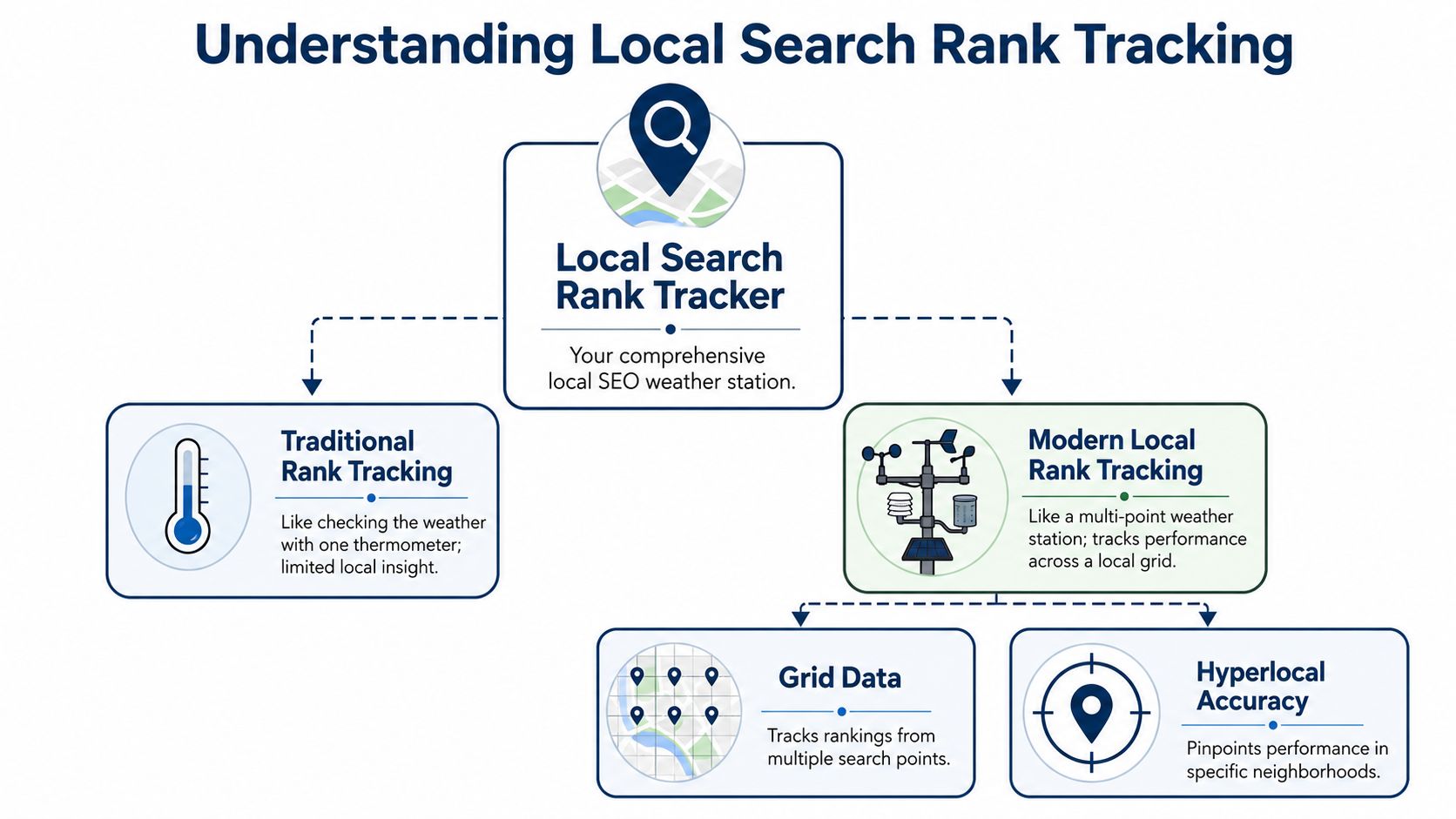
One ranking number is not local visibility
A standard rank check might say you rank second for “emergency electrician Birmingham”. Useful, but still incomplete. Second in the city centre is not the same as second in Edgbaston, Solihull, or on a mobile search made outside a competitor's premises.
Analysts at Next Growth's overview of local SEO rank tracking found that local rankings can change over very short distances in dense urban areas, and that broad city-level checks miss those shifts. For a business owner, the practical takeaway is simple. One-point tracking hides local weak spots.
What a geo-grid shows in practice
A geo-grid places scan points across a map and checks your ranking from each one. Common layouts include 5×5, 7×7, or 9×9 grids. Each point simulates a search from that area and records how your business appears in the map results for a chosen keyword.
Three settings control how useful that picture is:
- Scan centre. The middle of the area you want to measure, such as your premises, a target town, or a key postcode.
- Grid size. The number of points checked around that centre.
- Spacing. The distance between each point, which affects how much local variation you can see.
The output is more than a coloured map. It is a working list of priorities.
If one side of town ranks well and another does not, that usually points to a fixable issue. The weak area may need a tighter service page, better category alignment, stronger local landing pages, more relevant reviews, or closer citation consistency. A useful tracker helps you spot that pattern quickly so you can decide what to fix first.
Practical rule: If you serve several neighbourhoods or postcodes, one-point ranking checks do not give you enough detail to make confident decisions.
That is what a local search rank tracker is for. It does not just report positions. It shows where visibility turns into missed calls, missed direction requests, and missed jobs, then gives you a clearer starting point for action.
How Local Tracking Differs from Traditional SEO
Traditional SEO usually measures how a site performs for a keyword overall. Local tracking measures how visible your business is to a searcher standing in a specific part of town. That difference changes what you measure, what you fix, and how quickly ranking data turns into booked work.
For a small business, averages are often expensive. A report that says you rank well for “emergency plumber” sounds fine until you realise you only show up near your office and disappear in the postcodes that bring the best jobs.
Local SEO is driven by place, not just page strength
Google's local results are shaped by relevance, distance, and prominence, as outlined in Search Scale AI's guide to ranking in Google Maps.
Here is the practical version:
| Factor | What it means | What you can actually do |
|---|---|---|
| Relevance | How closely your business matches the search | Tighten categories, services, business description, and landing page alignment |
| Distance | How near the business appears to the searcher | Measure coverage properly and accept that some areas will be harder to win |
| Prominence | How trusted and established the business looks | Improve reviews, citations, links, profile completeness, and local brand signals |
Only part of that is under your control. You cannot change where the searcher is. You can improve how clearly Google understands what you do, and why your business deserves to appear ahead of nearby alternatives.
That is why local tracking is less about watching a headline rank and more about finding the pockets where visibility drops.
Standard rank tracking hides service-area gaps
A traditional rank tracker often gives you one position for one keyword. That might be good enough for national content work. It is weak for local decision-making.
Map rankings can shift sharply across a short distance. One neighbourhood may show your Google Business Profile in the top results, while the next one gives that space to a competitor with a closer address, stronger category match, or better review profile. If you only check one location, you miss where revenue is leaking.
This is where workflow matters. A local rank tracker should help you turn those weak areas into a task list. If visibility drops in one side of town, the next question is not “what is our average rank?” It is “what needs fixing here first?” That may be a thin service page, poor category targeting, weak review coverage for that service, or patchy citation consistency. If you want a quick way to test that before committing to a full platform, use a free local rank checker for SEO.
Local search data matters because the click path is different
In traditional SEO, the goal is often a website visit. In local search, the result itself can drive the action. A prospect may call from the map listing, ask for directions, or compare reviews without visiting your site at all.
That changes the job of rank tracking. You are not only measuring blue-link visibility. You are checking whether your business appears in the Local Pack and Maps where customers are ready to act, and whether the weak spots on your grid point to fixes that will increase calls, direction requests, and enquiries.
Used properly, local tracking becomes an operations tool. It shows where you are losing ground, helps you prioritise the fixes with the best commercial payoff, and stops you wasting time on average rankings that hide the primary opportunity.
Essential Features Your Tracker Must Have in 2026
Most software demos look good for five minutes. The key question is whether the tool helps you decide what to do next. If it doesn't, it's a reporting tool dressed up as a strategy tool.
This is the sort of screen that matters because it turns ranking checks into something you can scan quickly.
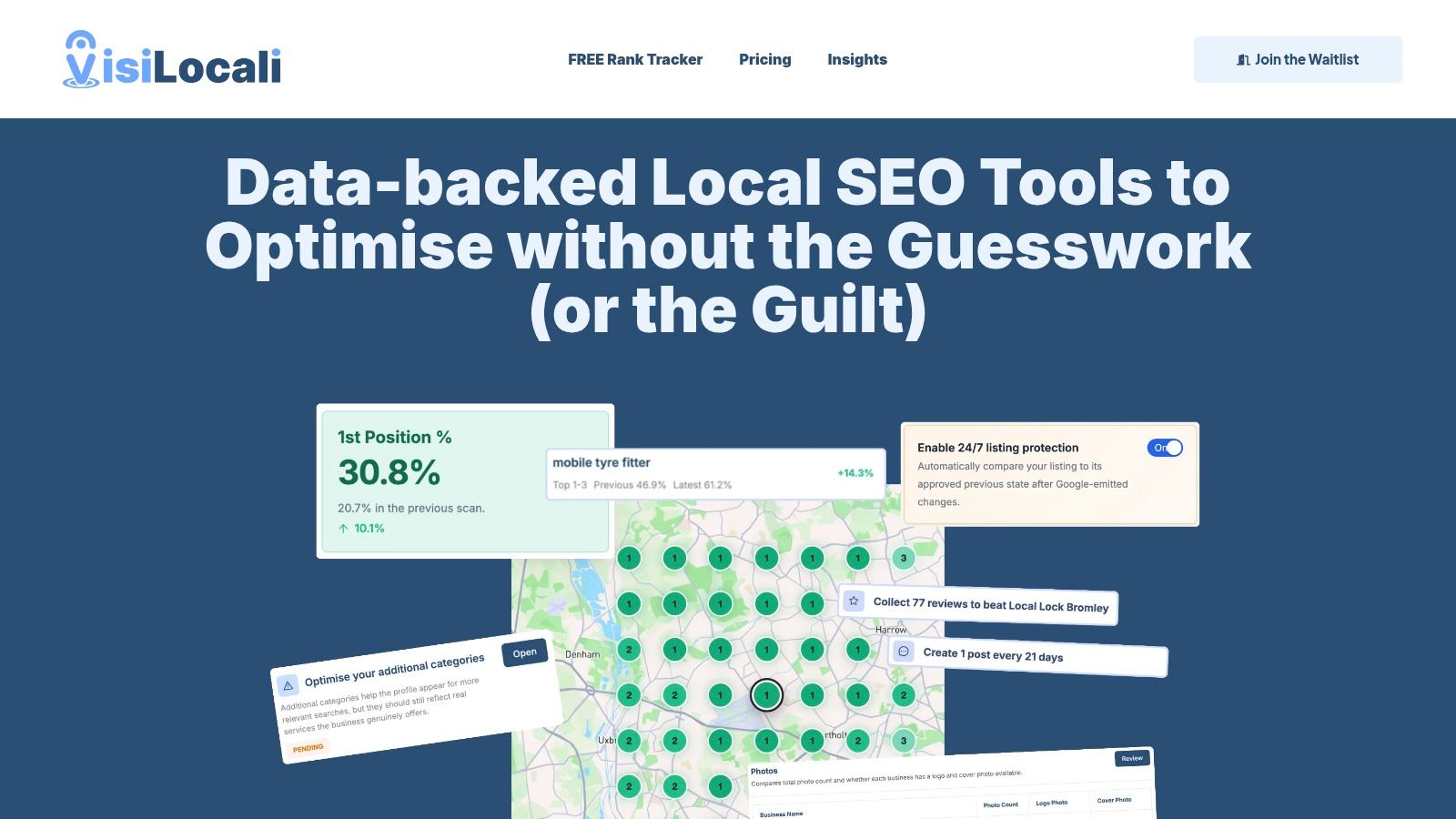
The non-negotiables
A modern local search rank tracker should include these features:
- Interactive geo-grid maps that let you see visibility across an area, not one point. At minimum, you want flexible grid options such as 5×5, 7×7, or 9×9 so you can match the scan to your market.
- Custom scan centre selection so you can test rankings from the town, district, or postcode that matters, not only from your business address.
- Keyword-level local views because “plumber” and “boiler repair” may produce very different maps.
- Competitor comparison inside the same local context so you can see who fills the gaps where you're weak.
- Google Business Profile analysis tied to rank changes. A red square on a map is only useful if the tool helps explain why it's red.
The last point matters most. Whitespark's 2026 Local Search Ranking Factors report confirms that leading drivers for UK Local Pack and Maps rankings include primary business category selection, physical proximity to the searcher, review quality and volume, and GBP completeness with keyword relevance, as summarised in ALM Corp's write-up on Google Maps SEO.
A tracker that only reports positions without connecting them to those controllable factors isn't enough.
What useful software should help you decide
Good local software should reduce your decision load. It should help you spot things like:
- Category mismatch where your primary category is too broad or less accurate than the businesses outranking you.
- Review weakness where competitors have a stronger review profile in the areas you want to win.
- Incomplete profile details such as missing attributes, weak descriptions, or thin photo coverage.
- Patchy coverage by town where you rank well around your base but poorly in the nearby town you target.
If you want a lightweight way to test the concept before committing, a free local SEO rank checker is a sensible starting point.
The best tracker doesn't just say “you dropped”. It says “you dropped here, against these competitors, and this is the likely reason”.
That's what turns reporting into action.
From Grid Data to More Customers A Practical Workflow
Most businesses don't need more local SEO theory. They need a repeatable routine. A proper workflow starts with a map, but it should end with a short list of tasks that have a clear commercial reason behind them.
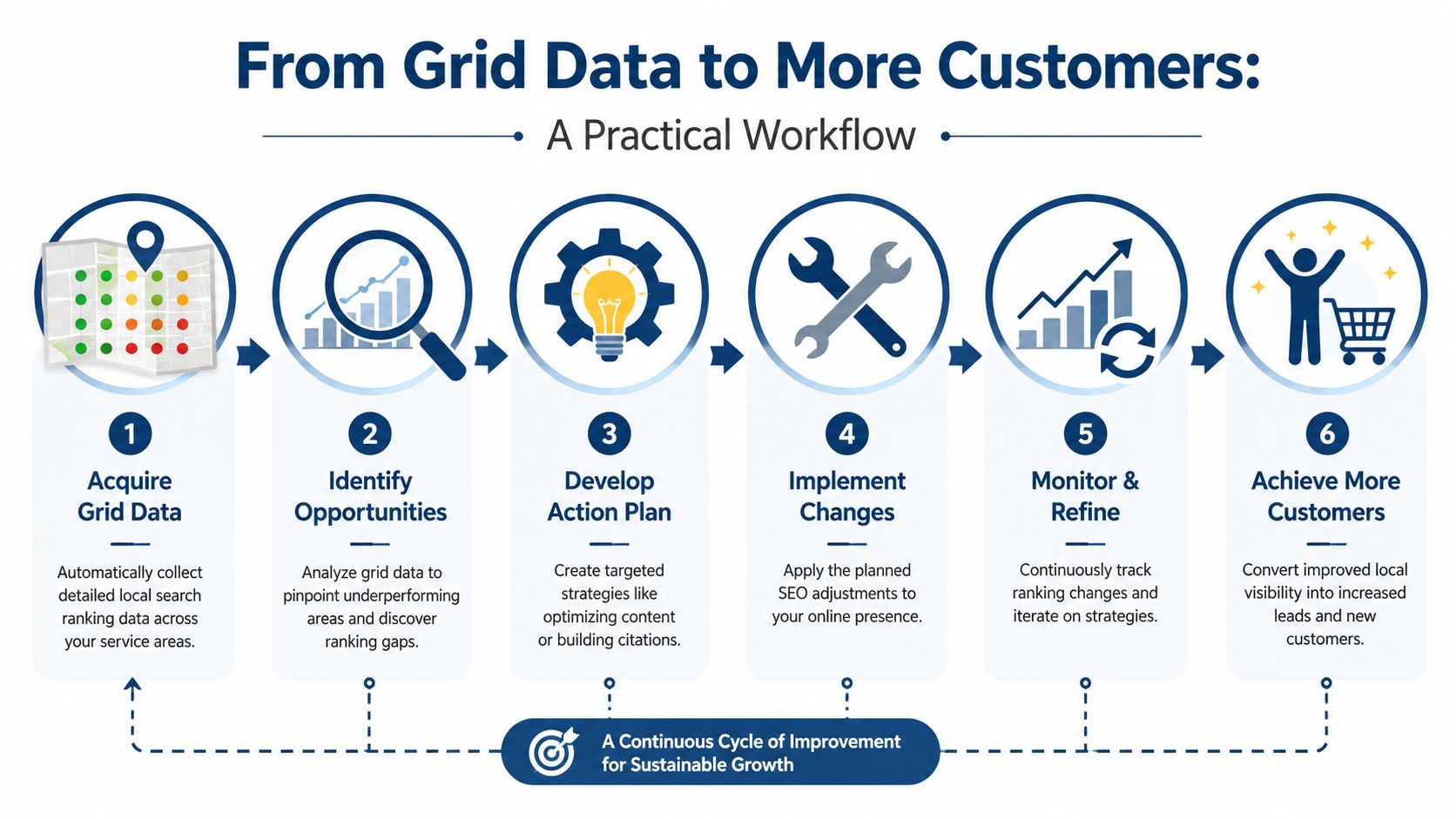
Start with a weak patch not a vanity average
Suppose you run an electrical business and your grid shows solid visibility near your office but weak rankings in a residential area a few postcodes over. Don't start by staring at the average. Start with the weak patch.
That weak patch matters because the Local Pack wins a disproportionate share of local attention. In the UK, the average Local Pack click-through rate for service industries such as plumbing and electrical work is 44%, compared with 18% for organic listings, and losing one position in the Local Pack for a high-volume postcode can remove over £1,200 in monthly qualified traffic for a typical small business, according to Rank Alert's analysis of local rank tracking and click value.
So the workflow begins like this:
Choose one priority keyword
Pick the service that drives revenue, not the one that flatters the report.Look for geographic weakness
Find the cluster of poor results, especially in areas you actively serve.Check whether the weakness is consistent
If the weakness appears across a section of the grid rather than one isolated point, you've found a pattern worth working on.
Turn findings into a short task list
Once you've found the weak area, the next job is diagnosis. During diagnosis, many businesses stop too early. They see the gap, but they don't compare the profile details behind it.
A smarter process is:
- Compare your profile with the businesses outranking you in that specific area. This isn't about copying. It's about spotting meaningful differences.
- Review your category choices. If the leading businesses use a more precise primary category, that can be a strong clue.
- Examine review strength and freshness. If your review profile is thinner or older, that weakness often shows up first in tougher areas.
- Check profile completeness. Missing services, thin descriptions, weak media, or unmanaged questions can all reduce local competitiveness.
A practical competitor review can help structure this step. This guide on how to analyse local competitors is useful if you need a framework.
Here's what a prioritised action list might look like after that analysis:
| Priority | What you found | What to do |
|---|---|---|
| High | Primary category is less precise than top local competitors | Update the primary category to better match the service searched |
| High | Review profile looks weaker in quality or volume | Ask recent customers for genuine reviews and reply to existing ones |
| Medium | Profile lacks service detail | Expand service descriptions to better match real search intent |
| Medium | Photos and posts are stale | Refresh visual proof and publish regular updates |
Measure whether the fix changed the map
A local search rank tracker earns its keep by providing tangible results. After you make a change, you don't just wait and hope. You rescan the same grid and look for movement in the same weak zone.
If the improvement appears only around your premises, you haven't solved the original problem. If the weak zone begins to fill in, you've made a fix that matters commercially.
Don't optimise for a prettier dashboard. Optimise for stronger visibility in the postcodes that bring profitable jobs.
Over time, this creates a practical loop:
- Scan the area
- Find the weak patch
- Compare against the leaders there
- Fix the likely cause
- Rescan and confirm
That loop is simple enough for a busy owner to maintain and strong enough for an agency to run across multiple clients. It also prevents a common mistake in local SEO, which is doing random “best practice” updates without knowing whether they address the actual gap.
Choosing the Right Tool and Avoiding Common Pitfalls
Some platforms try to be everything. Site audits, backlinks, content briefs, technical monitoring, competitor intelligence, reporting, forecasting, and local rank tracking all piled into one subscription. That can work for large teams. For most local businesses, it creates more noise than value.
A better approach is to choose software that helps you act quickly on local visibility problems.
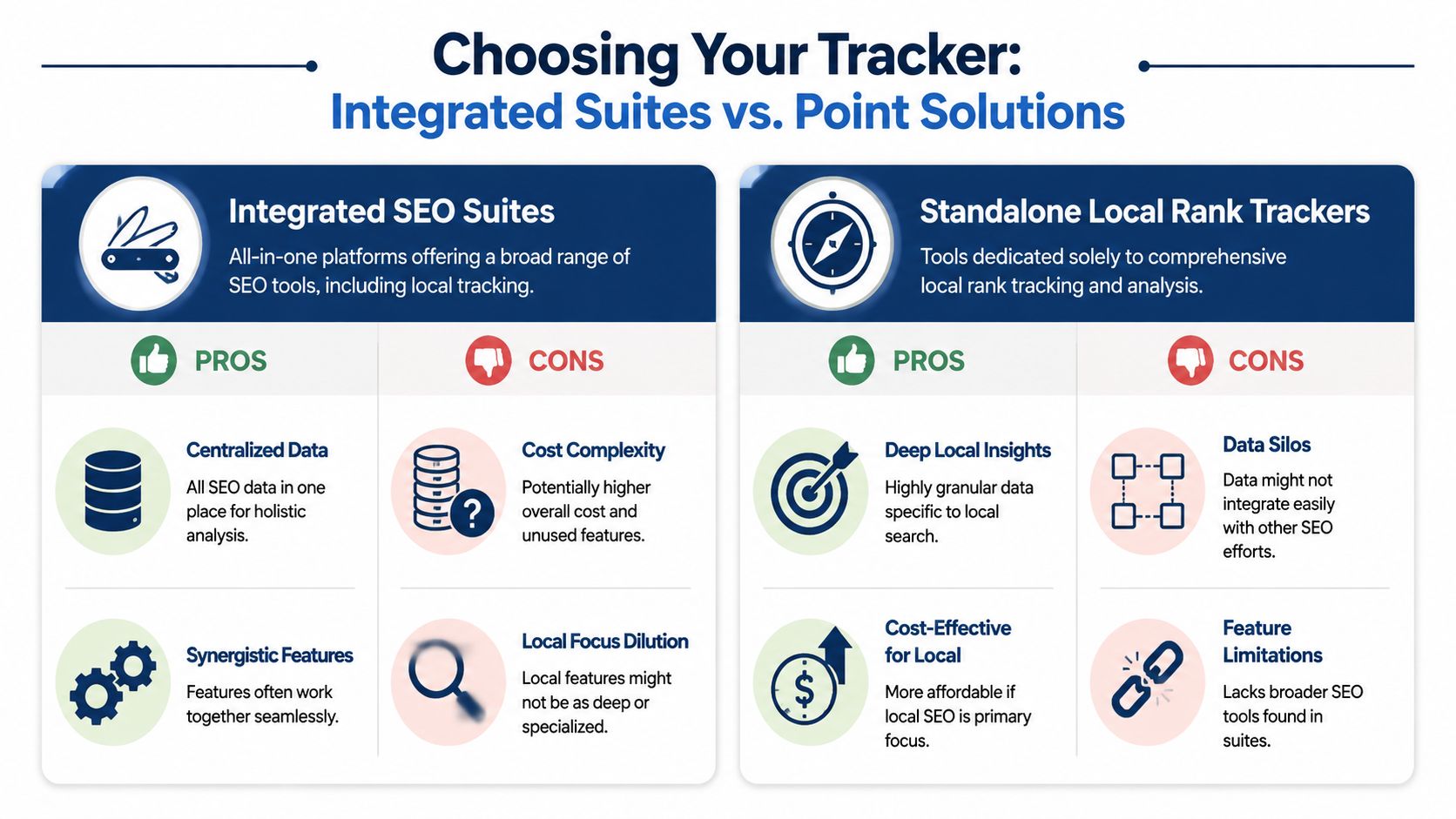
Two very different product philosophies
Here's the practical trade-off:
- Broad SEO suites can be helpful if you have a team that will use the wider feature set. They tend to suit agencies with varied service lines or in-house marketers managing more than local SEO.
- Focused local tools tend to work better for small businesses and local agencies that care most about Google Maps visibility, profile improvements, and clear next steps.
Neither model is automatically right. The mistake is paying for complexity you won't use.
Mistakes that waste time and budget
The most common buying and usage mistakes are simple.
Paying for feature bloat
If most of the platform sits untouched, you're not buying capability. You're buying clutter.Watching rankings too often
Local results move. If you check obsessively, you'll react to noise instead of trend. It's better to review on a steady cadence and pay closer attention after meaningful profile changes.Treating rank as the only goal
Rankings matter because they affect enquiries. The point isn't to worship every movement on the grid. The point is to improve visibility where customers search, then connect that to calls, clicks, and direction requests.Ignoring review competitiveness
For UK service businesses, industry guidance for 2026 says a competitive position in local search typically requires 40 to 60 genuine reviews with a minimum 4.5-star rating, alongside consistent monthly review additions, according to Ampliflow's local SEO guidance for UK service businesses. If you're far behind that benchmark, the software should make the gap obvious and help you prioritise it.
If you're comparing options, this guide on how to choose a local SEO optimisation tool gives a sensible decision framework.
Choose the tool that makes the next action clearer, not the tool that produces the most charts.
Frequently Asked Questions About Local Rank Tracking
How often should I check local rankings
For most local businesses, weekly review is enough for routine monitoring. If you've changed your primary category, updated key profile fields, improved reviews, or started targeting a new town, check more closely for a period afterwards.
Daily checking often creates anxiety rather than insight. Local search moves around naturally. What matters is whether the map improves in the areas you care about over time.
Should I track competitors too
Yes, but with a purpose. Competitor tracking is useful when it helps answer a practical question such as, “Why are they stronger than us in this postcode?” It's less useful when it turns into endless spying without action.
Focus on differences you can respond to. Category choices, review strength, profile completeness, and local messaging are worth studying. Their brand history or exact proximity to a searcher may not be something you can change.
Is the Local Pack the same as organic search
No. The Local Pack is the map-based group of business listings that appears for local-intent searches. Organic search is the standard list of website results below or around it.
That distinction matters because a business can perform differently in each. You might have a decent website ranking and still be weak in the map results that drive high-intent local clicks. A proper local search rank tracker focuses on that map visibility, not only your website's organic position.
Can I track a nearby town even if my business is based elsewhere
Yes, if the tool lets you set a custom scan centre. That's important for service-area businesses that want to understand visibility in a nearby town or district, especially when the keyword includes the town name.
What should I fix first if the grid looks poor
Start with what you control directly on your Google Business Profile. Category accuracy, review quality and volume, completeness of the profile, and clear service relevance are usually the first places to look. After that, compare your profile against the businesses winning in the weak parts of the grid and work from the clearest gap.
If you want a local SEO platform built around clear priorities rather than feature bloat, VisiLocali helps small businesses and agencies turn geo-grid ranking data into practical tasks that improve Google Maps visibility.
