 Skip to content

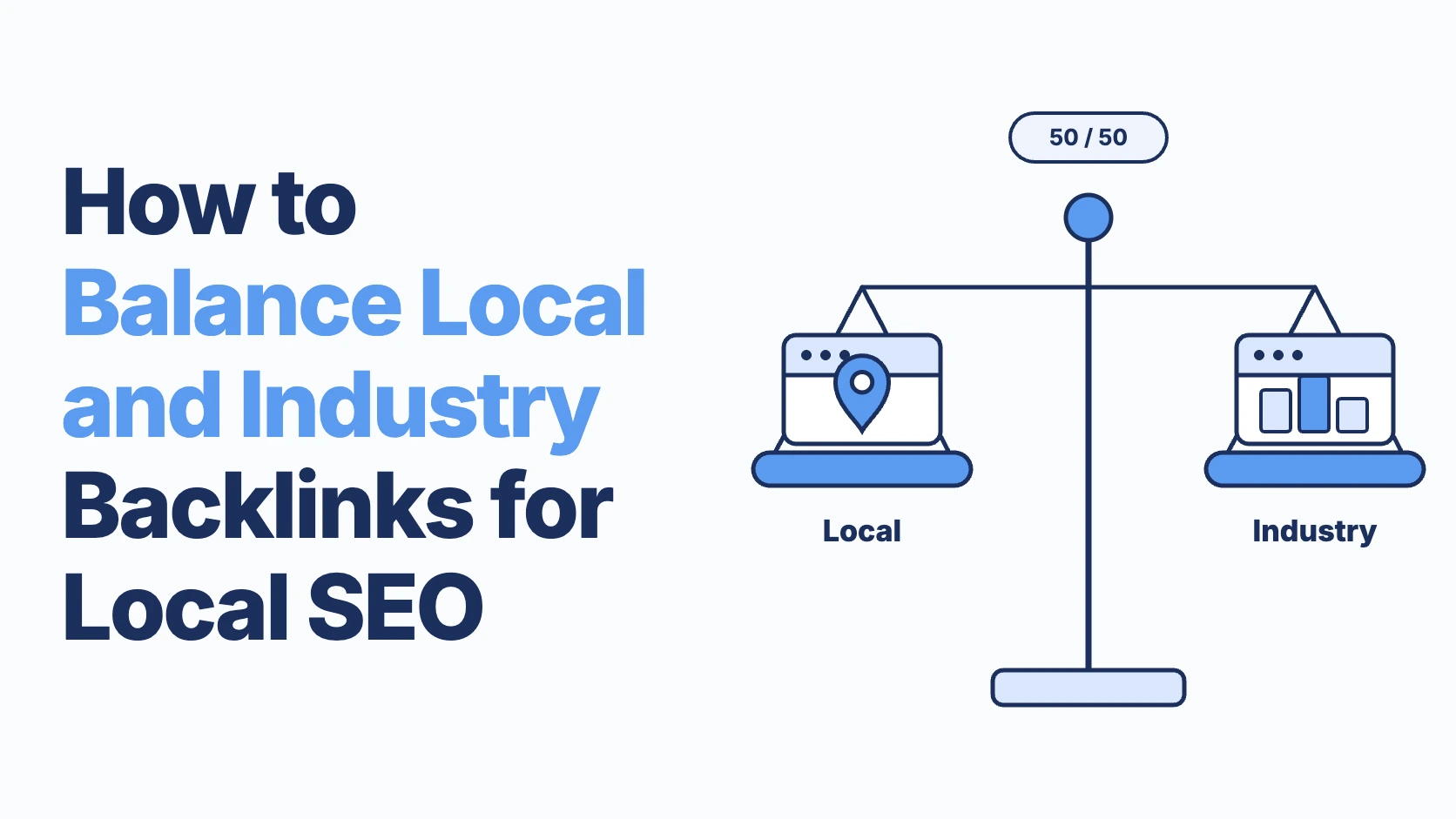
Not every backlink tells Google the same thing, and the gap between a local link and an industry link is bigger than most people assume. A plumber in Bristol who earns a link from a national plumbing trade journal gets a very different signal than one who sponsors the local under-12s football club. Both links matter, but they serve different purposes in how Google evaluates your business for local search results. Understanding how to balance local and industry backlinks for local SEO is the difference between a profile that ranks well in one or two searches and one that consistently appears across your entire service area. The challenge is that most advice treats these two link types as interchangeable, when they’re anything but. Local links tell Google where you operate. Industry links tell Google what you’re an authority on. You need both, and the ratio depends on factors specific to your business, your competition, and your market.
The Dual Role of Local and Industry Backlinks in Search Rankings
Google’s local ranking algorithm weighs three primary factors: relevance, distance, and prominence. Backlinks feed directly into prominence, but not all links contribute equally. A link from your city council’s business directory reinforces geographic prominence. A link from a respected trade publication reinforces topical authority. Together, they paint a complete picture of a business that is both locally rooted and professionally credible.
Think of it this way: if you run an estate agency in Manchester, a mention on the Manchester Evening News website tells Google you’re a real, active business in that area. A feature on a property industry blog like Estate Agent Today tells Google you know what you’re talking about. Neither link alone gives the full story. The estate agency that earns both types consistently will almost always outperform one that only pursues a single category.
The distinction becomes even more important when you look at Map Pack rankings specifically. Google Business Profile visibility is influenced by signals beyond the profile itself, and backlinks pointing to your website (which is linked from your GBP) contribute to how prominently you appear. Local links tend to influence the geographic radius in which you show up, while industry links tend to strengthen your relevance for specific service-related queries.
Establishing Geographic Relevance through Local Link Building
Local backlinks are your proof of address, in a sense. They confirm to search engines that your business genuinely operates in and serves a specific area. These links come from sources that are inherently tied to a location: local newspapers, community organisations, chambers of commerce, neighbourhood blogs, and event pages.
The best local links aren’t just directories. They’re contextual mentions that place your business within the fabric of a community. A mention in a “best independent businesses in Leeds” roundup on a local lifestyle blog carries far more weight than a bare listing in a generic UK business directory.
Leveraging Community Sponsorships and Local Charities
Sponsoring local events, sports teams, or charitable causes remains one of the most reliable ways to earn genuine local backlinks. When you sponsor a charity run in Glasgow, the event website typically lists sponsors with links. When you support a local food bank’s annual appeal, their thank-you page often includes your business name and URL.
The key is choosing sponsorships that align with your business and your audience. A children’s dentist sponsoring a primary school’s sports day makes perfect sense. A commercial solicitor sponsoring a local tech meetup connects them with potential clients. These links feel natural because they are natural.
Budget doesn’t have to be enormous either. Many local charities and community groups are grateful for contributions of £100 to £500, and the link you receive often sits on a page with genuine authority within the local area. Look for organisations that maintain their websites properly: a sponsorship link on a page that hasn’t been updated since 2022 won’t carry much value.
Securing Mentions from Regional News and Hyper-local Blogs
Regional news outlets are hungry for stories, particularly ones with a local angle. If your business has done something genuinely noteworthy, such as expanding, hiring, launching a community initiative, or reaching a milestone, a press release to your regional paper can earn a high-authority local link.
Hyper-local blogs are an underused resource. Many towns and neighbourhoods have bloggers who write about local businesses, restaurants, and events. A genuine relationship with these bloggers, built through offering them something useful rather than just asking for a link, can produce recurring mentions. Invite them to visit your premises, offer expert commentary for their articles, or provide a discount for their readers. The resulting links carry strong local relevance signals that pure industry links simply cannot replicate.
Building Authority with Niche-Specific Industry Backlinks
While local links anchor you to a place, industry backlinks establish you as a credible professional within your field. These come from trade associations, industry publications, professional directories, and authoritative niche websites. They tell Google that people within your profession recognise your expertise.
For a local service business, industry links often carry higher domain authority than local links. A mention on a national trade body’s website or a feature in a sector-specific publication typically comes from a domain with strong trust signals. This authority passes through to your site, strengthening your overall domain profile and making it easier to rank for competitive service-related terms.
Earning Placements in Trade Publications and Industry Directories
Every industry has its publications and directories. Tradespeople have Checkatrade and trade association listings. Solicitors have the Law Society directory. Accountants have professional body listings. These are often the easiest industry links to acquire because membership or accreditation automatically generates them.
Beyond directories, trade publications regularly feature practitioner insights, case studies, and opinion pieces. If you’re a heating engineer, contributing a piece to a plumbing and heating trade magazine about common boiler issues in older properties gives you a link from a highly relevant domain. The content doesn’t need to be groundbreaking: practical, experience-based insights are exactly what these publications want.
Don’t overlook supplier and manufacturer websites either. If you’re an authorised installer or stockist, many manufacturers maintain lists of approved professionals on their websites. These links are highly relevant and typically come from domains with significant authority.
Strategic Guest Posting on Highly Authoritative Niche Sites
Guest posting gets a bad reputation because so many people do it poorly: mass-producing thin articles for any site that will accept them. Done well, though, contributing genuinely useful content to respected industry sites remains one of the strongest ways to build topical authority.
The approach that works is selective and quality-focused. Identify three to five authoritative sites in your niche that your ideal customers or peers actually read. Study their existing content to find gaps you can fill. Pitch specific article ideas rather than generic “I’d love to write for you” emails. When you do write, make it genuinely useful: share real experiences, specific numbers, and practical advice that readers can act on.
A single well-placed guest post on a respected industry site will do more for your authority than twenty links from low-quality blogs. Quality over quantity isn’t just a cliché here: it’s the only approach that produces lasting results.
Determining the Ideal Link Ratio for Your Business Model
There’s no universal formula for the perfect split between local and industry backlinks, but there are sensible guidelines based on your business type and competitive environment.
For most local service businesses, such as plumbers, electricians, solicitors, dentists, and estate agents, a ratio somewhere around 60% local to 40% industry tends to work well. The local majority ensures strong geographic relevance, while the industry portion builds the authority needed to compete for service-specific queries.
Businesses in highly competitive niches may need to weight industry links more heavily. If every competitor in your area already has strong local links, the differentiator becomes topical authority. Conversely, businesses in less competitive areas might find that a handful of strong local links is enough to dominate, with industry links providing a comfortable margin.
The best way to determine your ideal ratio is to analyse what’s working for the businesses currently outranking you. Tools like VisiLocali’s Local Rank Tracker can show you exactly where competitors are stronger across your target area using visual ranking grids, which helps you identify whether your gap is geographic (needing more local links) or authority-based (needing more industry links). That data should drive your strategy rather than guesswork.
Synergising Local Citations with Global Industry Authority
Citations, meaning mentions of your business name, address, and phone number across the web, form the foundation of local SEO. But citations and backlinks work best when they reinforce each other rather than existing in isolation.
A strong citation profile across local directories (Yell, Thomson Local, local chamber of commerce listings) establishes baseline geographic trust. When you then earn industry backlinks that point to the same website listed in those citations, Google sees a consistent pattern: a real business, in a real location, with genuine professional credibility.
The mistake many businesses make is treating citations as a one-time setup task and backlinks as a separate, ongoing effort. They should be coordinated. When you update your website URL or business details, those changes need to flow through both your citation profile and any pages linking to you. VisiLocali’s GBP Audit Tool can help identify inconsistencies in your profile that might be undermining the value of your backlinks, flagging areas where your business information doesn’t match what’s listed elsewhere.
Think of citations as the soil and backlinks as the plants. Without healthy soil, even the best plants struggle. Without plants, the soil just sits there doing nothing. The combination is what produces results.
Avoiding Common Pitfalls in Local SEO Link Acquisition
Link building for local SEO has its own set of traps that can waste your time or actively harm your rankings. Knowing what to avoid is just as important as knowing what to pursue.
Identifying and Steering Clear of Low-Quality Link Neighbourhoods
Not every link opportunity is worth taking. Links from spammy directories, link farms, or irrelevant websites can trigger manual penalties or algorithmic filters that suppress your visibility. A good rule of thumb: if a site would accept a link from literally any business regardless of relevance or quality, it’s probably not worth pursuing.
Watch out for “local business directories” that are actually just link schemes with a geographic veneer. If the site has no real traffic, no editorial standards, and lists thousands of businesses with no apparent curation, skip it. Similarly, be cautious of reciprocal link arrangements where two businesses simply trade links with no genuine reason for the connection.
Check the domain authority and spam score of any site before pursuing a link. A link from a domain with a spam score above 30% is more likely to hurt than help. Focus your energy on earning links from sites that real people actually visit and trust.
Ensuring NAP Consistency Across All Backlink Profiles
NAP stands for Name, Address, and Phone number, and inconsistency across your backlink and citation profiles is one of the most common issues undermining local rankings. If your website says “123 High Street” but a directory listing says “123 High St” and a sponsorship page says “123 High Street, Suite 2,” Google has to guess which is correct. That uncertainty reduces confidence in your listing.
Audit every page that links to your business and verify that your NAP details match exactly. This includes the format of your phone number (do you use spaces, hyphens, or neither?), the way your street address is written, and even whether you include “Ltd” or “Limited” after your business name. Consistency signals legitimacy, and legitimacy drives rankings.
VisiLocali’s GBP Management Tool can help you maintain accuracy across your Google Business Profile, ensuring the hub of your local presence stays correct. From there, you can work outward to ensure all linking sites reflect the same details.
Measuring the Impact of a Balanced Link Profile on Map Pack Visibility
Building links without measuring their impact is like exercising without ever stepping on the scales: you might be making progress, but you can’t be sure. Tracking how your link building efforts translate into actual visibility changes is essential for refining your strategy.
The most direct measurement is your position in the Google Maps local pack across your target area. This isn’t a single ranking: it varies by the searcher’s location, the time of day, and the specific query. A geo-grid rank tracker provides the clearest picture by showing your visibility across a grid of points within your service area, revealing exactly where you’re strong and where you’re losing ground.
After building a batch of local links, you might notice improved visibility in the specific neighbourhoods associated with those links. After earning industry backlinks, you might see improved rankings for service-specific queries across a broader area. Tracking these patterns over time reveals which types of links are producing the most value for your particular business.
Set a review cadence of monthly check-ins where you compare your link building activity against ranking changes. It typically takes four to eight weeks for new backlinks to influence rankings, so don’t expect overnight shifts. The businesses that succeed with local SEO link building are the ones that track, adjust, and persist.
Future-Proofing Your Local SEO Strategy with Sustainable Outreach
Google’s algorithm updates increasingly reward genuine authority and penalise artificial link patterns. The businesses that will thrive in 2026 and beyond are those building real relationships rather than chasing shortcuts.
Sustainable outreach means becoming a genuine part of your local community and your professional industry, not just performing those roles for the sake of links. Sponsor events you actually care about. Contribute expertise to publications whose readers you genuinely want to help. Build relationships with local journalists and bloggers because you have something worth saying, not because you want a link.
This approach naturally produces a balanced link profile over time. A business that is actively involved in its community and its industry will organically attract both local and niche-specific links without having to manufacture them. The link profile ends up looking natural because it is natural, and that’s exactly what Google’s algorithms are designed to reward.
Create a simple quarterly plan: identify two local link opportunities and two industry link opportunities each quarter. That’s just sixteen targeted efforts per year, but done consistently, it builds a link profile that most competitors simply won’t match. Pair this with regular monitoring through tools that show you where your visibility is changing, and you have a strategy that compounds over time rather than one that needs constant reinvention.
If you’re unsure where your current link profile stands or which gaps are costing you visibility, VisiLocali can help you identify what to prioritise. Built by a Local SEO specialist with over ten years of experience, the platform turns ranking data and profile audits into clear next steps. Start with a 14-day free trial on any plan to see exactly where you stand and what to focus on first.
