 Skip to content

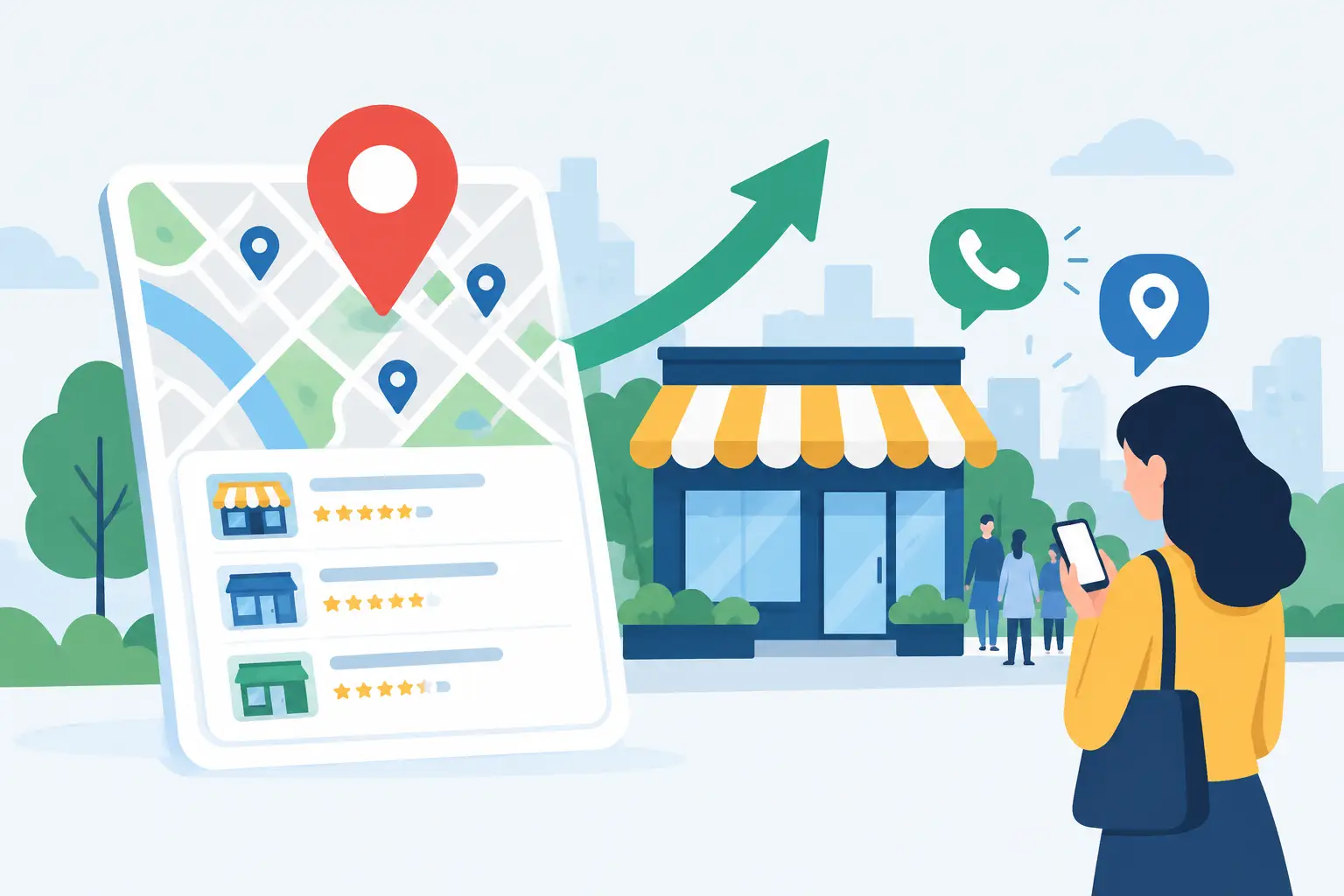
A plumber can appear first on Google Maps outside their office, then disappear from the map results three miles away. That is why map rankings need more than one postcode check. They show how visible your Google Business Profile is where real customers search, and whether that visibility is likely to produce calls, bookings and visits.
For a local business, a single ranking position is rarely the full story. Google changes map results according to the searcher’s location, the service they need, the competition nearby and the quality of the available business profiles. Knowing exactly where you are visible gives you a far better starting point than guessing from an occasional search on your own mobile phone.
What map rankings actually measure
Map rankings track a business’s position in Google Maps or the local map pack for a chosen search term and location. A rank of one means you are at the top of the results at that point. A rank of 15 means customers may need to scroll or look elsewhere before finding you.
The important phrase is “at that point”. Someone searching for “emergency locksmith” in a town centre may see a different set of businesses from someone using the same words in a nearby village. This variation matters especially for trades, clinics, hospitality businesses and service-area companies whose customers are spread across several neighbourhoods.
A useful map ranking report checks positions across a grid of locations, rather than relying on one central postcode. It reveals the shape of your visibility: where you dominate, where you appear lower down, and where competitors are taking the enquiries you want.
This is not about chasing a vanity number. The commercial question is whether you are visible in the places that contain your best customers. A café may care most about the streets within a ten-minute walk. A roofing firm may need consistent coverage across several towns. The right measurement depends on how and where people buy from you.
Why Google shows one business before another
Google has never offered a simple checklist that guarantees a top map position. However, its local results broadly reflect relevance, distance and prominence. Understanding those factors helps you focus effort where it can make a difference.
Relevance is how closely your profile matches the search. Your primary category, additional categories, services, business description, posts, reviews and website information all help Google understand what you do. A profile with a vague category and a thin service list gives Google less confidence than one that clearly describes the work it provides.
Distance is the relationship between the searcher and your location or service area. You cannot optimise your way around every proximity advantage. A business based two streets away will often have an edge for a highly local search. That does not make optimisation pointless. It means you should measure realistic coverage and strengthen relevance and prominence in the areas where competition is close.
Prominence is Google’s view of how established and trusted a business is. Reviews, review quality and recency, accurate citations, local recognition, profile activity and general online signals can all contribute. A business with more reviews is not automatically better, but a healthy, credible profile is easier for Google and customers to trust.
These factors overlap. A highly relevant profile with excellent reviews may outperform a closer competitor in some searches. In other cases, proximity wins. The aim is not to believe one ranking factor explains everything. It is to identify the gaps you can actually fix.
How to read a map ranking grid
A grid turns local visibility into a practical picture. Each point represents a search location and shows where your business ranks for a chosen term. If most points are green and near the top, you have strong coverage. If the centre is strong but the outer points drop sharply, your visibility is concentrated too narrowly.
Look for patterns before reacting to individual squares. If you rank poorly across the whole grid, your profile may not be sufficiently relevant or prominent for that service. If you rank well in one town but not another, competitor density, distance or weak local signals may be limiting you. If your rankings have fallen everywhere, check for profile edits, category changes, review slowdowns, listing issues or stronger competitor activity.
You should also compare the search terms that matter commercially. Ranking for a broad category can look encouraging, but a more specific high-intent search may generate better leads. A solicitor, for example, may be visible for a general legal term while missing searches for the service that produces their most valuable cases.
Do not treat every movement as a crisis. Local rankings naturally fluctuate, and results can shift with searcher location, device, competition and Google testing. The signal worth acting on is a sustained pattern across your target area, not a one-place change on a single day.
The actions that improve local map visibility
Once you can see where performance is weak, make changes in order of likely impact. The most productive work is usually less glamorous than SEO advice makes it sound: complete the profile accurately, prove that the business is active, and remove inconsistencies that create doubt.
Start with the basics. Choose the most accurate primary category, then use secondary categories only where they genuinely reflect services you provide. Add a complete service list in plain customer language, keep opening hours correct, and use a precise business description. For service-area businesses, set service areas that reflect real operating locations rather than trying to cover an unrealistic radius.
Then focus on the signals customers notice as well as Google. Ask for reviews consistently after completed work, respond professionally and refer naturally to the service provided when relevant. Fresh, detailed reviews can help a customer choose you even when several businesses have similar star ratings.
Use posts and photos to keep the profile current. A recent project photo, seasonal availability update or service announcement gives potential customers evidence that the business is active. It will not compensate for an inaccurate category or a weak reputation, but it supports a profile that feels reliable.
Finally, check your business details wherever they appear online. Your name, phone number, address or service information should be consistent. Old phone numbers, duplicate listings and conflicting opening hours create friction for customers and muddy the signals surrounding your business.
There are four priorities worth revisiting regularly:
- Profile accuracy: categories, services, hours, contact details and service areas.
- Review momentum: a steady flow of genuine reviews and timely responses.
- Competitor gaps: categories, services, posts and reputation signals competitors use more effectively.
- Geographic coverage: the towns and neighbourhoods where rankings fall below a commercially useful level.
Competitor analysis turns rankings into decisions
A weak ranking report tells you that you are behind. Competitor analysis tells you what may be helping the businesses ahead of you. Compare the top profiles in the locations where you want more visibility. Look at their categories, services, review volume and recency, photos, posts, attributes and completeness.
The point is not to copy competitors blindly. A restaurant with hundreds of reviews may be established over many years, while a newer venue needs a realistic plan for earning reviews and improving its offer. A service-area business may find that the leading competitor has a more focused category setup and clearer service information, which is much quicker to address.
This is where fragmented tools slow owners down. Checking rankings in one place, reviews in another and profile changes somewhere else makes it harder to prioritise. VisiLocali brings rank tracking, competitor comparisons and profile analysis together so the next action is based on evidence, not a generic checklist.
Avoid the mistakes that distort your data
Do not use your own Google search as your only measure. Your location, search history and device can influence what you see. Incognito mode reduces some personalisation, but it does not make one search a reliable view of a whole service area.
Avoid changing categories, business names or service areas repeatedly in pursuit of a quick lift. Frequent, unjustified edits can create inconsistency and may breach Google’s policies. Make accurate changes, record what changed and give the data enough time to show whether the work helped.
It is also unwise to chase rankings outside the area you can serve well. Expanding visible coverage sounds attractive, but enquiries from distant locations can waste time if travel costs, availability or response times make them unprofitable. Better map rankings should support a better local business, not a bigger map for its own sake.
The next time you review your visibility, choose one valuable service and one target area. Find the gap, compare the businesses winning there, then make the clearest improvement first. That is how local search becomes a repeatable route to more enquiries rather than another dashboard full of numbers.
