 Skip to content

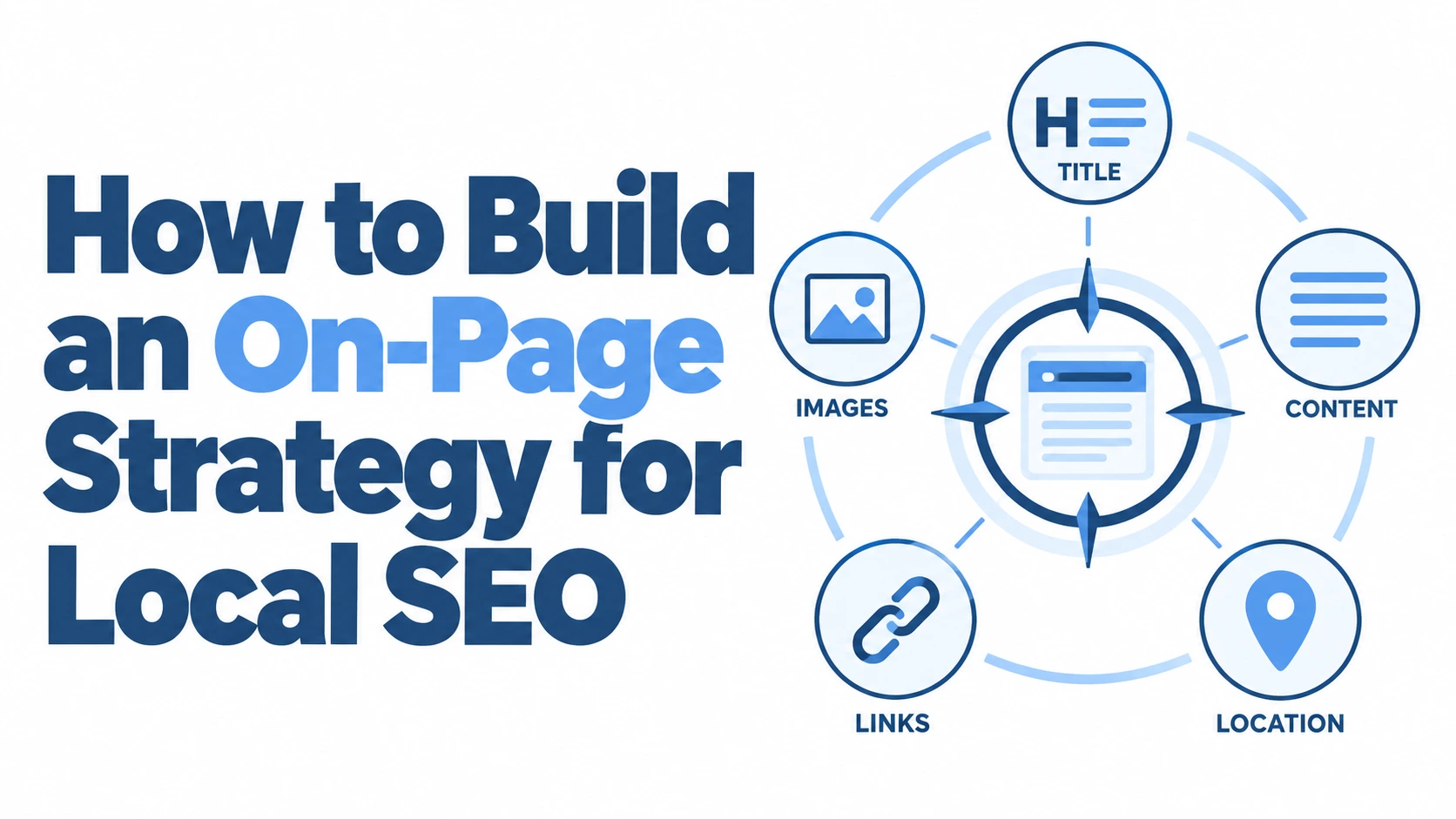
Most local businesses already have a website and a Google Business Profile, yet they still struggle to appear when potential customers search for services nearby.
The missing piece is often a structured on-page approach: one that connects what’s on your website to the specific locations and services you actually serve.
Building an on-page strategy for local SEO isn’t about stuffing your city name into every paragraph. It’s about making your site genuinely useful for local searchers and giving Google the right signals to match you with nearby queries.
If you’re a plumber in Leeds, an estate agent in Bristol, or a physiotherapist in Glasgow, the principles are the same, but the details matter enormously. This guide walks through the practical steps, from metadata and content creation to schema markup and mobile experience, so you can turn your existing website into a local search asset that actually performs.
The Fundamentals of On-Page Local SEO Strategy
On-page local SEO is the practice of optimising individual pages on your website so they rank for searches with local intent. That includes queries like “emergency locksmith near me,” “best Italian restaurant in Manchester,” or “accountant Sheffield.” Google uses a combination of relevance, distance, and prominence to decide which businesses appear in local results, and your on-page elements directly influence the relevance part of that equation.
The foundation starts with three things: making sure every important page targets a specific location and service combination, ensuring your site’s technical structure supports local signals, and creating content that genuinely serves people in your area. A common mistake is treating local SEO as a single task rather than a coordinated effort across your entire site. Your homepage, service pages, contact page, and blog all play different roles.
Think of your website as the hub that supports your Google Business Profile. While your GBP listing handles the Maps pack, your website reinforces those signals and captures organic results below the map. The two work together: a strong GBP with a weak website, or vice versa, leaves visibility on the table. Tools like VisiLocali’s GBP Audit can identify gaps in your profile, but the on-page work on your website is what ties everything together into a coherent local presence.
Optimising Metadata for Local Search Intent
Your metadata is often the first thing both Google and potential customers see. Getting it right sets the tone for your entire local strategy.
Crafting Geo-Targeted Title Tags and Meta Descriptions
Title tags remain one of the strongest on-page ranking signals, and for local SEO, they need to include both your primary service and your target location. A title like “Boiler Repair & Installation in Leeds | Smith Heating” tells Google exactly what you do and where, while remaining readable for humans. Keep titles under 60 characters where possible to avoid truncation in search results.
Meta descriptions don’t directly influence rankings, but they heavily affect click-through rates. A well-written description that mentions your area, a key benefit, and a subtle call to action can be the difference between someone clicking your result or a competitor’s. For example: “Trusted boiler repair across Leeds and West Yorkshire. Same-day callouts, fixed pricing, and Gas Safe registered engineers. Call for a free quote.” That’s specific, local, and gives the searcher a reason to click.
Avoid duplicating the same meta description across multiple pages. Each page should have unique metadata reflecting its specific content and location focus.
Header Tag Hierarchy for Regional Relevance
Your H1 tag should clearly state what the page is about, including the location if it’s a location-specific page. For a service page targeting Birmingham, an H1 like “Professional Carpet Cleaning in Birmingham” works well. Use H2 and H3 tags to break content into logical sections that cover related local topics: specific neighbourhoods, common local problems, or service variations relevant to the area.
A solid header structure also helps Google understand the topical depth of your page. If your carpet cleaning page in Birmingham has H2s covering “Domestic Carpet Cleaning in Edgbaston and Moseley” and “Commercial Carpet Cleaning for Birmingham Offices,” you’re signalling both geographic and service-level relevance without keyword stuffing.
Mastering Localised Content Creation
Content is where most local businesses either shine or fall flat. Generic service descriptions copied from a template won’t cut it.
Developing Location-Specific Landing Pages
If you serve multiple areas, each area deserves its own dedicated landing page with unique, substantial content. This doesn’t mean creating 50 pages that say the same thing with the city name swapped out. Google has been penalising thin, duplicated location pages for years, and in 2026, the bar is even higher.
A strong location page should include at least 400 words of genuinely unique content. Mention local landmarks, specific challenges people in that area face, and customer testimonials from that location. For a roofing company serving both Manchester and Stockport, the Manchester page might reference the city’s Victorian terrace roofs and common issues with flat roofs on converted mills, while the Stockport page could discuss the mix of older stone properties in the town centre and newer estates on the outskirts.
Include a local map embed, your address or service area details, and clear calls to action. These pages should feel like they were written by someone who actually knows the area, because they should be.
Incorporating Local Events and Community News
One of the most underused local SEO tactics is creating content tied to local events, seasonal trends, or community news. A pest control company in Bristol could write about increased wasp activity during the Balloon Fiesta season. A dog groomer in Edinburgh might create content around preparing pets for the Fringe Festival crowds.
This type of content does two things: it signals to Google that your site is genuinely connected to the local area, and it gives you natural opportunities to earn local backlinks and social shares. A blog post about “How to Keep Your Garden Safe During Leeds Bonfire Night Celebrations” from a landscaping company is far more likely to attract local engagement than a generic “5 Tips for Garden Maintenance” post.
Update this content regularly. A post about a 2024 event won’t help you in 2026. Keep your local content fresh and relevant to what’s happening now.
Leveraging NAP Consistency and Schema Markup
Your business name, address, and phone number (NAP) should be identical everywhere it appears: on your website, your Google Business Profile, directory listings, and social media profiles. Even small inconsistencies, like “Street” versus “St.” or a missing suite number, can dilute your local signals. Pick one format and stick with it everywhere.
On your website, display your full NAP in the footer of every page and on your contact page. Use crawlable HTML text rather than embedding it in an image. This seems basic, but I’ve audited sites where the phone number was only visible as part of a header graphic that Google couldn’t read.
Implementing Local Business Structured Data
Schema markup is code you add to your website that helps search engines understand your content more precisely. For local businesses, LocalBusiness schema (or more specific types like Plumber, Dentist, or Restaurant) tells Google your business type, location, opening hours, service area, and accepted payment methods in a structured format.
Here’s what to include in your local business schema:
- Business name, address, and phone number (matching your NAP exactly)
- Opening hours, including bank holiday variations
- Geographic coordinates (latitude and longitude)
- Service area if you travel to customers
- Price range and accepted currencies (£)
- Links to your Google Business Profile and social media pages
You can validate your markup using Google’s Rich Results Test. Errors in your structured data can mean Google ignores it entirely, so test after every change. If you’re using WordPress, plugins like Rank Math or Yoast can generate local schema without requiring you to write JSON-LD manually.
Enhancing User Experience for Mobile Local Search
Over 75% of local searches happen on mobile devices, and a significant portion of those happen while someone is actively looking for a business to visit or call. If your site loads slowly, displays poorly on a phone, or makes it hard to find your phone number, you’re losing customers to competitors whose sites work better on small screens.
Google’s Core Web Vitals remain a ranking factor in 2026, and they matter even more for local results where users expect instant answers. Your largest contentful paint (LCP) should be under 2.5 seconds, and your site should be interactive within 200 milliseconds. Run your key pages through PageSpeed Insights and prioritise fixing anything flagged as poor.
Practical mobile optimisations for local businesses include making your phone number a clickable tap-to-call link, placing your address near the top of your contact page with a link to directions, and ensuring your booking or enquiry form works smoothly on mobile. A restaurant that requires pinch-zooming to read the menu on a phone is haemorrhaging potential reservations. Test your site on actual devices, not just browser emulators. Ask a friend to find your phone number on your site using their phone. If it takes more than two taps, redesign that flow.
Integrating Google Business Profile with On-Page Elements
Your Google Business Profile and your website should reinforce each other rather than existing as separate entities. The information on your GBP, including your business categories, services, and description, should align with what’s on your website. If your GBP lists “emergency plumbing” as a service but your website doesn’t mention emergency services anywhere, that’s a disconnect Google notices.
Link your GBP to specific, relevant pages on your site rather than always pointing to your homepage. If you have a dedicated page for each service, link your GBP service entries to those pages. Your GBP posts can also drive traffic to specific landing pages, blog posts, or seasonal offers on your site, creating a feedback loop between your profile and your website.
VisiLocali’s GBP Management Tool makes this coordination easier by letting you manage your profile content, posts, photos, and reviews from one place while connecting those efforts to your broader local strategy. You can identify what needs improving through the GBP Audit, make changes through the management tool, and then use the Local Rank Tracker to see whether those changes are translating into better visibility across your target area. The rank tracker uses visual ranking grids that show exactly where you’re appearing on Google Maps across different locations: a practical way to measure whether your on-page and GBP work is paying off in specific neighbourhoods and postcodes.
Utilising Visual Assets and Alt Text for Local Discovery
Images and videos aren’t just decorative: they’re ranking signals, especially for local search. Google Images drives a meaningful amount of local discovery, and properly optimised visual content can put you in front of searchers who might not find you through standard results.
Every image on your site should have descriptive alt text that includes relevant local context where natural. Instead of alt=”team photo,” use alt=”Smith Heating engineers outside our Leeds workshop.” This helps with accessibility, image search rankings, and reinforces your local relevance. Don’t stuff keywords into alt text: describe the image honestly while including location details where they genuinely apply.
Original photos outperform stock images for local SEO. Photos of your actual premises, team, completed projects, and local area signal authenticity to both Google and potential customers. A before-and-after gallery of kitchen renovations you’ve completed in real homes across Manchester is infinitely more compelling than generic stock photos of kitchens. Compress images before uploading to keep page speeds fast, and use modern formats like WebP where your CMS supports them.
For video content, embed locally relevant videos on your service and location pages. A 60-second walkthrough of your showroom or a customer testimonial filmed at their home adds trust signals that text alone can’t match.
Measuring Success and Refining Your Local Strategy
Building your on-page local SEO strategy is only half the work. Measuring what’s actually happening after you make changes is what separates businesses that grow their local visibility from those that stay stuck.
Track your local keyword rankings regularly, but do it properly. Local rankings vary dramatically depending on where the searcher is located. Someone searching “plumber near me” from the centre of Leeds will see different results than someone searching from Headingley, even though they’re only a few miles apart. VisiLocali’s Local Rank Tracker addresses this by showing your rankings across a visual grid of your target area, so you can see exactly where you’re strong and where competitors are outperforming you. That level of detail tells you which location pages need more work and which are already performing.
Beyond rankings, monitor these metrics monthly:
- Organic traffic to your location-specific pages (via Google Analytics)
- Click-through rates from search results (via Google Search Console)
- Phone calls and direction requests from your GBP listing
- Conversion rates on your contact and booking pages
- Local keyword positions across different parts of your service area
When something isn’t working, dig into the specifics. If your Manchester page gets traffic but few enquiries, the problem might be your call to action rather than your SEO. If your rankings are strong in the city centre but weak in surrounding suburbs, you might need dedicated content for those areas. Refine based on data, not assumptions.
The businesses that do well with local search treat it as an ongoing programme rather than a one-off project. Google’s algorithms evolve, competitors improve their sites, and customer behaviour shifts. Review your on-page strategy quarterly, update your location content with fresh local references, and keep your NAP and schema markup current as your business changes.
If you want a clear starting point, VisiLocali offers a 14-day free trial across all plans, giving you access to the GBP Audit, rank tracking grids, and profile management tools. It’s built by a local SEO specialist with over 10 years of experience, and comes with a 90-day improvement guarantee: a practical way to identify what to fix first and track whether those fixes are making a real difference in your local rankings.
