 Skip to content


You've probably already done the obvious checks. The profile exists, the phone number is right, and the hours look fine. Yet the business still isn't showing where you expect, or you're seeing a competitor with a cleaner, sharper name sitting above you in Google Maps. That usually means the problem isn't just your listing, it's the way your business name is being read inside a wider local search profile.
For UK businesses, that name has to do two jobs at once. It needs to be accurate enough to stay compliant with Google's UK guidance, and clear enough to support local relevance without drifting into keyword stuffing. Google says businesses with complete and accurate information are more likely to appear in local search results, and it uses relevance, distance, and prominence as its three core local ranking factors, so the name field never works in isolation from the rest of the profile (Google Business Profile help).
Table of Contents
- Why Your Business Name Matters for Local Search
- Audit Your Current Business Name Consistency
- Comply with Google Naming Guidelines
- Craft a Compliant and Impactful Business Name
- Implement and Test Your Name Changes Safely
- Monitor Impact and Rollback If Needed
- Tips for Multi Location Businesses and Conclusion
Why Your Business Name Matters for Local Search
A local plumbing firm can have the right postcode, the right category, and a perfectly serviceable website, yet still struggle to appear in Maps if the profile name is muddy or inconsistent. That is frustrating for the owner, and it also confuses Google and the customer at the same time. Google's guidance is clear that complete, accurate information supports local visibility, and it also reminds businesses to keep hours current, add photos and videos, and respond to reviews so the profile earns trust rather than depending on the name alone.

The name is a trust signal, not a shortcut
A business name that matches its trading name helps people recognise the listing quickly. That matters because local customers often decide whether to click based on a glance at the profile, and a weak listing can disappear before they reach your phone number. In practice, the name is part of a broader trust pattern, not a standalone ranking hack.
A clean profile works because Google can reconcile it across the web. If the storefront sign, website header, directory citations, and GBP name all point to the same business, the listing looks more credible. If those signals do not line up, the profile can feel stitched together, which is exactly the kind of friction local search is designed to sort out. For a closer look at how competitors handle naming and profile consistency, a local competitor analysis can reveal where their signals are aligned and where they are taking unnecessary risks.
Practical rule: keep the name accurate first, then improve the rest of the profile around it. That is safer and usually more sustainable than trying to force visibility through wording alone.
Why service-area businesses need extra care
For a UK service-area business, the challenge is different from a shop on the high street. Customers may never visit a physical storefront, so the listing has to work harder as the first point of contact. Google's advice, paired with the reality of local search usage, means the name should sit inside a profile that is verified, complete, and consistent across directories and owned channels.
This is especially important for businesses in competitive local markets, where a suspension or edit reversal would be far more damaging than a short-lived ranking gain. The safer route is to protect the profile first, then test small, compliant adjustments only where they fit Google's UK naming policy.
That is why this question matters so much for practitioners asking how to optimise my business name on Google Business Profile. The answer is not to treat the title field like a keyword slot. It is to treat it as the front door of a profile that has to earn trust in a local market where searchers are often deciding in seconds.
Audit Your Current Business Name Consistency
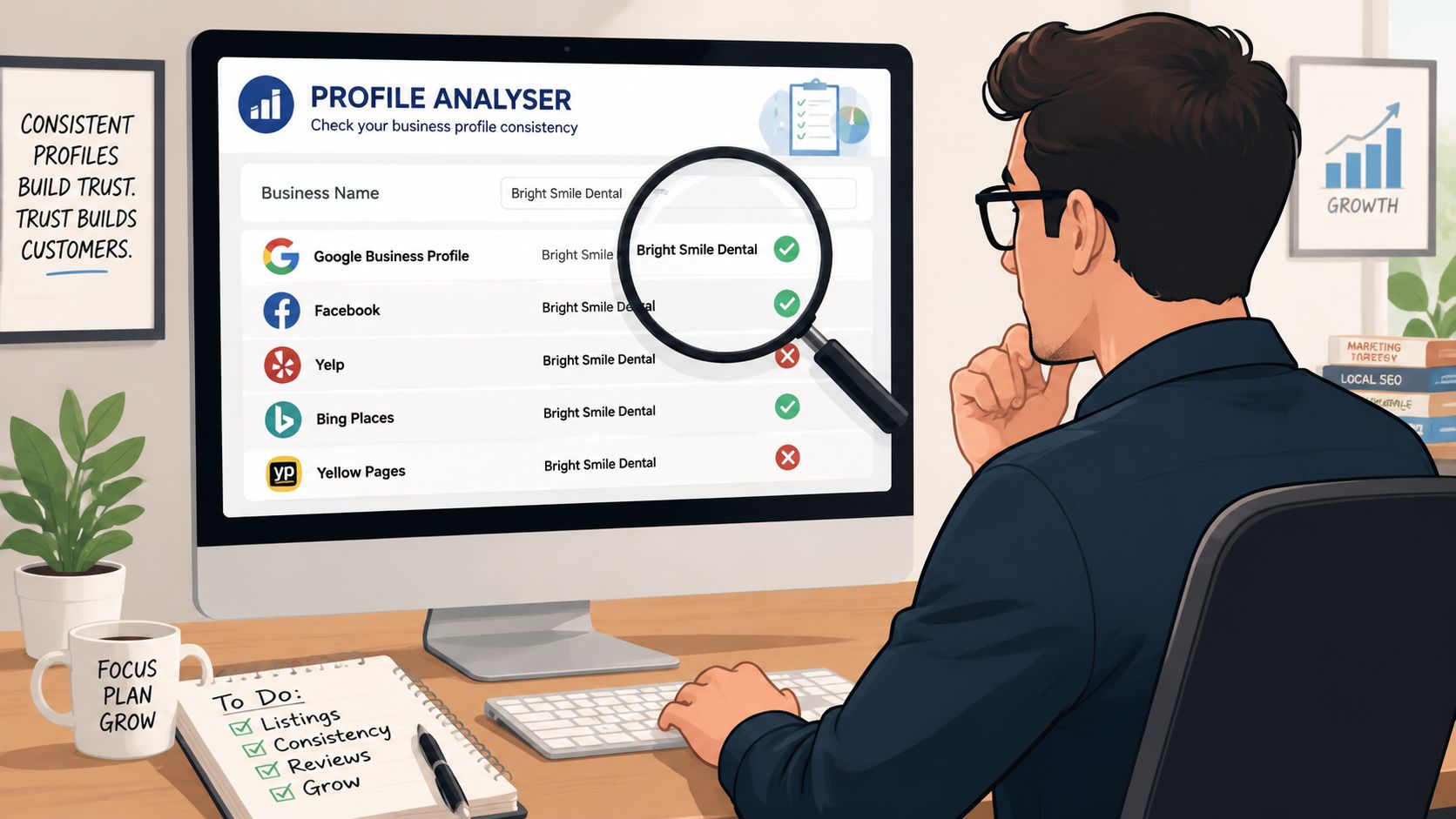
Before changing anything, map the business name exactly as it appears everywhere that matters. Start with the GBP name, then compare it with your website header, footer, contact page, Google Maps signage, Companies House record if applicable, and the main UK directories you already rely on. The aim is simple, spot any mismatch before Google does.
Start with the real-world trading name
The safest UK approach is to keep the Business Name exactly identical to the established trading name used on signage and on the website, because Google's UK guidance emphasises complete, accurate information, and UK-specific optimisation advice warns against keyword stuffing in the name field (StudioHawk's UK guide). If the profile says one thing and the website says another, you're creating a split signal for both customers and Google.
A quick audit works best when it's done in writing. List every variation you can find, even the minor ones, because small differences can matter more than people expect. “Ltd” versus “Limited”, a missing apostrophe, or a location added to the brand can all create unnecessary inconsistency.
Use a simple consistency checklist
A practical audit usually looks like this:
- Profile name: check the exact text in Google Business Profile and record any variation.
- Website name: compare the homepage header, footer, and contact page for the same wording.
- Legal and directory records: verify whether Companies House, major directories, and trade listings match the live trading name.
- Signage and documents: make sure the business name on storefront or vehicle signage matches the online version where relevant.
If you find one mismatch, assume there are more. Correcting the first inconsistency often reveals another hidden version on a directory or a social profile.
If the name varies across channels, fix the source record first, then work down the list. That reduces the chance of one edit creating three more problems.
You can also use a local SEO workflow to compare profiles side by side and prioritise what to change first. A useful internal reference for that kind of analysis is how to analyse local competitors, because the cleanest businesses usually have the cleanest naming patterns too. The point isn't to copy rivals, it's to spot where your own naming is weaker or less consistent.
Comply with Google Naming Guidelines
Google's naming rule is stricter than many business owners expect. In the UK, the business name should be the real-world name used consistently across the storefront, website and documentation, and Google explicitly warns against adding extra keywords, services or locations unless they form part of the registered name (Harridigital's UK guide). That's the line between a compliant profile and a risky one.
Good names and bad names are usually easy to spot
| Good Example | Bad Example |
|---|---|
| Baker & Sons Plumbing | Baker & Sons Best Emergency Plumbing London |
| Northfield Dental Clinic | Northfield Dental Clinic Cheap Implants Near Me |
| Maple Garden Services Ltd | Maple Garden Services Ltd Gardeners in Manchester 24/7 |
| Albion Joinery | Albion Joinery Expert Joiners and Carpenters Birmingham |
The good examples use the genuine business identity. The bad examples try to bolt on search phrases, and that's exactly where compliance problems begin.
What the rule really means in practice
The business name field is one of the few parts of GBP that can shape how both Google and customers interpret the listing. That's why the temptation to “help” the name with a service or town is so common. It may feel harmless, but Google treats the name as a factual identifier, not a marketing headline.
Compliance first: if the extra wording isn't part of the registered or real trading name, leave it out.
That applies to locations, too. A business can only include a city, district, or service phrase in the name if it's part of the legal or established trading name. Otherwise, the safer path is to place that detail in the category, description, service areas, or website content instead.
The tension here is real. Many UK guides still hint that adding a service or place name can improve relevance, but the safer reading of Google's policy is that the profile name must match the actual business identity. That's especially important for businesses in competitive local markets, where a suspension or edit reversal would be far more damaging than a short-lived ranking gain.
Craft a Compliant and Impactful Business Name
The best name structure is usually the simplest one, brand first, modifiers only when they are real. If your registered trading name already includes a service term, then use that exact name. If it doesn't, don't force one into the GBP field just because it looks attractive in search results. A compliant name is the one that survives scrutiny as well as it performs in local search.
Use the legal name as the anchor
Start by writing the exact registered or trading name on a blank page. That becomes your anchor. Then test whether any extra wording is consistently part of the name as used in signage, website branding, and official documentation.
If the answer is no, stop there. You can still make the profile clearer through other fields without risking a naming violation. That's often the better trade-off, because the profile remains easier to defend if Google reviews it or a competitor reports it.
Handle service terms carefully
There are a few common scenarios:
- Multi-service firms: if the legal name is broad, keep it broad in GBP and use categories to show the services.
- Named local branches: if the branch name is the actual sign on the door, use that exact branch name.
- DBA or trading-style names: if a service term is part of the officially used trading name, that term can appear, provided it matches the actual identity.
The key is evidence. If you can't point to signage, website usage, or legal registration that supports the wording, it doesn't belong in the name field.
Build clarity without drifting into stuffing
A business that wants more local relevance doesn't need to overload the name. It can use a cleaner pattern like a known brand name with the strongest category, then reinforce relevance through opening hours, photos, review responses, and service area settings. That's the safer route for UK service businesses, especially those with a strong local footprint but no retail shopfront.
The historical lesson is that local SEO rewards precision, not noise. A tidy name, a verified listing, and consistent data often do more for long-term stability than a risky edit that may need to be rolled back later. That's the balance to aim for if you're trying to optimise without crossing the line.
Implement and Test Your Name Changes Safely
A name change should be treated like a controlled edit, not a casual tweak. GBP can react sharply to changes in core fields, so the safest approach is to update the name only after the profile is already clean, verified, and internally consistent. If you change the name before fixing the rest of the record, you make it harder to tell whether any ranking movement came from the edit or from the unresolved inconsistencies.
Roll out in a controlled sequence
Use this order:
- Verify the profile and clean the source data. Make sure the business is confirmed and every public reference matches the same trading name.
- Prepare evidence. Keep screenshots or copies of signage, website headers, and official business records in one place.
- Make the edit during a quiet period. Avoid changing the name while the phone is busiest, so you can monitor calls and messages more calmly.
- Review the listing carefully after the update. Check that Google hasn't altered the wording or triggered a review state.
That sequence reduces confusion. It also gives you a clearer trail if the edit invites scrutiny.
Document every change
Keep a short change log with the date, the exact old wording, the exact new wording, and the reason for the edit. That matters because name edits are not just cosmetic. They can affect how Google classifies the listing, how customers recognise it, and whether you need to revisit other profile fields afterwards.
If you manage profiles through a tool or workflow, use how to use Google Business Profile Manager as the operational reference point for that process. A simple checklist prevents rushed changes, duplicate edits, and unnecessary back-and-forth with support.
Good practice: change one core element at a time, then wait long enough to see whether the profile stays stable before you touch anything else.
Know when not to test
Avoid “creative” A/B testing on the name itself. GBP isn't a conversion page where you can casually swap headlines. If you need to measure local relevance, test supported fields instead, such as categories, photos, descriptions, or service areas, while keeping the name anchored to the actual business identity.
This is the part most owners underestimate. The safest test is often the one you don't run on the name field at all. If the profile is already compliant and consistent, a risky change rarely gives you enough upside to justify the administrative and reputational cost.
Monitor Impact and Rollback If Needed
Once the name is live, treat the change like a controlled release. Watch grid-based position shifts, map pack impressions, and clicks from the profile, because those are the clearest signs that visibility improved or slipped after the edit. Do not obsess over daily noise. Look for a meaningful shift early enough to respond before the listing drifts too far from what you intended.

Read the profile as a set of signals
A clean name change should sit alongside the rest of the profile. It should not pull the listing out of balance. Google's guidance still points to verified, complete profiles and regular updates as part of local performance, and an industry source quoting Google says regularly updated Business Profiles receive 5x more views (Biziq's GBP statistics summary). The name alone does not create that result, but it does sit inside the wider pattern of activity, accuracy, and profile quality.
That same source says complete profiles can earn 7x more clicks. It also says category selection is reported as a leading ranking factor in one analysis. The practical reading is simple. The name matters, but it works best as part of a broader authority signal that includes category, hours, and ongoing management.
Decide in advance what counts as a problem
Set the rollback plan before the edit goes live. If the profile becomes less visible, gets flagged, or starts looking less credible to customers, revert to the previous compliant name quickly. That matters even more for service-area businesses, where trust and route-to-contact often matter more than a slightly tighter keyword fit.
Use these triggers:
- Visibility drop: if map presence falls in the areas that matter most to your service region.
- Trust issue: if the name no longer matches signage or website wording.
- Compliance risk: if the wording attracts edits, review delays, or support attention.
- Customer confusion: if calls or enquiries suggest people no longer recognise the business.
The safest rollback is the one that restores clarity without another round of guesswork. If the change did not deliver a visible benefit, do not keep pushing it just to prove the edit was worthwhile.
Keep service area relevance genuine
UK businesses often search and are searched for by postcode, so service area definitions should stay genuine and locally specific rather than inflated. That is especially important if the business name itself is plain and compliant. The profile can still be locally strong. It just needs to show relevance in the right places instead of overloading the name field.
Use the same discipline for service-area pages and profile management. This service-area business guide is the right model for keeping naming clean while still expressing local reach.
Measure the whole listing, not just the label. If the profile performs better after the edit and remains compliant, keep it. If it does not, roll it back quickly, document the change, and leave the name field boring and accurate.
Tips for Multi Location Businesses and Conclusion
Multi-location businesses need one naming rule across every branch, then local relevance handled through the rest of the profile. That protects brand consistency and reduces the risk of one location drifting into a slightly different name style that confuses Google and customers. For service-area operations, this service-area business guide shows how to keep naming clean while still reflecting genuine local reach.
Keep the brand pattern uniform
Use the same naming pattern across locations unless the actual trading names differ. A branch should not add extra wording just because a nearby competitor looks more detailed in Maps. Keep the name stable, then let categories, hours, photos, review responses, and service settings handle the local relevance.
That approach scales better across a wider group of listings. It also makes audits easier, because inconsistency stands out faster when every location follows the same convention.
Make consistency checks routine
A practical multi-location workflow stays simple and repeatable.
- Monthly spot-checks: compare each listing with signage, website copy, and directory records.
- Exception logging: record any location that uses a different registered name or trading style.
- Central approval: route name edits through one person or team before they go live.
This keeps the naming structure tight and helps prevent accidental drift across branches.
The most effective way to optimise my business name on Google Business Profile is to protect it, not decorate it. Keep it true to the actual business, align every source of record, and use the rest of the profile to strengthen relevance and trust.
For multi-location teams, the safest gains usually come from consistency, clear local signals, and careful testing rather than clever wording. Stay close to Google's UK naming policy, watch how each branch performs, and treat any name change as something to verify before you keep it.
