 Skip to content
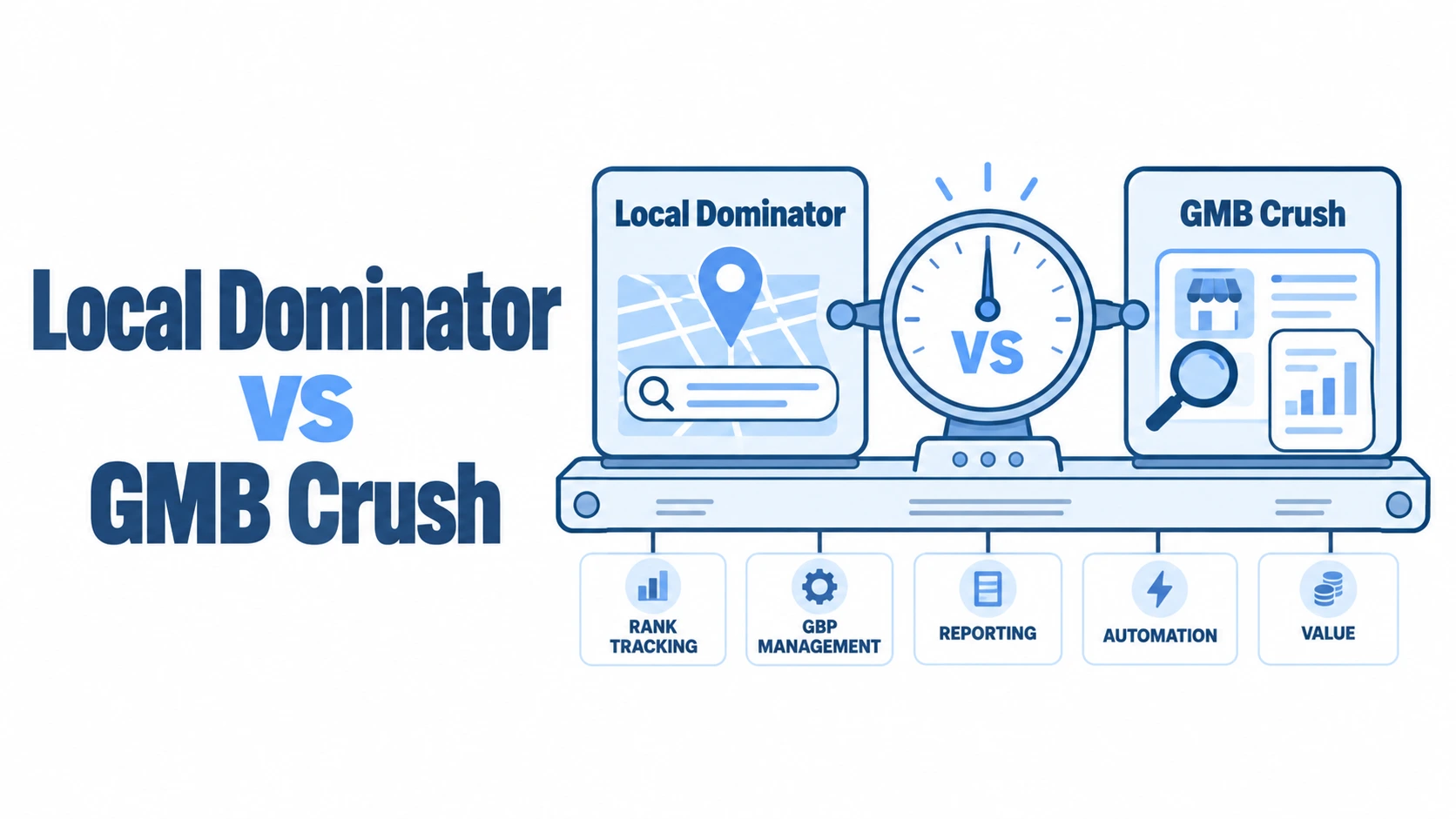
Choosing the right local SEO tool can feel like picking between two solid options on a restaurant menu: both look good, but the wrong choice means you’re spending money on something that doesn’t quite satisfy.
If you’ve been weighing up Local Dominator against GMB Crush, you’re probably already running a local business (or managing several) and you know that Google Business Profile visibility matters.
The question isn’t whether you need a tool: it’s which one actually fits the way you work.
Both platforms target the same problem, but they approach it from different angles, and the right pick depends on whether you need deep auditing intelligence or broad rank tracking at scale.
This comparison breaks down features, pricing, usability, and real scenarios so you can make a confident decision.
Quick Summary for Time-pressed SEOs and Business Owners
| Tool | Best for | Main strength | How VisiLocali differentiates |
|---|---|---|---|
| GMB Crush | Single-location businesses and consultants needing a one-off or periodic diagnosis | Detailed GBP audits and competitor comparisons that reveal potential optimisation gaps | VisiLocali connects auditing with GBP management and rank tracking, allowing users to identify issues, make changes and measure the results within one platform. |
| Local Dominator | Agencies and multi-location businesses running ongoing local campaigns | Geo-grid tracking, scheduled monitoring and scalable local ranking reports | VisiLocali combines visual rank tracking with GBP audits and AI-powered recommendations that help explain what may need improving. |
| VisiLocali | Businesses and agencies wanting one continuous local SEO workflow | Auditing, profile management and local rank tracking in one platform | VisiLocali supports the complete audit, act and measure process, reducing the need to combine separate auditing and tracking tools. |
The Evolution of Local SEO and Google Business Profile Management
Local SEO has changed dramatically since the days when stuffing keywords into a business description was enough to rank. Google’s local algorithm now weighs hundreds of signals: review velocity, profile completeness, posting frequency, proximity, relevance, and behavioural signals from users interacting with your listing. For small businesses in cities like Manchester, Bristol, or Glasgow, this means that a half-maintained Google Business Profile is essentially invisible to potential customers searching nearby.
The tools built around this space have evolved too. Five years ago, most local SEO platforms focused almost exclusively on citation building and basic keyword tracking. In 2026, the best platforms combine profile auditing, competitor analysis, rank visualisation, and ongoing management into a single workflow. That’s the context in which both GMB Crush and Local Dominator operate: they’re products of a market that demands more than surface-level data.
Understanding the Role of GMB Crush in Local Rankings
GMB Crush positions itself primarily as an audit and competitor intelligence tool. Its core strength lies in pulling apart your Google Business Profile and comparing it against competitors who are outranking you. The platform analyses profile elements like categories, attributes, review counts, and posting activity, then flags gaps you can act on.
For a single business owner: say, an estate agent in Leeds who knows they’re not showing up for “estate agent near me” but can’t figure out why: GMB Crush offers a structured way to diagnose the problem. It essentially answers the question “what are they doing that I’m not?” by benchmarking your profile against the top performers in your local pack.
The tool is particularly popular with businesses that want a one-off or periodic deep dive rather than continuous monitoring. Think of it as a diagnostic scan rather than a daily dashboard.
How Local Dominator Simplifies Multi-Location Tracking
Local Dominator takes a different approach. Its flagship feature is geo-grid rank tracking, which shows you exactly where your business appears (and where it doesn’t) across a visual map of your service area. Instead of telling you “you rank #4 for this keyword,” it shows you a grid of points across your target area, colour-coded by ranking position.
This is enormously useful for businesses that serve a wide area. A plumber based in South London, for instance, might rank well within a two-mile radius but drop off completely in neighbouring postcodes. Local Dominator’s heatmap makes that pattern immediately obvious, which is something a simple rank number can’t communicate.
The platform is built with agencies and multi-location businesses in mind, offering bulk tracking and reporting features that make it practical to manage dozens of locations without losing your mind.
Core Feature Comparison: Audit vs Automation
The fundamental difference between these two tools comes down to philosophy. GMB Crush leans into diagnosis: understanding why you rank where you do. Local Dominator leans into measurement: tracking where you rank and how that changes over time. Neither approach is wrong, but they serve different stages of the optimisation process.
A useful analogy: GMB Crush is like getting a detailed health check from a specialist, while Local Dominator is like wearing a fitness tracker every day. The health check tells you what’s wrong and what to fix. The fitness tracker tells you whether your efforts are paying off. Ideally, you’d want both: but if budget forces a choice, your decision should depend on where you are in your local SEO journey.
GMB Crush Audit Tools and Competitor Intelligence
GMB Crush’s audit functionality examines your Google Business Profile across several dimensions: category selection, attribute completeness, review profile, photo quality, and posting consistency. Where it really earns its keep is in the competitor comparison. You can select specific competitors (or let the tool identify them) and see a side-by-side breakdown of where your profile falls short.
For example, if you run a GP surgery in Birmingham and three competing practices all have 150+ reviews while you have 40, GMB Crush highlights that gap clearly. It also flags things like missing business attributes or categories that competitors are using but you’ve overlooked.
The limitation is that GMB Crush is primarily a snapshot tool. It tells you what to fix right now, but it doesn’t continuously monitor whether those fixes are working. You’ll need to run new audits periodically to measure progress.
Local Dominator Rank Tracking and Heatmap Visualisation
Local Dominator’s geo-grid tracking is its standout feature. The visual ranking grids display your position across a defined area, typically showing a grid of 49 or more points, each representing a specific location within your target zone. Green squares mean you’re ranking well; red squares mean you’re not visible there.
This type of visualisation is incredibly effective for communicating results to clients or stakeholders who don’t speak SEO. An agency managing a chain of dental practices across the Midlands can show each practice exactly where they’re winning and where they’re losing ground, all in a single visual.
The tracking runs on a scheduled basis, so you can monitor changes weekly or monthly. If you make a change to your profile: updating your business description, adding new photos, or responding to a batch of reviews: you can see whether those efforts moved the needle at your next tracking interval.
Workflow Integration and Reporting Capabilities
Both tools offer reporting, but the format and depth differ. GMB Crush generates audit-style reports that are useful for presenting a list of recommended changes. These reports work well as a one-time deliverable: hand it to a client, explain what needs fixing, and let them (or you) get to work.
Local Dominator’s reports are more suited to ongoing performance tracking. They show ranking trends over time, which is exactly what agencies need when justifying monthly retainers. The white-label reporting options (more on this later) make it easy to brand these reports as your own.
Neither tool, however, combines auditing with management and tracking in a single workflow. This is where platforms like VisiLocali fill a gap: its GBP Audit Tool identifies what needs improving, the GBP Management Tool helps you make those changes, and the Local Rank Tracker shows whether your visibility is actually improving. That closed loop of audit, act, and measure is something you’d otherwise need multiple tools to replicate.
User Experience and Dashboard Intuitiveness
A tool is only as good as your willingness to actually use it. The most feature-rich platform in the world is useless if the interface makes you want to close the tab after thirty seconds.
Onboarding for Agencies vs Single Business Owners
GMB Crush has a relatively straightforward onboarding process. You connect your Google Business Profile, select competitors to analyse, and the tool generates your first audit within minutes. For a single business owner who just wants answers, this simplicity is a genuine advantage. There’s no steep learning curve, and you don’t need to configure complex tracking grids.
Local Dominator’s onboarding requires a bit more setup. You need to define your tracking grid (size, location, keywords), which means making decisions about how wide an area to monitor and which search terms matter most. For agencies, this is routine. For a sole trader who runs a locksmith business in Newcastle, it can feel like unnecessary complexity before you even see your first result.
The trade-off is clear: GMB Crush gets you to insights faster, while Local Dominator requires more initial configuration but delivers richer ongoing data once it’s running.
Data Accuracy and Frequency of Updates
Rank tracking accuracy depends on how frequently the tool checks positions and how it handles Google’s personalisation and proximity signals. Local Dominator runs its geo-grid scans on a schedule you define, and the results reflect actual Google Maps rankings at each grid point. This is generally reliable, though no tool can perfectly replicate what every individual user sees on their phone.
GMB Crush’s audit data is pulled at the time you run the audit, so it’s a point-in-time snapshot. The competitor data is accurate when generated but can become stale if you don’t re-run the analysis regularly. If your competitors are actively improving their profiles, a three-month-old audit won’t reflect the current reality.
For businesses that want continuous monitoring without manually triggering reports, Local Dominator has the edge. VisiLocali’s Local Rank Tracker offers a similar advantage: it uses visual ranking grids to reveal where you’re visible and where competitors are stronger, updating on a regular schedule so you always have current data.
Pricing Models and Return on Investment
Subscription Tiers and Credit-Based Systems
GMB Crush uses a credit-based pricing model. You purchase credits, and each audit or report consumes a set number. This works well for businesses that only need occasional audits: you pay for what you use. However, it can become expensive if you’re running frequent audits across multiple locations, as credits deplete quickly.
Local Dominator operates on a subscription model with tiers based on the number of locations and keywords tracked. Entry-level plans start around £30-50 per month for a handful of locations, scaling up significantly for agencies managing larger portfolios. The predictable monthly cost makes budgeting easier, but you’re paying whether you actively use the tool that month or not.
The ROI calculation depends on your use case. A single-location business that needs a quarterly audit might get better value from GMB Crush’s credit system. An agency tracking 20+ locations monthly will almost certainly find Local Dominator’s subscription model more cost-effective per location.
White-Label Options for Marketing Consultants
If you’re a marketing consultant or agency, white-label reporting can be a dealbreaker. Local Dominator offers white-label options on its higher-tier plans, allowing you to brand reports with your own logo and colours. This is essential for agencies that want to present a professional, unified experience to clients.
GMB Crush has more limited white-label capabilities. Its reports are useful but carry the tool’s own branding, which can undermine the perception that you’re providing proprietary insights. For consultants who position themselves as the expert (rather than a tool reseller), this matters.
VisiLocali also offers white-label reporting across its plans, which is worth considering if you want audit, management, and tracking under one branded umbrella: particularly given its 90-day improvement guarantee, which gives clients additional confidence in the process.
Strategic Use Cases for Optimal Local Visibility
When to Choose GMB Crush for Deep Competitor Analysis
GMB Crush makes the most sense when you’re starting from scratch with local SEO or when you suspect specific profile issues are holding you back. If you’re a dentist in Edinburgh who recently noticed a drop in new patient enquiries, running a GMB Crush audit against your top three local competitors can quickly reveal whether the issue is a category mismatch, a review gap, or something else entirely.
It’s also a strong choice for one-off consulting engagements. If a client hires you to diagnose their local SEO problems and deliver a recommendation report, GMB Crush gives you the data to build that report efficiently. You run the audit, identify the gaps, present the findings, and move on.
Where GMB Crush falls short is in ongoing management. It doesn’t track rankings over time, it doesn’t help you implement changes, and it doesn’t monitor whether your fixes are working. You’ll need a separate tool for that, which adds cost and complexity.
Why Local Dominator Suits Scalable Local Campaigns
Local Dominator is built for ongoing measurement, making it ideal for agencies and multi-location businesses that need to track progress across many keywords and areas simultaneously. If you manage local SEO for a chain of gyms across the North West, being able to see geo-grid rankings for each location on a single dashboard saves hours of manual checking.
The platform also works well for businesses in competitive markets where rankings shift frequently. A solicitor’s firm in central London, for example, might see weekly fluctuations as competitors adjust their profiles. Local Dominator’s scheduled tracking catches these movements, allowing you to respond before you lose significant visibility.
The weakness is that Local Dominator tells you where you rank but doesn’t always tell you why. If you drop from position 2 to position 7 in a specific postcode, you’ll see it on the grid: but diagnosing the cause requires either manual investigation or a separate audit tool.
This is precisely the gap that a combined platform addresses. VisiLocali, for instance, pairs its rank tracking grids with a GBP Audit Tool that analyses your profile and uses AI to translate findings into plain-English recommendations. Instead of seeing a red square on a grid and wondering what went wrong, you get a specific list of what to fix next: developed by a team with over 10 years of local SEO experience.
Final Verdict: Selecting the Best Tool for Your Local Strategy
The choice between Local Dominator and GMB Crush isn’t really about which tool is “better” in absolute terms. It’s about matching the tool to your workflow and goals. GMB Crush excels at competitor-focused auditing and is ideal for periodic diagnostic work. Local Dominator excels at visual rank tracking and is built for continuous monitoring across multiple locations.
If you’re a single-location business that needs to understand why competitors outrank you, GMB Crush gives you that clarity quickly. If you’re an agency or multi-location business that needs to track and report on rankings at scale, Local Dominator is the stronger fit.
The honest truth, though, is that most businesses need elements of both: audit capability to identify what’s wrong, management tools to fix it, and rank tracking to confirm the fixes are working. If you’d rather not juggle multiple subscriptions, a platform that combines all three into a single workflow is worth exploring. VisiLocali offers exactly that combination, and you can test it with a 14-day free trial on any plan: Monitor, Entrepreneur, or Agency. Card details are required at sign-up to prevent trial abuse, but there’s no obligation to continue if it’s not the right fit. Sometimes the best way to choose a tool is simply to use it.
