 Skip to content

VisiLocali market research
Navigating local search in Bristol requires a clear understanding of the competitive baseline across trade services. VisiLocali analysed 686 Google Business Profiles across plumbing, central heating, and gas engineering categories in Bristol to determine what separates market leaders from stagnant listings.
The findings highlight significant optimisation gaps across the market. While 77.7% of businesses have claimed their Google Business Profile, fundamental technical setups—such as secure HTTPS website linking and detailed secondary category mapping—are frequently neglected by local tradespeople.
Whether you are an established heating firm in BS16 or an independent gas engineer launching in BS3, this research provides the empirical benchmark needed to tailor your local SEO strategy for Bristol.
Executive summary
- Unclaimed listing opportunity: 22.3% (153 profiles) of listings remain completely unclaimed, while unclaimed profiles average only 2 reviews compared to 16 for claimed listings.
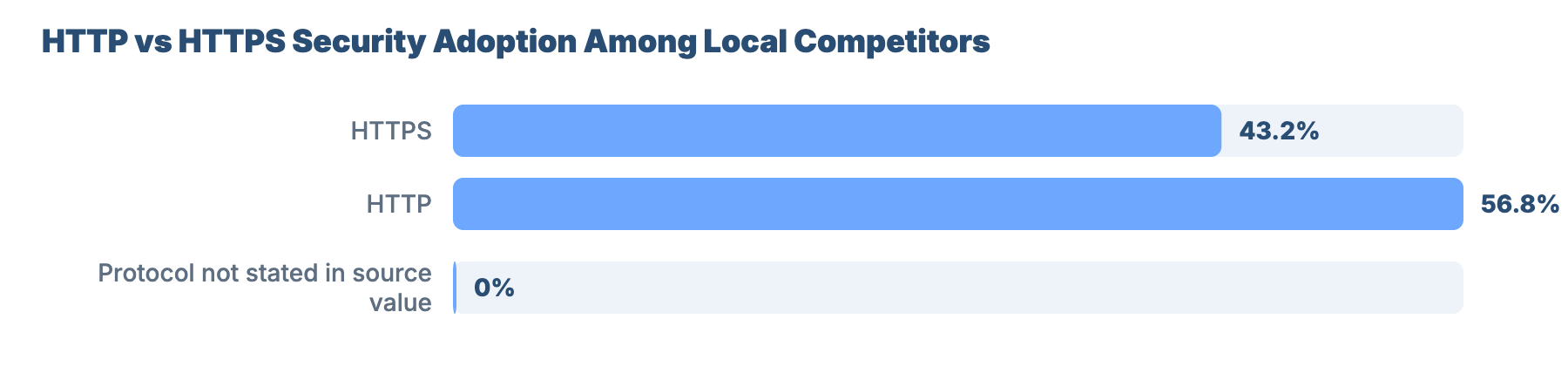
- Severe HTTPS deficit: Among the 470 profiles with linked websites, 56.8% still connect to unencrypted HTTP URLs, creating an immediate conversion and trust bottleneck.
- Review concentration: The top 10% of profile holders control 55.3% of all reviews across the dataset (11,731 out of 21,208 total reviews), raising the competitive threshold for top Map Pack visibility.
- Category under-optimisation: 37.5% of profiles rely solely on a single primary category, missing out on secondary category signals like Central Heating Service or Boiler Supplier.
- Description keyword gaps: While 72.2% of profile descriptions mention ‘Bristol’, only 11.2% explicitly include ‘plumber’ and just 1.9% include ‘gas engineer’.
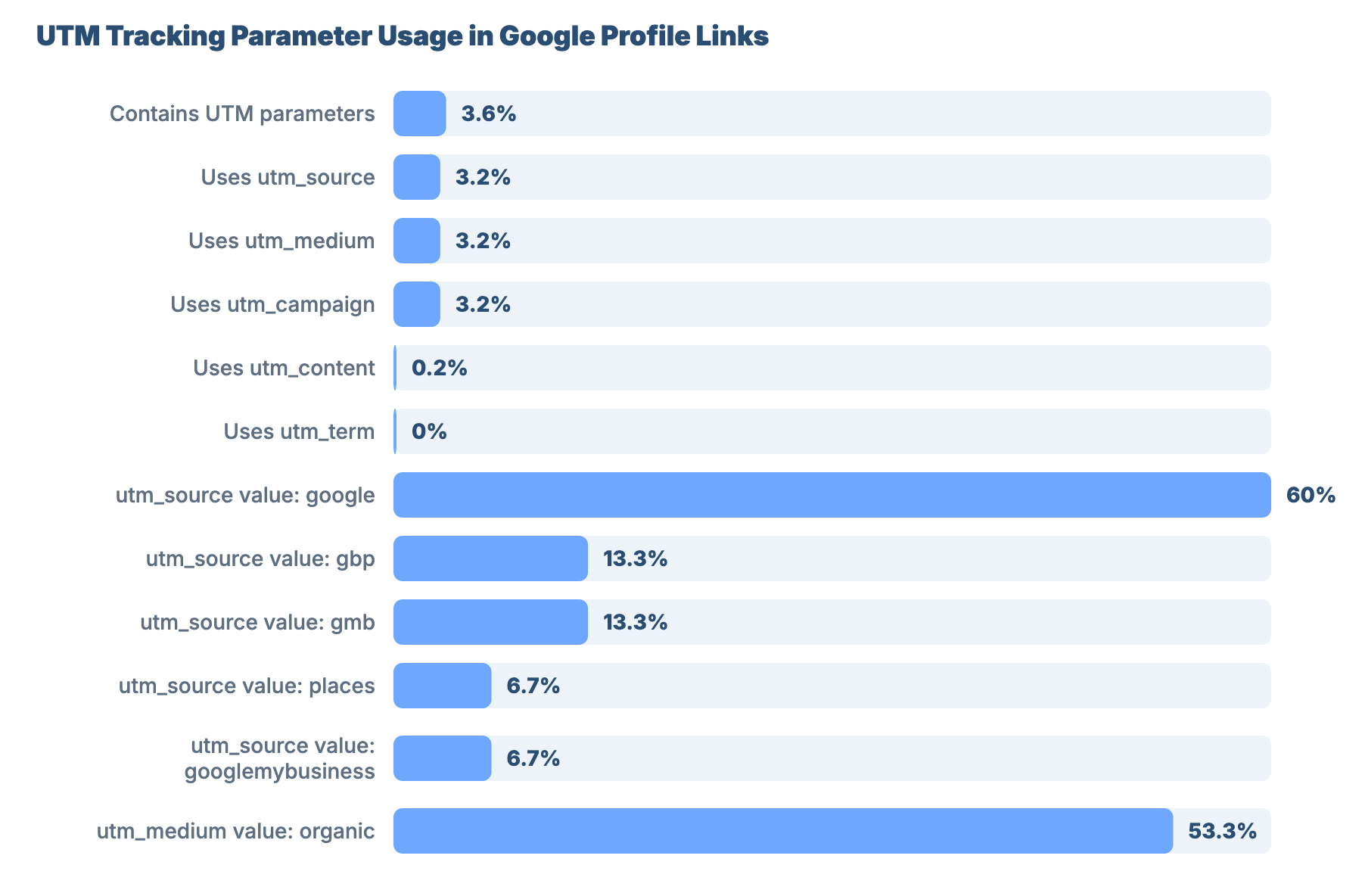
- UTM tracking blackout: A full 96.4% of businesses do not use UTM parameter tracking on their Google Business Profile website link, leaving them blind to GBP traffic performance in Google Analytics.
Website Integration and Domain Strategy for Bristol Plumbing and Heating Engineers
A surprising 31.5% of plumbing and gas engineering profiles in Bristol operate without any linked website. For the 68.5% (470 listings) that do link to a web resource, domain ownership is overwhelmingly high at 95.7%, dominated by standard .co.uk (78.1%) and .com (19.6%) extensions. Social media profiles account for a mere 3.4% of linked destinations, indicating that Bristol trade professionals recognise the necessity of maintaining independent digital assets.
Despite high website ownership, basic technical hygiene and tracking infrastructure are severely neglected. Over half (56.8%) of connected websites link to unsecure HTTP URLs rather than HTTPS, exposing visitors to browser security warnings that erode trust before a lead is captured. Furthermore, a remarkable 96.4% of listings fail to utilise UTM tracking parameters, leaving local tradespeople completely blind to the exact volume and ROI generated by their Google Business Profile traffic.
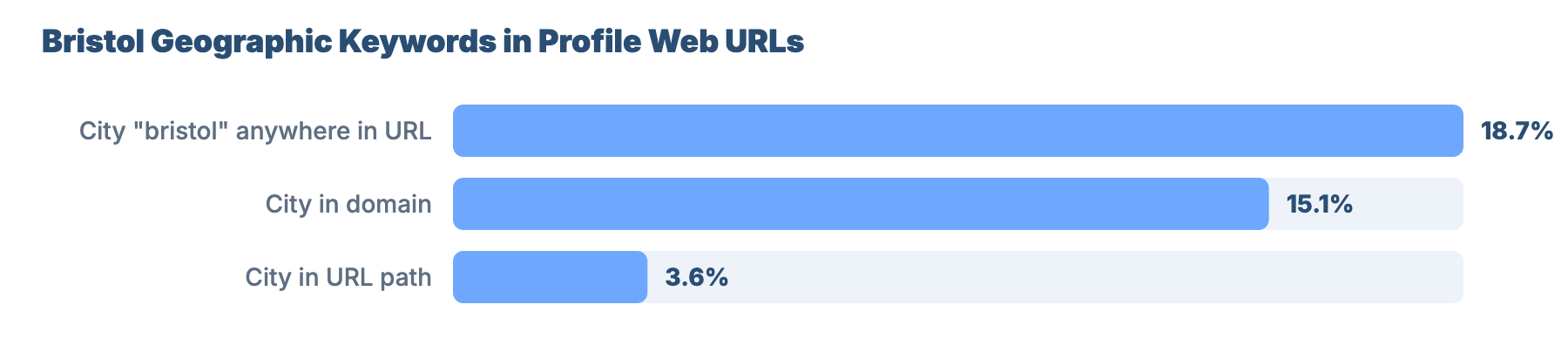
Local targeting and page architecture also present significant organisation and optimisation gaps. Only 18.7% of profile URLs incorporate the target city ‘bristol’, primarily through exact-match local domain names (15.1%) rather than strategic URL paths (3.6%). Additionally, 90.4% of profiles route map pack traffic directly to generic homepages. Amongst the 9.6% that point to internal pages, location-specific pages (37.8%) and service-focused pages (31.1%) are the primary destinations, highlighting an underutilised opportunity to funnel local search intent into high-converting dedicated landing pages.

What the data proves
- 68.5% (470 of 686) of Bristol plumbing and gas listings link to an external web property.
- 56.8% of connected listings link directly to an unsecure HTTP address.
- Only 17 out of 470 linked websites (3.6%) contain UTM parameters to track GBP traffic.
- 90.4% of profiles direct users to a primary homepage rather than an internal subpage.
- The .co.uk domain extension dominates the local market at 78.1% of all linked sites.
What can be inferred
- Unsecure HTTP links likely depress user conversion rates due to modern browser security warnings.
- The widespread absence of UTM tracking suggests most Bristol plumbing firms underestimate the leads produced by Google Business Profiles.
- Businesses pointing to dedicated location or service landing pages may achieve better conversion relevance for specific local queries.
For established businesses
- Upgrade the website connection protocol to HTTPS immediately to prevent security warnings and maintain visitor trust.
- Implement UTM tracking parameters (e.g. utm_source=gbp&utm_medium=organic) to gain full visibility into Google Business Profile conversions.
- Test directing GBP traffic to dedicated Bristol service landing pages instead of the main homepage to improve lead conversion rates.
For new entrants
- Secure a professional .co.uk domain name with HTTPS enabled before creating or verifying a Google Business Profile.
- Incorporate ‘bristol’ into the domain structure or build dedicated city landing pages if targeting specific postal districts.
- Set up proper UTM parameter tracking from day one to measure marketing channel efficiency accurately.
Phone Contact Trends for Bristol Plumbers & Gas Engineers
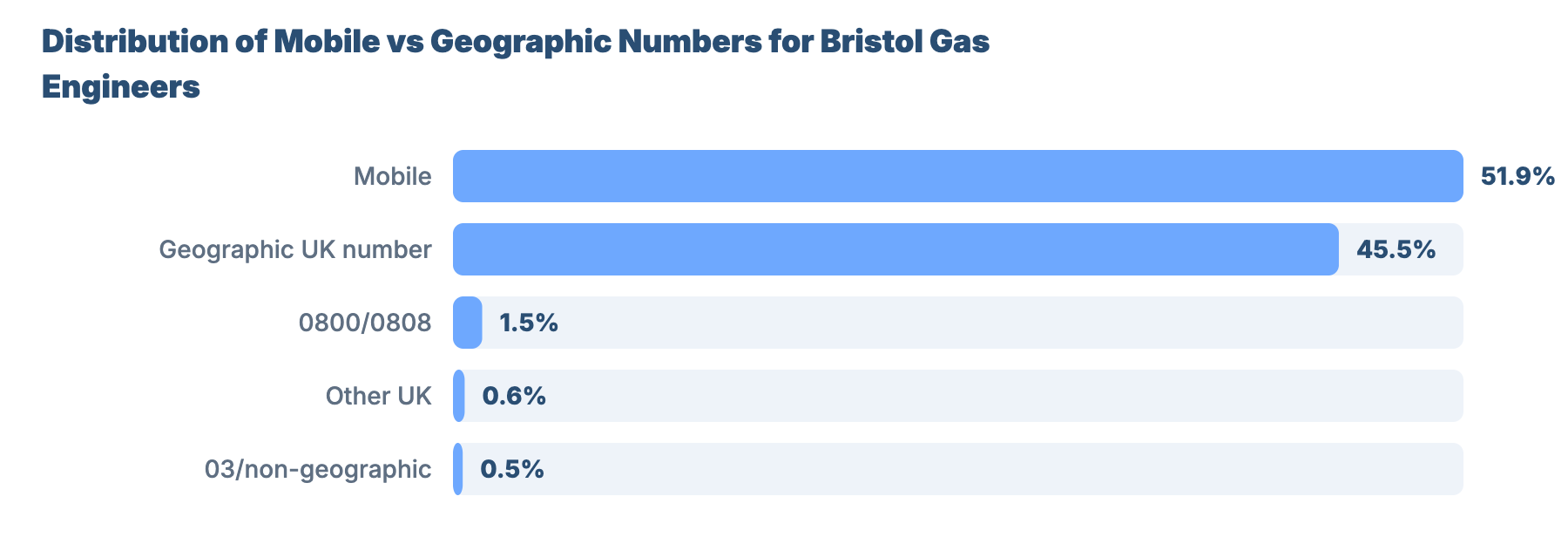
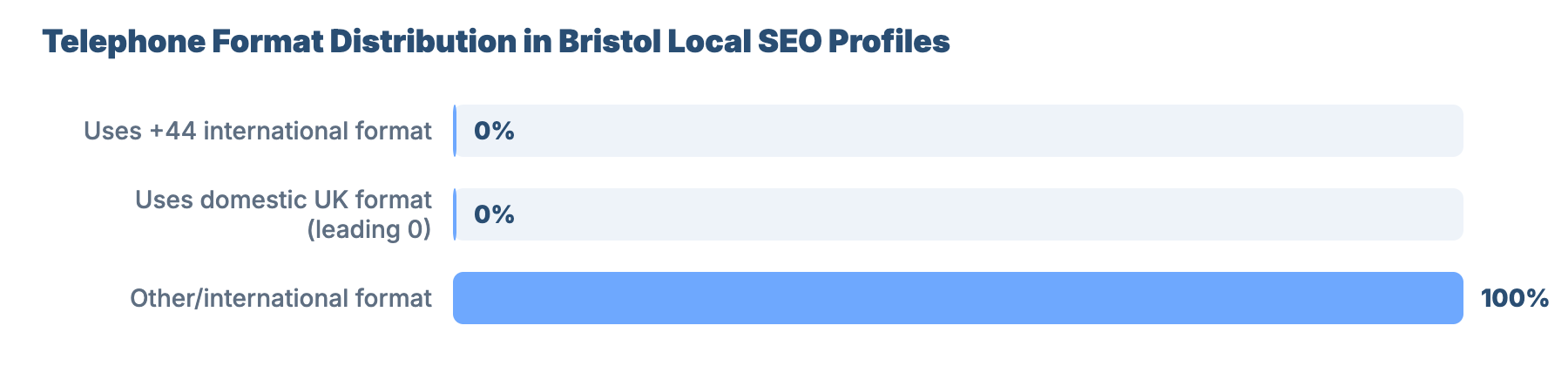
High telephone adoption (94.2% or 646 of 686) reflects the immediate, emergency-driven nature of plumbing and gas engineering services across Bristol. However, 5.8% (40 profiles) list no contact number, creating an immediate barrier to direct lead intake. Mobile numbers represent the primary contact method for 51.9% (335 listings), narrowly pacing geographic landlines at 45.5% (294 listings), which underscores a market heavily populated by agile sole traders and mobile field engineers.
Within geographic landlines, trust is heavily anchored to Bristol’s core identity: 74.5% (219 of 294) utilise the local 0117 area code. Neighbouring codes such as 01275 (Clevedon/North Somerset at 10.5%) and 01454 (Yate/South Gloucestershire at 7.8%) capture surrounding commuter belts, demonstrating clear regional specialisation and service coverage across Greater Bristol.
A significant operational risk across the local market is telephone duplication. Nearly half of all profiles with phone numbers (45.4%, or 293 profiles across 144 distinct shared numbers) share numbers with at least one other business listing. This high level of duplication stems from service-area expansions, secondary brand listings, or shared trade call-centres, which can create entity confusion within local search ecosystems.


What the data proves
- 94.2% (646/686) of analysed Google Business Profiles publish a direct contact phone number.
- Mobile numbers account for 51.9% (335/646) of active listings, while geographic numbers represent 45.5% (294/646).
- 74.5% (219/294) of landline numbers utilise Bristol’s 0117 local area code.
- 45.4% (293/646) of active profiles share their telephone number across 144 distinct repeated numbers.
What can be inferred
- Sole traders and micro-contractors form the backbone of Bristol’s plumbing sector, prioritising direct mobile dispatch over fixed reception desks.
- Plumbing firms employing 01275 and 01454 area codes deliberately target affluent suburban belts outside the immediate city centre.
- Widespread number duplication suggests extensive reliance on multi-location strategy, brand splitting, or shared lead-generation infrastructure.
For established businesses
- Audit shared phone numbers across secondary listings to ensure clear entity separation and avoid potential NAP conflicts.
- Pair a primary 0117 geographic landline with call-forwarding to mobile to maintain strong local trust without missing field calls.
- Implement call tracking call extension numbers specifically configured for local map pack conversion monitoring.
For new entrants
- Secure a dedicated 0117 local area code number to immediately establish geographic relevance for Bristol plumbing queries.
- Ensure your business telephone number is entirely unique to your entity to prevent matching conflicts with legacy profiles.
- Prominently display a direct mobile line if offering 24/7 emergency call-outs to cater to high-intent mobile searchers.
Google Business Profile Rating Value Analysis for Bristol Gas Engineers
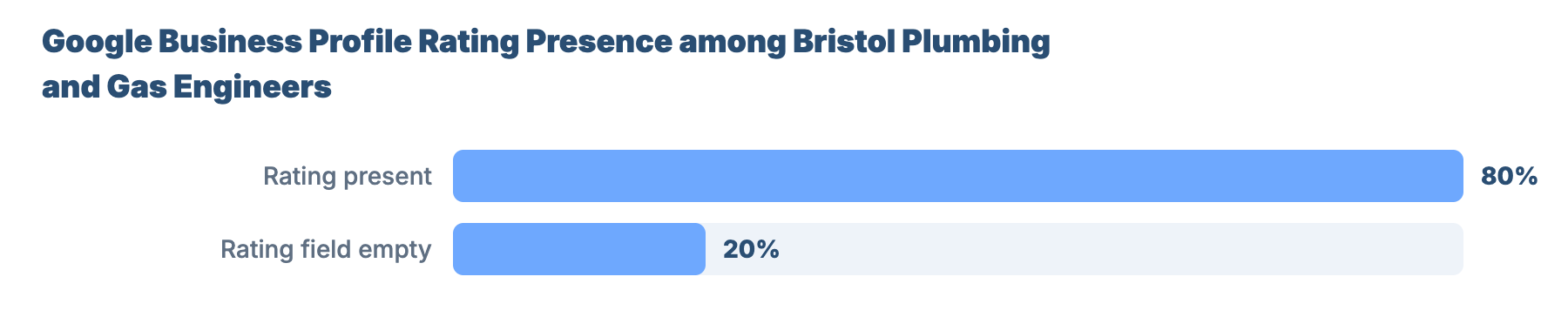
Out of 686 Google Business Profiles analysed across Bristol, 80% (549 profiles) have established star ratings, whilst 20% (137 profiles) lack ratings entirely. Among those with feedback, customer satisfaction metrics are remarkably high: the average rating sits at 4.64 stars, with both the median and mode reaching a perfect 5.0 stars. Over half of all rated profiles (55.2%, or 303 listings) possess a pristine 5.0 star score, demonstrating an extremely competitive local landscape.
A clear trajectory emerges when inspecting rating averages across review-count bands. Emerging profiles with 1–5 or 6–10 reviews display lower average ratings (4.44), largely due to early negative reviews disproportionately weighing down small sample sizes. However, as profiles collect more volume, ratings rise and stabilise—peaking at an average rating of 4.88 stars among businesses with 51–100 reviews. For high-volume operators with over 100 reviews, averages hold firm around 4.87, before dipping slightly to 4.77 for the rare cohort with 500+ reviews.
Maintaining a perfect 5.0 rating becomes progressively harder as review volume scales. Whilst 22% of all profiles (151 listings) boast a 5.0 rating with 10 or more reviews, this drops to 14.1% at 25+ reviews, 7% at 50+ reviews, and just 3.4% (23 profiles) at 100+ reviews. For heating and plumbing businesses targeting local SEO in Bristol, aiming for a 4.8+ rating backed by double- or triple-digit review counts offers a far more sustainable commercial threshold than attempting to keep an unblemished 5.0 score indefinitely.


What the data proves
- 80% of Bristol plumbing and gas profiles (549 of 686) display an active star rating.
- 55.2% of all rated profiles hold a 5.0 score, making 5.0 the modal rating across the market.
- The 75th percentile of rated profiles requires a 4.7 star score or higher.
- Only 23 profiles (3.4% of the dataset) sustain a perfect 5.0 rating alongside 100+ reviews.
What can be inferred
- Bristol homeowners demonstrate a strong propensity to leave 5-star reviews when boiler installations and emergency repairs meet expectations.
- Profiles with fewer than 10 reviews are particularly vulnerable to single negative reviews that pull down their overall average.
- High-volume trades businesses inevitably collect occasional negative feedback, making 4.8 to 4.9 stars the natural equilibrium for mature operations.
- A rating below 4.5 creates a distinct conversion disadvantage against the 80.5% of rated local competitors operating above that line.
For established businesses
- Protect your average score by implementing automated review follow-ups immediately following gas safety checks or heating installs.
- Aim to remain above the 4.8 star threshold rather than stressing over losing a perfect 5.0 rating as review volume grows.
- Implement formal customer service escalation paths to resolve issues before clients post damaging public reviews on Google.
For new entrants
- Prioritise gathering your first 10 to 25 positive reviews quickly to move past the fragile 4.44 average typical of early-stage profiles.
- Focus on exceeding client expectations on every job to secure 5-star feedback and build trust against established competitors.
- Actively target a 4.8+ rating during your initial growth phase to beat the 10th percentile threshold (3.88) and align with market leaders.
Review Count Benchmarks for Plumbers and Gas Engineers in Bristol
The Bristol market for plumbers and gas engineers displays a heavily skewed review distribution. Out of 686 analysed Google Business Profiles, 549 (80%) have recorded at least one customer review, accumulating 21,208 reviews in total. However, the market median stands at just 13 reviews, contrasting sharply with the mathematical mean of 38.63. This divergence is driven by a long tail of inactive profiles, with 31.1% of reviewed businesses holding between 1 and 5 reviews.
Market trust is heavily concentrated among a small tier of dominant operators. The top 10% of businesses hold 55.3% of all customer reviews in Bristol, while the top 20% control nearly three-quarters (73.2%) of the market’s total feedback. Hitting 100 reviews places an engineer in the top 10% of local profiles (P90 is 100.2), whereas only three operators in the entire city have breached the 500-review threshold.
Despite this top-end concentration, the threshold to enter the upper performance tiers remains highly attainable. A modest gap of just 24 additional reviews separates a median profile (13 reviews) from the top quartile (37 reviews). Because almost half of all profiles (45.3%) have 10 or fewer reviews, standardising post-service feedback requests allows reactive heating and plumbing specialists to outpace local competitors rapidly.



What the data proves
- 80% (549 of 686) of analysed profiles have accrued at least one Google review.
- The market median is 13 reviews, whereas the mean average is 38.63 due to high-volume outliers.
- The top 10% of profiles hold 55.3% (11,731 out of 21,208) of all accumulated reviews in Bristol.
- Exactly 10.6% of reviewed profiles (58 businesses) have surpassed 100 total reviews.
What can be inferred
- Most Bristol plumbing firms lack a systematic post-job review generation process, leaving their profiles stagnant after earning initial feedback.
- A minority of established gas and heating firms actively leverage automated software or field incentives to systematically collect feedback.
- Crossing the 37-review milestone substantially improves consumer click-through rates by outperforming 75% of local competitors.
For established businesses
- Audit existing review collection workflows to close the 87.2-review gap needed to reach the 90th percentile threshold (100.2 reviews).
- Implement automated SMS review requests sent within two hours of completing boiler installations or plumbing services.
- Train on-site gas engineers to explicitly request feedback upon successfully completing high-value heating jobs.
For new entrants
- Set an initial target of 14 reviews to immediately surpass the median Bristol plumbing competitor.
- Aim for 37 reviews within the first six months of operation to secure a position in the top 25% of local profiles.
- Focus on maintaining a consistent acquisition velocity rather than sporadic bursts to build profile trust steadily.
Geographic Distribution and Address Density for Bristol Plumbers
Every single listing within this 686-profile dataset displays a physical street address, reflecting full compliance with address requirements for local listings across Bristol. Postcode completion is virtually absolute at 99.4%, with 682 profiles falling under the broader BS postcode area. This absolute completeness underlines how fundamental geographic anchors are for plumbers, gas engineers, and heating contractors operating within the region.
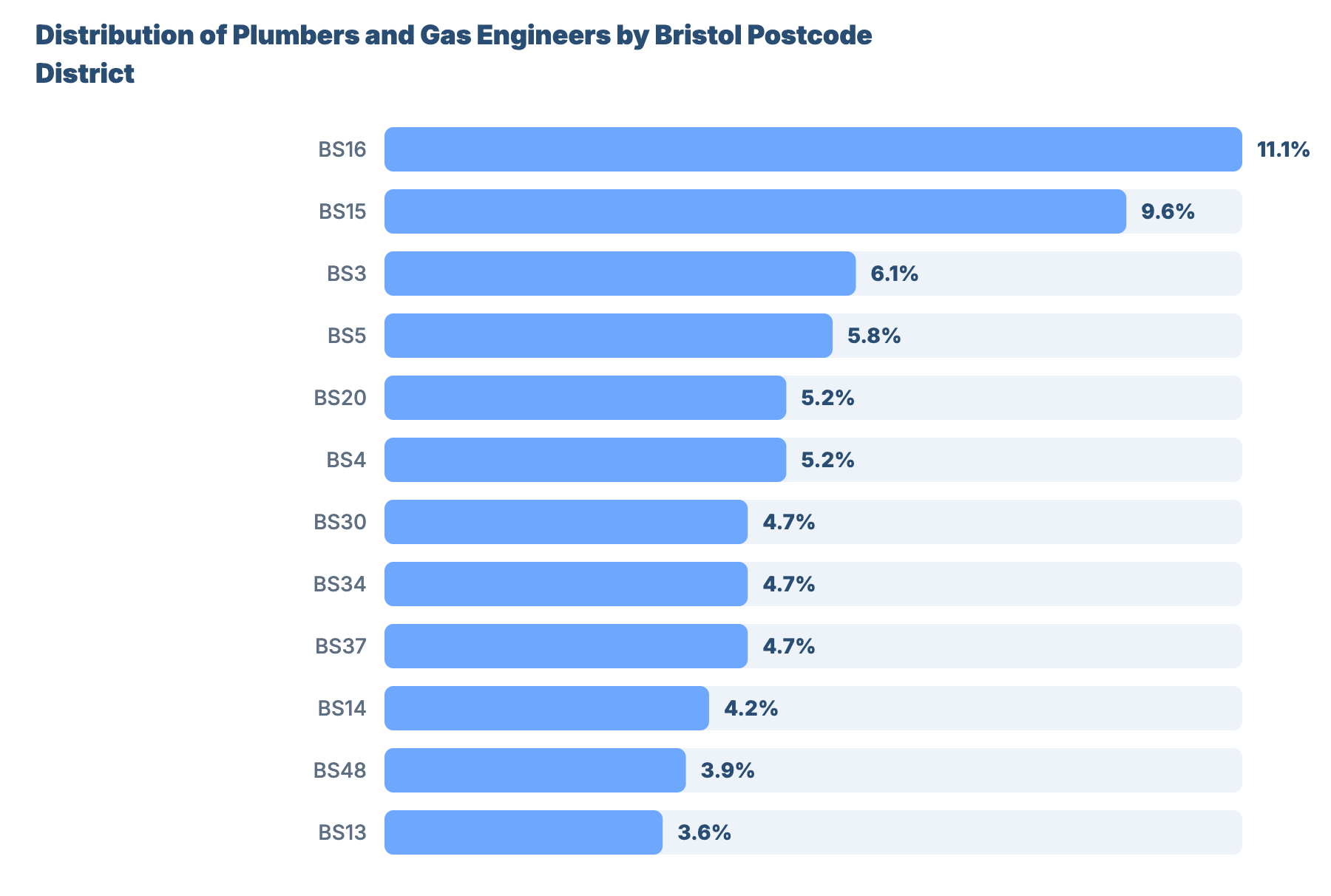
Geographic concentration is heavily weighted towards east and outer north-east Bristol. BS16 (Fishponds, Emersons Green) leads the sector with 11.1% of profiles (76 businesses), followed closely by BS15 (Kingswood, Hanham) at 9.6% (66 businesses). Together with South Bristol hubs like BS3 (6.1%) and BS5 (5.8%), over a third of all listings originate from four postcode districts. Conversely, affluent central and western districts like BS8 (Clifton, 0.9%) and BS6 (Cotham, Redland, 1.7%) show remarkably sparse profile density.
A substantial 42.3% of profile listings share a street address with at least one other registered entity across 144 distinct shared locations, though density per address remains low (topping out at three businesses per location). This pattern indicates widespread usage of shared industrial units, accounting addresses, or co-registered trades, rather than massive spam hubs.



What the data proves
- 100% of analysed Google Business Profiles (686) display a physical address located in Bristol.
- 99.4% of profiles include a full BS-prefix postcode, with BS16 and BS15 accounting for 20.7% of all profiles.
- 42.3% of listings (290 profiles) share an address with another business across 144 distinct locations.
- Central and western postcodes (BS8, BS6, BS1) together represent under 6% of local trade listings.
What can be inferred
- Tradespeople favour eastern suburbs and outer industrial corridors (BS16, BS15) due to lower premises overheads and direct access to the A4174 ring road.
- Low profile density in high-income areas like Clifton (BS8) reflects higher property costs rather than a lack of plumbing demand.
- The high rate of shared addresses suggests widespread reliance on home offices, shared trade units, or corporate registration addresses.
For established businesses
- Target high-value, low-density districts such as BS8 and BS6 with dedicated location pages to capture underserved search queries.
- Audit shared address configurations on your Google Business Profile to maintain strict NAP consistency and prevent algorithmic filtering.
- Optimise local service area boundaries to capture surrounding commercial zones where competitors over-index on eastern residential districts.
For new entrants
- Consider registering your initial address outside oversaturated clusters like BS16 unless your core customer base is strictly local to that zone.
- Ensure your business address matches official registration documents precisely to avoid suspension risks associated with shared premises. Constantin
- Leverage service area settings to explicitly target affluent pockets such as Clifton, Redland, and Westbury-on-Trym where local competitor density is minimal.
Opening Hours and Operational Schedules in Bristol
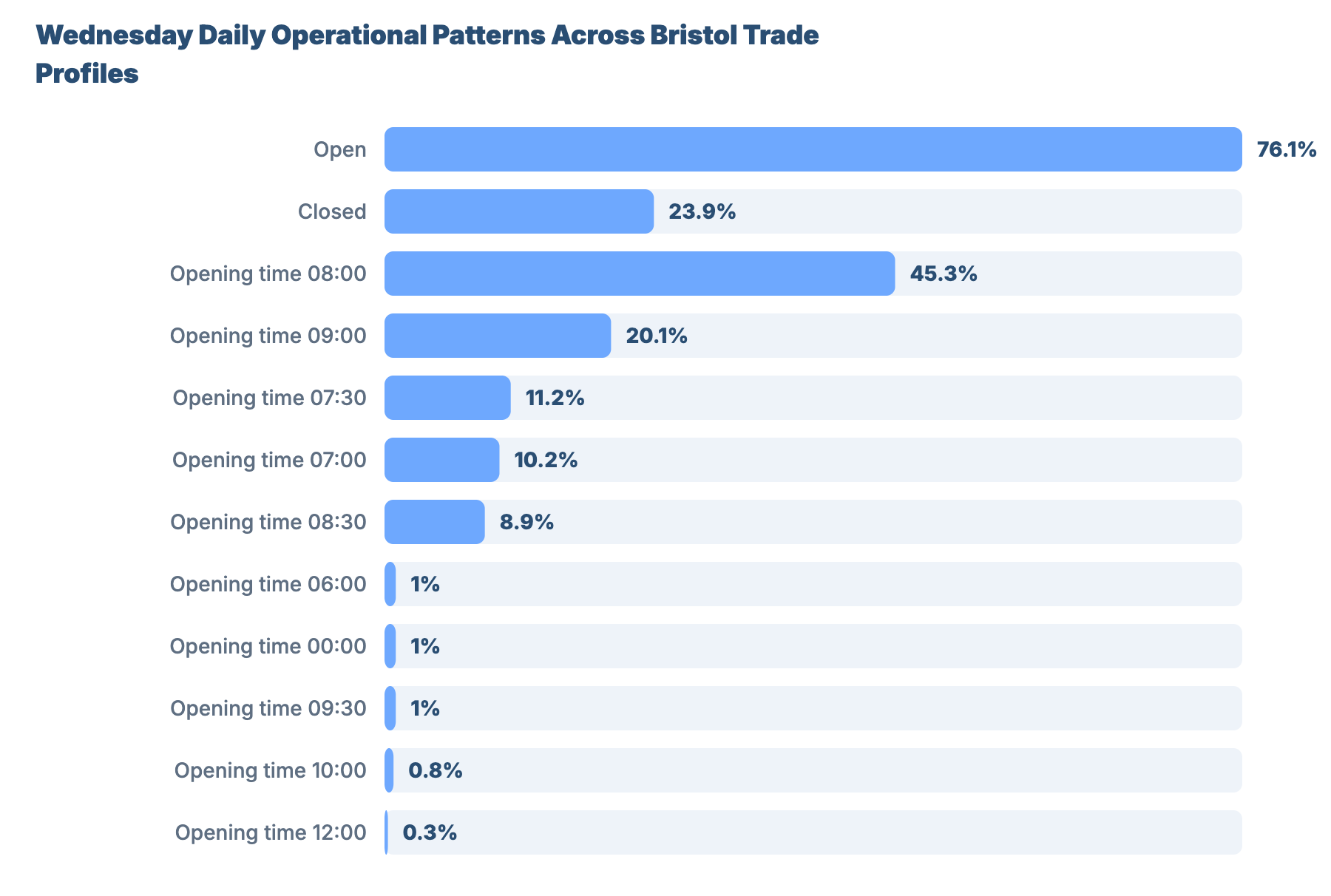
Analysis of 686 Google Business Profiles in Bristol reveals a distinct structural divide between standard daytime operations and round-the-clock emergency providers. On weekdays, roughly 76% of businesses are open, with 08:00 to 17:00 representing the clear market baseline. Over 76% of operational weekday profiles are open by 08:00, and 95% remain open until at least 17:00, serving standard domestic heating and plumbing appointments.
Weekend availability contracts significantly across the region. While 41.4% of tradespeople maintain Saturday hours, Sunday availability drops to 25.7%, matching the exact proportion of businesses operating seven days per week. Crucially, 16.0% of the entire sample (110 profiles) list explicit 24/7 operational hours, capturing high-intent emergency call-out searches when mainstream firms are offline.
A notable 23.6% of profiles present unstated hours or remain listed as closed across the entire week. For firms seeking high-converting leads through targeted SEO for Plumbers and Gas Engineers Bristol campaigns, maintaining complete and accurate operational schedules is vital to avoid exclusion during ‘open now’ user filtering.



What the data proves
- 34.8% of Bristol plumbing profiles operate a 5-day week, whereas 25.7% list availability 7 days a week.
- 08:00 is the dominant weekday opening time, utilised by over 45% of businesses specifying open hours.
- 16.0% (110 out of 686 profiles) explicitly publish 24/7 operating hours across the full week.
- 41.4% of surveyed profiles maintain Saturday opening hours, declining to 25.7% on Sunday.
What can be inferred
- Publishing 24/7 or extended evening hours captures high-margin emergency enquiries when 75% of local competitors are closed.
- Profiles with missing or unstated hours (23.6%) are systematically filtered out during out-of-hours Google Maps searches.
- The prevalence of an 08:00 start time aligns directly with trade counter opening times and domestic client schedules in Bristol.
For established businesses
- Audit Google Business Profile schedules regularly to ensure listed hours accurately match emergency answering capacity.
- Evaluate extending published weekday closing times from 17:00 to 19:00 to capture post-work boiler breakdown searches.
- Align landing page messaging with published hours, highlighting out-of-hours emergency availability alongside core services.
For new entrants
- Publish complete opening hours upon setup; unstated hours harm conversion rates against established competitors.
- Capture early market share by offering weekend appointments, stepping into the void left by the 58.6% of businesses closed all weekend.
- Only select a 24/7 profile setting if incoming calls can be answered immediately, as unanswered emergency calls harm review scores.
Profile Verification Status & Market Completeness in Bristol
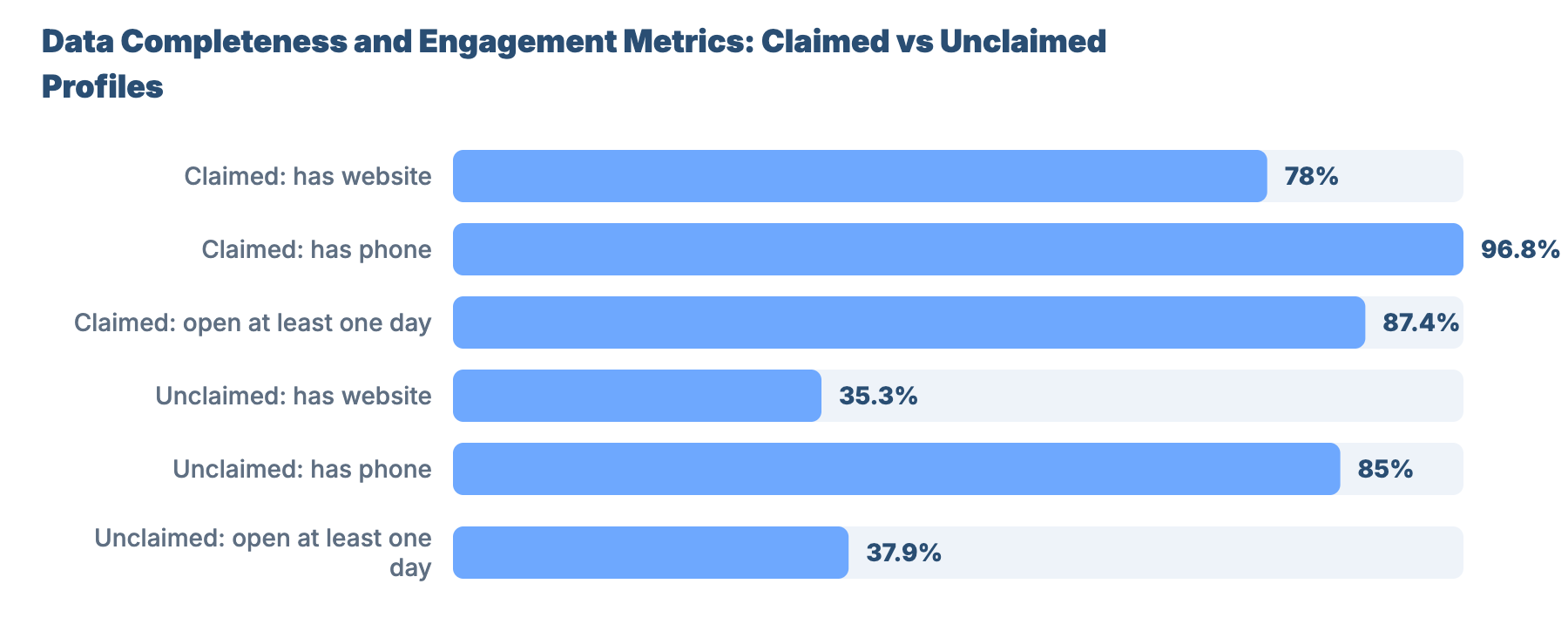
In the Bristol plumbing and heating sector, basic digital hygiene is broadly established, with 77.7% (533 of 686) of Google Business Profiles successfully claimed. The remaining 22.3% (153 profiles) represent unclaimed listings that largely exist as unmanaged digital assets. A clear structural divide exists between these two groups: claimed profiles are more than twice as likely to maintain a website link (78.0% versus 35.3%) and publish operational hours (87.4% versus 37.9%).
Reputation building is heavily concentrated among verified listings. Claimed profiles achieve a median of 16 reviews and an average rating of 4.71 (n=471), whereas unclaimed profiles lag behind with a median of just 2 reviews and an average rating of 4.22 (n=78). Furthermore, whilst 96.8% of claimed profiles provide a telephone contact, 15.0% of unclaimed profiles lack a phone number entirely, introducing critical friction for immediate emergency call-outs across Bristol.
For local tradespeople, profile ownership acts as the baseline threshold for digital competitiveness. While claiming a profile does not automatically guarantee top Pack placement, failing to claim and populate basic parameters isolates a business into the lower-performing quarter of the local market.

What the data proves
- 77.7% (533 of 686) of analysed Google Business Profiles in Bristol are claimed.
- Claimed profiles hold a median of 16 reviews compared to a median of 2 for unclaimed profiles.
- 87.4% of claimed profiles state opening hours, whereas only 37.9% of unclaimed profiles do so.
- 78.0% of claimed profiles include a website URL, compared to 35.3% of unclaimed listings.
What can be inferred
- Unclaimed listings are primarily auto-generated profiles created from third-party directories or user map edits.
- Active profile ownership correlates strongly with customer review acquisition and higher overall star ratings.
- Businesses operating unclaimed profiles lose substantial phone lead volume due to missing contact details and absent operating hours.
For established businesses
- Audit secondary or legacy business names across Bristol postcodes to identify and merge duplicate unclaimed listings that may confuse potential clients.
- Implement post-service review automation to exceed the current market median threshold of 16 reviews.
- Ensure full completion of business attributes, including specific emergency or out-of-hours availability, to capture leads missed by less active competitors.
For new entrants
- Claim and verify your Google Business Profile prior to public launch to maintain full control over your primary business data. stream
- Link a mobile-optimised website immediately upon profile verification to match the baseline standard set by 78.0% of established claimed operators.
- Target a rapid acquisition of your first 15 to 20 verified customer reviews to quickly surpass the unclaimed profile segment and achieve local parity.
Visual Asset Density: Photo Count Benchmarks for Bristol Plumbers
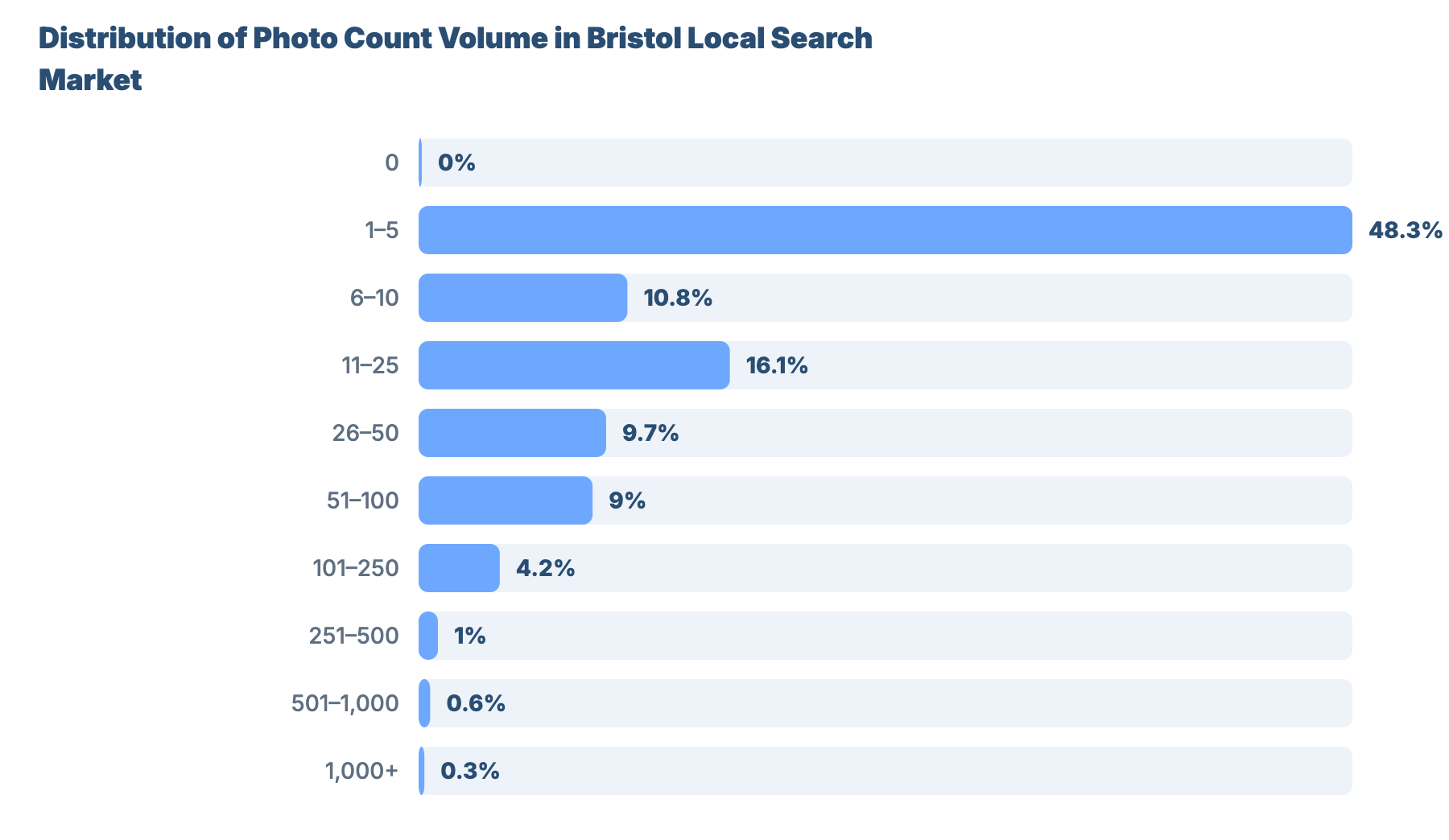
Nearly every active profile in Bristol’s heating and plumbing sector (97.5%) displays visual content, but the volume of images varies dramatically across the market. While the dataset average sits at 32.91 photos due to a handful of high-volume outliers reaching up to 1,469 images, the median rests at just 6 photos. In fact, nearly half of all profiles with photos (48.3%) maintain only 1 to 5 images, revealing a widespread reliance on minimal visual proof among local operators.
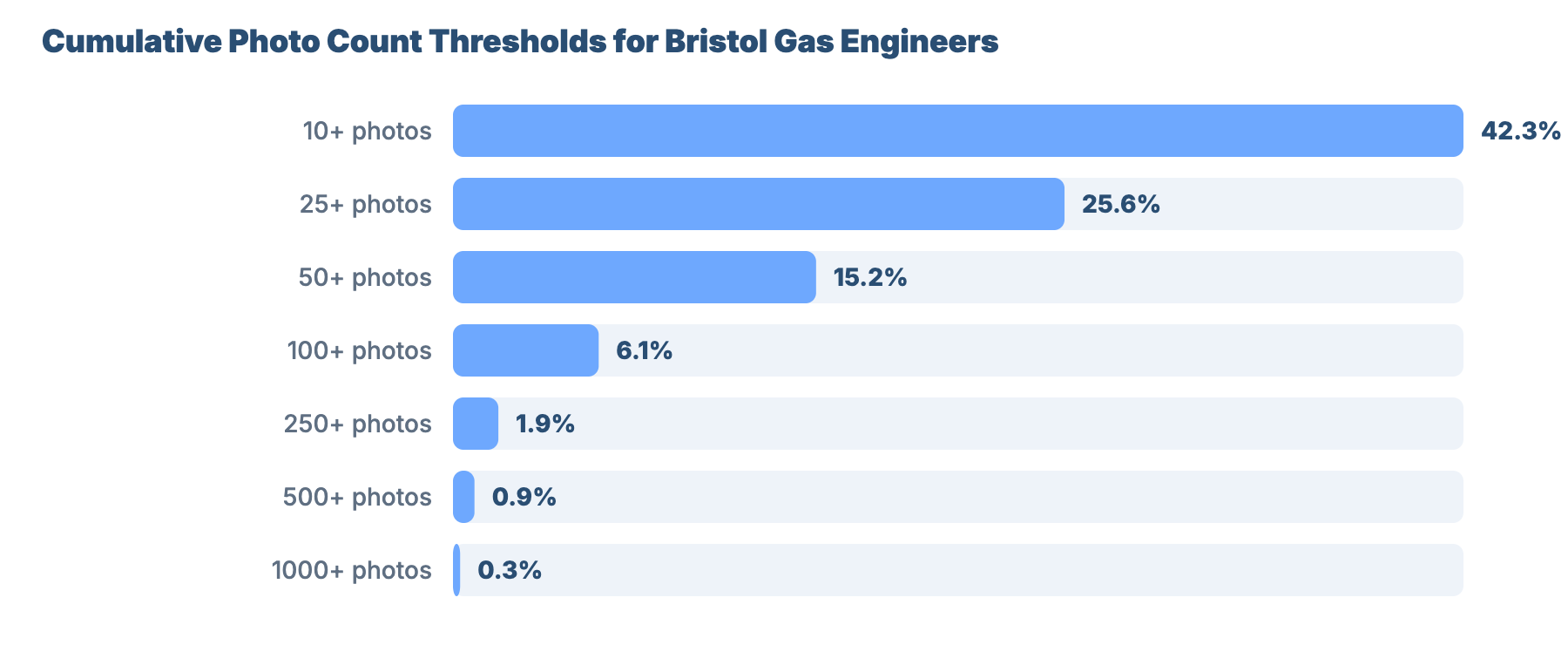
Ownership and digital maturity strongly dictate photo activity. Claimed Google Business Profiles maintain a median of 12 photos compared to just 1 for unclaimed listings. Similarly, operators with a connected website show a median photo count of 10, whereas those without a website remain stuck at a median of 1. Over a quarter of profiles (25.6%) cross the 25-photo mark, and entering the top 10% requires at least 72 photos.
This distribution highlights a significant operational gap in Bristol. Most tradespeople upload a handful of initial images upon setup and rarely update their gallery. Businesses targeting competitive visibility can easily differentiate themselves by instituting a routine imagery upload process, bridging the gap between passive profile creation and active digital engagement.

What the data proves
- 97.5% of profiles in this dataset (669 out of 686) feature at least one photo.
- The median photo count across all profiles with visual assets is 6, with an average of 32.91.
- Claimed listings hold a median photo count of 12, compared to a median of 1 for unclaimed profiles.
- 48.3% of profiles containing visual assets possess between 1 and 5 photos.
- Only 6.1% of profiles (41 listings) feature 100 or more photos.
What can be inferred
- Higher photo counts correlate with active profile management rather than direct algorithmic ranking boosts.
- Profiles attached to functional websites are more likely to have a dedicated digital marketing process that includes regular image uploads.
- Consumer trust in local plumbing services is enhanced by clear visual evidence showing completed boiler installs and central heating repairs.
- Unclaimed profiles rely almost exclusively on automated Google Street View or user-submitted images.
For established businesses
- Audit your existing imagery library to ensure you comfortably exceed the P75 benchmark of 25 photos.
- Implement a weekly routine for engineers to photograph completed boiler installations and pipework before and after job completion.
- Target reaching the P90 threshold (72 photos) to place your business among the top 10% visually documented profiles in Bristol.
- Remove low-quality, blurry, or stock photos that dilute authentic visual evidence of your trade work.
For new entrants
- Upload at least 10 high-resolution photos immediately upon claiming your Google Business Profile to exceed the local median.
- Focus initial uploads on branded work vans, team uniforms, gas safety badges, and clear job-site work photos.
- Set a target to reach 25 photos within your first quarter of operation to align with the top 25% of established Bristol competitors.
Google Business Profile Additional Categories for Bristol Plumbers and Gas Engineers
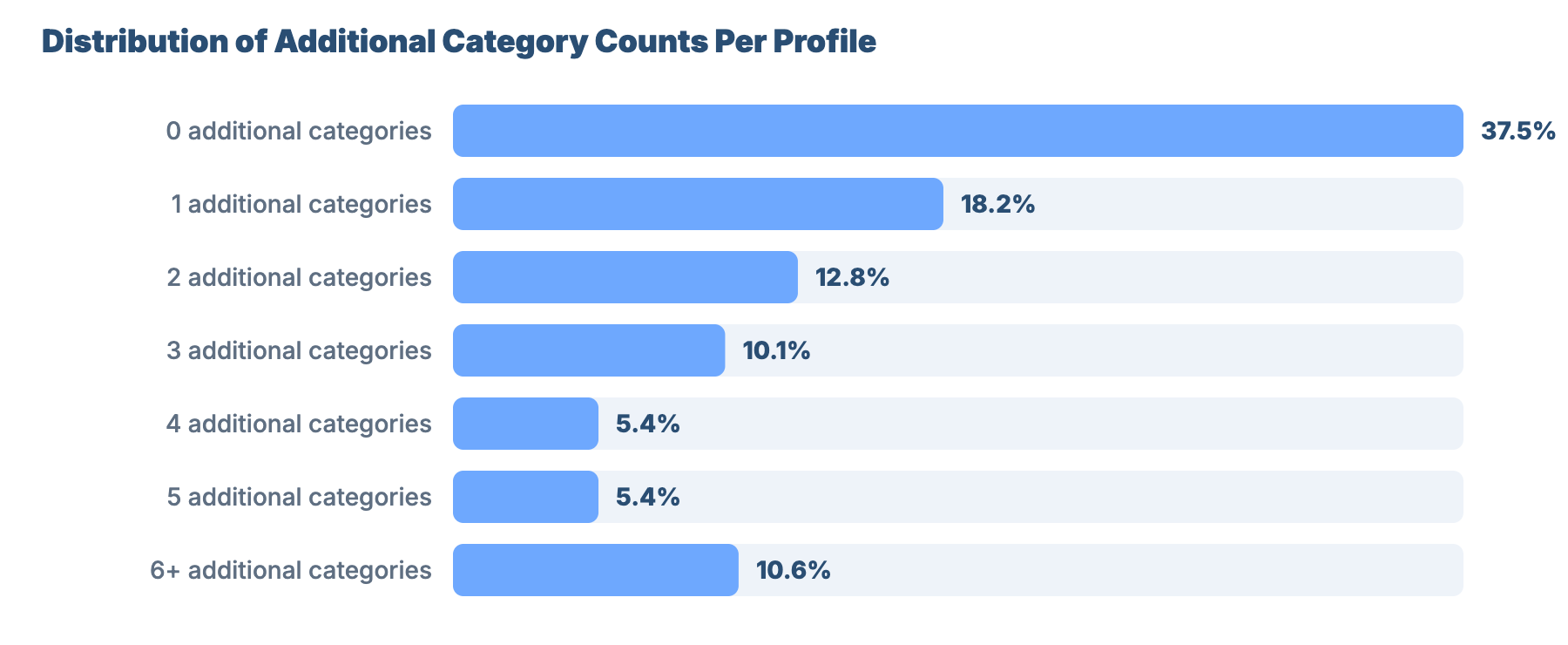
In the Bristol heating and plumbing sector, 62.5% of analysed Google Business Profiles actively maintain at least one additional category, yielding an average of 2.01 categories per listing. A substantial minority of 37.5% rely entirely on a single primary category. However, profile optimisation behaviour varies significantly across the market: whilst 18.2% attach just one extra category, 10.6% assign six or more secondary categories to expand their local search visibility across complementary trade terms.
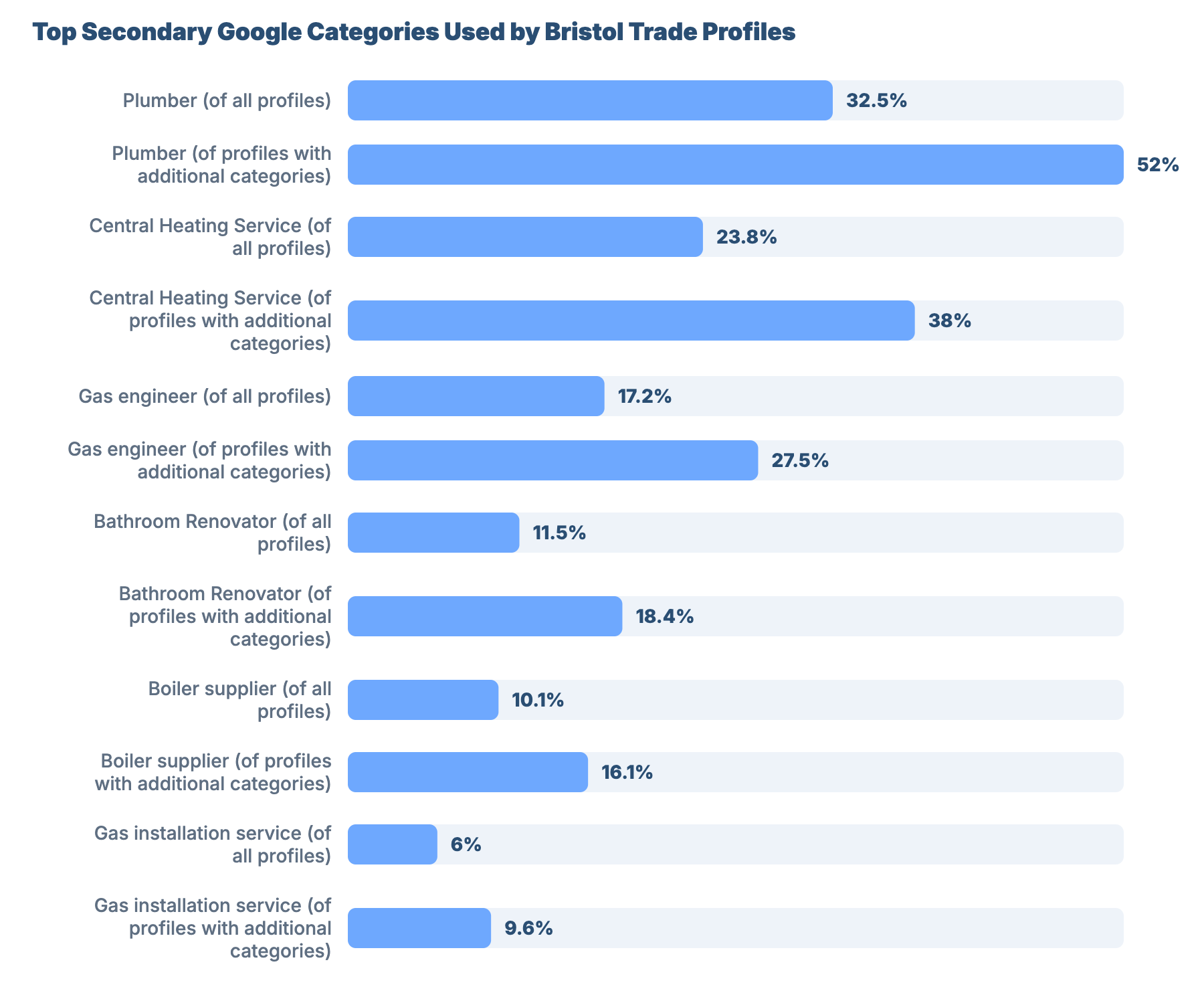
Secondary category selections concentrate heavily around closely linked trade disciplines. Among all 686 analysed listings, ‘Plumber’ leads as an additional category at 32.5% (representing 52% of profiles with extra categories), followed by ‘Central Heating Service’ at 23.8% (38% of multi-category profiles) and ‘Gas engineer’ at 17.2% (27.5% of multi-category profiles). Service expansion into installations and renovations is also widespread, with ‘Bathroom Renovator’ present on 11.5% of listings and ‘Boiler supplier’ on 10.1%.
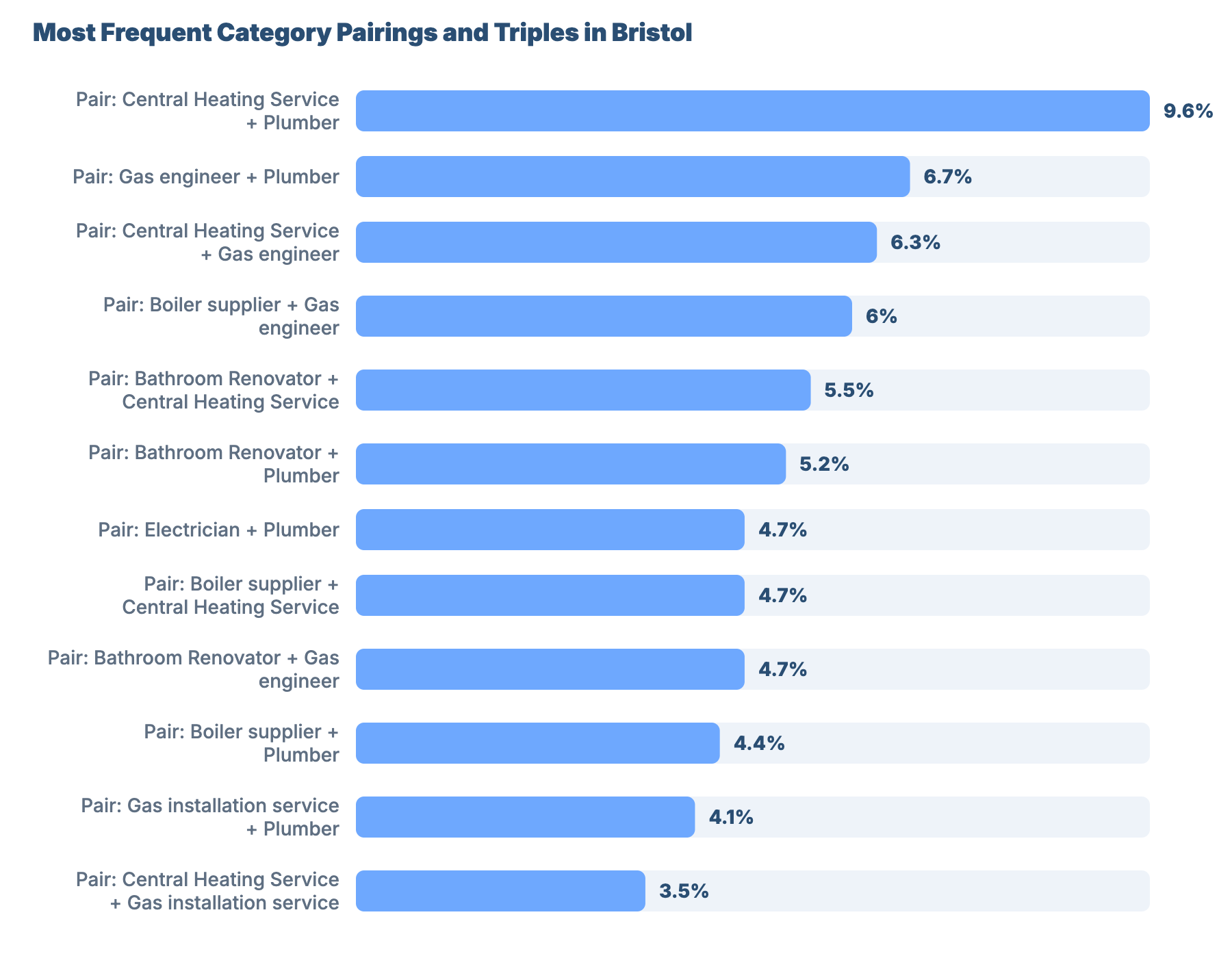
Co-occurrence patterns confirm that Bristol trades businesses frequently target combined plumbing and heating queries. The most common dual-category pairing is ‘Central Heating Service + Plumber’, observed on 9.6% of profiles (66 listings), followed by ‘Gas engineer + Plumber’ at 6.7% (46 listings) and ‘Central Heating Service + Gas engineer’ at 6.3% (43 listings). Across the market, 171 unique additional categories were recorded, ranging from core trade additions to highly diluted selections such as ‘Wine club’ or ‘Scaffolding Service’.

What the data proves
- 62.5% (429 of 686) of Bristol profiles utilise one or more additional categories, whilst 37.5% (257) rely solely on one primary category.
- ‘Plumber’ is the most frequent secondary category overall, present on 32.5% of all profiles and 52% of profiles with secondary categories.
- The top two-category combination is ‘Central Heating Service + Plumber’, found on 9.6% (66) of analysed listings.
- A total of 171 distinct secondary Google categories are currently deployed across the Bristol market.
What can be inferred
- Profiles adopting primary and secondary categories like ‘Plumber’, ‘Central Heating Service’, and ‘Gas engineer’ align closer with broad local intent for SEO for Plumbers and Gas Engineers Bristol.
- Operators using six or more categories are attempting to capture adjacent revenue streams like bathroom fitting and electrical work, though excessive broad categories risk diluting core relevance.
- The 37.5% of businesses without additional categories are missing structured categorical relevance for high-intent secondary services like boiler installations or gas fitting.
For established businesses
- Audit existing category structures to ensure high-margin services such as ‘Central Heating Service’, ‘Gas engineer’, and ‘Boiler supplier’ are explicitly represented.
- Remove unrelated low-volume categories (such as general builder or handyman tags) that do not reflect your core operational capacity or primary revenue drivers.
- Align dedicated website landing pages with each assigned secondary category to reinforce local entity relevance for targeted Bristol search queries.
For new entrants
- Select a precise primary category that matches your core licence (e.g., Gas Engineer or Plumber) and immediately add 2 to 3 high-volume secondary categories like ‘Central Heating Service’.
- Capitalise on the market gap left by 37.5% of competitors who fail to use any additional categories whatsoever.
- Avoid over-expanding into peripheral categories until your primary service area landing pages and customer reviews are fully established.
Google Business Profile Description Optimisation for Bristol Plumbers and Gas Engineers
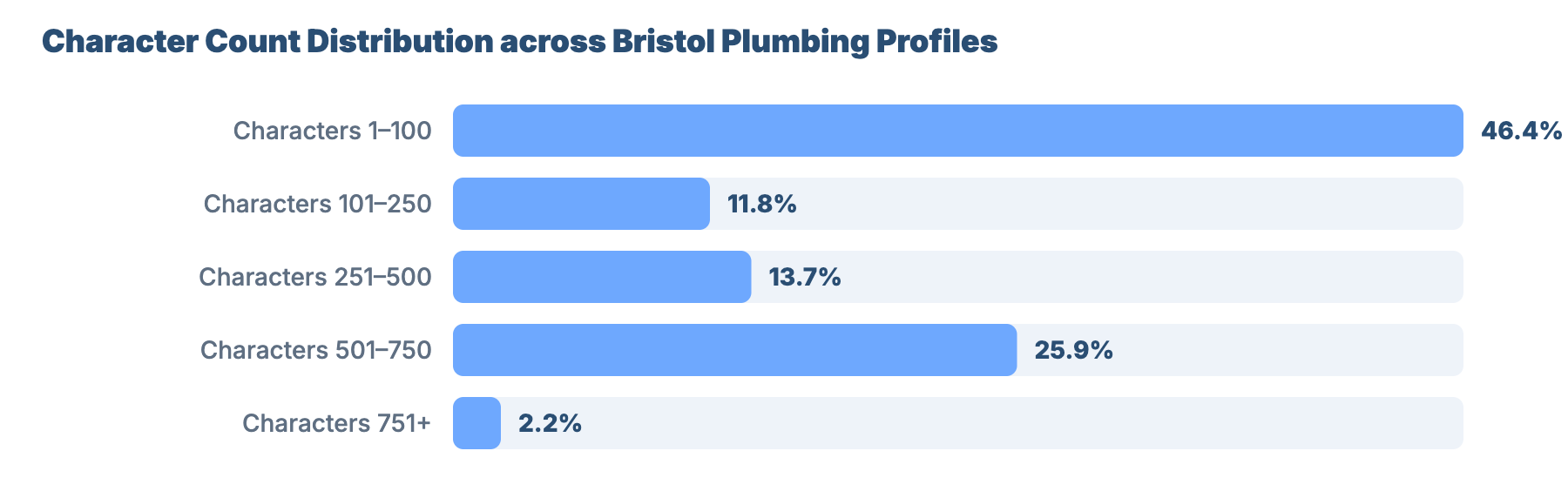
Every single profile in this 686-business dataset includes a filled-in Google Business Profile description. However, the depth and strategic effort behind these descriptions vary dramatically across the market. Almost half of all traders (46.4%) write brief snippets under 100 characters, resulting in a low median word count of just 21 words. Conversely, over a quarter of operators (25.9%) utilise substantial descriptions between 501 and 750 characters, pulling the sample mean up to 280.5 characters.
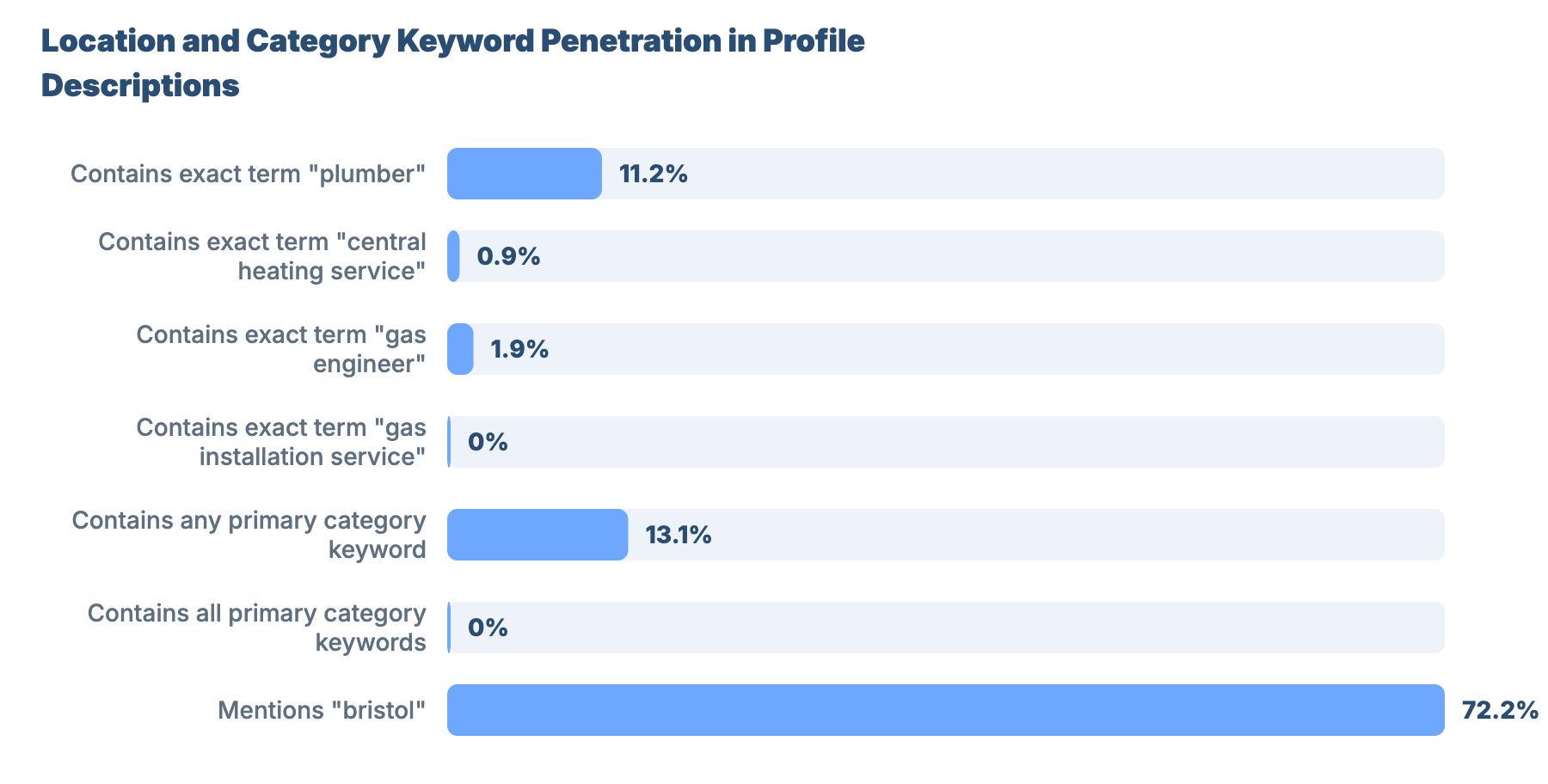
Local positioning is clearly prioritised by Bristol heating and plumbing businesses, with 72.2% explicitly naming “Bristol” within their body copy (generating 671 total mentions). In stark contrast, primary service keywords are remarkably under-represented. Only 11.2% of profiles mention the word “plumber”, while “gas engineer” appears in a mere 1.9% of descriptions, and exact matches for “gas installation service” are entirely absent across all 686 profiles.
This distinct gap highlights a widespread operational oversight. While trade professionals routinely confirm their geographic location, only 13.1% include any exact-match primary category keyword, and zero profiles incorporate all four core trade phrases. This creates an immediate opportunity for local contractors to differentiate their listings through structured, comprehensive descriptive copywriting.

What the data proves
- 100% of analysed profiles (686 of 686) contain a non-empty business description field.
- 46.4% of descriptions are 100 characters or fewer, yielding a low overall median length of 21 words.
- 72.2% of businesses explicitly include the location name Bristol in their profile text.
- Only 13.1% of profile descriptions contain at least one primary category keyword.
- Zero profiles in the 686 dataset contain all four primary category keywords simultaneously.
What can be inferred
- Bristol tradespeople naturally focus on geographic relevance over technical service keywords when writing business summaries.
- The high prevalence of short descriptions suggests many profile managers complete the description field as an afterthought during setup.
- The complete absence of exact match phrases such as ‘gas installation service’ indicates trade descriptions are written for human readability rather than exact category alignment.
For established businesses
- Audit your existing description to ensure it expands beyond minimal boilerplate copy towards the 750-character limit.
- Incorporate secondary service terms like ‘gas engineer’ and ‘central heating service’ alongside your primary trade designation to capture wider search intent.
- Maintain clear local references to Bristol and target surrounding neighbourhoods to reinforce local geographic coverage without keyword stuffing.
For new entrants
- Draft a detailed description close to 750 characters from day one, giving potential customers immediate clarity on services offered.
- Capitalise on the low category keyword usage (13.1%) across competitors by clearly stating core specialisms like boiler installations and central heating repairs.
- Place your primary service terms and key Bristol target areas within the first 100 characters so they are visible before any user click to expand.
Primary Category Distribution for Bristol Plumbers and Gas Engineers
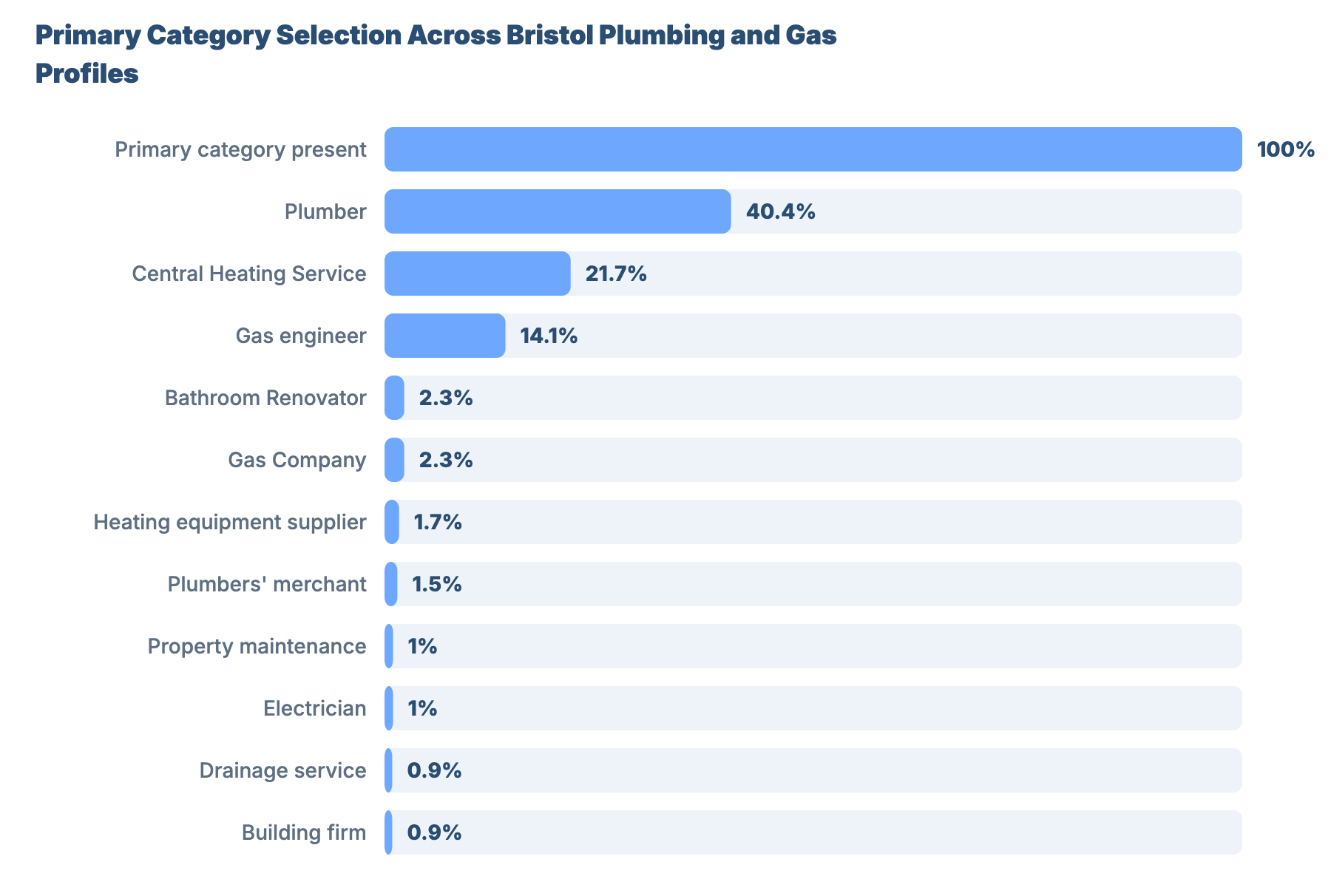
In the Bristol market, primary category selection is heavily concentrated across three core classifications, accounting for 76.2% of all 686 analysed Google Business Profiles. ‘Plumber’ leads decisively at 40.4% (277 profiles), followed by ‘Central Heating Service’ at 21.7% (149 profiles) and ‘Gas engineer’ at 14.1% (97 profiles). This establishes a clear primary taxonomy that defines the dominant local search positioning strategies across the region.
Beyond the top three, a long tail of niche classifications emerges. Secondary concentrations include ‘Bathroom Renovator’ (2.3%, 16 profiles) and ‘Gas Company’ (2.3%, 16 profiles), alongside trade-adjacent listings like ‘Heating equipment supplier’ (1.7%) and ‘Plumbers’ merchant’ (1.5%). Interestingly, general trade labels such as ‘Property maintenance’ and ‘Electrician’ each represent just 1.0% (7 profiles), demonstrating that most operators in this sample explicitly align their primary category with core plumbing or heating services rather than broad home repairs.
Notably, specific high-intent primary categories like ‘Gas installation service’ appear on just 0.1% (1 profile) of listings. This under-utilisation suggests that local trade businesses overwhelmingly default to broad classifications rather than precise operational specialisms, leaving distinct opportunities for firms targeting specialised search queries.
What the data proves
- Every single profile (100%, 686/686) in the Bristol sample has a designated primary category.
- ‘Plumber’ is the most frequent primary category, present on 40.4% (277) of analysed profiles.
- Only three primary categories achieve double-digit market share: Plumber (40.4%), Central Heating Service (21.7%), and Gas engineer (14.1%).
- Adjacent trade labels like ‘Property maintenance’ and ‘Electrician’ represent just 1.0% (7 profiles each) of the dataset.
What can be inferred
- Operators selecting ‘Plumber’ over ‘Gas engineer’ likely seek to capture higher general call-out volume rather than specialised boiler servicing searches.
- The low adoption of ‘Gas installation service’ (0.1%) implies businesses rely on secondary categories to cover specific sub-services rather than primary positioning.
- Bristol heating specialists frequently use ‘Central Heating Service’ to intentionally differentiate themselves from general domestic plumbers.
For established businesses
- Audit your primary category alignment against primary revenue drivers; if high-margin boiler installations fuel your business, evaluate whether ‘Central Heating Service’ yields better intent alignment than ‘Plumber’.
- Utilise secondary categories systematically to cover niche offerings like ‘Gas installation service’ or ‘Bathroom Renovator’ without sacrificing broad category coverage.
- Monitor local Map Pack competitors in your specific Bristol postcode area to identify whether niche primary categories are capturing targeted search queries.
For new entrants
- Select ‘Plumber’ as your primary category if offering general domestic repairs to capture the highest baseline search volume across Bristol.
- Position under ‘Central Heating Service’ or ‘Gas engineer’ if focusing exclusively on boiler installs, heating upgrades, and landlord safety certifications.
- Avoid generic primary categories such as ‘Property maintenance’ or ‘Builder’, which dilute direct trade relevance for plumbing and gas searches.
Action playbooks
Established businesses
- Upgrade website infrastructure immediately to enforce HTTPS on all GBP landing page links, resolving the 56.8% unencrypted URL issue observed across local competitors.
- Implement robust UTM tracking codes (e.g., utm_source=gbp&utm_medium=organic&utm_campaign=bristol_gmb) to accurately isolate direct Google Business Profile leads in Google Analytics.
- Target the P90 review threshold of 100+ reviews through automated post-service SMS and email review collection requests.
- Expand category depth by adding relevant high-converting secondary categories such as Boiler Supplier (10.1% usage), Bathroom Renovator (11.5%), and Heating Equipment Supplier (5.8%).
- Refine profile descriptions to naturally incorporate primary target service terms (‘plumber’, ‘gas engineer’, ‘central heating service’) alongside local district identifiers like BS16, BS15, and BS3.
- Maintain an active visual feed by adding new high-quality job photos monthly to move past the median threshold of 6 photos towards the P90 benchmark of 72 photos.
Starting out in this market
- Claim your Google Business Profile instantly to secure control over your business listing and distinguish yourself from the 22.3% of unclaimed market competitors.
- Select ‘Plumber’ or ‘Gas Engineer’ as your primary category depending on core focus, then add 2-3 essential secondary categories during initial setup.
- Obtain a dedicated local 0117 phone number or ensure your primary mobile line is consistently formatted without national duplication.
- Set clear, competitive operating hours covering early mornings (07:30 or 08:00 start) and consider offering weekend coverage to tap into the 58.6% weekend closure gap.
- Systematically collect your first 15-25 reviews from existing local clients to surpass the market median of 13 reviews and unlock trust thresholds.
- Upload 15-20 high-resolution photos of branded vehicles, tools, and completed boiler or plumbing installations to immediately exceed the 1-5 photo baseline of 48.3% of listings.
Frequently asked questions
How many reviews do I need to rank as a plumber in Bristol?
The market median in Bristol is 13 reviews, but market leaders in the top 10% hold at least 100 reviews. To break into the top local Pack in competitive postcodes like BS16 or BS15, aim for a minimum of 37 to 100 verified Google reviews with an average rating above 4.7 stars.
What is the best primary category for a gas engineer in Bristol?
If your core revenue comes from boiler installations and heating systems, ‘Gas Engineer’ or ‘Central Heating Service’ is ideal. If general plumbing work is your primary focus, select ‘Plumber’ as your main category and add ‘Gas Engineer’ and ‘Central Heating Service’ as secondary categories.
Should I link my GBP to my homepage or a Bristol location page?
Our research shows 90.4% of Bristol trades link to their homepage. However, if your business serves specific suburban districts or if your domain represents a broader multi-location business, linking to a dedicated Bristol location page can improve local keyword relevance.
Does adding HTTPS to my plumbing website affect my local SEO?
Yes. In our Bristol sample, 56.8% of linked websites still use HTTP. Upgrading to HTTPS protects user security, prevents browser security warnings, improves mobile conversion rates, and ensures smooth indexation by Google.
Why should plumbers in Bristol use UTM tracking on Google Business Profiles?
Only 3.6% of Bristol plumbing profiles currently use UTM tracking. Adding parameters like utm_source=gbp allows you to accurately track calls, form fills, and organic website traffic coming directly from your Map Pack listing inside Google Analytics.
How often should gas engineers upload photos to Google Business Profile?
The market median in Bristol is just 6 photos, while top-tier profiles feature over 70 images. Uploading 2-4 fresh photos weekly—such as clean boiler installs, Gas Safe badges, and team photos—signals ongoing activity to Google and builds trust with potential clients.
Methodology and caveats
Data was collected from 686 public Google Business Profiles in Bristol categorised under plumber, central heating service, gas engineer, and gas installation service. Metrics evaluated include profile claiming status, review volume and distribution, star ratings, primary and additional categories, website technical attributes (HTTPS, domain structure, UTM parameters), opening hours, photo volume, and profile descriptions. Statistical analysis was performed using parametric and non-parametric measures to establish realistic operational benchmarks.
This dataset represents a point-in-time observational analysis of 686 Google Business Profiles located within the Bristol area as categorised under plumbing and gas engineering services. Correlation between specific profile optimisations (such as category counts, photo volume, or UTM parameter usage) and local search rankings is derived from aggregate market patterns and does not constitute proof of Google ranking algorithms. External factors including geographic proximity, backlink authority, organic search performance, and local user proximity heavily influence actual local Pack rankings.
