 Skip to content

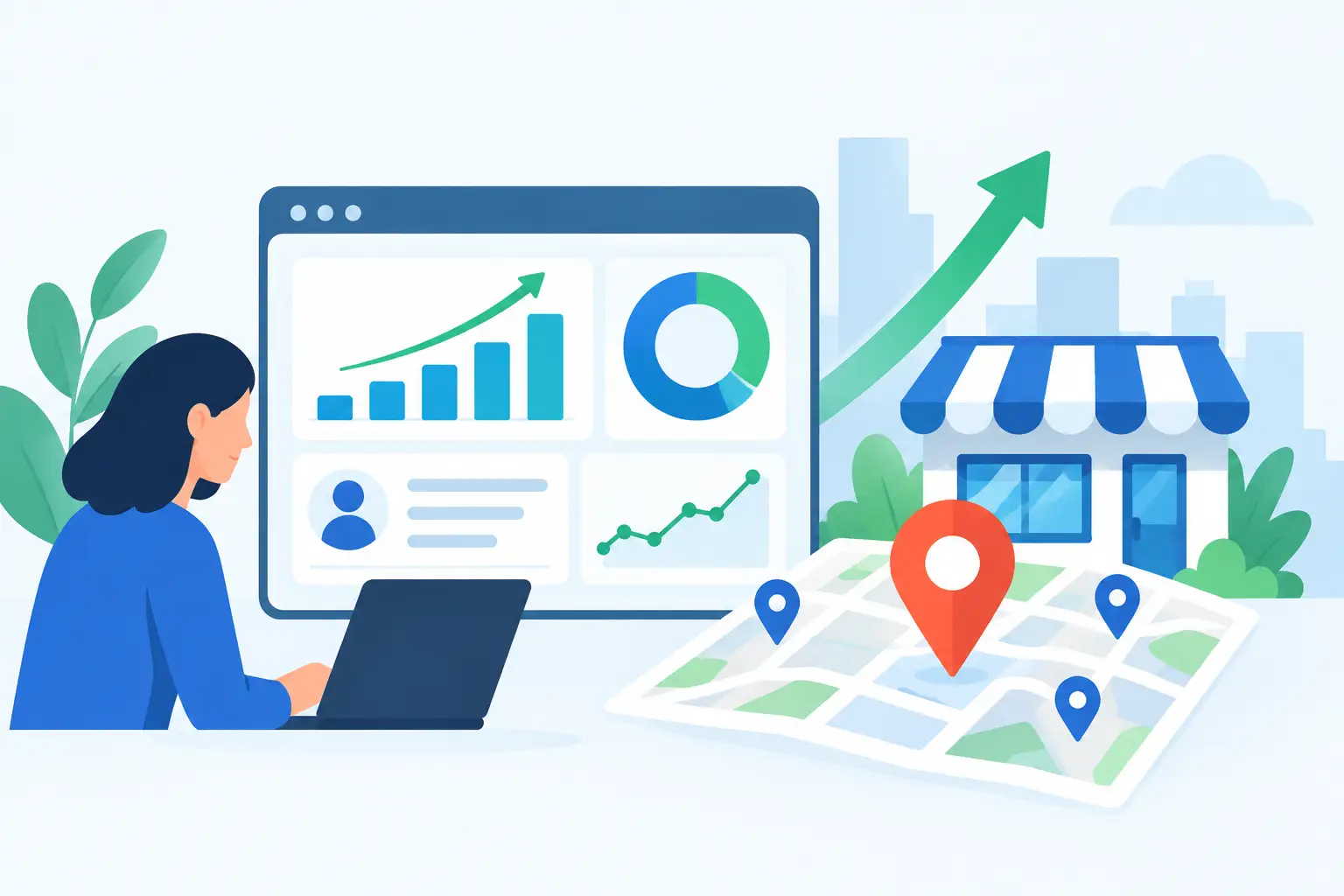
A Google Business Profile can look complete and still lose ground to a nearby competitor. The opening hours are correct, the phone number works, and a few photos are in place. Yet competitors appear more often in the local results and receive the calls, booking enquiries and footfall that should have gone to you. Profile analytics explains why – and, more importantly, what to change next.
For a local business, the point is not to collect more data. It is to replace assumptions with clear evidence. Which parts of your profile are weaker than the businesses outranking you? Are reviews holding you back? Is your category selection too broad, your service information too thin, or your recent activity falling behind? The answers should lead directly to action.
What profile analytics actually measures
Profile analytics is the process of reviewing the strength, completeness and competitive position of your Google Business Profile. It looks beyond whether your profile exists and asks whether it gives Google and potential customers enough relevant, trustworthy information to choose you.
A useful analysis considers your profile alongside the businesses that rank around you for the searches that matter. Looking at your profile in isolation can make a missing detail seem minor. Seeing that the top three competitors have more recent reviews, better category coverage, regular posts and stronger photo activity makes the priority obvious.
The most valuable areas to assess are your primary and additional categories, business description, services, opening hours, attributes, photos, posts, reviews and responses. It should also consider practical conversion details such as your website, telephone number, booking link and service-area information.
None of these elements guarantees a top position on its own. Local visibility depends on relevance, distance and prominence, and some factors will matter more in one market than another. But a profile with gaps creates avoidable uncertainty. A well-maintained one gives both Google and customers clearer reasons to trust it.
Why a completed profile is not necessarily a competitive profile
Many businesses treat Google Business Profile setup as a one-off job. They add the basic details, publish the profile and return only when a customer leaves a review. That is better than neglect, but it is not optimisation.
Local search is competitive. If a rival is publishing useful updates, adding genuine job photos, responding properly to reviews and accurately describing services you also provide, their profile may offer stronger signals of relevance and activity. Your profile can be technically complete while still being less persuasive.
This is especially common for service-area businesses. A plumber, pest controller or electrician may list a broad service area but fail to explain the specific work they do. Meanwhile, a competitor has detailed services for emergency call-outs, boiler repairs, drainage work or electrical testing. When customers search with that intent, the more specific profile is better placed to match it.
The same applies to local clinics, restaurants, shops and hospitality venues. A profile that does not show current photos, clear appointment options, accurate accessibility details or recent customer feedback gives people little reason to choose it over the business beside it.
The profile data that deserves attention first
Not every metric needs an immediate response. The aim is to identify the gaps that affect visibility and conversion, then deal with the highest-impact work first.
Categories and services
Your primary category is one of the clearest ways to tell Google what your business is. It should reflect the main service or type of business you want to be found for, rather than a vague label that merely sounds broad enough. Additional categories can support genuine parts of your offer, but adding irrelevant categories to chase more searches can dilute the picture.
Services need the same discipline. List the work you actually deliver, using clear customer language. A decorator should not rely on a single generic service if they also provide interior painting, exterior painting, wallpaper removal and commercial decorating. Specificity helps customers understand the offer and makes the profile more useful for relevant searches.
Reviews and responses
Review quantity matters, but it is only part of the story. Look at the rate of new reviews, average rating, review themes and response quality. A profile with 100 reviews from several years ago may be less convincing than one receiving consistent recent feedback.
Read competitors’ reviews closely. Customers often reveal what drives decisions in your area: speed, cleanliness, value, availability, friendliness, workmanship or a particular specialist service. Those patterns can highlight improvements to your operations as well as your profile wording.
Responses should be timely, personal and professional. Avoid copying the same reply repeatedly. Thank customers for details they have shared and address criticism calmly. A review response will not fix poor service, but it shows potential customers that you take accountability seriously.
Photos, posts and profile activity
Photos should help someone decide whether to contact or visit you. Use genuine images of your team, premises, completed work, vehicles, products or before-and-after results where appropriate. Stock imagery rarely creates the same confidence, and old photos can make an active business look neglected.
Posts can support timely offers, updates, seasonal services and useful reminders. They are not a substitute for good categories, services or reviews, and they should not become a weekly task with no purpose. Use them when you have something relevant to say – for example, new availability, a bank holiday opening change or a seasonal maintenance service.
Accuracy and conversion routes
Small errors can cost real enquiries. Check that your phone number, website, opening hours, booking route and address or service area match the way you operate now. If you close early on Fridays, work by appointment only or cover certain areas on specific days, make that clear.
For service-area businesses, consistency matters more than trying to appear everywhere. Set a realistic area you can serve well. Promising coverage across an enormous region may create poor customer experiences and wasted travel time, even if it looks ambitious on the profile.
Turn competitor comparisons into an action plan
The difference between reporting and useful profile analytics is prioritisation. A dashboard full of scores is not helpful if you still do not know what to do on Monday morning.
Start by comparing your profile against the businesses that appear most often for your priority local searches. Look for repeated differences, not one-off quirks. If several top-ranking competitors use a more precise primary category, offer fuller service lists and have gained fresh reviews in the last month, those are strong candidates for action.
Then separate quick fixes from ongoing work. Correct categories, opening hours, missing attributes and weak service descriptions first. Next, create a realistic routine for reviews, photos and posts. A consistent monthly process is more valuable than a burst of activity followed by six months of silence.
Finally, connect profile changes to business outcomes. Track whether improvements lead to better local positions, more profile views, calls, website visits, direction requests or booking enquiries. Rankings matter, but they are a means to an end. A rise in visibility that does not produce qualified leads may mean you are targeting the wrong searches, the wrong area or the wrong customer intent.
Avoid the common mistakes
The biggest mistake is copying competitors without checking whether their approach fits your business. A category may work for them because it reflects their core offer, while being misleading for yours. The objective is not to imitate every field. It is to identify where their profile communicates useful information that yours does not.
Another mistake is treating every recommendation as equally urgent. If your opening hours are wrong, that deserves attention before you spend time drafting a post. If customers repeatedly praise a competitor’s rapid response but your callback process is slow, profile edits alone will not solve the real problem.
It is also worth avoiding artificial activity. Do not use keyword-heavy business names, buy reviews or publish misleading service details. These tactics can damage trust and may put the profile at risk. Sustainable local visibility comes from accurate information, genuine customer proof and regular maintenance.
Make profile analytics part of regular management
A profile should be reviewed whenever something changes in the business, but a scheduled check also prevents small gaps becoming expensive ones. Monthly is sensible for most local businesses. Businesses in fast-moving sectors, or agencies managing several locations, may need a more frequent view of reviews, rankings and competitor movement.
VisiLocali brings profile analysis, competitor comparisons, rank tracking, review analysis and profile management into one place, so the next action is clear rather than buried across separate tools. The useful question is never simply, “How is my profile doing?” It is, “What is stopping it from winning more local customers?”
Use the answer to make one meaningful improvement, measure what changes, then move to the next priority. That is how a Google Business Profile becomes less of a listing to maintain and more of a reliable source of calls, bookings and visits.
