 Skip to content
VisiLocali market research
Visualising local search visibility across Doncaster reveals a stark divide between active heating firms and dormant trade listings. In this benchmark report for VisiLocali, we systematically analysed 135 Google Business Profiles targeting category keywords such as plumber, gas engineer, gas installation service, and central heating service across the DN postcode area.
The findings reveal significant operational gaps. Nearly half of all listings (48.1%) lack a website link entirely, 34.8% remain completely unclaimed, and 63.7% fail to utilise additional Google categories. For trade professionals seeking to capture high-intent local calls, these shortcomings represent immediate market opportunities.
Executive summary
- Digital gap: 48.1% of Doncaster plumbing and heating profiles operate without a website link, whilst 40% of existing site links use insecure HTTP protocols.
- Unclaimed listings: 34.8% of local profiles are unclaimed. Verified profiles average higher ratings (4.55 vs 4.21) and substantially higher review volume (median 10 vs 3).
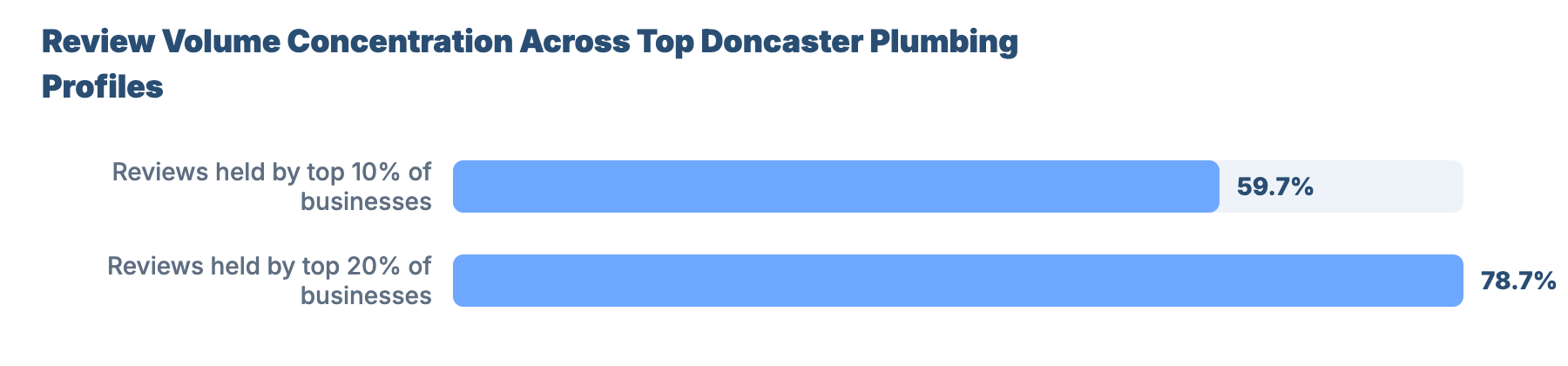
- Review concentration: The local review landscape is heavily skewed; the top 10% of businesses hold 59.7% of all 2,367 reviews, with a median review count across all listings of just 4.
- Category under-optimisation: 63.7% of profiles list only a single category, omitting critical secondary tags such as Central Heating Service (21.5%) or Gas Engineer (14.1%).
- Truncated descriptions: While 100% of profiles feature a description, the median length is just 50 characters, and only 4.4% incorporate a primary category keyword.
- Media scarcity: The median profile contains only 2 photos, though top-tier profiles in the 90th percentile maintain 34 or more visual assets.
Website Integration & Technical Optimisation for Doncaster Plumbers and Gas Engineers
Almost half of the analysed Google Business Profiles in Doncaster (48.1%) list no website address at all, revealing a striking digital divide among local plumbing and heating trade listings. Among the 70 profiles (51.9%) that do link to a web destination, the vast majority control their own domain (94.3%), favouring .co.uk (61.4%) and .com (21.4%) extensions. However, technical best practices are shockingly absent across the sector, leaving massive commercial opportunities for forward-thinking tradespeople.
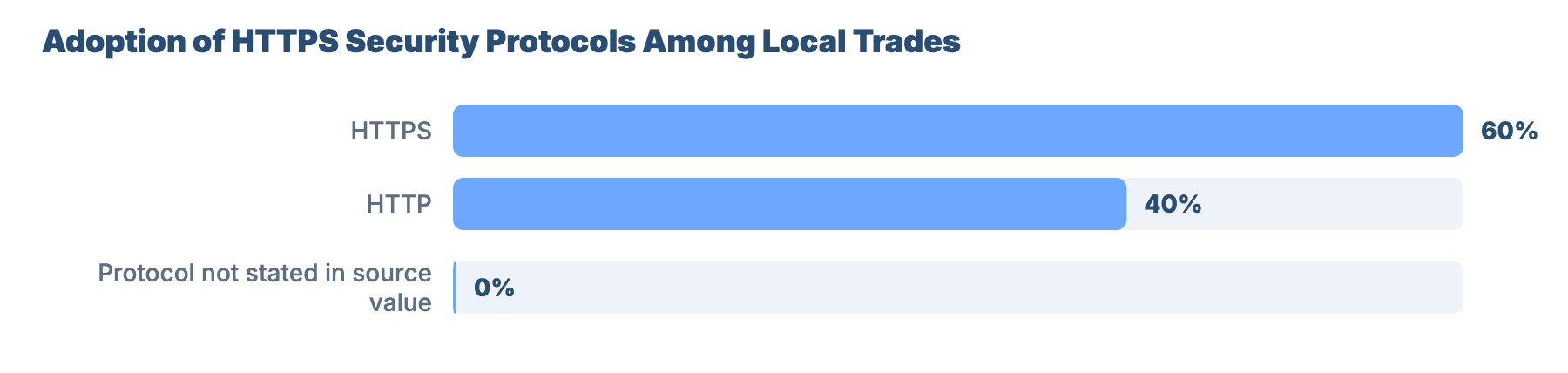
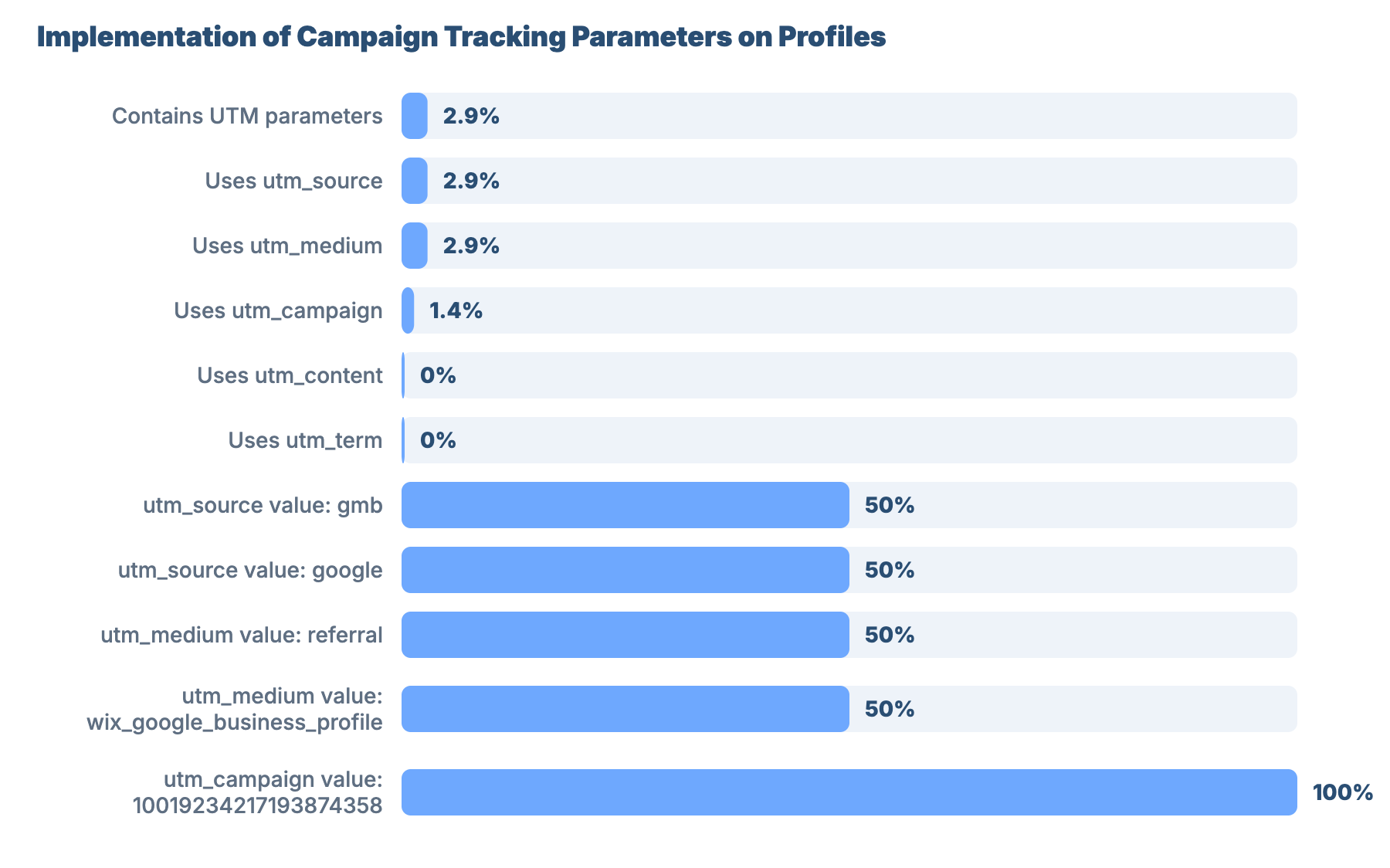
Security and tracking compliance represent critical technical vulnerabilities in this market. A concerning 40.0% of listed websites still run on unencrypted HTTP protocols, exposing prospective customers to browser warnings and missing out on basic security standards. Furthermore, tracking maturity is nearly non-existent: a mere 2.9% of profiles utilise UTM parameters to attribute traffic from their Google Business Profile to their web analytics suite.
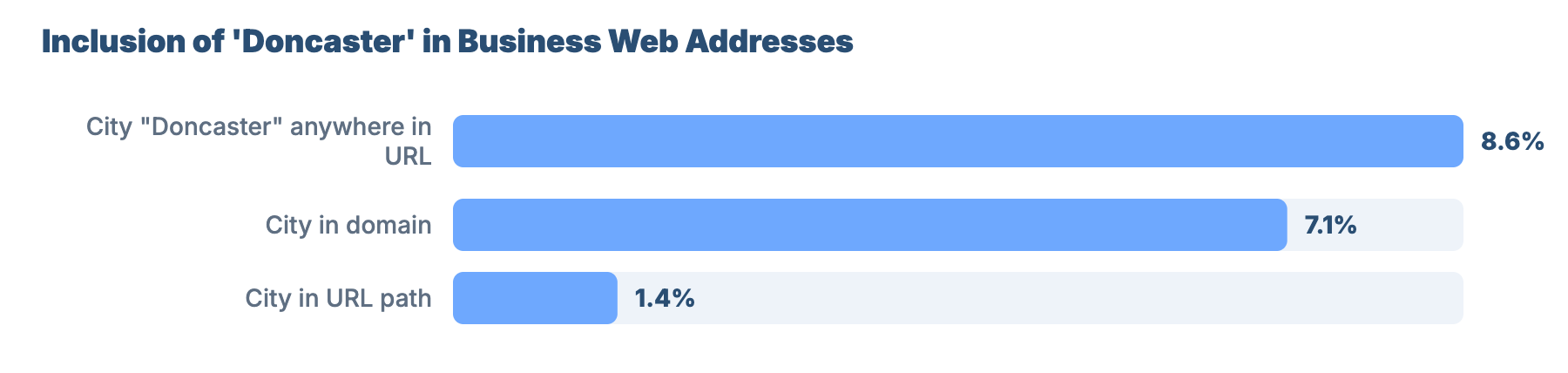
Architecture choices also show significant room for search engine optimisation. While 78.6% of profiles link directly to their homepage, 21.4% link to an internal page. Of those internal destinations, only 6.7% lead to dedicated service-and-location landing pages, with most pointing to generic or uncategorised internal URLs. Furthermore, localised domain targeting remains underutilised, with only 8.6% featuring "Doncaster" anywhere within the URL structure.

What the data proves
- 48.1% (65 out of 135) of local plumbing and gas listings operate without a linked website on their profile.
- 60.0% (42 out of 70) of connected websites use secure HTTPS encryption, while 40.0% remain on unencrypted HTTP.
- 78.6% of profiles with web links direct users to a homepage rather than a deep internal page.
- 94.3% of businesses with web links own their domain, predominantly choosing .co.uk (61.4%) and .com (21.4%).
What can be inferred
- Local tradespeople severely under-invest in web tracking, meaning most businesses cannot measure the revenue generated from their Google Business Profile.
- Security compliance is neglected, causing potential customer drop-off due to browser security warnings on unencrypted HTTP sites.
- Competitors are failing to leverage hyper-local URL structures and dedicated service landing pages to capture targeted Doncaster search traffic.
For established businesses
- Upgrade your web hosting immediately to secure an SSL certificate, converting HTTP URLs to HTTPS to build trust and protect visitor data.
- Implement clean UTM parameter tags on your profile’s website link (e.g. utm_source=google&utm_medium=organic&utm_campaign=gbp) to accurately track incoming calls and form submissions.
- Build dedicated service and location landing pages for high-margin jobs, such as boiler installations in Doncaster, and link your profile to the most relevant URL.
For new entrants
- Capitalise on the low digital barrier to entry by launching a modern, HTTPS-secured website from day one, instantly outperforming nearly half the local market.
- Choose a primary .co.uk domain name and consider including key service or geographic terms if available to reinforce local relevance.
- Establish robust analytics and UTM tagging before launching marketing campaigns to ensure clear line-of-sight on customer acquisition costs.
Phone Number Presence and Duplication Patterns in Doncaster
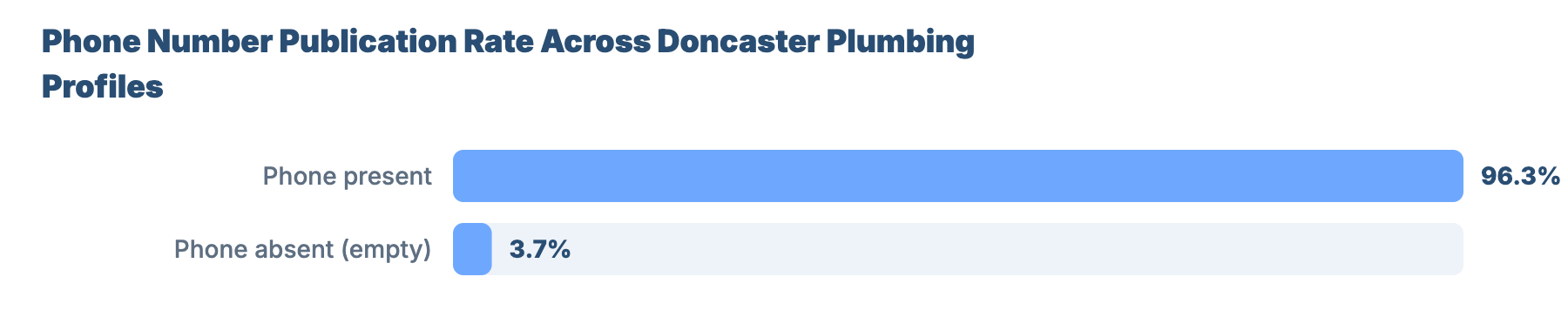
Phone number publication is virtually universal among Doncaster plumbing and gas engineering profiles, with 96.3% (130 of 135) displaying a contact line. Contactability is a fundamental operational requirement in emergency trade categories, making phone presence table stakes for local search visibility.
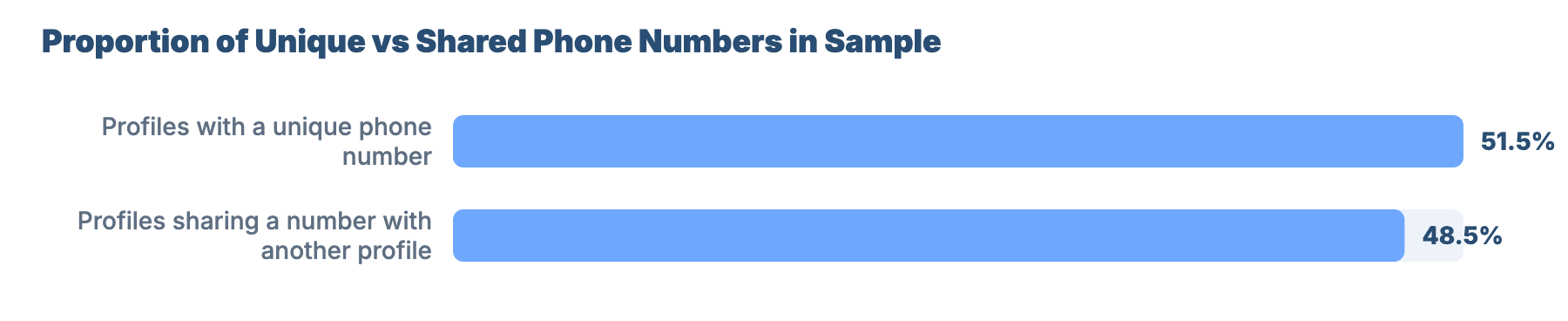
However, deeper inspection reveals significant structural duplication across the market. Almost half of all listings with phone numbers (48.5%) share their contact line with at least one other profile. In total, just 13 distinct phone numbers account for 63 profiles, driven heavily by central call centres and lead-generation networks. For instance, a single 01303 number covers 24 profiles, while one local 01302 number spans 16 separate listings.
This high rate of duplication indicates that multi-location lead networks actively occupy local SERP real estate in Doncaster. Independent operators maintaining a single, unique phone line represent only 51.5% of the active profile pool, highlighting a clear line between local sole traders and multi-profile operations.
What the data proves
- 96.3% (130 of 135) of audited profiles include a contact telephone number.
- 48.5% of phone-enabled profiles (63 of 130) share a number with another listing in the dataset.
- A single non-local telephone number is attached to 24 distinct Google Business Profiles.
- Only 67 profiles (51.5% of those with numbers) utilise a completely unique phone number.
What can be inferred
- A significant proportion of Google Business Profiles in Doncaster operate as lead-generation routes or multi-branch agency listings.
- Google’s automated spam filters permit extensive phone number duplication across separate trade profiles in this category.
- Local independent traders face map pack competition from off-site call-centre operations occupying multiple listings.
For established businesses
- Audit your primary phone number across all digital directories to ensure strict local NAP (Name, Address, Phone) consistency.
- Maintain a unique, dedicated telephone line rather than sharing numbers across secondary service-area listings.
- Promote rapid local response times on your profile and website to differentiate your business from central call-centre networks.
For new entrants
- Acquire a dedicated local 01302 geographic number or clean mobile line exclusively for your new trade entity.
- Avoid using virtual call-forwarding services that assign recycled or shared numbers across multiple trade clients.
- Ensure your phone number is prominently displayed on your website homepage and matches your primary Google Business Profile exactly.
Google Rating Value Trends for Doncaster Heating and Plumbing Services
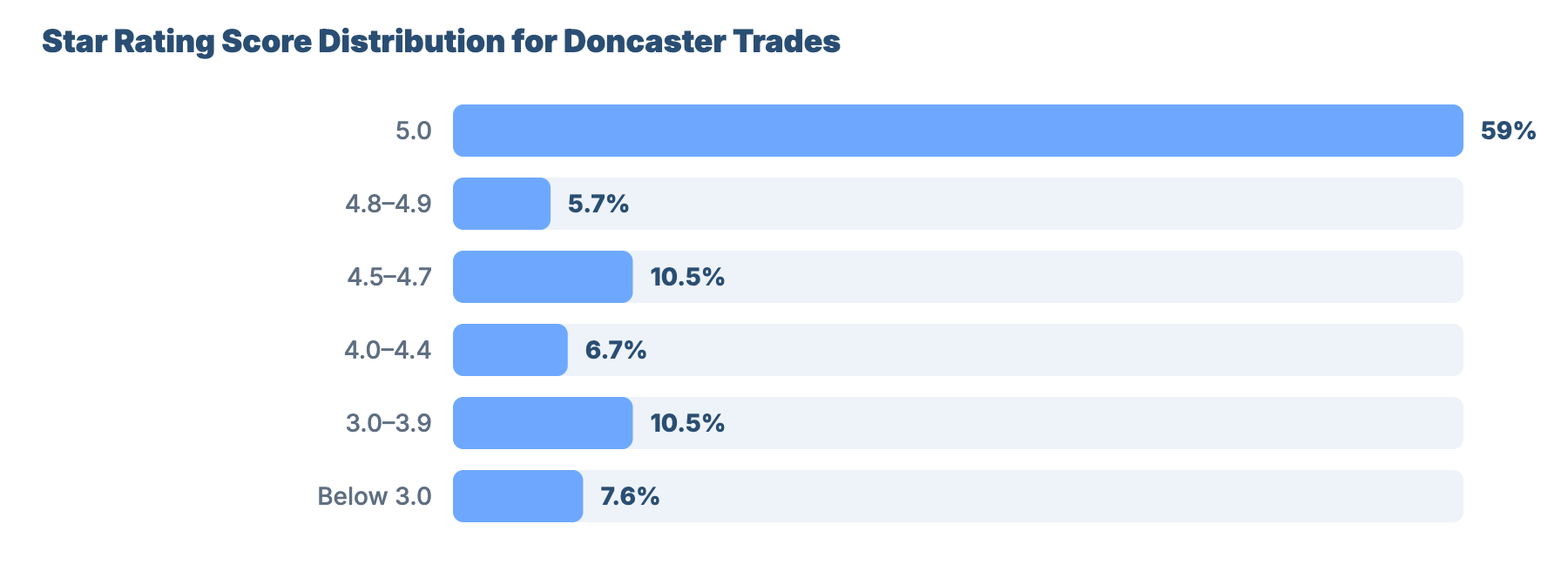
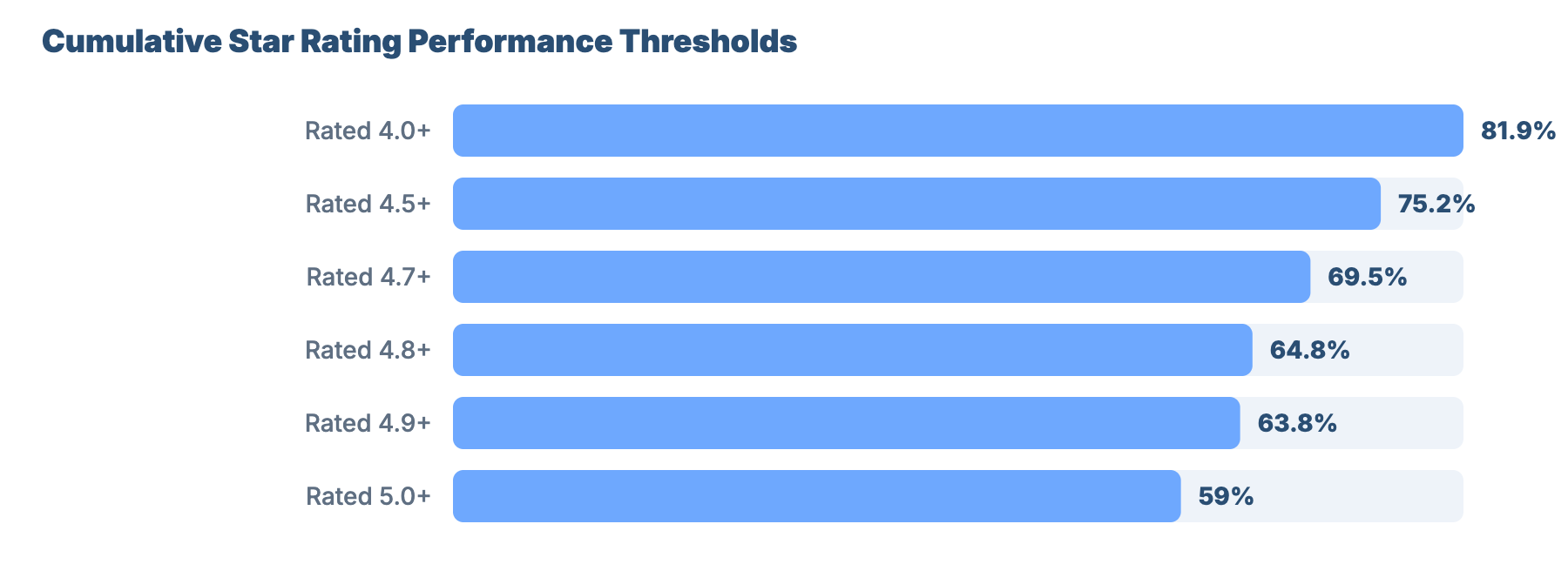
The Doncaster plumbing and gas engineering sector exhibits extreme rating polarisation across its Google Business Profiles. Of the 105 rated profiles (out of 135 analysed), a staggering 59.0% maintain a perfect 5.0 score, driving the market median to 5.0 and the overall mean to 4.44. However, this perfection is largely fragile: 60 of the rated profiles sit in the 1–5 review band, where maintaining a 5.0 average requires very few satisfied customers.
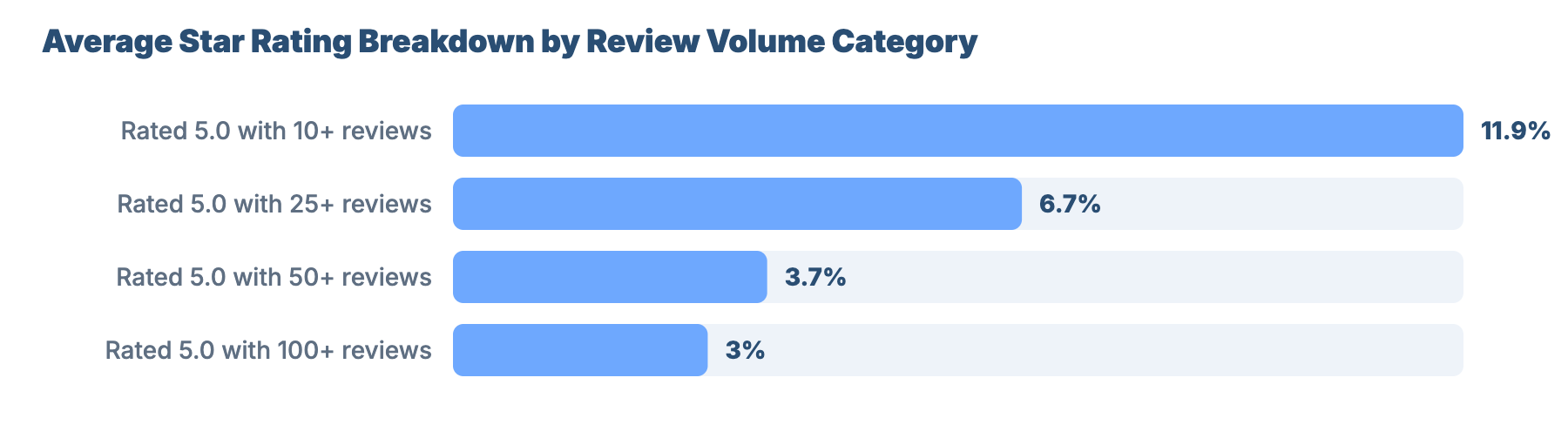
As review volume scales, maintaining a perfect score becomes exceptionally rare. Only 16 profiles (11.9% of the overall market) sustain a 5.0 rating with 10 or more reviews, dropping to just 4 profiles (3.0%) at the 100+ review mark. High-volume operators in the 101–250 review band settle into a healthy 4.69 average rating (4.95 median), demonstrating that consumer trust remains robust even when minor negative feedback inevitably occurs.
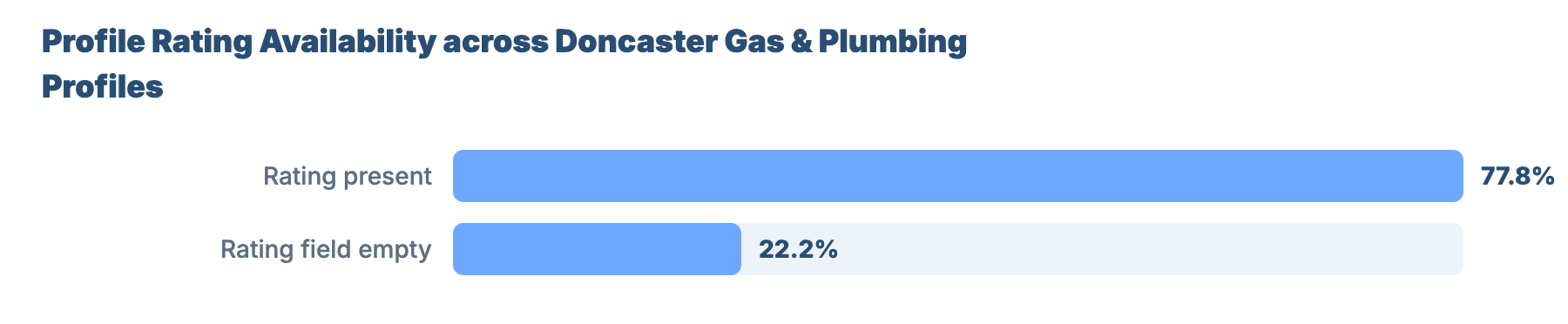
Crucially, 22.2% of profile listings have no ratings whatsoever, while 18.1% of rated profiles fall below the 4.0 threshold. This creates a distinct divide between unmanaged, low-trust listings and highly rated established tradespeople. For local SEO strategy in Doncaster, achieving a high rating threshold is essential simply to enter consideration, but review volume is the key factor that validates that rating.
What the data proves
- 77.8% of Doncaster profiles (105 of 135) have at least one rating score published.
- 59.0% of rated profiles (62 listings) possess a perfect 5.0 star average rating.
- 18.1% of rated listings fall below 4.0 stars, with 7.6% rated below 3.0 stars.
- No plumbing or gas engineering business in Doncaster has exceeded 250 Google reviews in this dataset.
What can be inferred
- Low-volume profiles with 5.0 stars are predominantly micro-businesses or sole traders relying on occasional client feedback rather than structured review management.
- Google searchers in Doncaster likely treat 4.7+ star profiles with 25+ reviews as more credible than 5.0 star profiles with only 1 or 2 reviews.
- Businesses with empty rating fields (22.2%) face a severe conversion handicap in local pack listings compared to rated competitors.
For established businesses
- Focus on review volume growth over preserving an artificial 5.0 average; a 4.7+ score with 50+ reviews carries far greater market authority.
- Implement a systematic post-job request process to regularly generate fresh ratings and cushion your business against stray negative feedback.
- Respond constructively to lower-star reviews to demonstrate accountability to prospective local clients scanning your Google Business Profile.
For new entrants
- Prioritise acquiring your first 10 5-star ratings immediately upon launch to outperform the 22.2% of market listings with zero feedback.
- Set an initial performance benchmark target of 4.8+ stars across your first 25 completed jobs in the Doncaster area.
- Dilute early negative feedback quickly by actively inviting all satisfied boiler installation and repair clients to post feedback.
Review Count Analysis for Doncaster Plumbers and Gas Engineers
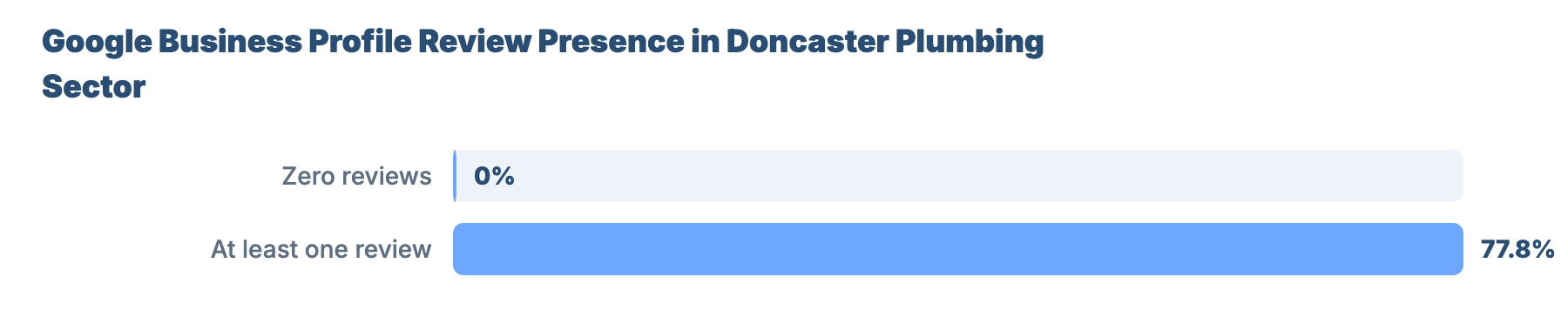
In the Doncaster plumbing and gas engineering sector, review acquisition is heavily skewed towards a small fraction of market leaders. Across 135 analysed Google Business Profiles, 105 profiles (77.8%) have received at least one review, accumulating a total of 2,367 reviews across the market. However, the median review count sits at a modest 4, compared to a mean average of 22.54 and a trimmed mean of 12.13, illustrating how a handful of high-volume profiles inflate the overall market average.
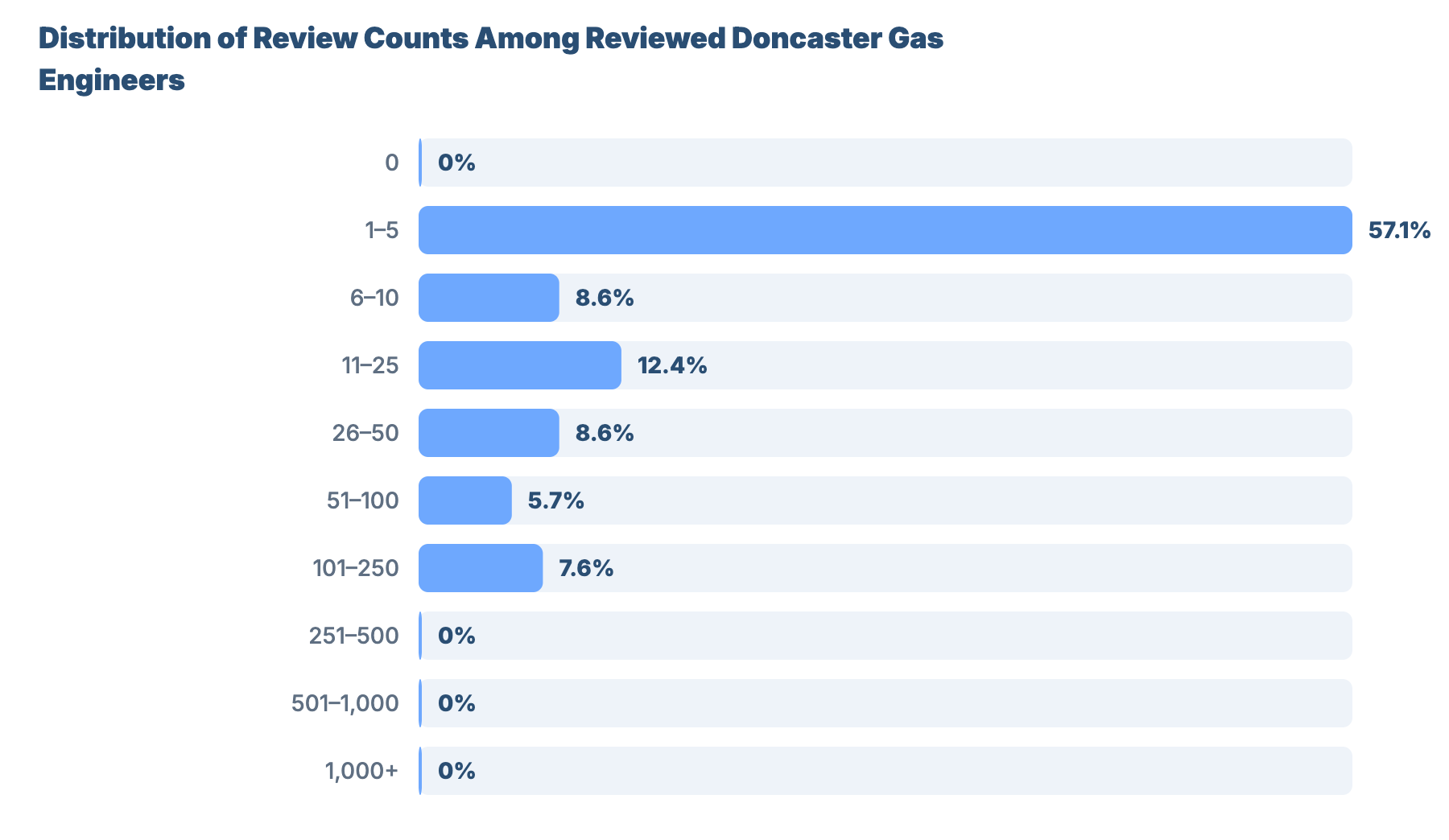
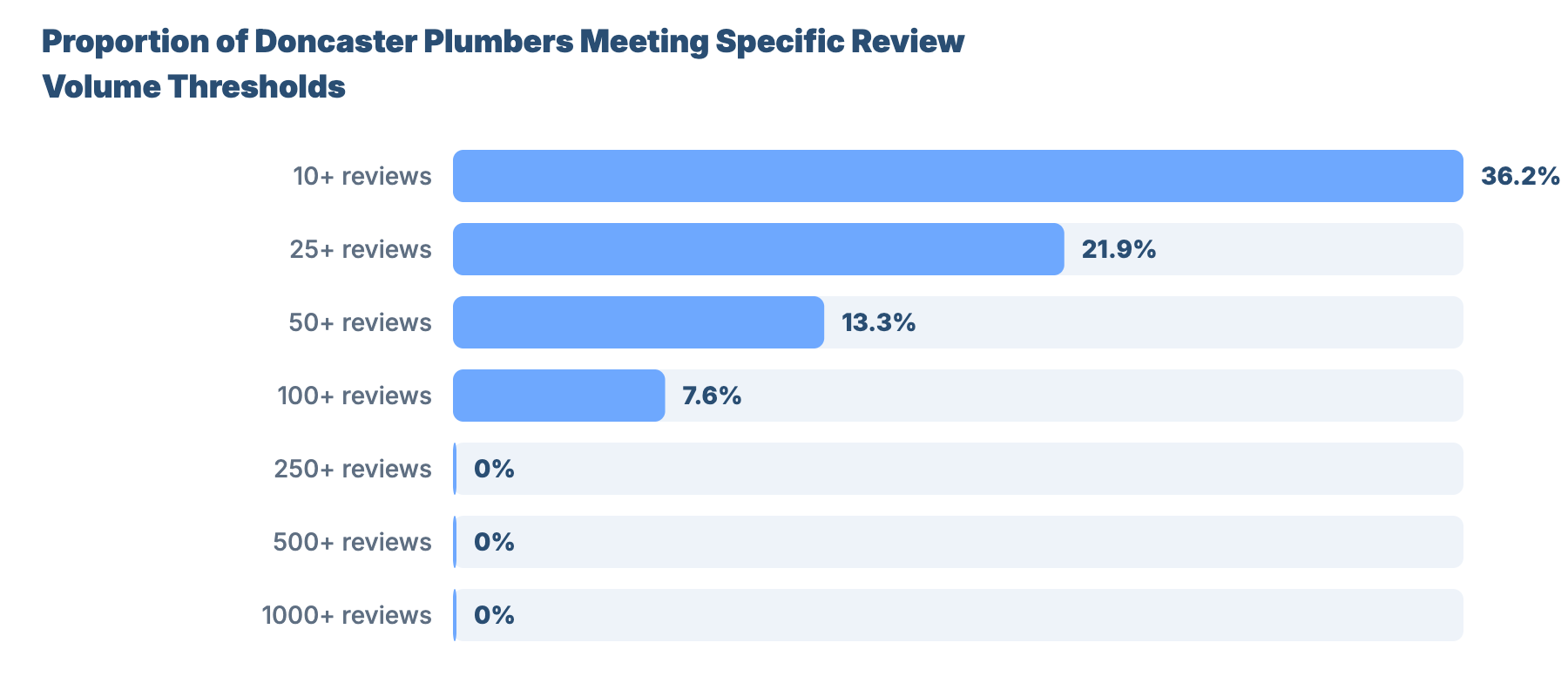
The distribution reveals a massive long tail of low-activity listings, with 57.1% of reviewed profiles (60 businesses) holding between 1 and 5 reviews. Only 36.2% reach double digits (10+ reviews), and a mere 7.6% (8 profiles) cross the 100-review milestone. The market is disproportionately dominated by the top 10% of profiles, which command 59.7% of all customer reviews in Doncaster (1,414 reviews), whilst the top 20% control nearly four-fifths (78.7%) of the total review volume.
Bridging the gap from an average local listing to the market elite requires relatively low review velocity due to low overall regional activity. A business needs just 22 reviews to enter the top 25% (P75) of the Doncaster market—a gap of only 18 reviews from the median. Achieving 84 reviews elevates a profile into the top 10% (P90), offering an attainable target for tradespeople looking to establish prominent local visibility.
What the data proves
- 77.8% (105 out of 135) of analysed profiles have accumulated at least one review.
- The top 10% of reviewed businesses account for 59.7% (1,414) of the total 2,367 reviews in Doncaster.
- 57.1% of reviewed businesses hold between 1 and 5 reviews, while only 7.6% have over 100 reviews.
- The median review count across reviewed profiles is 4, whereas the 75th percentile threshold is 22.
What can be inferred
- Most Doncaster plumbing firms do not run proactive or automated review generation campaigns.
- High review volumes among market leaders stem from dedicated post-job SMS or email follow-up routines.
- Reaching 22 reviews provides a distinct social proof advantage over three-quarters of regional competitors.
- A significant portion of local profiles rely solely on organic, unsolicited customer feedback.
For established businesses
- Implement automated post-service SMS follow-ups to standardise review requests after every heating or plumbing job.
- Target the P90 threshold of 84+ reviews to place your profile among the top 10% of Doncaster gas engineers.
- Train field engineers to request feedback directly upon completing boiler servicing or emergency repairs.
- Monitor competitor review velocity across Doncaster to maintain a buffer above the P75 benchmark of 22 reviews.
For new entrants
- Target 5 quick initial reviews to immediately surpass the bottom 57.1% of active local profiles.
- Set an operational goal of 22 reviews to break into the top 25% of the Doncaster market within six months.
- Provide direct links or QR codes on job completion invoices to reduce friction for clients leaving feedback.
- Leverage seasonal winter heating calls to accelerate early review acquisition.
Address Distribution and Location Density for Doncaster Heating Engineers
Data across the 135 analysed Google Business Profiles demonstrates complete compliance regarding physical address disclosure. Exactly 100% of local trade listings display a full physical address, a valid postcode, and explicit Doncaster locality formatting. Unlike service-based categories where operators frequently hide their home addresses, Doncaster plumbing and gas specialists maintain fully visible map pins. Furthermore, zero address duplication was detected across the entire sample, confirming that multi-brand listing tactics and shared co-working spaces are non-existent in this local market.
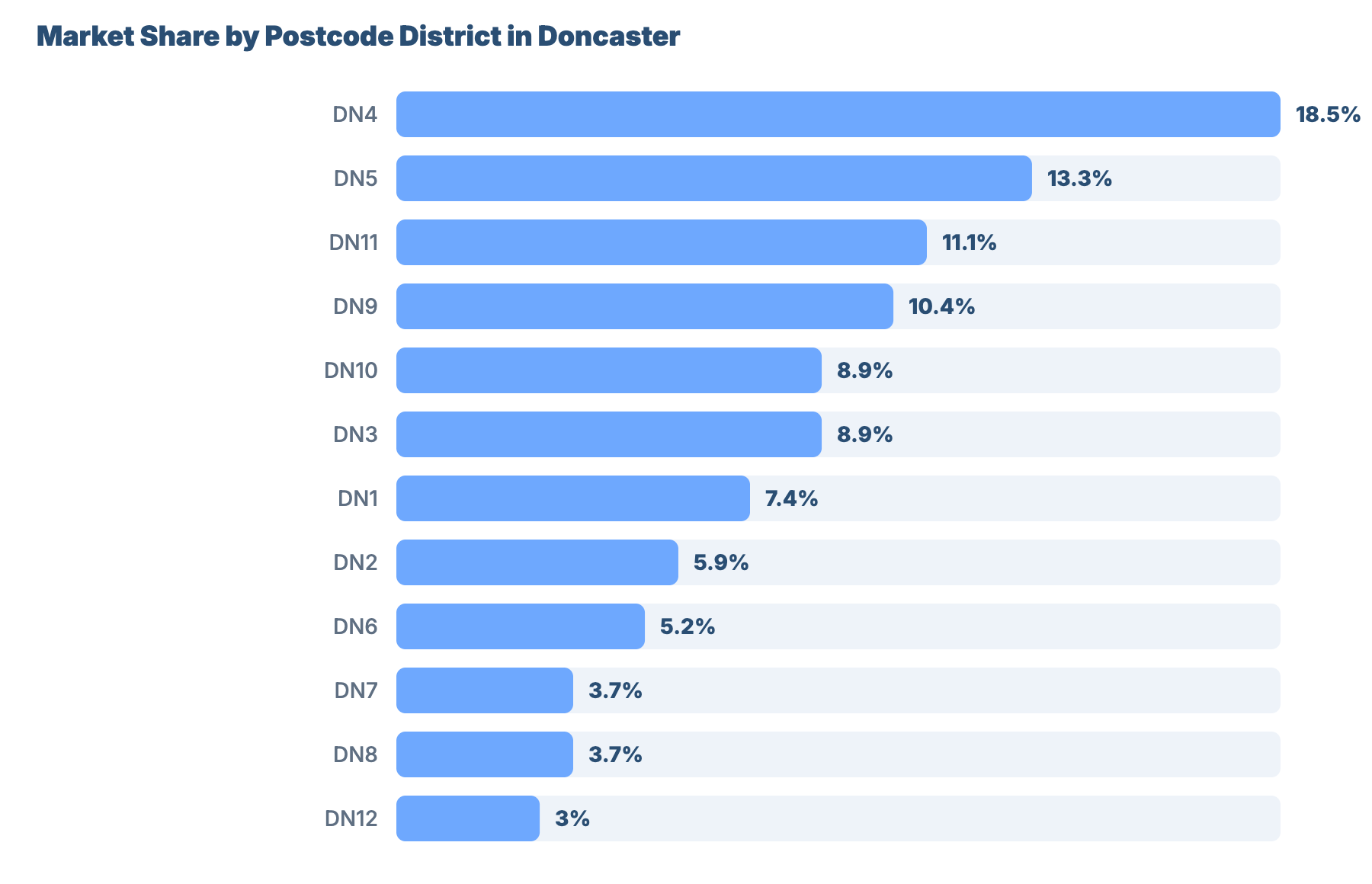
Geographical concentration is heavily skewed towards central and southern suburban zones. The DN4 district leads the market with 18.5% of all profiles (25 businesses), followed by DN5 (13.3%) and DN11 (11.1%). Together, the top four postcode districts—DN4, DN5, DN11, and DN9—account for over half (53.3%) of all plumbing and heating profiles in the area. Conversely, eastern and outer peripheral districts such as DN12 (3.0%), DN7 (3.7%), and DN8 (3.7%) display a noticeable scarcity of registered local operators.



What the data proves
- All 135 profiles (100%) publish a visible physical address with a valid DN postcode.
- Every profile in the sample sets its local authority area explicitly to Doncaster.
- DN4 represents the highest density of heating and plumbing businesses with 25 profiles (18.5%).
- No two businesses in the dataset share a common address or office suite.
What can be inferred
- Doncaster heating engineers favour address disclosure to build trust and maximise local map proximity signals.
- High profile density in DN4 and DN5 reflects larger residential populations and older housing stock requiring central heating maintenance.
- Underserved postcodes like DN12 present lower local pack competition for operators serving those specific catchment areas.
For established businesses
- Audit your Google Business Profile address against Royal Mail guidelines to ensure consistent NAP data across all online trade directories.
- Target service area expansion into lower-density postcodes like DN12 or DN7 where local proximity competition is weaker.
- Build dedicated location pages on your primary website to reinforce organic signals across high-competition clusters like DN4 and DN5.
For new entrants
- Establish a distinct physical presence with a valid postcode to align with the 100% address transparency standard established in Doncaster.
- Avoid virtual offices or shared addresses, as the local competitive landscape is defined by unique physical premises.
- Consider locating your registered hub near under-represented districts such as DN12 or DN8 to secure easier map pack placements.
Opening Hours Strategy for Plumbers and Gas Engineers in Doncaster
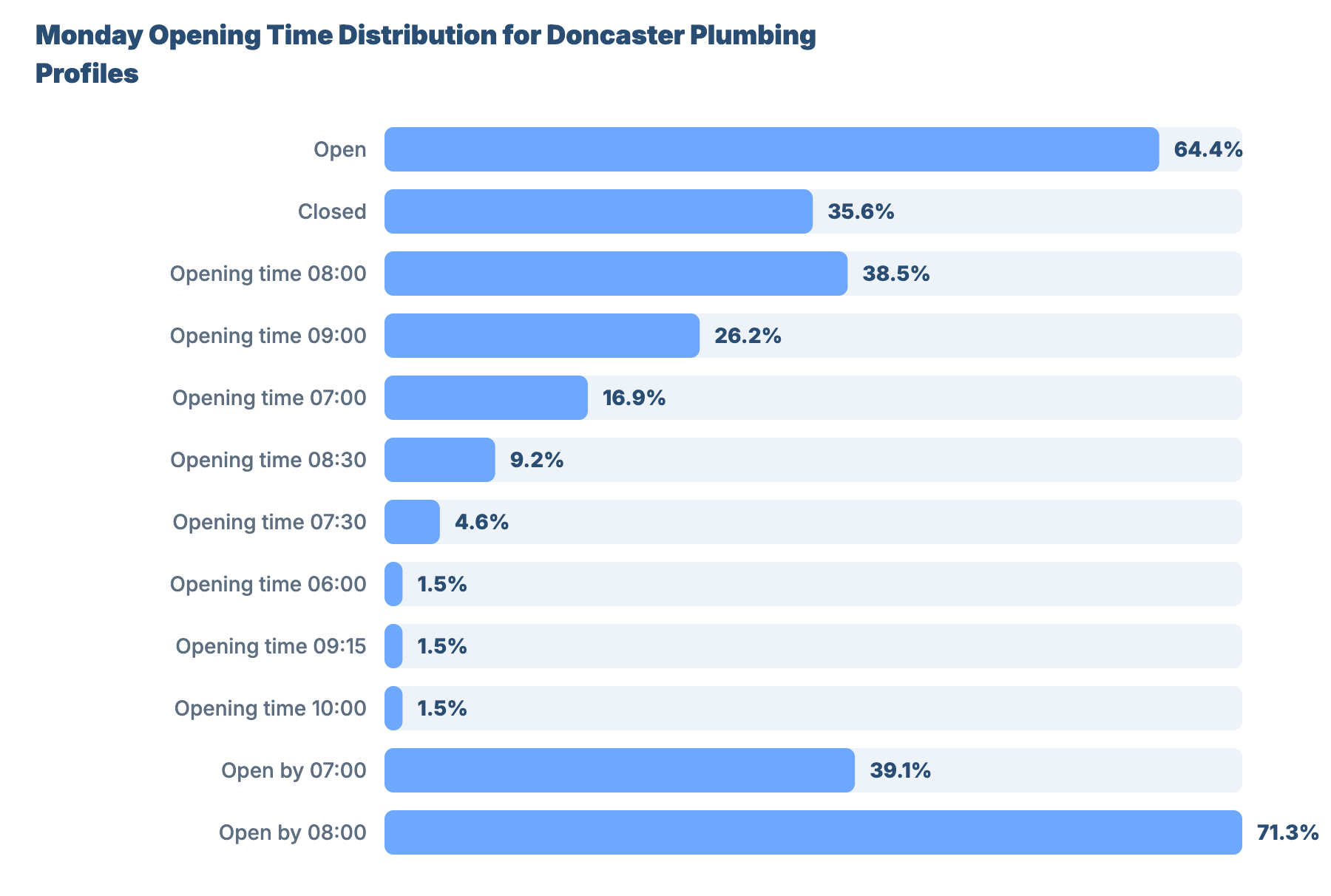
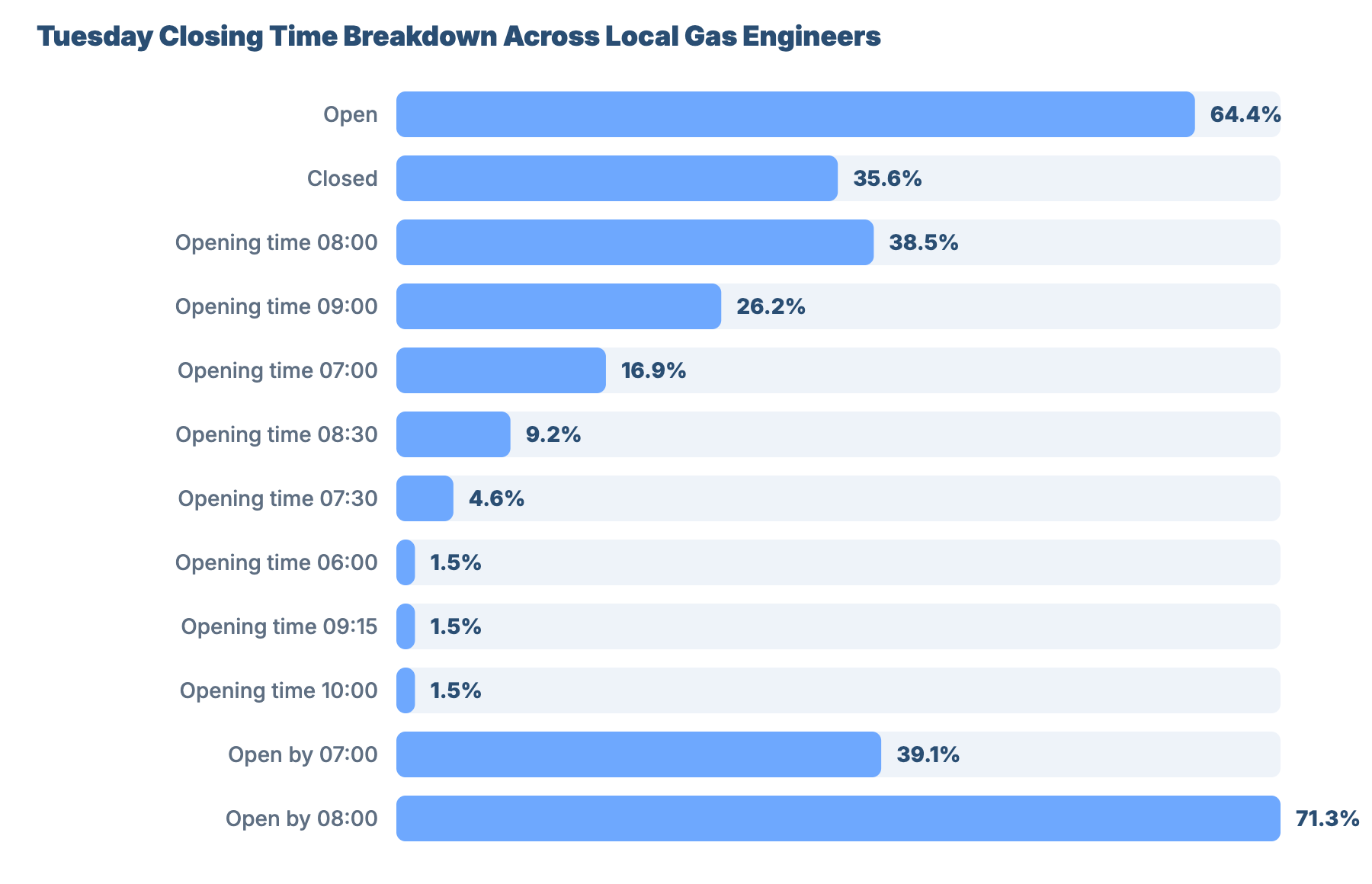
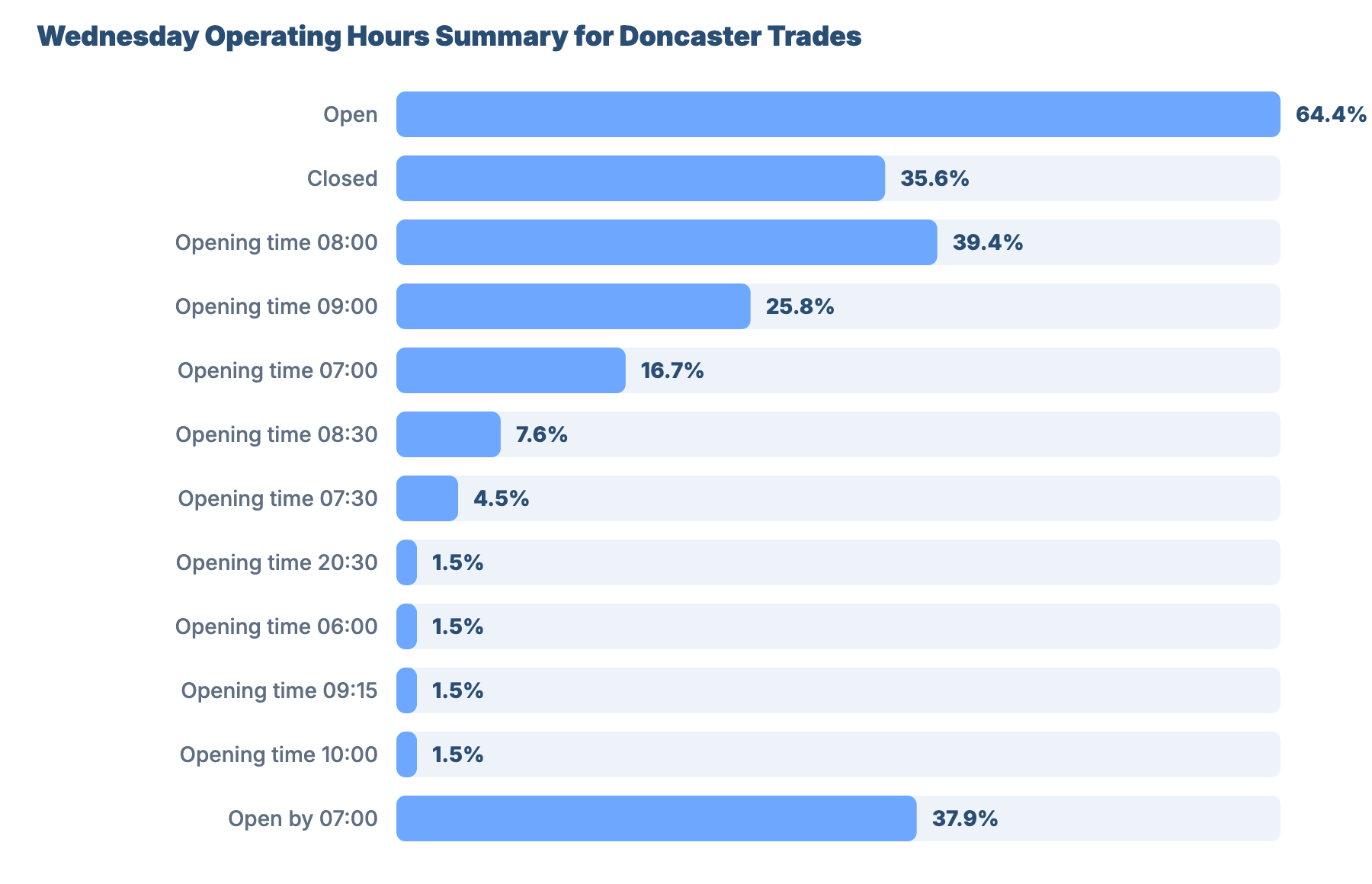
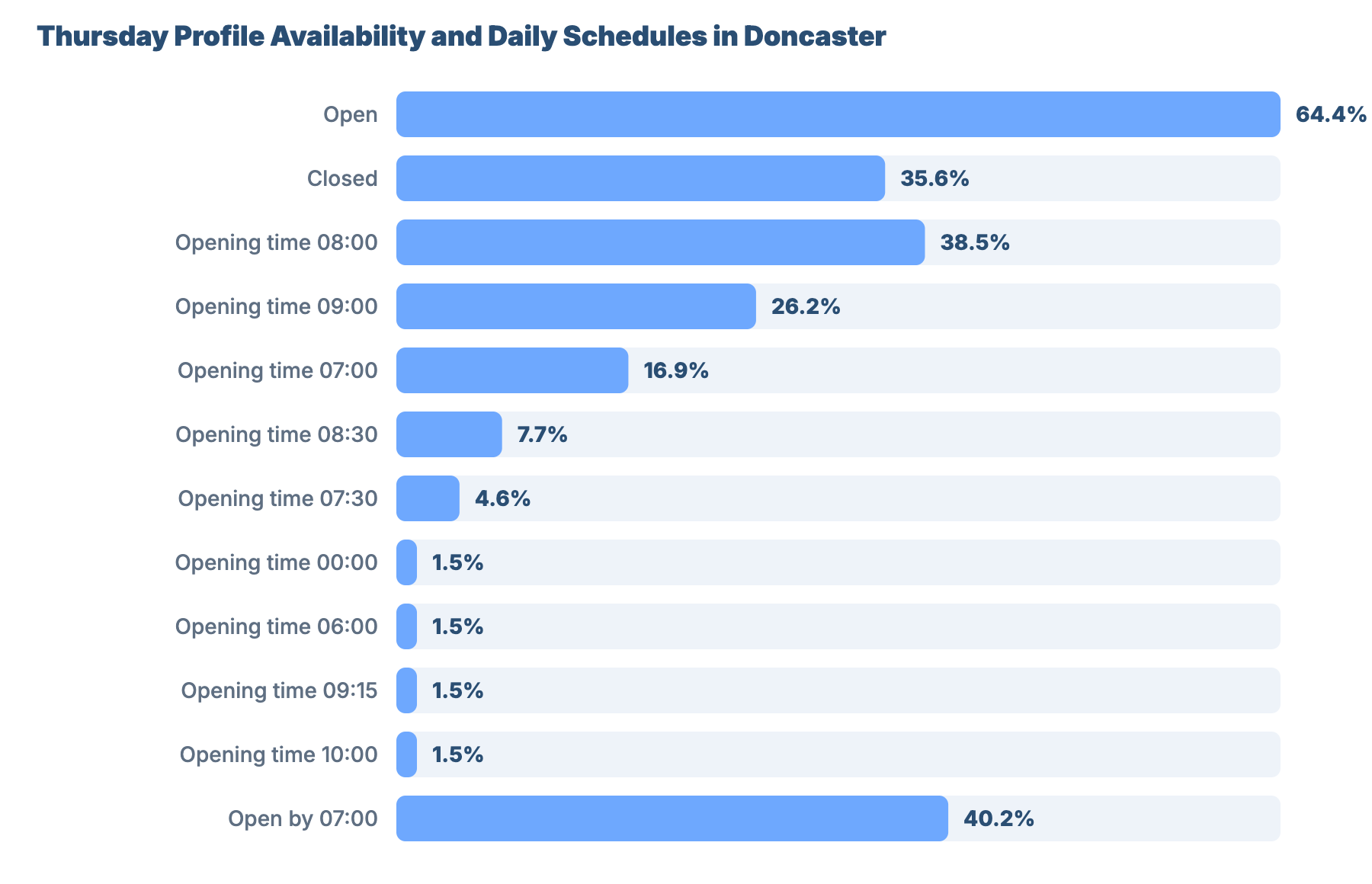
Analysis of 135 Google Business Profiles in Doncaster reveals a stark operational divide within the local plumbing and heating sector. Exactly 35.6% of listings display no regular opening hours, effectively marking themselves as unmanaged or closed on Google Maps. Among active listings, weekday operations are heavily standardised: 64.4% operate Monday through Friday, with 08:00 standing as the dominant opening time (38.5% of timed profiles) and 17:00 as the standard closing threshold (up to 49.2%).
Weekend availability drops significantly across the borough. Only 41.5% of listings operate on Saturdays, falling further to 24.4% on Sundays. Notably, 14.1% of all profiles claim 24/7 availability to capture out-of-hours heating emergencies and burst pipe call-outs. Average weekly open duration reaches 53.69 hours (median 45 hours), heavily influenced by 24-hour operators and extended 7-day trade services.
For contractors targetting search terms like SEO for Plumbers and Gas Engineers Doncaster, incomplete operational hours represent an immediate conversion handicap. Profiles displaying active hours trigger ‘open now’ map pack filters during high-intent search windows, whereas unconfigured listings are systematically excluded by Google during evening and weekend queries.
What the data proves
- 64.4% of tracked Google Business Profiles in Doncaster publish weekday operating hours, while 35.6% leave their hours completely unstated or closed.
- The standard weekday operational window is 08:00 to 17:00, accounting for the largest cluster of active profiles (38.5% opening at 08:00 and up to 49.2% closing at 17:00).
- 24.4% of local profiles remain open 7 days a week, and 14.1% maintain a 24/7 operational schedule.
- Saturday opening drops to 41.5% (56 profiles), whilst Sunday trade falls to 24.4% (33 profiles).
What can be inferred
- The 35.6% of profiles with no stated hours represent sole traders or sub-contractors who rely on direct word-of-mouth rather than active search visibility.
- Operators advertising 24/7 availability gain disproportionate local pack prominence during late-night emergency queries when main-market competitors switch to ‘closed’.
- Businesses closing precisely at 17:00 lose high-intent conversion opportunities from homeowners searching for boiler repairs immediately after work.
For established businesses
- Extend displayed profile closing times from 17:00 to 18:00 or 19:00 if phone lines remain active, capturing peak evening homeowner enquiries.
- Configure special holiday hours within your Google Business Profile to prevent automated ‘hours may differ’ warning labels during bank holidays.
- If providing out-of-hours emergency cover, explicitly update weekend listings to prevent conversion leakage to 24/7 competitors.
For new entrants
- Publish fully defined operating hours from launch to avoid falling into the 35.6% unmanaged profile cluster.
- Target weekend market gaps by listing Saturday and Sunday availability, where active trade competition drops by up to 75.6%.
- Align website schema markup hours directly with your Google Business Profile to build strong entity confidence across local search algorithms.
Google Business Profile Verification and Verification Gaps in Doncaster
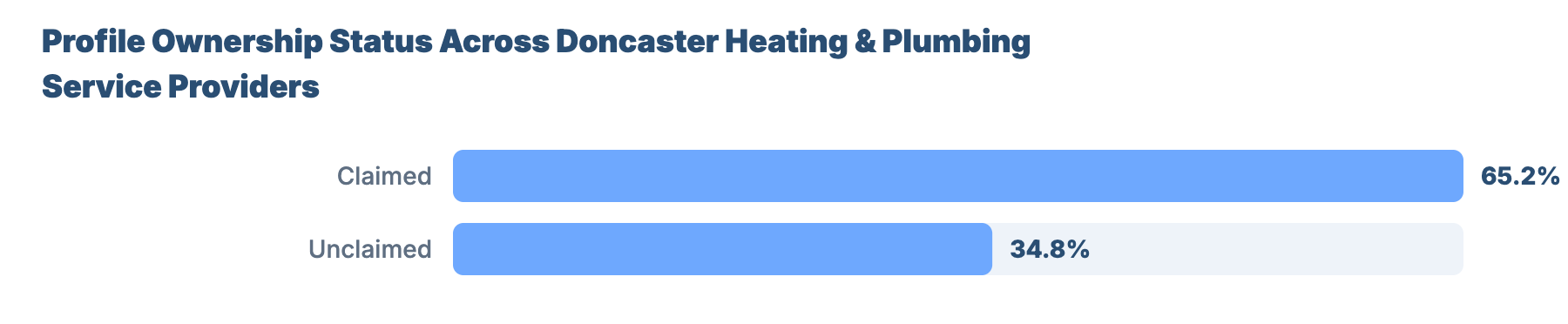
Over a third (34.8%) of plumbing and gas engineering listings in Doncaster remain completely unclaimed on Google Business Profile. This high proportion of unmanaged listings reflects a fragmented local market where many sole traders operate without taking ownership of their primary digital shopfront, leaving potential customers to rely on auto-generated profiles with incomplete operational data.
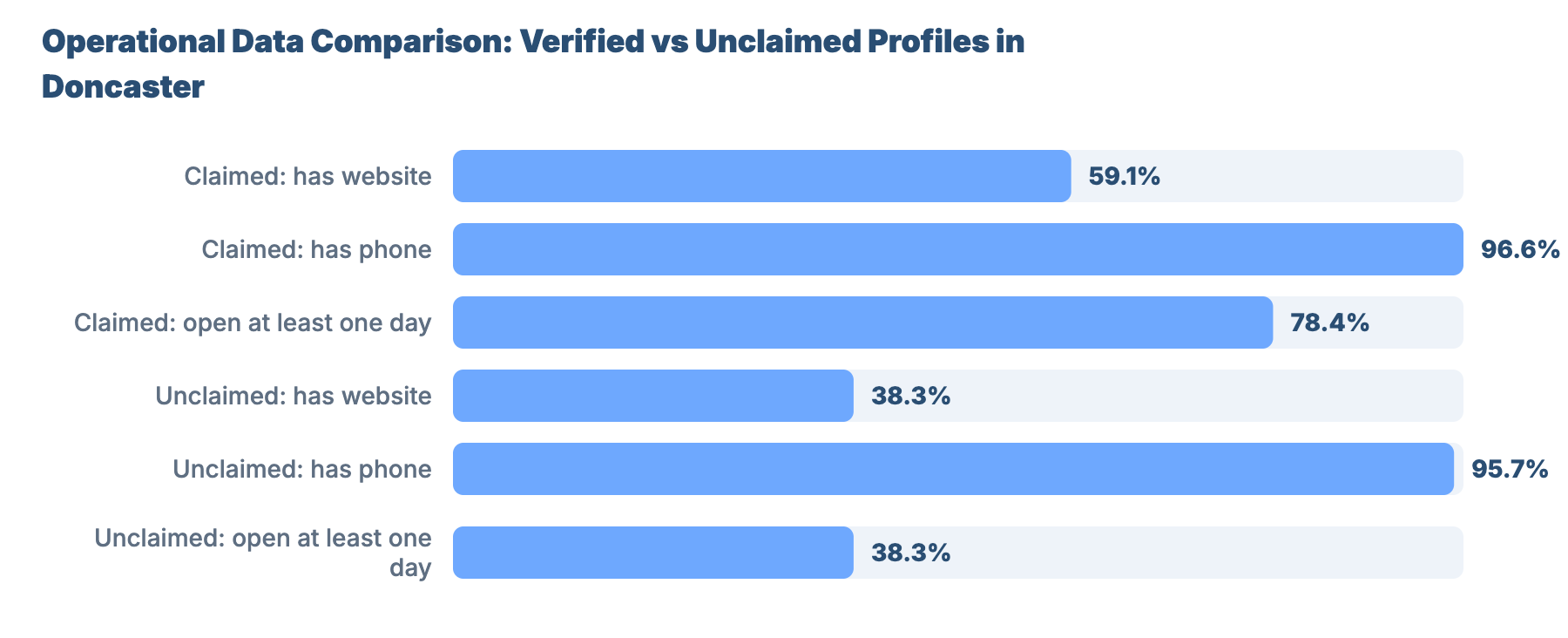
The operational gap between claimed and unclaimed listings is stark. Verified profile owners are far more likely to publish business hours (78.4% versus 38.3%) and link to an active website (59.1% versus 38.3%). Mobile and landline phone presence remains high across both categories (96.6% claimed vs 95.7% unclaimed), demonstrating that direct voice contact is the baseline standard for Doncaster tradespeople regardless of digital maturity.
Verification strongly correlates with review volume and customer feedback scores. Verified listings accumulate a median of 10 reviews with a 4.55 average star rating, whereas unclaimed profiles lag at a median of 3 reviews and a 4.21 rating. For businesses targeting local visibility, securing profile ownership represents the baseline operational requirement before embarking on tailored local search strategies.
What the data proves
- 65.2% (88 of 135) of analysed profiles in Doncaster are formally claimed by their operators.
- Claimed profiles hold a higher median review count (10) than unclaimed listings (3).
- 78.4% of claimed profiles publish opening hours, compared to just 38.3% of unclaimed listings.
- Phone coverage is virtually identical between claimed (96.6%) and unclaimed (95.7%) records.
What can be inferred
- Unclaimed profiles suffer lower review counts because operators lack dashboard access to generate direct review request links.
- Unverified listings present an operational risk, remaining vulnerable to inaccurate user edits or spam reporting.
- The 34.8% unclaimed rate indicates that a significant segment of the local market treats digital presence as secondary to word-of-mouth recommendations.
For established businesses
- Audit existing online listings to confirm ownership, taking control of unverified records before launching local campaigns.
- Fill the operational baseline by populating complete opening hours, a gap currently left open by 21.6% of claimed profiles.
- Link a dedicated, mobile-friendly landing page to the profile to gain an advantage over the 40.9% of verified peers without a website.
For new entrants
- Search Google Maps for auto-generated listings under your intended trading name before creating a brand-new profile.
- Complete profile verification on day one to gain an immediate structural advantage over the 34.8% of unverified local competitors.
- Build an automated post-job review invitation workflow to quickly surpass the modest market median of 10 reviews.
Visual Presence and Photo Count Benchmarks for Doncaster Plumbers
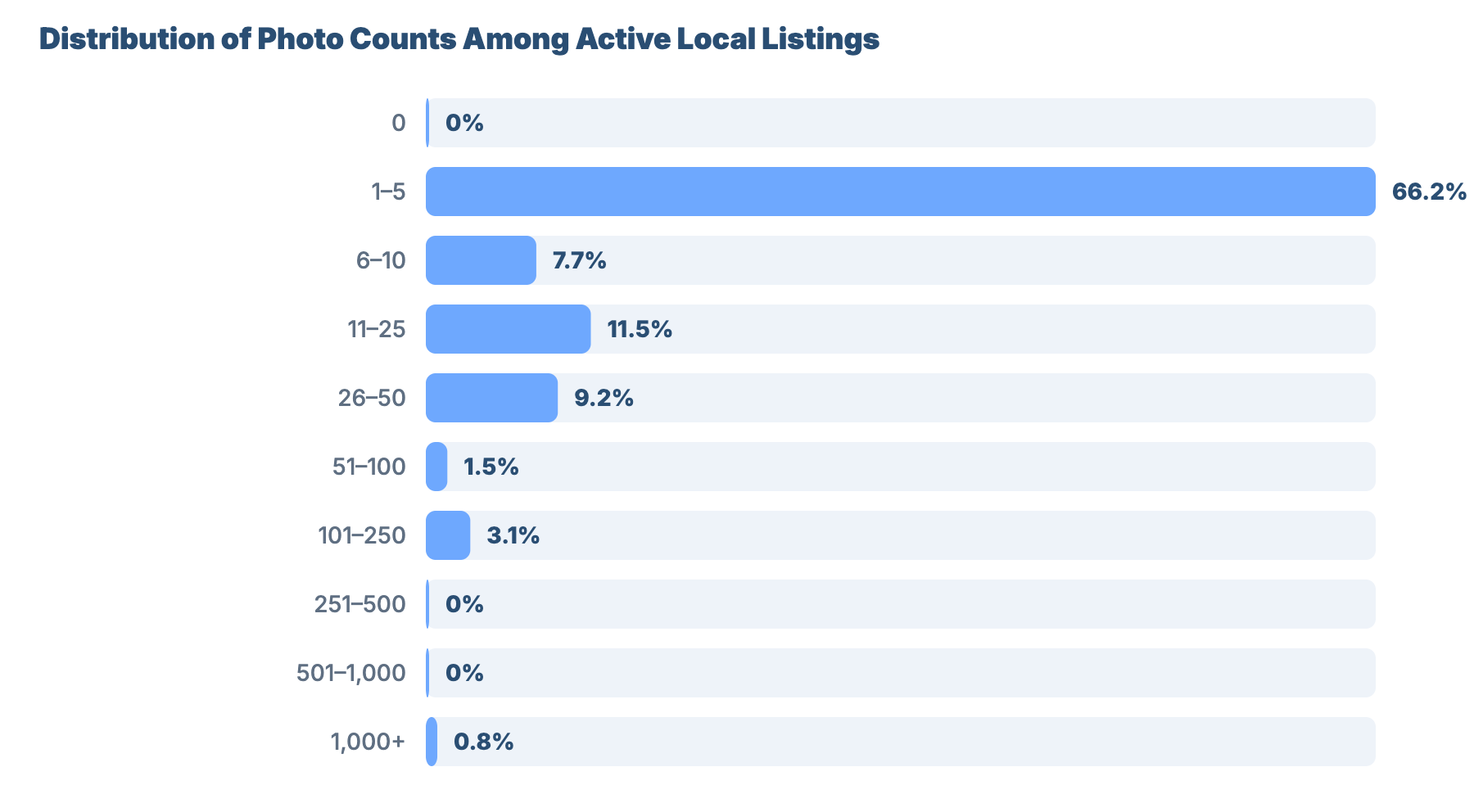
Visual content represents a massive content gap in Doncaster’s heating and plumbing sector. Whilst an overwhelming 96.3% of Google Business Profiles have uploaded at least one photo, the vast majority stop at the bare minimum. Two-thirds of profiles (66.2%) contain between just 1 and 5 photos, driving the market median down to 2 images. The mean figure of 23.1 is heavily distorted by a single extreme outlier with 1,176 photos.
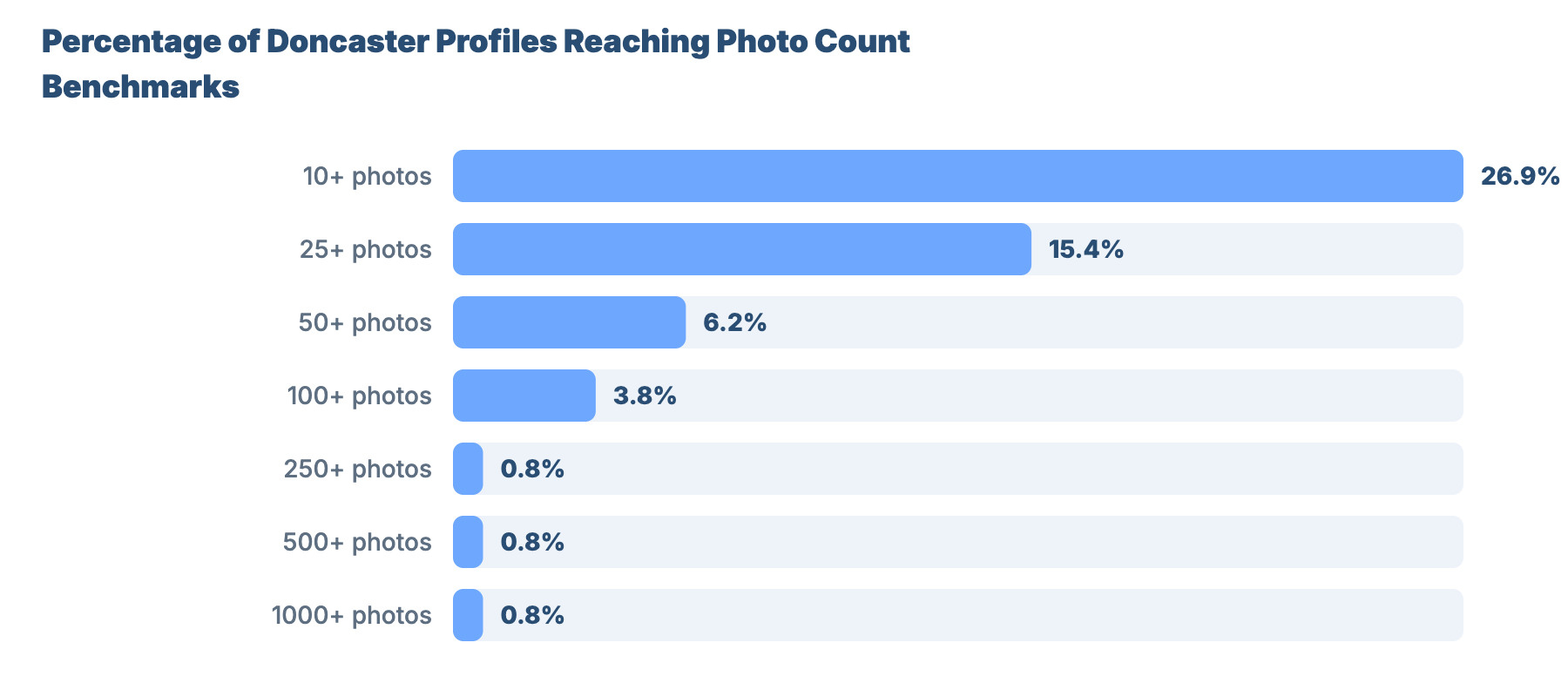
A clear operational split exists between active and passive profiles. Claimed listings show a median photo count of 5.5, whereas unclaimed profiles stagnate at a median of 1. Similarly, businesses with an active website maintain a median of 5 photos compared to 1 for those without a web presence. Crossing into the top 25% of the local market (P75) requires only 17 photos (16.8), whilst achieving P90 status takes just 35 images (34.1).
This lack of visual investment offers a straightforward opportunity for local tradespeople. Most profiles rely on basic logo uploads rather than showcasing recent boiler installations, bathroom fit-outs, or branded vehicles. A concerted effort to publish authentic job-site imagery easily elevates a business into the top decile for visual density in Doncaster.

What the data proves
- 96.3% of analysed Doncaster plumbing profiles contain at least one uploaded photo.
- 66.2% of profiles hold between 1 and 5 photos, yielding a market-wide median of 2 photos.
- Claimed profiles hold a median of 5.5 photos compared to a median of 1 for unclaimed profiles.
- Only 3.8% of local profiles possess 100 or more photos on their Google listing.
What can be inferred
- Higher photo counts reflect broader digital maturity and regular listing maintenance by business owners.
- Active profile management strongly correlates with having both a claimed profile and a linked website.
- An upload collection of 35 high-quality images is sufficient to outperform 90% of local competitors.
For established businesses
- Upload 35 to 65 original, high-resolution photographs to instantly place your profile in the top 5% to 10% of local competitors.
- Categorise photos systematically across service categories, including boiler servicing, central heating upgrades, and emergency plumbing.
- Implement an operational routine where engineers capture clear before-and-after project photos using their mobile devices.
For new entrants
- Launch your Google Business Profile with an initial batch of 10 to 15 distinct photos showing branded vans, staff, and real equipment.
- Avoid stock imagery; Google and local customers favor authentic photos taken on site around the Doncaster region.
- Target reaching 20 or more photos within your first month to immediately bypass 75% of established local listings.
Additional GBP Categories in Doncaster: Adoption, Pairings, and Opportunities
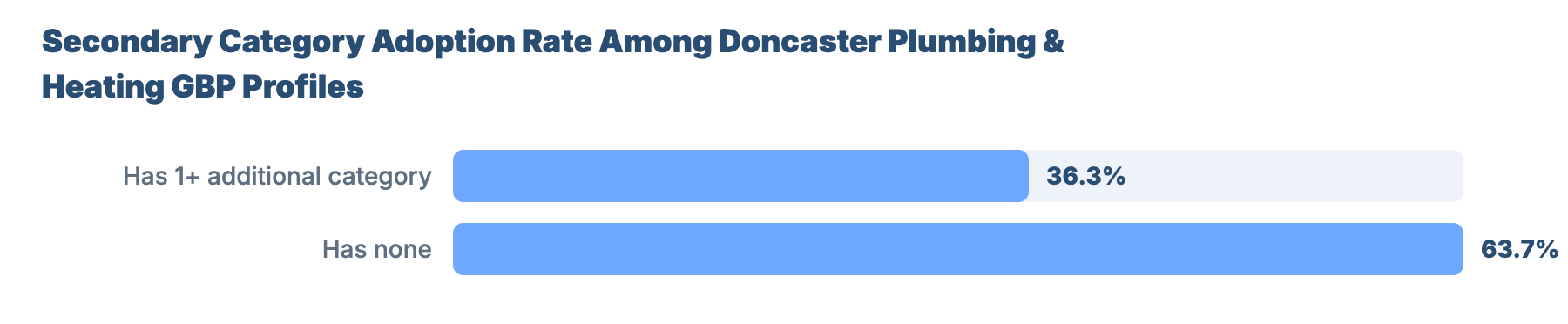
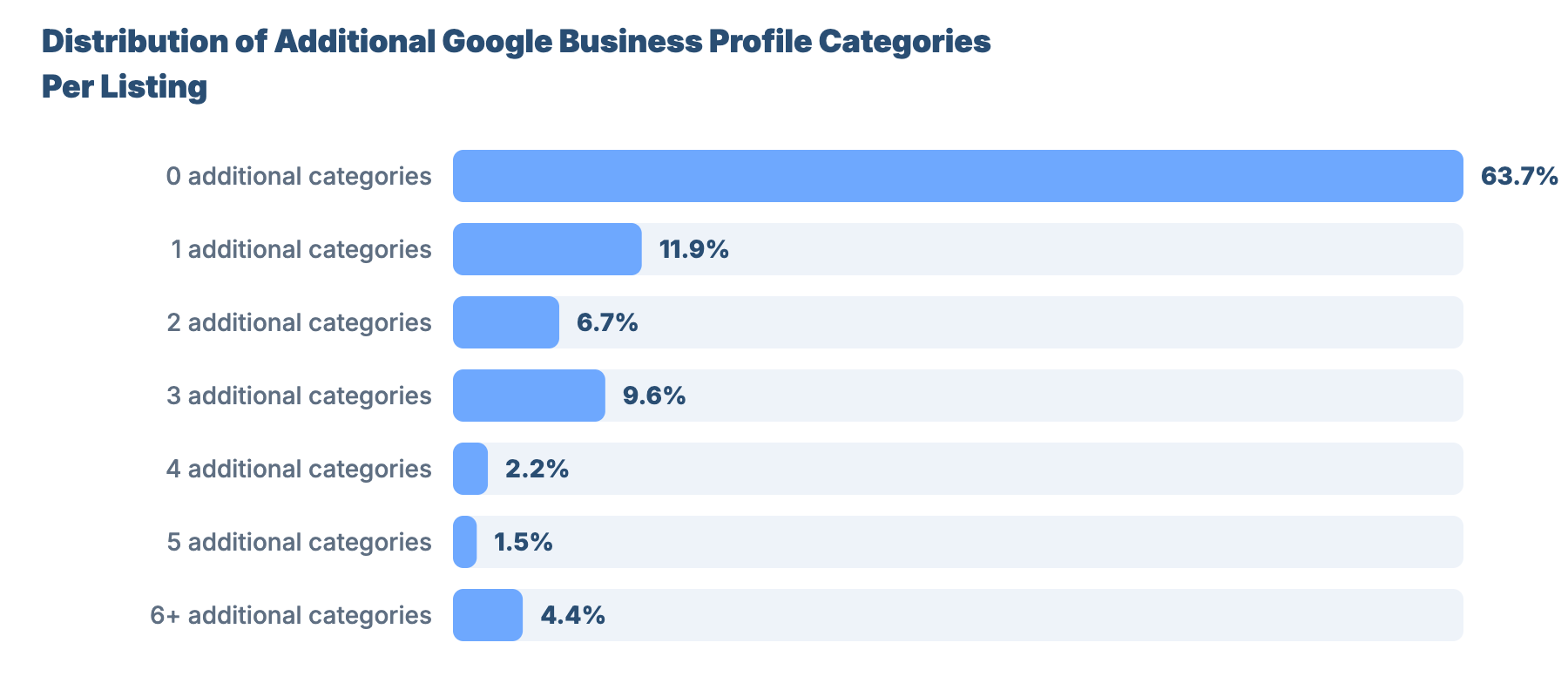
A striking 63.7% of analysed Google Business Profiles for plumbing and heating trade professionals in Doncaster operate with zero secondary categories attached to their listing. Across the 135 profiles surveyed, the median number of secondary categories is zero, with an overall mean of just 1.01 categories. This reveals a substantial optimisation vacuum in the local market, where nearly two-thirds of businesses fail to signal secondary trade capabilities directly within Google Maps.
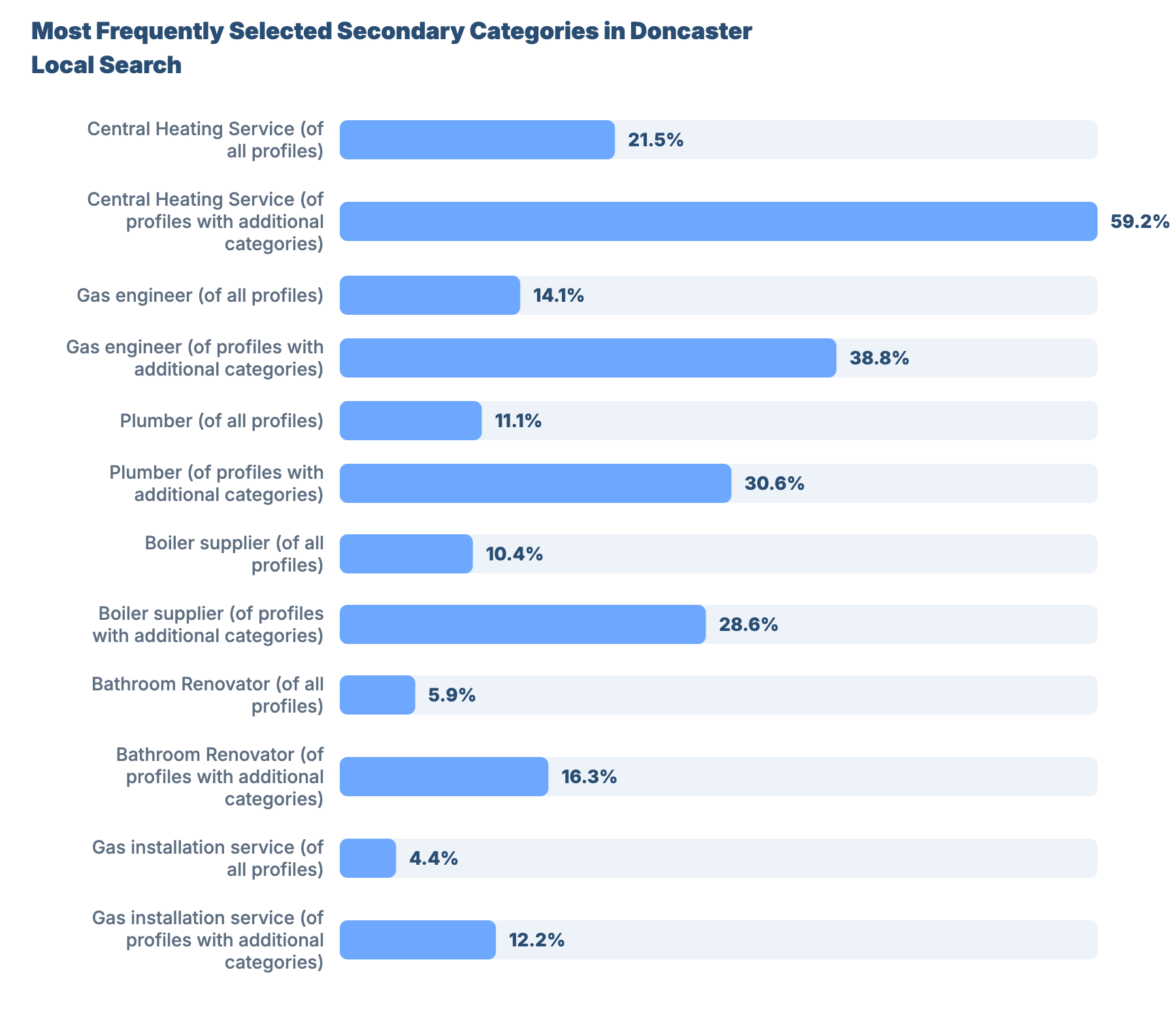
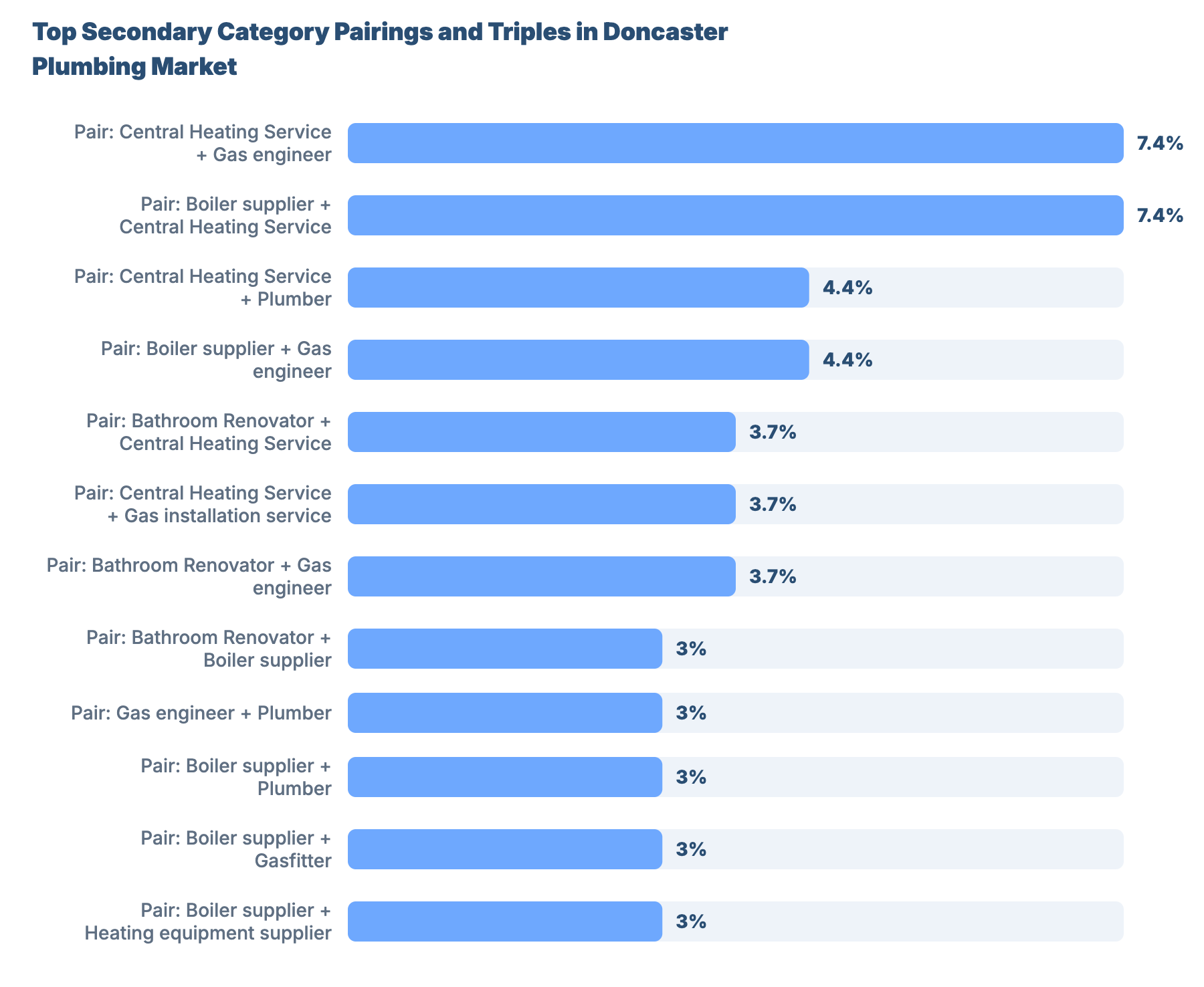
Among the 36.3% (49 profiles) that do leverage additional categories, clear core clusters emerge. "Central Heating Service" is by far the most dominant secondary choice, selected by 59.2% of multi-category profiles (21.5% of the overall market), followed by "Gas engineer" at 38.8% (14.1% overall), "Plumber" at 30.6% (11.1% overall), and "Boiler supplier" at 28.6% (10.4% overall). The top-performing category pairing combines "Central Heating Service" with "Gas engineer" or "Boiler supplier", each adopted by 7.4% of all local profiles.
The data demonstrates high category diversity alongside distinct specialisation niches. Across the audit, 33 unique secondary categories were identified, ranging from "Bathroom Renovator" (5.9% total profiles) down to rare entries like "Drainage service", "Solar energy system service", and "LPG conversion". While a small minority of listings (4.4%) overload their profiles with 6 or more secondary categories, the sweet spot for structured coverage without category dilution appears to sit between 1 and 3 carefully aligned additions.
What the data proves
- 63.7% (86 of 135) of Doncaster profiles rely solely on their primary category with no secondary additions.
- Central Heating Service is the most common secondary category, present on 59.2% of multi-category listings (29 profiles).
- 33 distinct secondary categories are currently deployed across the local market.
- 4.4% of profile owners assign 6 or more secondary categories to their Google Business Profile.
What can be inferred
- Most local tradespeople in Doncaster do not routinely audit or update their Google Business Profile secondary category options.
- Profiles adding high-demand categories such as Central Heating Service and Boiler Supplier capture broader intent across non-plumbing search queries.
- Profiles listing 6+ secondary categories risk diluting local relevance signals if secondary terms conflict with primary core services.
For established businesses
- Audit your secondary categories to ensure essential secondary specialisms like Central Heating Service, Gas Engineer, or Boiler Supplier are explicitly assigned.
- Cap your secondary selection to 2-4 highly relevant categories directly supported by specific landing pages on your website.
- Avoid assigning low-volume or unserviced categories (e.g. Home Improvement Shop) merely to expand listing reach.
For new entrants
- Gain an immediate structural edge over 63.7% of established competitors by selecting 2-3 core secondary categories upon profile creation.
- Combine ‘Central Heating Service’ and ‘Gas engineer’ alongside your primary category to capture high-intent heating boiler searches immediately.
- Align secondary profile categories with your primary service menu and localised website URL structure from day one.
Google Business Profile Description Optimisation for Doncaster Plumbers & Gas Engineers
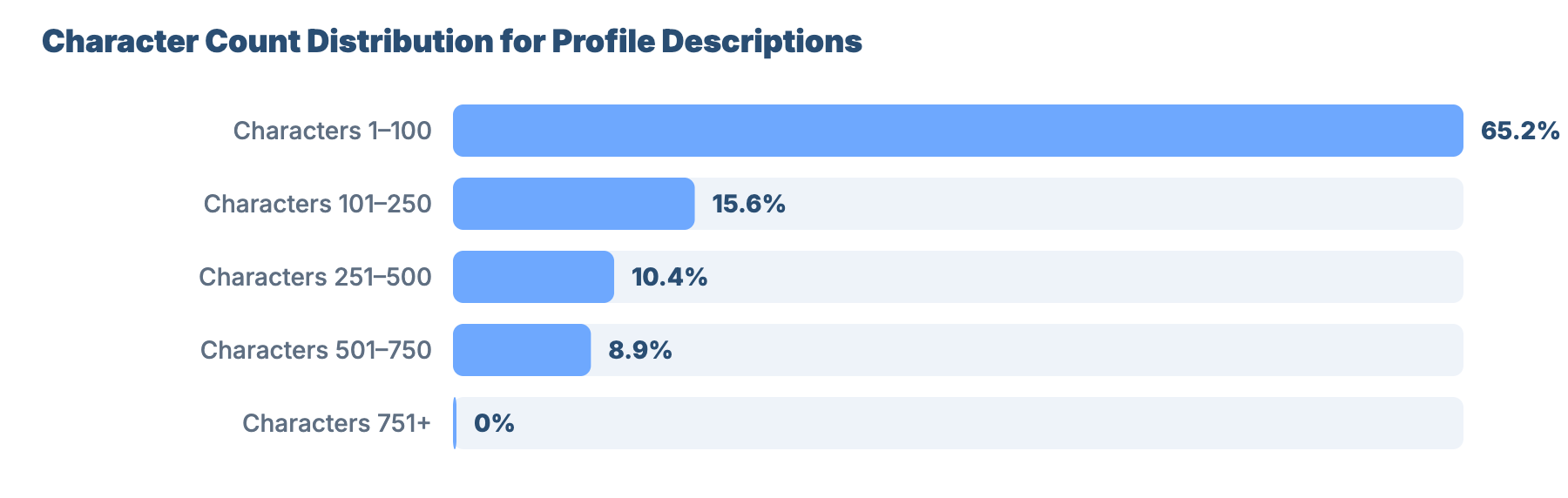
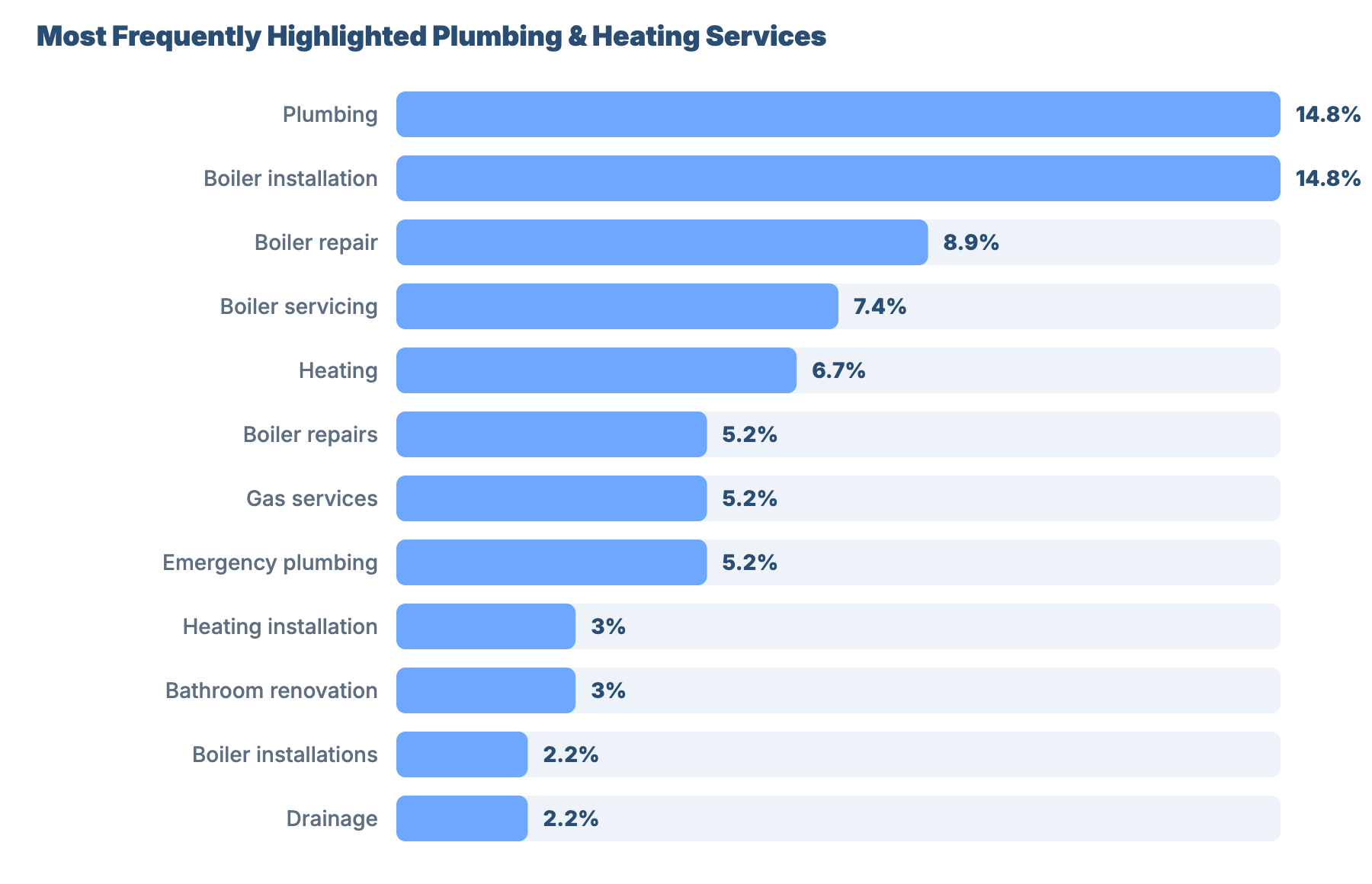
While 100% of the 135 analysed Google Business Profiles in Doncaster feature a populated description, the depth of content is extraordinarily low. The median description length is a mere 50 characters—roughly eight words—with 65.2% of businesses offering 100 characters or fewer. This demonstrates that while local tradespeople complete the initial setup field, the vast majority treat the profile description as a quick formality rather than a high-value customer acquisition asset.
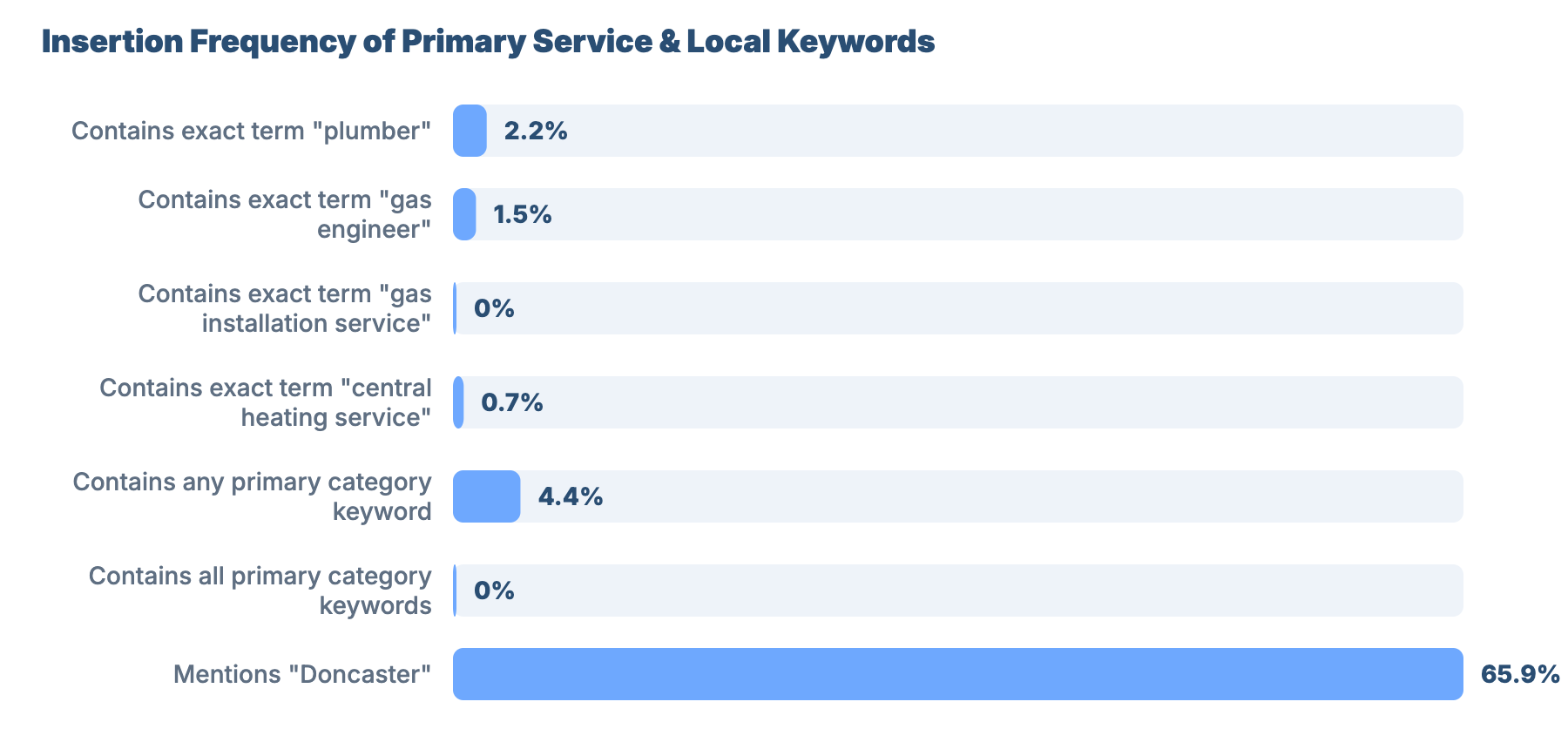
From a search optimisation standpoint, keyword implementation is severely neglected. Only 4.4% of profiles include any primary category keyword within their text, with exact terms like ‘plumber’ (2.2%) and ‘gas engineer’ (1.5%) almost entirely absent. Conversely, geographic positioning is widely understood: 65.9% of listings explicitly mention ‘Doncaster’, racking up 97 total mentions. However, AI content evaluation reveals that only 50.4% of descriptions semantically communicate the business’s core services, leaving half the market with ambiguous offering details.
Conversion triggers and trust signals represent another major operational gap. Only 28.1% of local profiles incorporate explicit trust signals such as trade certifications (17%) or years in business (11.9%). Furthermore, 85.9% of listings omit a direct call to action, with 63.7% maintaining a completely passive, neutral tone. Operators who craft comprehensive, trust-dense descriptions with clear calls to action stand to capture significant prospective client engagement.

What the data proves
- 100% of the 135 analysed Google Business Profiles in Doncaster feature a filled description field.
- The median description length is 50 characters (8 words), with 65.2% containing 100 characters or fewer.
- Local geographic targeting is present in 65.9% of descriptions, yielding 97 total mentions of ‘Doncaster’.
- Primary category keywords appear in just 4.4% of descriptions, with exact ‘plumber’ used by 2.2% and ‘gas engineer’ by 1.5%.
- Only 14.1% of listings include a clear call to action, and 28.1% display at least one verified trust signal.
What can be inferred
- Doncaster plumbing and heating firms treat profile descriptions as an administrative checkbox rather than a direct marketing tool.
- Tradespeople instinctively understand the necessity of declaring their city location but lack awareness regarding service category keywords.
- The prevalent use of ultra-short descriptions creates an easy opportunity for competitor listings to stand out through detailed service breakdowns.
- The widespread omission of domestic versus commercial service specifications (73.3% unstated) leads to mismatched customer leads.
For established businesses
- Expand short descriptions to fully utilise the 750-character limit, outlining specialised services like boiler servicing, powerflushing, and leak detection.
- Embed essential trade credentials—such as Gas Safe registration and local experience—to leverage the 71.9% market deficit in trust signals.
- Add a compelling direct response call to action (e.g., ‘Call our Doncaster team today for a free quote’) to boost profile conversion rates.
- Specify target client types clearly by stating whether your team handles domestic residential work, commercial contracts, or both.
For new entrants
- Draft a complete 750-character description prior to launch, explicitly including ‘plumber’, ‘gas engineer’, and ‘Doncaster’ near the beginning.
- Feature major trust signals immediately, highlighting trade accreditations, insurance status, and fixed-price guarantees to build fast credibility.
- List high-margin niche services such as heat pump installation, unvented cylinders, or landlord safety checks to attract targeted search queries.
Google Business Profile Primary Category Selection for Doncaster Plumbing and Gas Services
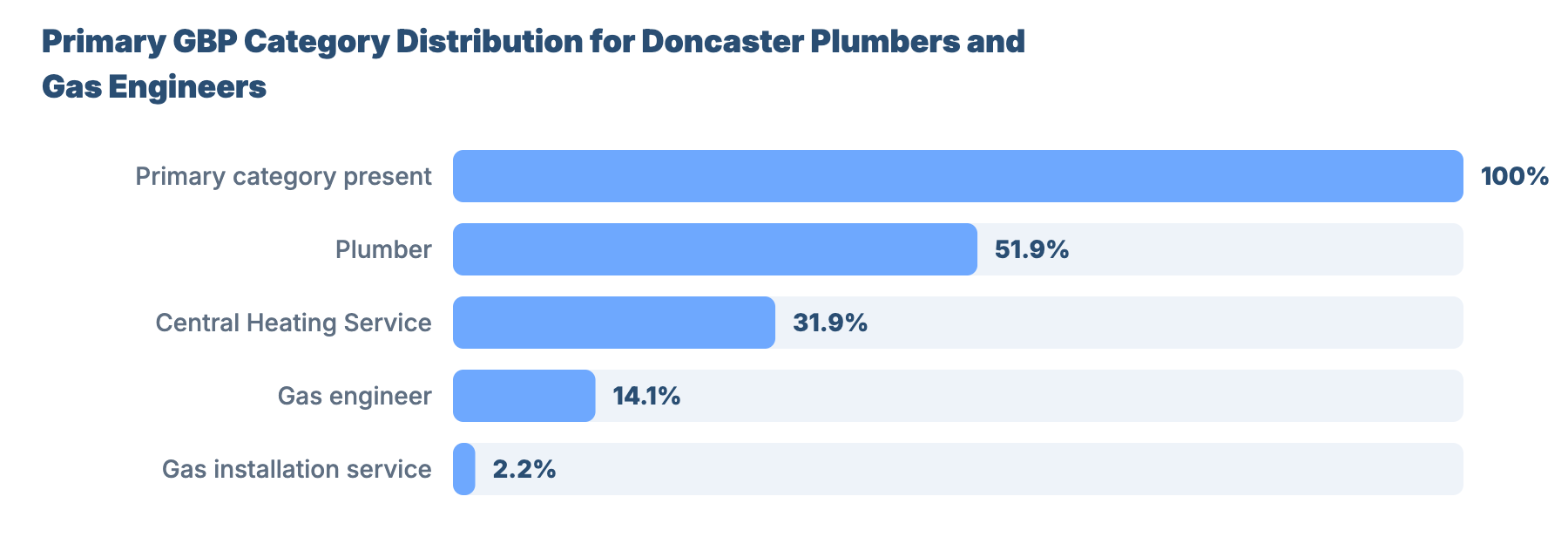
Over half of the 135 analysed Google Business Profiles in Doncaster default to ‘Plumber’ as their primary category (51.9%, 70 profiles). This demonstrates a strong tendency towards broad generalist positioning rather than niche technical classification, even among businesses that hold Gas Safe accreditation.
‘Central Heating Service’ represents the second largest share at 31.9% (43 profiles), whereas dedicated ‘Gas engineer’ profiles account for just 14.1% (19 profiles). The niche category ‘Gas installation service’ is virtually untapped as a primary designation, representing only 2.2% (3 profiles) of total local listings.
This distribution reflects a commercial tradeoff: while ‘Plumber’ captures broad consumer search volume, it forces operators into a highly saturated category pool. The lower adoption of specialist primary categories creates clear positioning opportunities for businesses specialising in boiler replacements and complex heating systems across Doncaster postcodes.
What the data proves
- 100% of the 135 analysed profiles have an active primary category set.
- ‘Plumber’ is the single largest category designation, used by 70 of 135 local businesses (51.9%).
- ‘Central Heating Service’ is utilised by 43 profiles (31.9%), forming the secondary market cluster.
- ‘Gas installation service’ is used as a primary category by only 3 businesses (2.2%) in the sample.
What can be inferred
- Many multi-skilled tradespeople select ‘Plumber’ under the assumption that it generates the highest volume of general local enquiries.
- Businesses prioritising ‘Central Heating Service’ or ‘Gas engineer’ are likely targeting higher-margin boiler replacement and servicing jobs over minor plumbing repairs.
- The low adoption of ‘Gas engineer’ as a primary category suggests a potential gap for listings to gain stronger relevance for dedicated gas enquiries.
For established businesses
- Audit your current primary category against your primary revenue drivers; if high-ticket boiler replacements generate most income, testing ‘Central Heating Service’ may be advantageous.
- Ensure all secondary categories are fully populated with missing terms such as ‘Gas engineer’ or ‘Plumber’ to maintain discovery coverage.
- Monitor local pack performance across specific Doncaster postcodes to see which primary category dominates your immediate territory.
For new entrants
- Consider selecting ‘Gas engineer’ or ‘Central Heating Service’ as your primary category to differentiate immediately from the 51.9% using ‘Plumber’.
- Include ‘Plumber’ as a secondary category to capture high-volume repair traffic without sacrificing specialist positioning.
- Align your primary category choice directly with your core high-margin service offering rather than defaulting to generic industry terms.
Action playbooks
Established businesses
- Audit website security and tracking: Upgrade the 40% of websites still running HTTP to secure HTTPS, and append UTM parameters to track Google Business Profile traffic accurately.
- Expand category coverage: Add relevant secondary categories such as Central Heating Service, Gas Engineer, Boiler Supplier, and Bathroom Renovator to capture broader search intent.
- Flesh out profile descriptions: Replace brief copy with comprehensive 500+ character descriptions that naturally include terms like plumber, gas engineer, and specific Doncaster suburbs.
- Scale photo publishing: Elevate your media profile above the top 10% benchmark (34+ images) by regularly posting photos of completed installations, vans, and team members.
- Systematise review acquisition: Target the 25+ review threshold to join the top 21.9% of local competitors, prompting clients to mention specific services in their feedback.
- Optimise landing page alignment: Ensure your GBP website link points directly to a high-converting, mobile-responsive local service page rather than a unoptimised homepage.
Starting out in this market
- Claim and verify your profile immediately: Instantly stand out from the 34.8% of unclaimed businesses by completing Google Business Profile verification.
- Fix business hours: Avoid falling into the 35.6% of profiles with unstated hours by publishing clear weekly opening times or setting 24/7 availability if offering emergency call-outs.
- Seed initial photo gallery: Upload 10–15 high-resolution images of your work, equipment, and branding immediately to surpass the market median of 2 photos.
- Establish baseline review volume: Gather reviews from your first 10 satisfied customers to break into the top 36.2% of businesses and outpace the median review count of 4.
- Select multi-category coverage: Set your primary category to Plumber or Central Heating Service, then immediately add at least two relevant secondary categories.
- Launch a fast HTTPS website: Build a lightweight website on a .co.uk domain with prominent click-to-call mobile buttons and clear NAP consistency.
Frequently asked questions
Why is SEO for Plumbers and Gas Engineers in Doncaster critical for trade businesses?
With 135 active profiles competing in Doncaster, local SEO ensures your business appears in Google’s Local 3-Pack when homeowners search for urgent plumbing or heating assistance. Because nearly half of local profiles lack a website, an optimised listing backed by a fast website provides a distinct competitive edge.
How many reviews do I need to rank in the Doncaster Google Local Pack for plumbing?
The median profile in Doncaster has just 4 reviews, but reaching 22 reviews puts your business in the top 25%. To compete with established leaders in the top 10%, target 84 or more reviews with an average rating above 4.5 stars.
Should my primary GBP category be Plumber or Gas Engineer in Doncaster?
In Doncaster, 51.9% of listings select Plumber as their primary category, while 31.9% choose Central Heating Service and 14.1% use Gas Engineer. Select the category that aligns with your core revenue driver, and add the remaining options as secondary categories.
Why do so many Doncaster plumbing GBP profiles lack website links?
Our analysis showed 48.1% of profiles have no website link, reflecting a high proportion of sole traders relying solely on word-of-mouth or phone directory listings. Adding a secure HTTPS website immediately sets a business apart from half the local competition.
How does adding opening hours impact local SEO for gas engineers in Doncaster?
35.6% of local listings fail to state their operating hours. Adding precise opening hours or offering 24/7 emergency service (utilised by 14.1% of profiles) improves conversion rates and helps your profile appear during out-of-hours searches.
Is a local 01302 Doncaster phone number required for GBP ranking?
While a unique phone number is essential for citation consistency—48.5% of profiles currently share numbers across duplicate listings—Google accepts both geographic 01302 landlines and UK mobile numbers, provided the address sits within the local service boundary.
Methodology and caveats
Data was compiled from a census of 135 Google Business Profiles operating within the Doncaster locality (covering postcode districts DN1 through DN12). Profiles were evaluated across 11 core ranking and conversion dimensions including primary and secondary category usage, verification status, photo volume, customer review counts, overall ratings, website protocols, phone number configuration, and business description optimisation.
This analysis covers 135 public Google Business Profiles in the plumbing and heating category across Doncaster. Statistical relationships between profile attributes (such as photo counts, review totals, or category selections) and map positioning do not imply direct algorithmic causation by Google. Search volumes are estimates derived from regional SEO tools. Business data represents profile states at the time of extraction.
