 Skip to content

VisiLocali market research
Analysing 221 Google Business Profiles across Liverpool reveals a striking disparity between baseline market participation and strategic local search optimisation. While 76% of trade profiles have been claimed by business owners, critical structural elements like website integration, category layering, and security protocols remain severely underutilised.
For heating engineers and plumbing contractors operating within the 0151 area code, local search represents the primary channel for acquiring emergency callouts and planned boiler installations. However, nearly half of active listings fail to link to an active website, and 57% of existing linked sites operate without secure HTTPS protocols.
This research outlines the empirical benchmarks derived from Liverpool’s local trade sector, delivering clear data-backed frameworks for both established firms seeking to protect their market dominance and new entrants striving to capture initial map pack visibility.
Executive summary
- Severe digital security vulnerability: 57% of trade websites linked to GBP profiles still run on unencrypted HTTP protocols, forfeiting user trust and technical SEO advantage.
- High profile abandonment rate: 48.4% of profiles fail to link to any website at all, while 24% of listed profiles remain completely unclaimed.
- Review dominance by top tier: The top 10% of profiles control 50.1% of all reviews across Liverpool (3,235 out of 6,462 total reviews), demonstrating heavy market concentration.
- Category under-optimisation: 54.3% of profiles use zero additional categories, despite operating in multi-disciplinary trade fields spanning plumbing, gas fitting, and heating.
- Photo deployment neglect: The overall median photo count is just 6 images, rising to 9.5 for claimed profiles but dropping to a single image for unclaimed accounts.
- Hyper-local identity alignment: 93.8% of geographic telephone numbers utilise Liverpool’s 0151 area code, and 67.4% explicitly target ‘Liverpool’ within their business descriptions.
Website Integration and Technical Hygiene for Liverpool Trades
Website adoption across Liverpool’s plumbing and gas engineering sector reveals a massive digital divide. Out of 221 Google Business Profiles analysed, nearly half (48.4%) do not link to a website at all. For the 114 businesses with an active link, custom domains are standard (96.5%), with .co.uk as the dominant choice (80.7%). However, basic technical standards are frequently neglected: 57.0% of listed websites still run on insecure HTTP protocols rather than HTTPS, creating immediate trust issues and browser warnings for prospective clients.
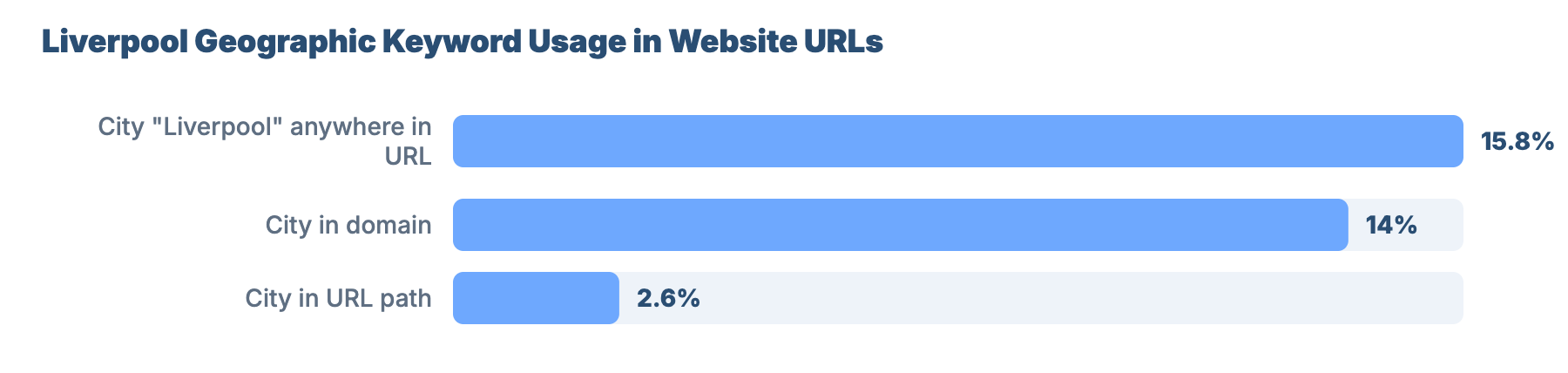
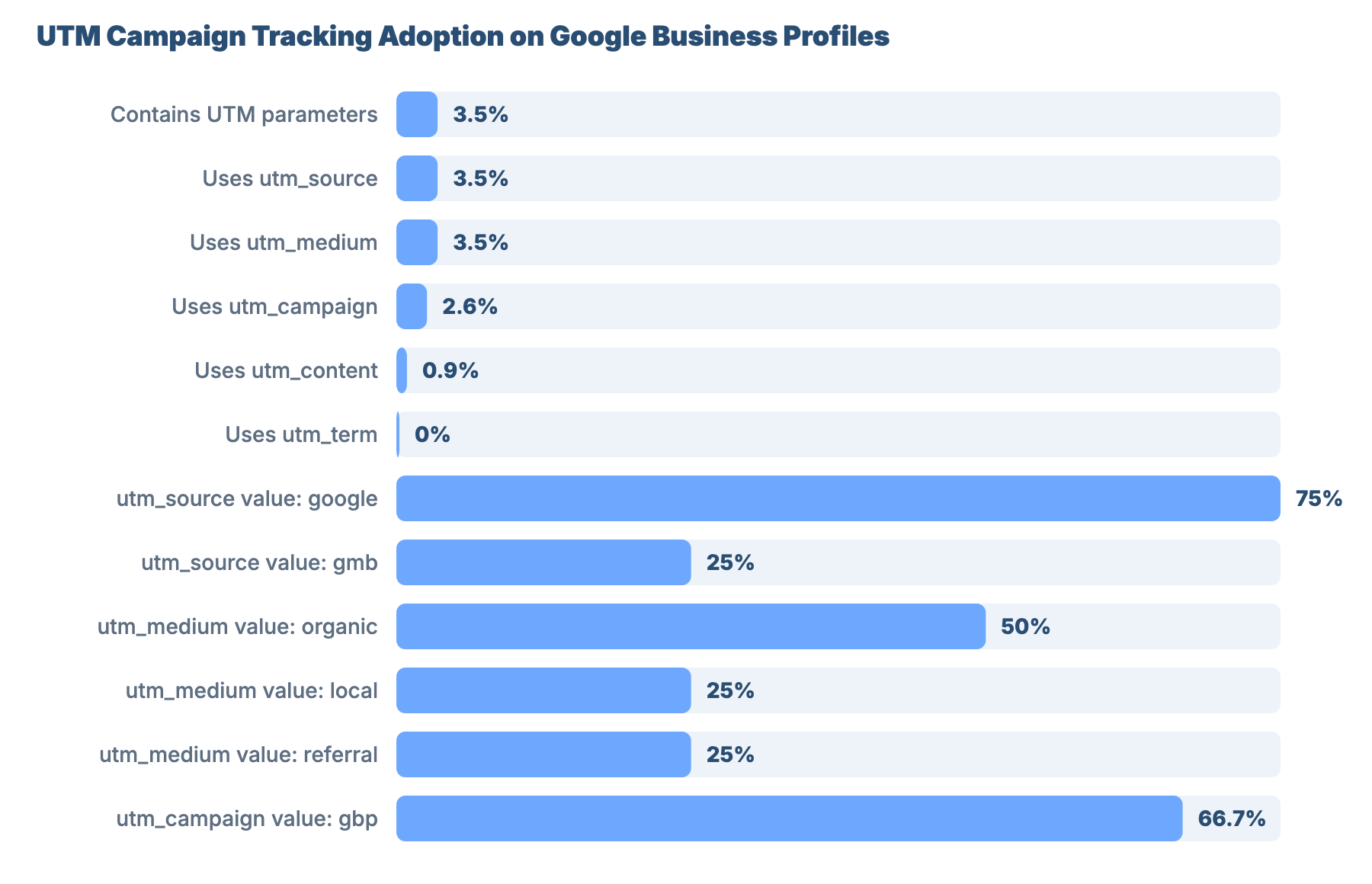
Local geographic targeting within URL structures remains exceptionally rare. Only 15.8% of connected websites include the city name "Liverpool" anywhere in their URL (14.0% in the root domain and 2.6% in the path). Furthermore, campaign tracking is almost entirely absent. A mere 3.5% of profile owners use UTM parameters, leaving 96.5% of local tradespeople unable to differentiate Google Maps traffic from standard organic search in their performance analytics.
User routing is similarly unrefined across the market. Over nine out of ten businesses (92.1%) direct Google Business Profile visitors straight to their root homepage. Only 7.9% link to internal pages, with dedicated service or location-specific landing pages representing a tiny fraction of total listings. This highlights a clear gap for operators willing to implement precise local landing pages and robust conversion tracking.


What the data proves
- 48.4% (107 of 221) of analysed profiles have no website URL linked.
- 57.0% (65 of 114) of active website links connect via insecure HTTP protocol.
- 92.1% of profile website links direct visitors straight to the root homepage.
- Only 3.5% of linked profiles utilise UTM parameters for conversion tracking.
What can be inferred
- Nearly half the market operates entirely through word-of-mouth or social channels without a dedicated digital home.
- Most local plumbers cannot accurately measure their Google Business Profile ROI due to a lack of attribution tracking.
- Migrating to HTTPS and creating dedicated local service pages provides an immediate competitive advantage over most local rivals.
For established businesses
- Install an SSL certificate immediately to resolve HTTP security warnings that deter prospective emergency calls.
- Append UTM parameters (`utm_source=google&utm_medium=organic&utm_campaign=gbp`) to your primary link to track Google Maps conversions accurately.
- Test linking your profile to a dedicated, high-converting Liverpool boiler or plumbing landing page instead of the generic homepage.
For new entrants
- Register a .co.uk domain to match local market expectations, as 80.7% of established competitors favour this extension.
- Ensure HTTPS protocol is active from day one before launching your website and linking it to your business listing.
- Structure your website with explicit local service pages (e.g. /boiler-repair-liverpool) to capture targeted local traffic.
Phone Contact Data Analysis: Mobile Dominance and Area Code Localisation for Liverpool Heating Engineers
Providing a phone number on Google Business Profiles is nearly universal among Liverpool plumbers and gas engineers, with 92.3% (204 out of 221) displaying a primary line. However, the reliance on mobile numbers is strikingly high: 62.7% of listed profiles (128 operators) use a UK mobile number as their main public contact, reflecting the sole-trader and mobile-first nature of trade services across Merseyside.
Geographic landlines account for just 31.4% (64 profiles) of listed numbers. Where landlines are deployed, local alignment is exceptional: 93.8% (60 out of 64) utilise Liverpool’s 0151 area code, with adjacent codes like Southport (01704) and St Helens (01744) capturing the remaining fringe. Freephone (0800/0808) and non-geographic (03) lines represent a negligible 5.9% combined share, confirming that national branding holds minimal appeal for domestic trade customers.
Phone number duplication is exceptionally low in this market. Only 3.9% of profiles (8 businesses) share a number across listings, comprising just four distinct pairs. This indicates a clean local ecosystem with minimal multi-location listing manipulation, though operators must still ensure contact lines remain strictly unique to maintain citation trust.


What the data proves
- 92.3% (204 of 221) of analysed profiles publish a primary phone number, whilst 7.7% omit one entirely.
- UK mobile numbers represent 62.7% of all listed contact points, outnumbering landlines by two to one.
- Among profiles displaying a geographic landline, 93.8% use the Liverpool 0151 area code.
- Phone number sharing is present on only 3.9% of listings across four distinct pairs.
What can be inferred
- Sole traders and emergency plumbers prefer direct mobile routing to capture urgent inbound calls whilst on job sites.
- Local consumers in Merseyside associate 0151 landlines with established firms, whereas mobile numbers signal immediate operational availability.
- Non-geographic numbers (0800/03) create friction for domestic repair queries where local proximity is prioritised.
For established businesses
- Audit secondary listing citations to ensure your primary 0151 or mobile contact number is consistent across all local web directories.
- Consider deploying call tracking on your GBP profile whilst retaining a dedicated, non-shared primary line to protect NAP consistency.
- If operating primarily via mobile, test adding a secondary 0151 landline to your website to reassure consumers seeking an established local contractor.
For new entrants
- Secure a dedicated Liverpool 0151 geographic virtual number or distinct mobile line prior to creating your Google Business Profile.
- Avoid 0800 freephone or 03 non-geographic numbers, as these are rarely used by competing local heating engineers in Liverpool.
- Ensure your chosen primary number is assigned exclusively to a single profile to prevent triggering duplication flags.
Google Business Profile Rating Value Analysis for Liverpool Plumbers and Gas Engineers
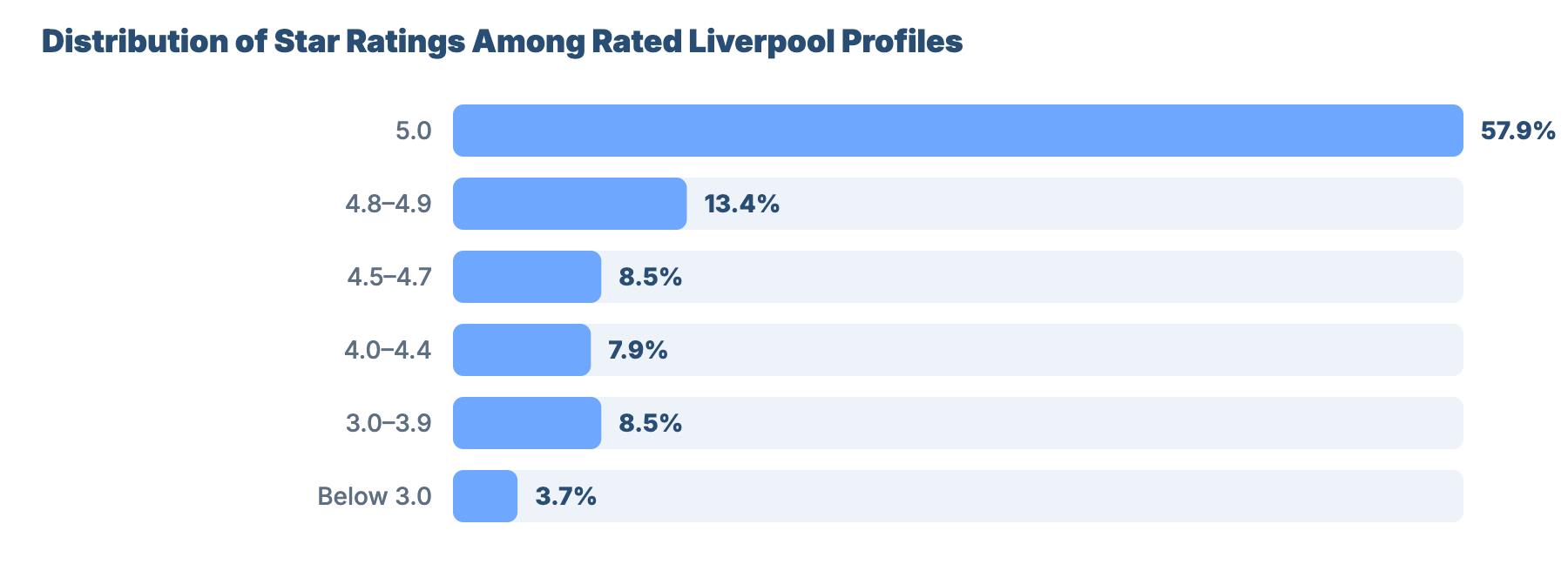
In the Liverpool plumbing and heating market, 74.2% of analysed Google Business Profiles possess a public rating, leaving 25.8% of listings entirely unrated. Among rated operators, customer evaluation scores are extraordinarily high: the market average rating sits at 4.65, while both the median and mode reach a perfect 5.0. Furthermore, 57.9% of rated profiles hold an immaculate 5.0 score, creating a dense baseline of perceived quality across local listings.
Analysing rating values against review-count bands reveals a clear structural trend. Profiles with low review counts exhibit greater rating instability; businesses in the 6–10 review bracket post the lowest group average at 4.31. However, as review accumulation increases, average ratings rise steadily and stabilise, progressing from 4.68 (11–25 reviews) to 4.84 (26–50 reviews) and peaking at 4.95 for profiles with 101–250 reviews.
While achieving a 5.0 score is common among smaller operators, sustaining perfection alongside substantial volume is rare. Across the total dataset of 221 listings, only 14.0% (31 profiles) maintain a 5.0 rating with 25 or more reviews, and just 5.0% (11 profiles) do so with 100 or more reviews. For local SEO for plumbers and gas engineers in Liverpool, establishing high review volume while protecting a score above 4.7 represents the true competitive moat.


What the data proves
- 74.2% of sampled Google Business Profiles in Liverpool have at least one rating, whilst 25.8% display no reviews.
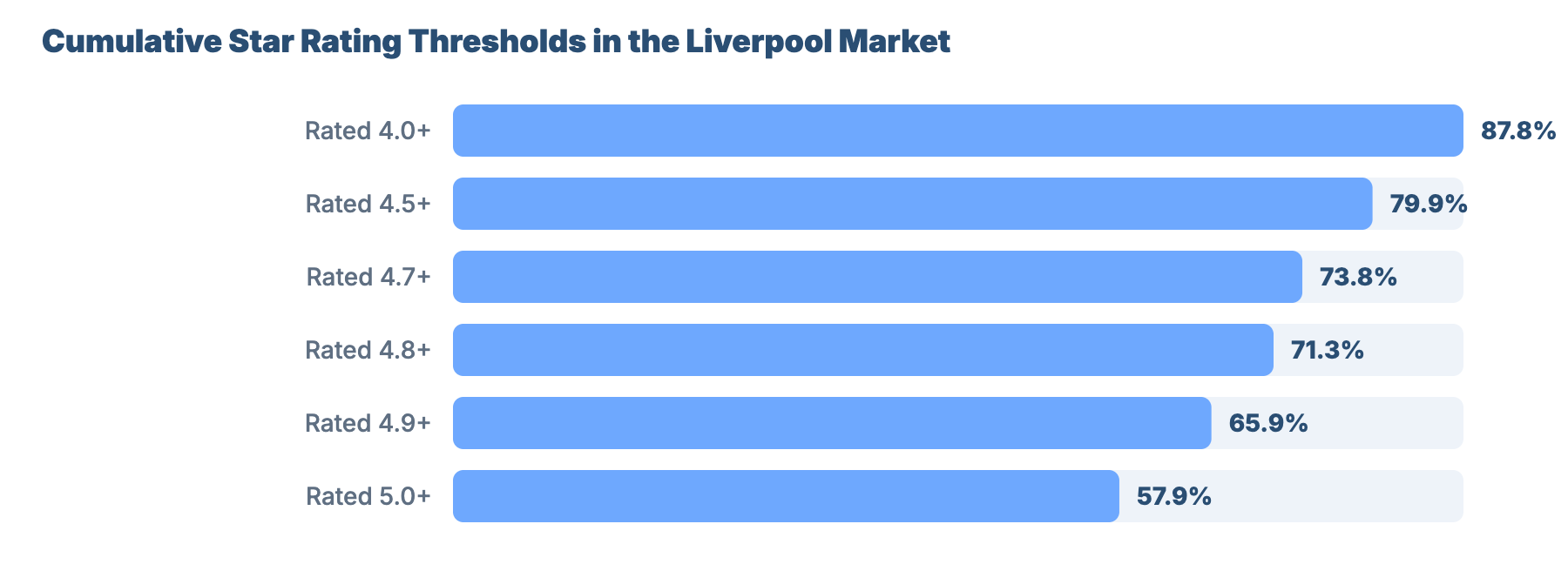
- Over seven in ten rated profiles (71.3%) maintain a star rating of 4.8 or higher.
- Profiles with 101–250 reviews achieve the highest average rating across volume bands at 4.95.
- Only 10.4% of total market profiles (23 listings) hold a 5.0 rating backed by 50 or more reviews.
What can be inferred
- Operators with systematic review request processes gather higher volumes of positive feedback that dilute isolated low ratings.
- Listings in the 6–10 review band suffer disproportionately from early negative reviews due to a lack of volume buffer. stream
- Consumer trust and conversion rates likely drop significantly for the 12.2% of rated listings falling below a 4.0 rating.
For established businesses
- Prioritise review velocity over pristine perfection, building a volume buffer to absorb occasional sub-5 feedback without slipping below the 4.7 market benchmark.
- Capitalise on the market gap where only 14.0% of Liverpool competitors hold a 5.0 rating with 25+ reviews to demonstrate clear operational authority.
- Integrate automated SMS or email review requests immediately following boiler servicing, repairs, or gas safety checks.
For new entrants
- Securing your first 5 ratings immediately places your listing ahead of the 25.8% of Liverpool competitors who operate with empty profiles.
- Aim for an initial target rating above 4.8, as 71.3% of rated local competitors currently meet or exceed this threshold.
- Focus heavily on customer satisfaction during early trades to avoid dropping into the volatile 6–10 review band average of 4.31.
Review Count Dynamics for Liverpool Plumbers and Gas Engineers
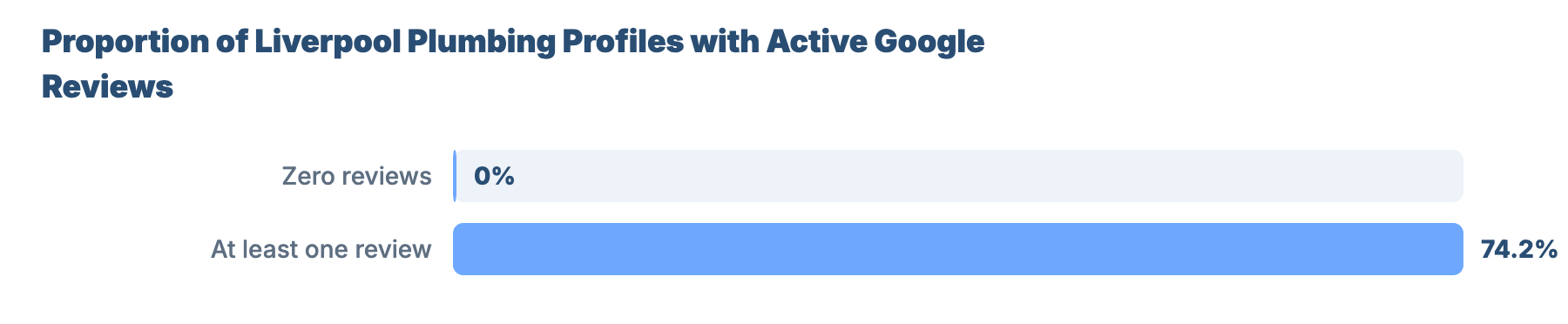
Analysis of 221 Google Business Profiles in Liverpool reveals a heavily skewed review landscape across local plumbing and heating services. While 74.2% of analysed listings (164 profiles) have accumulated at least one review, the total volume of 6,462 reviews is disproportionately concentrated among a minority of operators. The overall market median sits at just 14 reviews, whereas the mathematical mean of 39.4 is inflated by a handful of high-volume businesses, capped by a market maximum of 621 reviews.
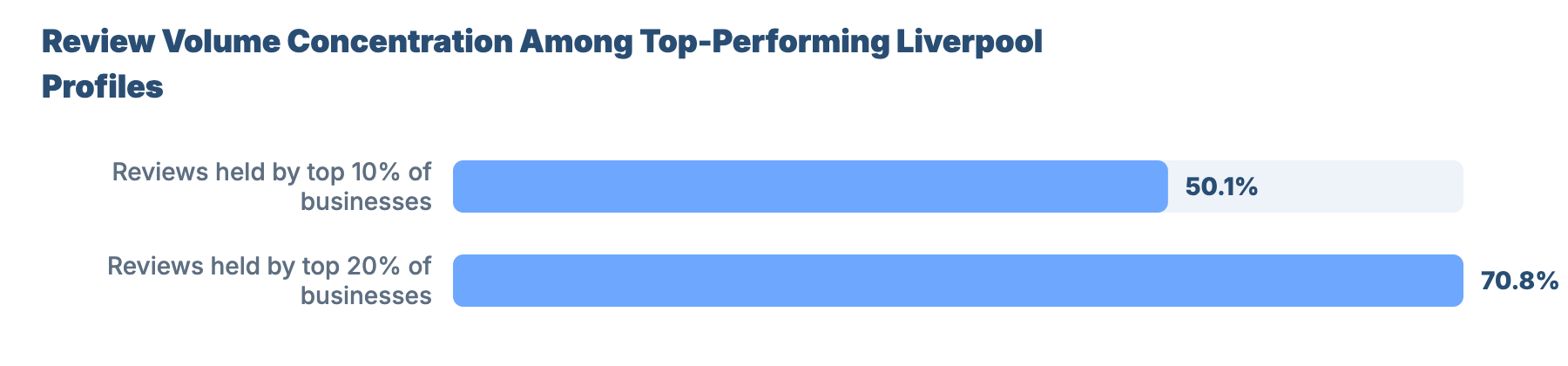
Market concentration is severe: the top 10% of reviewed businesses command 50.1% (3,235) of all reviews across Liverpool, and the top 20% hold 70.8% (4,572). For local operators, moving from a median position to the top quartile (P75) requires reaching 45 reviews—a gap of roughly 31 reviews. Crossing into the top 10% (P90) requires 99 reviews, representing an 84-review gap from the median baseline.
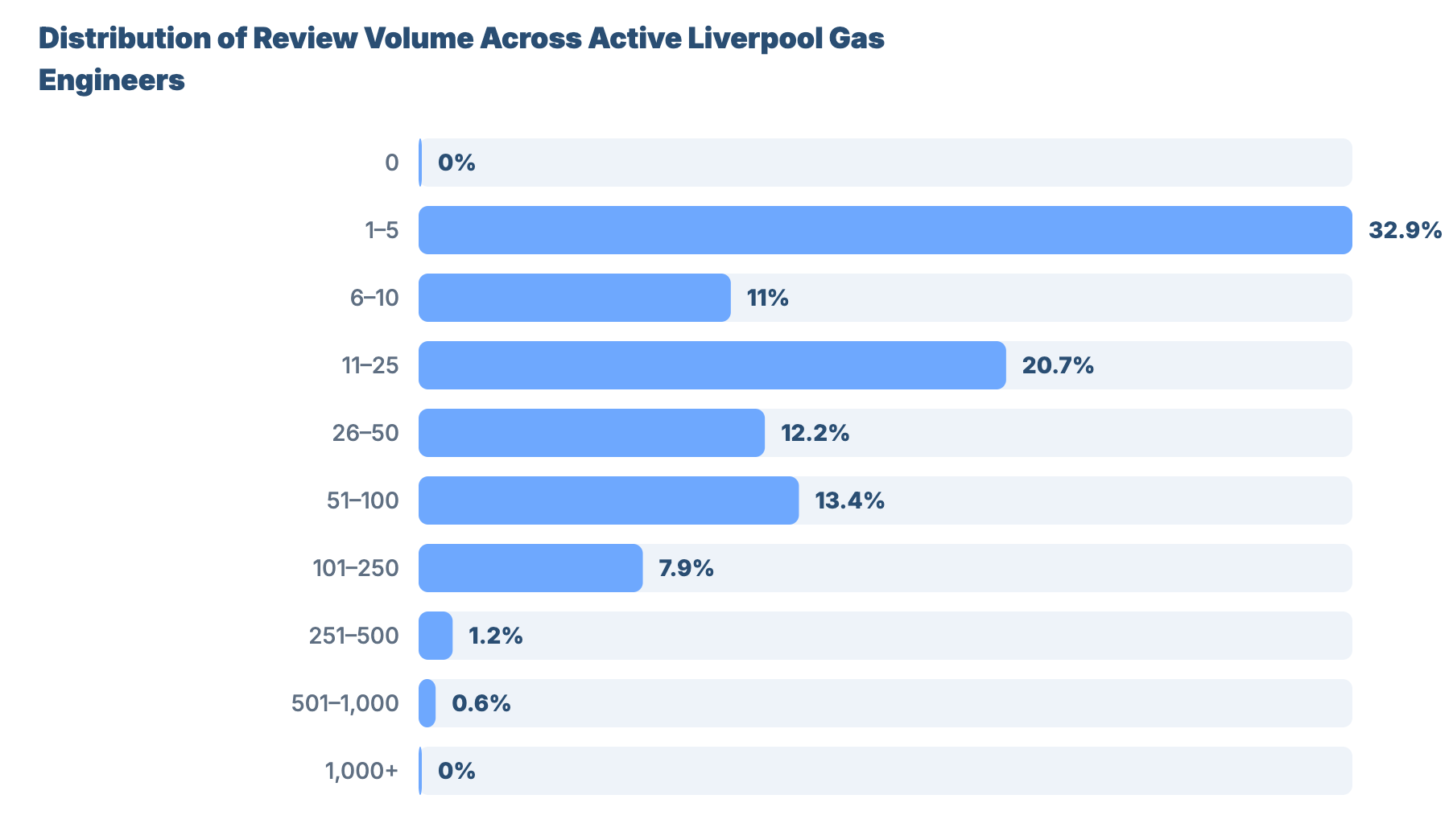
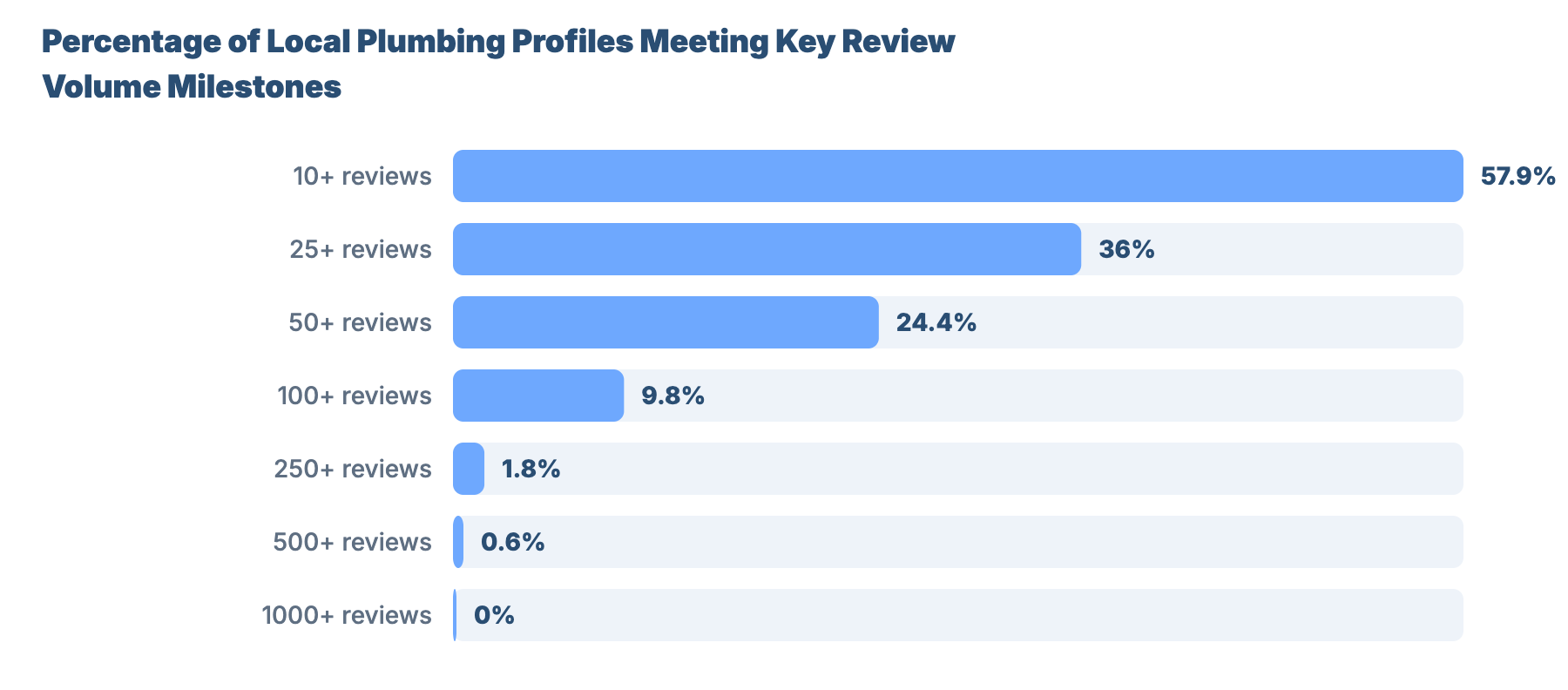
Nearly a third (32.9%) of reviewed profiles hold between 1 and 5 reviews, demonstrating that many sole traders struggle to establish automated review generation. Only 9.8% of reviewed profiles have crossed the 100-review milestone, creating a clear operational window for firms executing structured local SEO campaigns in Liverpool.
What the data proves
- Of the 221 analysed profiles, 164 (74.2%) have at least one Google review.
- The median review count across active profiles in Liverpool is 14, with a 10% trimmed mean of 24.33.
- The top 10% of reviewed plumbing profiles account for 50.1% of the 6,462 total reviews in the dataset.
- Only 16 businesses (9.8% of reviewed listings) possess 100 or more reviews.
What can be inferred
- A significant proportion of Liverpool plumbers lack systematic post-job review request workflows, leaving most profiles under 25 reviews.
- Crossing the 45-review threshold (P75) provides a distinct conversion advantage by outperforming three-quarters of local competitors.
- High review concentration among top operators indicates early-mover advantage or dedicated reputation management software usage.
For established businesses
- Audit your post-service communication to automate SMS or email review requests within 2 hours of completing a job.
- Target reaching 45 reviews to enter the top quartile (P75), and set a strategic milestone of 99 reviews to join the top 10% of Liverpool profiles.
- Monitor competitor review velocity in your specific Liverpool postcode to ensure your quarterly growth rate outpaces local rivals.
For new entrants
- Prioritise obtaining your first 15 reviews immediately upon launching to instantly outperform 50% of active profiles in Liverpool.
- Incorporate QR codes on physical invoices and completion documentation to make leaving feedback effortless for domestic plumbing clients.
- Encourage clients to mention specific services (e.g. boiler service, emergency repair) within their review text to strengthen local relevance.
Google Business Profile Address Distribution for Liverpool Plumbers and Gas Engineers
Every single profile analysed across Liverpool (100%, 221 of 221) displays a physical street address, with zero listings operating with hidden addresses. Furthermore, 98.6% (218 of 221) include a complete, valid postcode within the ‘L’ postcode area, establishing transparent physical anchoring as the universal baseline for local trade profiles in this region.
Geographic dispersion shows distinct suburban clusters rather than central city concentration. The top postcode districts—L37 (Formby), L23 (Crosby), L33 (Kirkby), and L36 (Huyton)—each house 6.3% (14 profiles) of the market. Combined with secondary hubs in L12 (West Derby, 5.9%) and L13 (Old Swan, 5.4%), local engineers predominantly register profiles in suburban residential belts rather than high-density commercial centres like L1 (5.0%).
Address uniqueness is exceptionally high at 98.2% (217 profiles), with only 1.8% (4 profiles across 2 distinct locations) sharing a street address. This confirms that shared virtual offices and co-working address manipulation are virtually non-existent in Liverpool’s plumbing sector, reflecting a market dominated by genuine home-registered or dedicated trade premises.




What the data proves
- 100% (221 of 221) of indexed GBP profiles in Liverpool maintain a visible street address.
- 98.6% of listings state an explicit ‘L’ sector postcode, confirming complete geographic data entry.
- Suburban residential hubs (L37, L23, L33, L36) collectively account for 25.2% of all registered profiles.
- Co-location is minimal, with 98.2% of profiles registered to completely unique addresses.
What can be inferred
- Liverpool tradespeople overwhelmingly prefer displaying physical home or workshop addresses to establish local consumer trust over hiding addresses as pure Service Area Businesses.
- Suburban address density corresponds to sole traders operating from home bases near affluent residential repair and boiler replacement markets.
- Proximity signals in Google’s local pack heavily reward businesses situated within dense suburban catchments over centralised commercial districts.
For established businesses
- Audit NAP (Name, Address, Phone) consistency across all external directories to match your published GBP street address exactly.
- Capitalise on your suburban address by building location-specific landing pages for surrounding high-demand postcodes within your actual driving radius.
- Maintain full address visibility on your profile to remain aligned with the 100% market standard and avoid perceived trust deficits.
For new entrants
- Register your profile using a legitimate physical address in your primary service zone rather than attempting to use virtual offices or PO boxes.
- Consider positioning your base in less saturated postcodes such as L8, L17, or L10 to capture local proximity advantages where direct competitors are fewer.
- Ensure your postcode is fully published during initial setup to immediately match the 98.6% market completeness benchmark.
Google Business Profile Opening Hours Strategy for Liverpool Plumbers and Gas Engineers
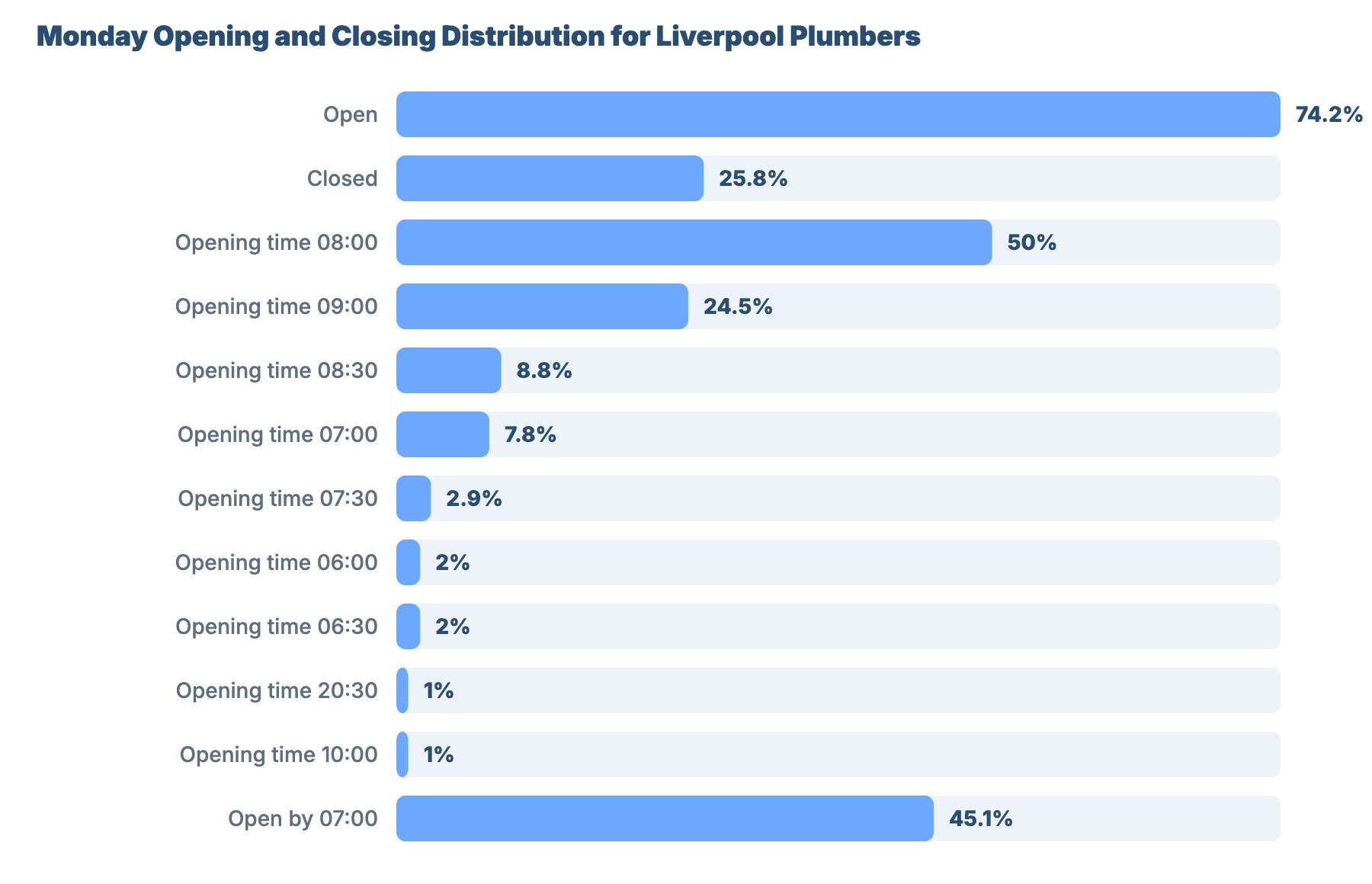
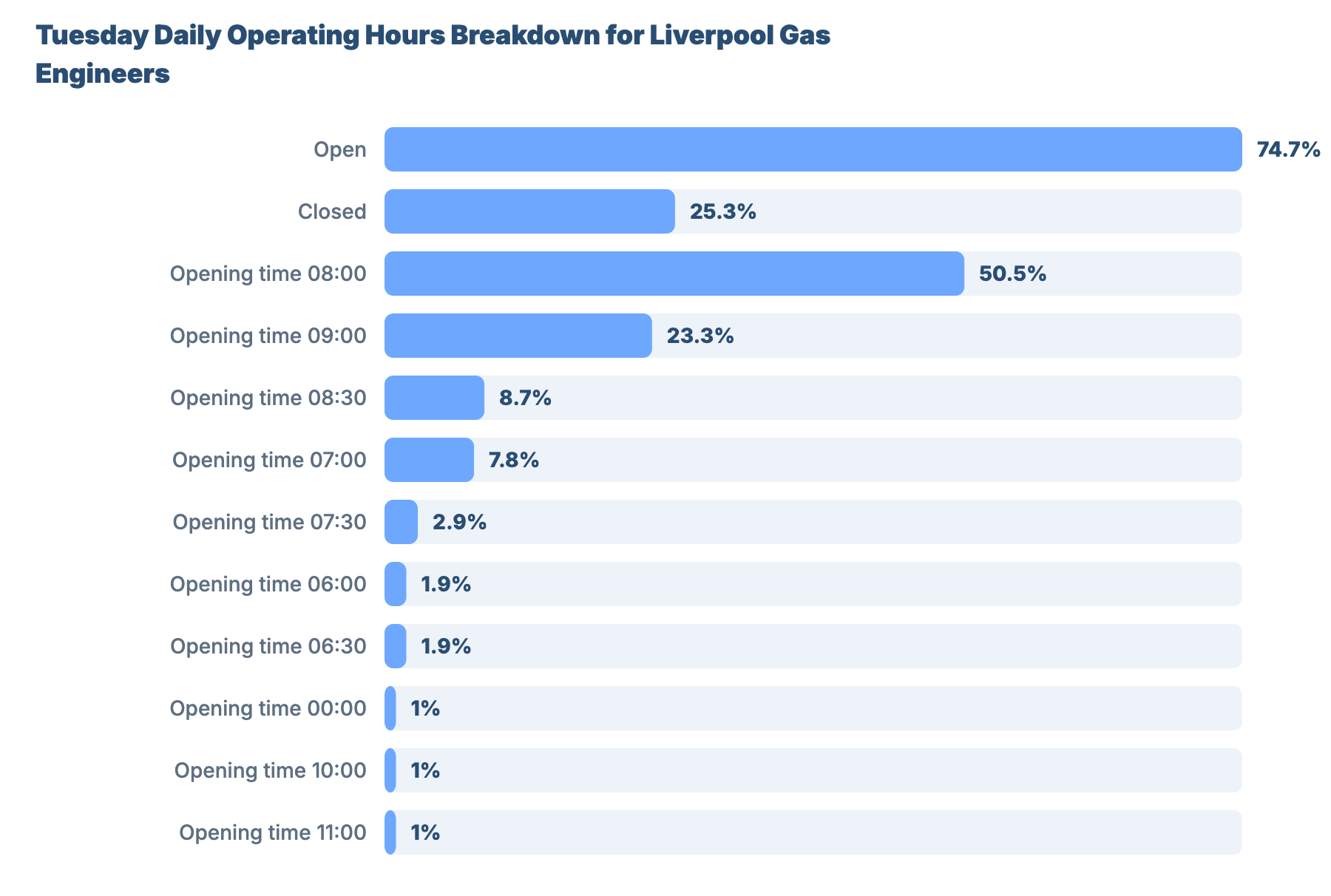
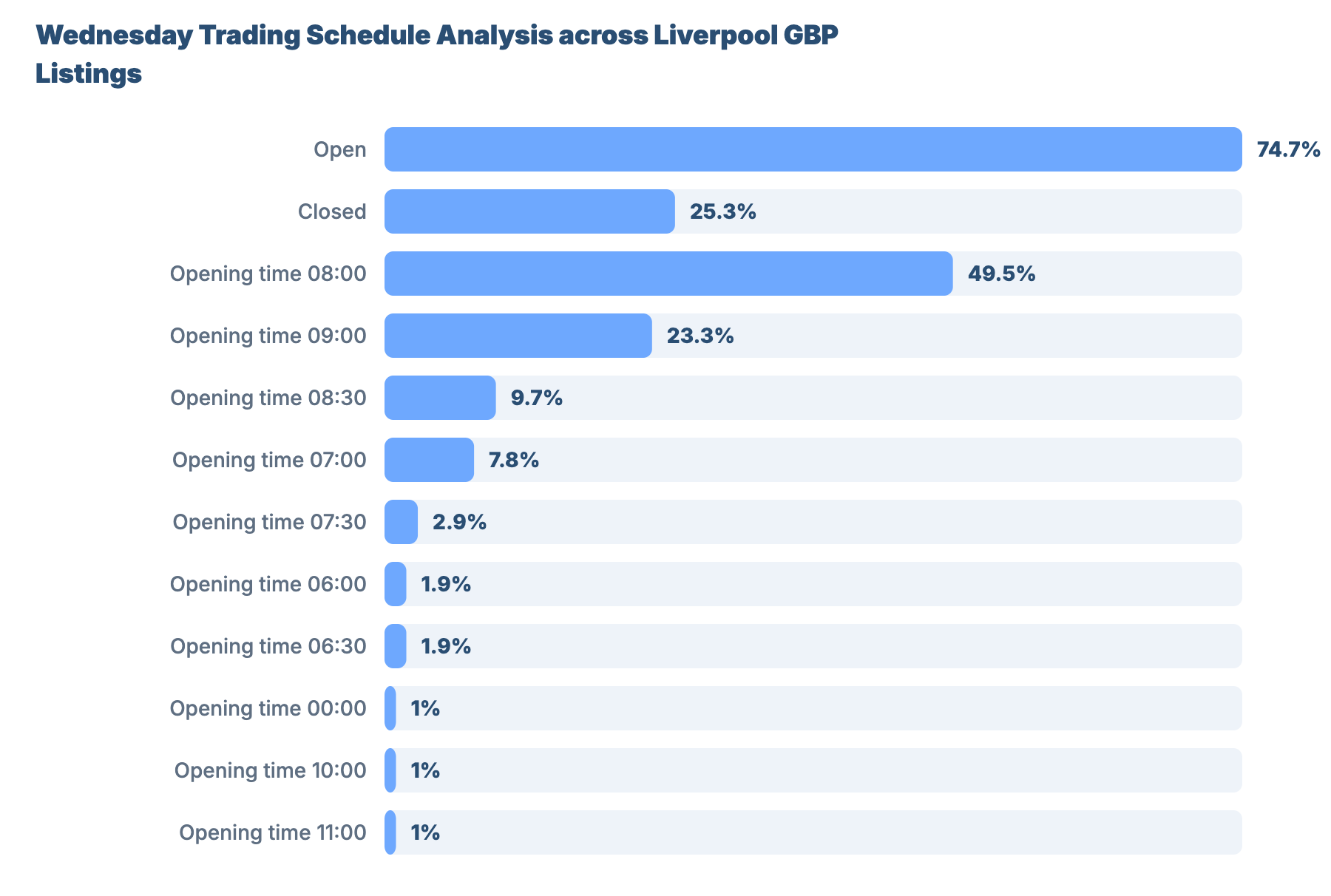
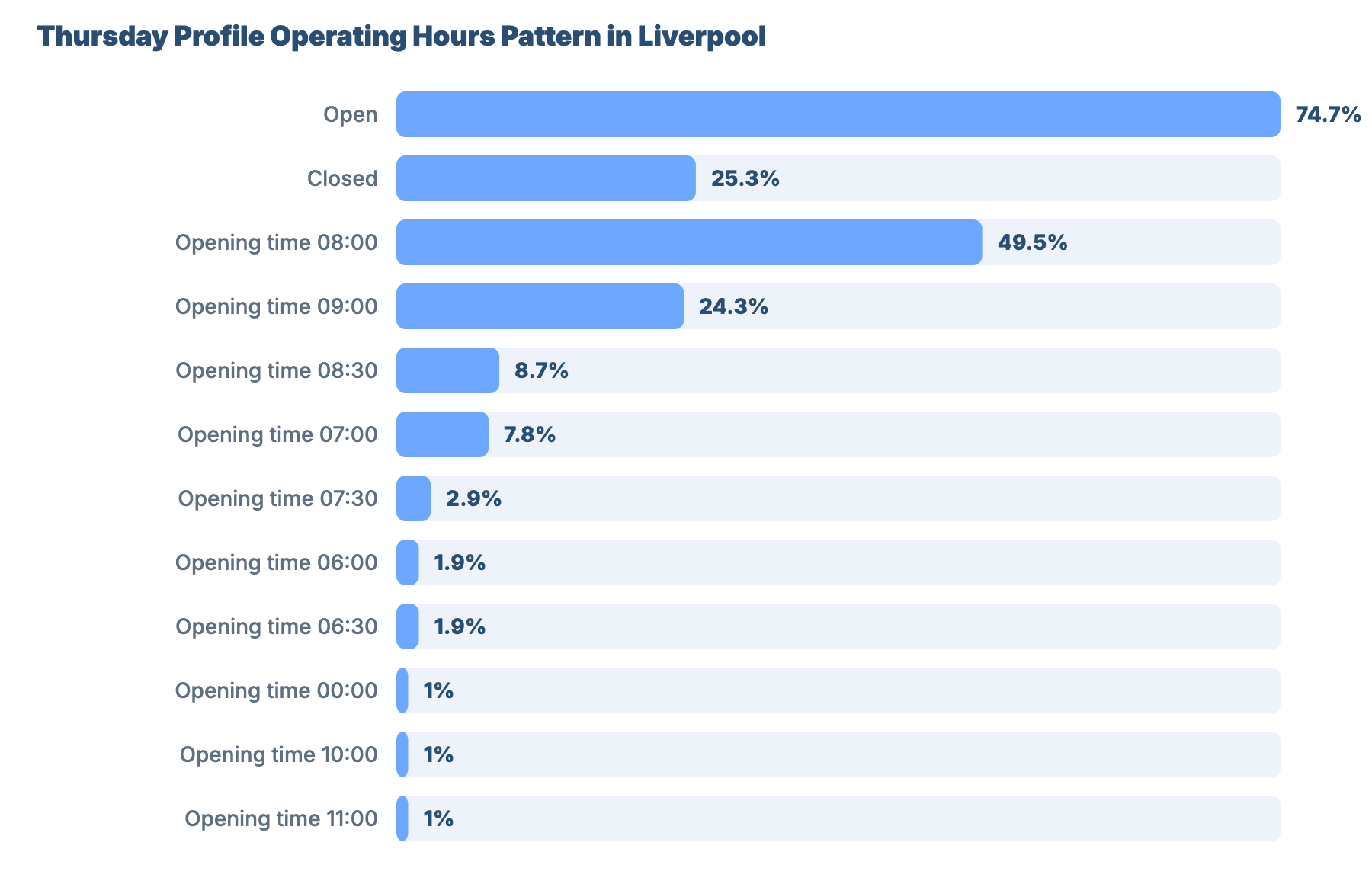
In Liverpool’s heating and plumbing sector, operating schedule configurations demonstrate a sharp divide between emergency coverage models and standard trade hours. Out of 221 analysed Google Business Profiles, 74.7% list active weekday hours, with 08:00 acting as the predominant opening baseline (50% of structured profiles) and 17:00 representing the standard closing mark (36.3%). Notably, 25.3% of all profiles list no opening hours at all, effectively forfeiting high-intent ‘open now’ search visibility during prime working hours.
Weekend availability drops significantly across the local market. Saturday trading drops to 56.6% (125 profiles), while Sunday operating hours shrink further to 38.9% (86 profiles). However, a substantial sub-segment of Liverpool gas engineers position heavily for out-of-hours emergencies: 28.1% claim 24-hour weekday operation, and 25.3% (56 profiles) explicitly list 24/7 continuous availability.
The median weekly opening duration across Liverpool heating engineers stands at 54 hours, though the arithmetic mean inflates to 74.46 hours due to the prevalence of 24-hour profiles. Split hours are virtually non-existent (under 0.6%), indicating that local plumbing firms universally operate uninterrupted daily blocks rather than traditional split shifts. Strategic alignment between listed hours and telephone response capability remains crucial for local engagement.
What the data proves
- 74.7% of surveyed Liverpool Google Business Profiles list active weekday operating hours.
- 08:00 is the median weekday opening time, adopted by roughly half of businesses with scheduled hours.
- 25.3% of analysed profiles maintain a 24/7 operating schedule, while 43.4% remain closed on both Saturday and Sunday.
- Only 0.6% of active profiles utilise split daily opening hours.
What can be inferred
- Profiles operating without listed opening hours likely lose visibility during filtered ‘Open Now’ local map searches.
- The high proportion of 24/7 listings indicates aggressive competition for lucrative out-of-hours boiler breakdown queries.
- Firms opting for standard 08:00-17:00 schedules target planned domestic installations rather than reactive call-outs.
For established businesses
- Audit existing GBP opening schedules to ensure full coverage during actual operational hours, capturing late afternoon call-outs.
- If emergency heating response is offered, switch profile settings to 24/7 to capture evening and weekend breakdown traffic.
- Align primary profile operating hours with call-handling capacity to prevent unserved customer leads and negative reviews.
For new entrants
- Set explicit opening hours immediately upon profile creation to avoid default inclusion in the 25.3% unconfigured gap.
- Target underserved weekend demand by listing Saturday or Sunday hours, where competitor listings fall to 56.6% and 38.9%.
- Establish an 07:00 opening time on weekdays to capture early morning heating emergency calls ahead of the 08:00 majority.
Google Business Profile Claim Rates and Optimisation for Liverpool Gas Engineers
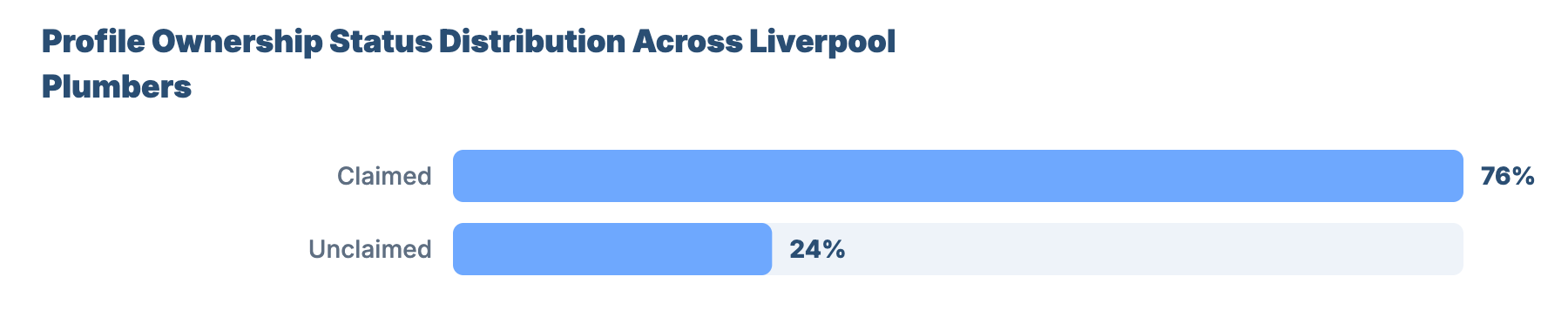
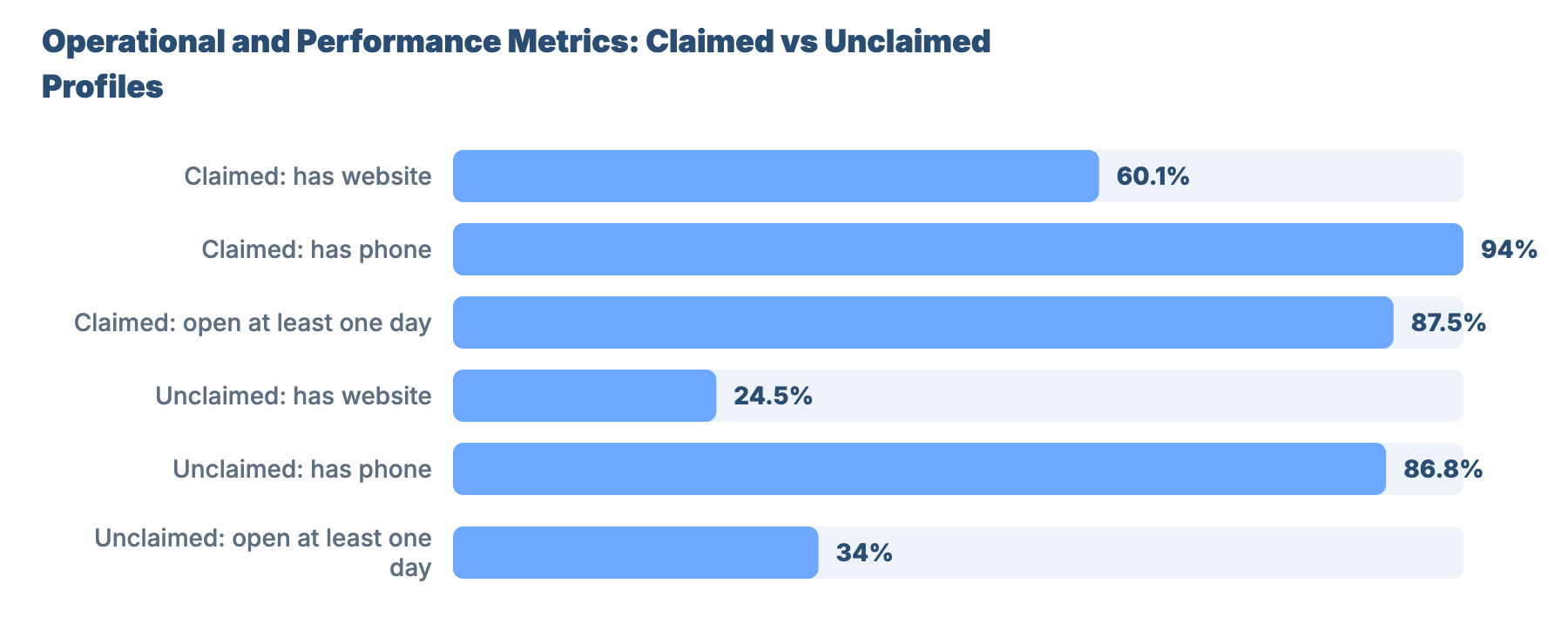
Three-quarters (76%, 168 of 221) of Liverpool plumbing and heating profiles are claimed, leaving nearly a quarter (24%, 53 profiles) completely unmanaged. Claiming a profile signals basic digital awareness, yet significant operational gaps remain even among claimed listings. For instance, nearly 40% of claimed profiles fail to link a website (60.1% have one), and 12.5% display no operational hours.
Unclaimed listings lag drastically across all engagement metrics. Only 24.5% of unclaimed profiles possess a website link, and just 34% list operational hours. Furthermore, while claimed profiles average a 4.73 rating with a median of 17 reviews, unclaimed profiles sit at a 4.26 rating and a median of just 2 reviews. This underscores that unclaimed profiles are largely unmonitored listings accumulating organic, often unresolved customer feedback.
From a local SEO perspective, claiming a listing is merely the baseline entry requirement. The substantial contrast in review volume (17 versus 2) indicates that profile ownership directly correlates with active reputation management and customer outreach, both essential components for local search visibility in Merseyside.
What the data proves
- 76% (168 of 221) of examined profiles in Liverpool are claimed by business operators.
- Claimed listings have higher website coverage (60.1%) and complete opening hours (87.5%) than unclaimed ones (24.5% and 34% respectively).
- Claimed profiles boast a higher average rating (4.73) and higher median review count (17) than unclaimed profiles (4.26 rating, median 2 reviews).
What can be inferred
- Claiming a profile reflects an active business owner who actively requests customer reviews and maintains web assets.
- Unclaimed listings are frequently legacy or secondary listings created automatically by Google or third-party directories without proactive owner management.
- Profiles with complete contact information and regular review collection demonstrate stronger commercial intent and active trading status.
For established businesses
- Ensure your Google Business Profile is claimed and verified immediately if you have not done so already.
- Add a direct website link to your profile to capitalise on the 39.9% of claimed competitors currently missing web links.
- Implement an automated post-service review request strategy to expand upon the median 17-review benchmark and widen the gap against unmanaged competitors.
For new entrants
- Audit the local area for unmanaged or duplicate listings under your intended business name prior to launch.
- Immediately claim and fully populate your profile with phone numbers, opening hours, and website links to instantly outperform the 24% of unclaimed market competitors.
- Prioritise gathering your first 20 verified customer reviews quickly to surpass the local median for claimed profiles.
Visual Engagement Benchmarks: Photo Count Analysis for Liverpool Plumbers and Gas Engineers
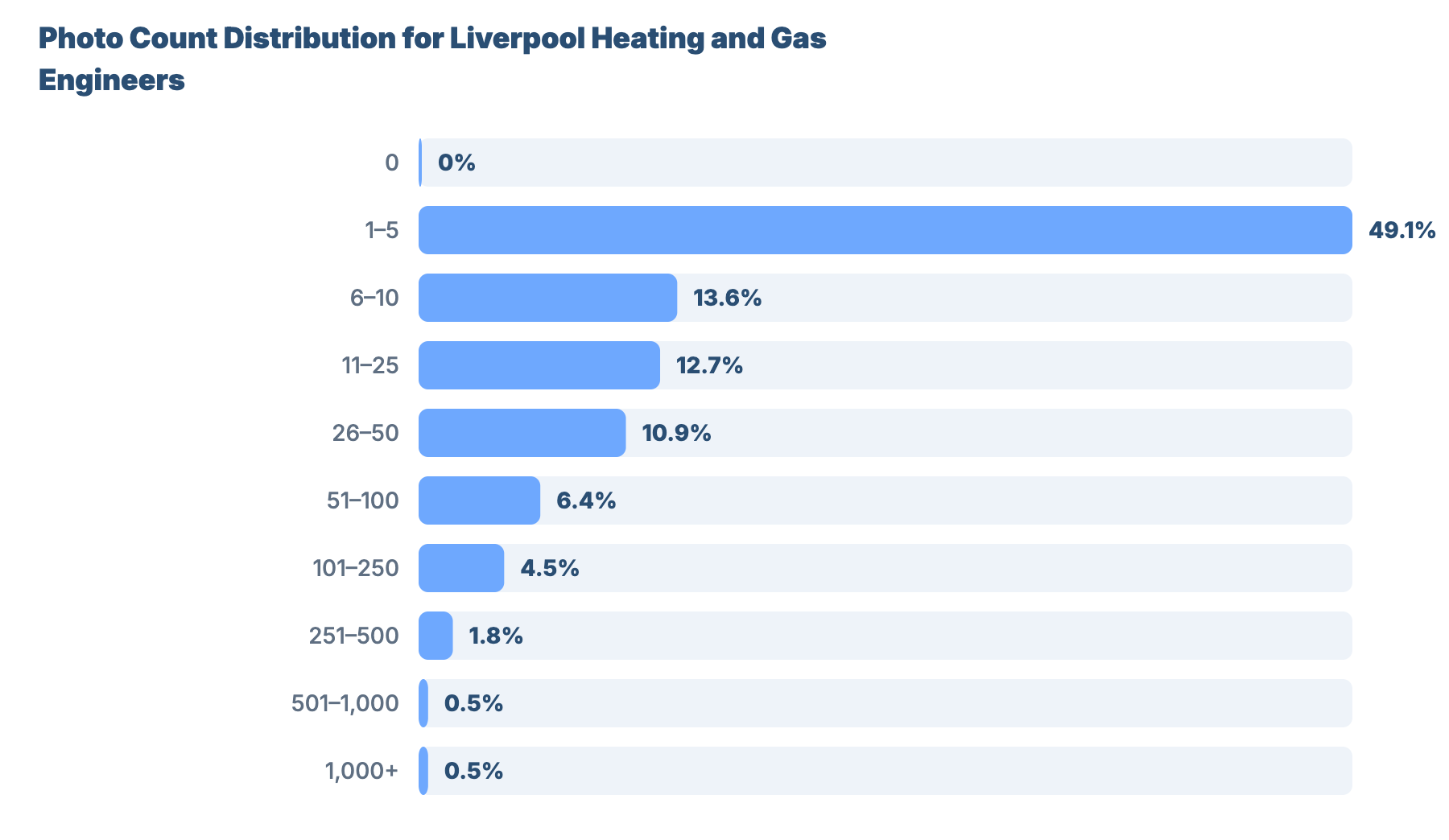
Visual assets are universal across the Liverpool plumbing sector, with 99.5% of profiles featuring at least one image. However, depth of investment is remarkably low across the board. Nearly half of all listings (49.1%) contain between 1 and 5 photos, pulling the market median down to just 6. While the mathematical average sits at 42.08, this is heavily distorted by a tiny fraction of hyper-active profiles, including a market maximum of 3,049 photos.
A clear operational divide exists between digitally managed businesses and neglected listings. Claimed profiles maintain a median photo count of 9.5 compared to a median of 1 for unclaimed listings. Similarly, profile owners who maintain an active website average a median of 10 photos, whereas those without a website sit at just 1.5 images. This indicates that visual content creation in Liverpool is largely confined to businesses with a broader commitment to digital marketing.
To build a competitive advantage for the keyword ‘SEO for Plumbers and Gas Engineers Liverpool’, businesses must look at upper-percentile thresholds. Reaching the top 25% of profiles requires a modest 25 photos (P75 is 24.3), while entering the top 10% demands 64 photos (P90). Profiles with over 100 photos represent just 8.2% of the total market, highlighting an achievable low-barrier opportunity to out-build local rivals visually.


What the data proves
- Virtually all profiles (99.5%) contain at least one image, with a overall market median of 6 photos.
- Claimed profiles maintain significantly higher median photo counts (9.5) than unclaimed listings (1).
- Businesses with linked websites hold a median of 10 photos compared to 1.5 for those without websites.
- Only 8.2% of Liverpool plumbing profiles feature 100 or more photos.
What can be inferred
- Active visual maintenance correlates strongly with overall digital maturity and ongoing listing management.
- Profiles featuring rich visual portfolios likely achieve superior conversion rates by showcasing authentic work quality.
- A small cohort of market leaders actively uses high-volume photo uploads to dominate visual local search real estate.
For established businesses
- Audit existing Google Business Profile media and set an immediate target to clear the top 25% benchmark of 25 images.
- Implement a systematic routine where engineers capture and upload before-and-after project photos from local jobs.
- Target the top 10% threshold (64+ photos) to create a distinct visual gap against the 49.1% of competitors stuck under 6 images.
For new entrants
- Upload an initial gallery of 10 to 15 high-resolution images during profile verification to immediately surpass passive competitors.
- Build visual volume toward 25 photos within the first 90 days to enter the top quartile of local listings.
- Focus media on branded vehicles, Gas Safe certification badges, and recognisable work across Liverpool postcodes.
Google Business Profile Additional Categories for Liverpool Plumbing & Heating Specialists
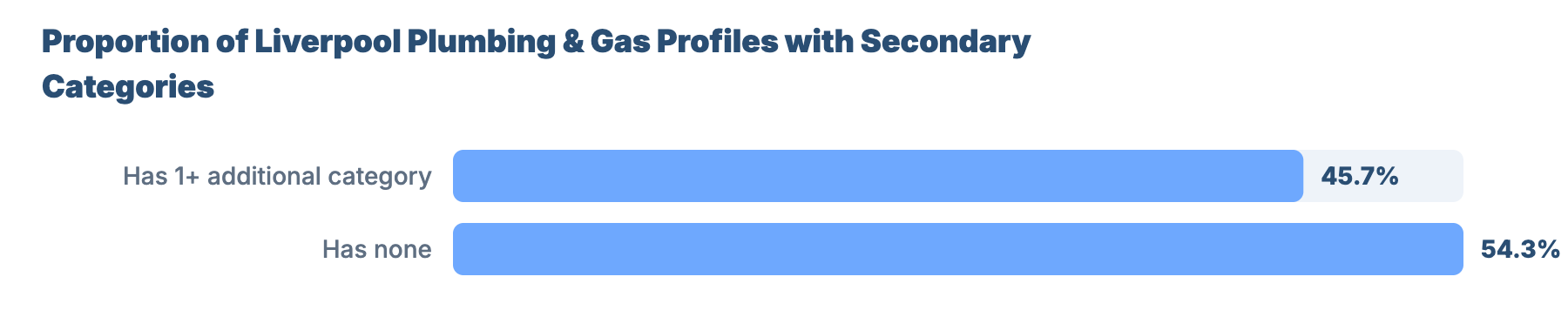
In the Liverpool heating and plumbing sector, over half of analysed Google Business Profiles (54.3%) operate without a single additional secondary category configured. This structural passivity leaves 120 profiles relying entirely on their chosen primary classification to trigger map pack positions across search queries in Merseyside. For local businesses aiming to capture broader search intent across Liverpool, failing to populate relevant secondary categories represents a significant missed opportunity for secondary keyword contextualisation.
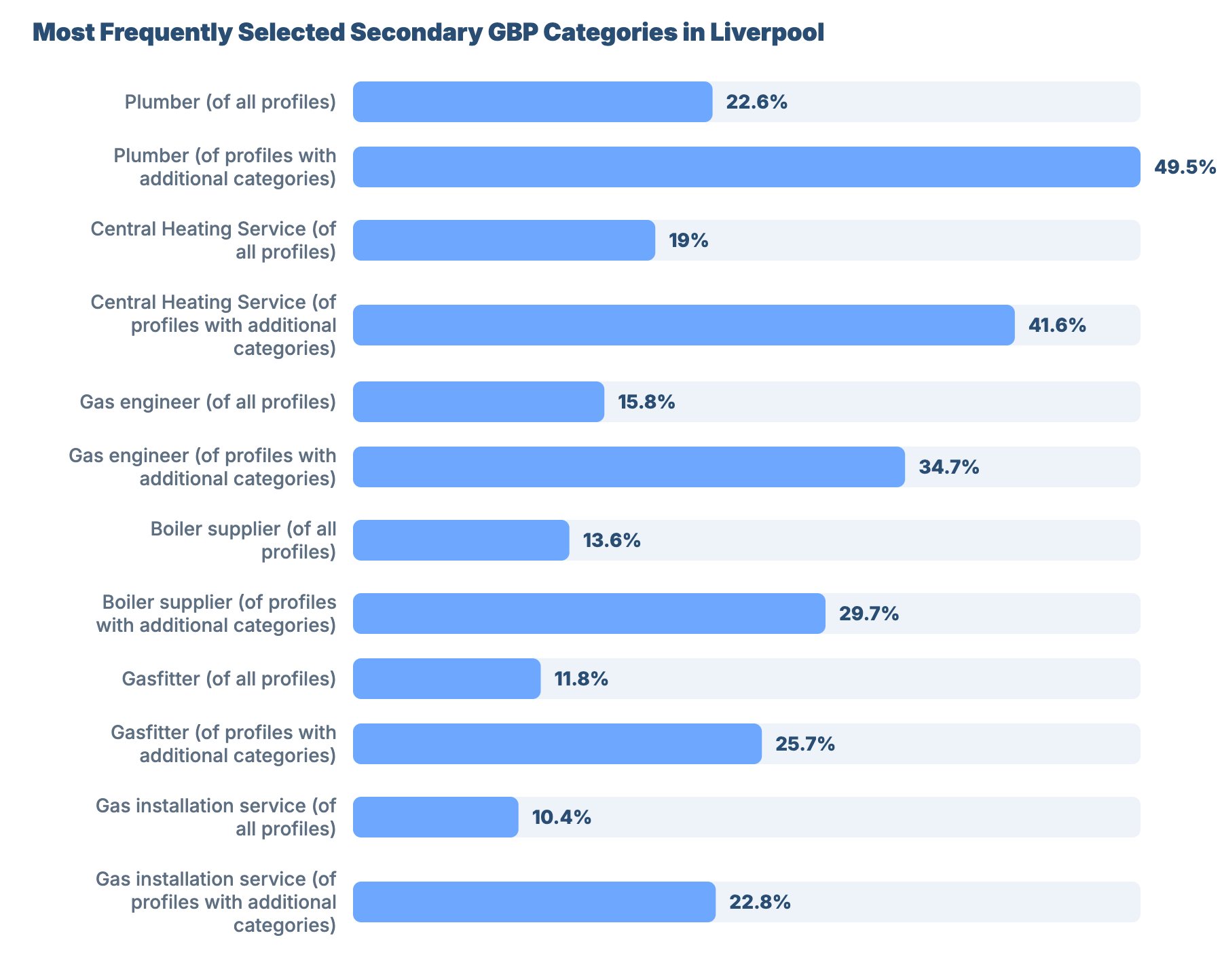
Amongst the 45.7% of businesses utilising secondary categories, the average addition is 1.41 categories per profile, though 6.3% maintain six or more additional classifications. The most frequently selected secondary categories closely track core service lines: Plumber is added by 49.5% of multi-category profiles (22.6% total), Central Heating Service by 41.6% (19.0% total), Gas engineer by 34.7% (15.8% total), and Boiler supplier by 29.7% (13.6% total). Interestingly, high-ticket cross-sell categories like Bathroom Renovator appear on 17.8% of multi-category profiles (8.1% total).
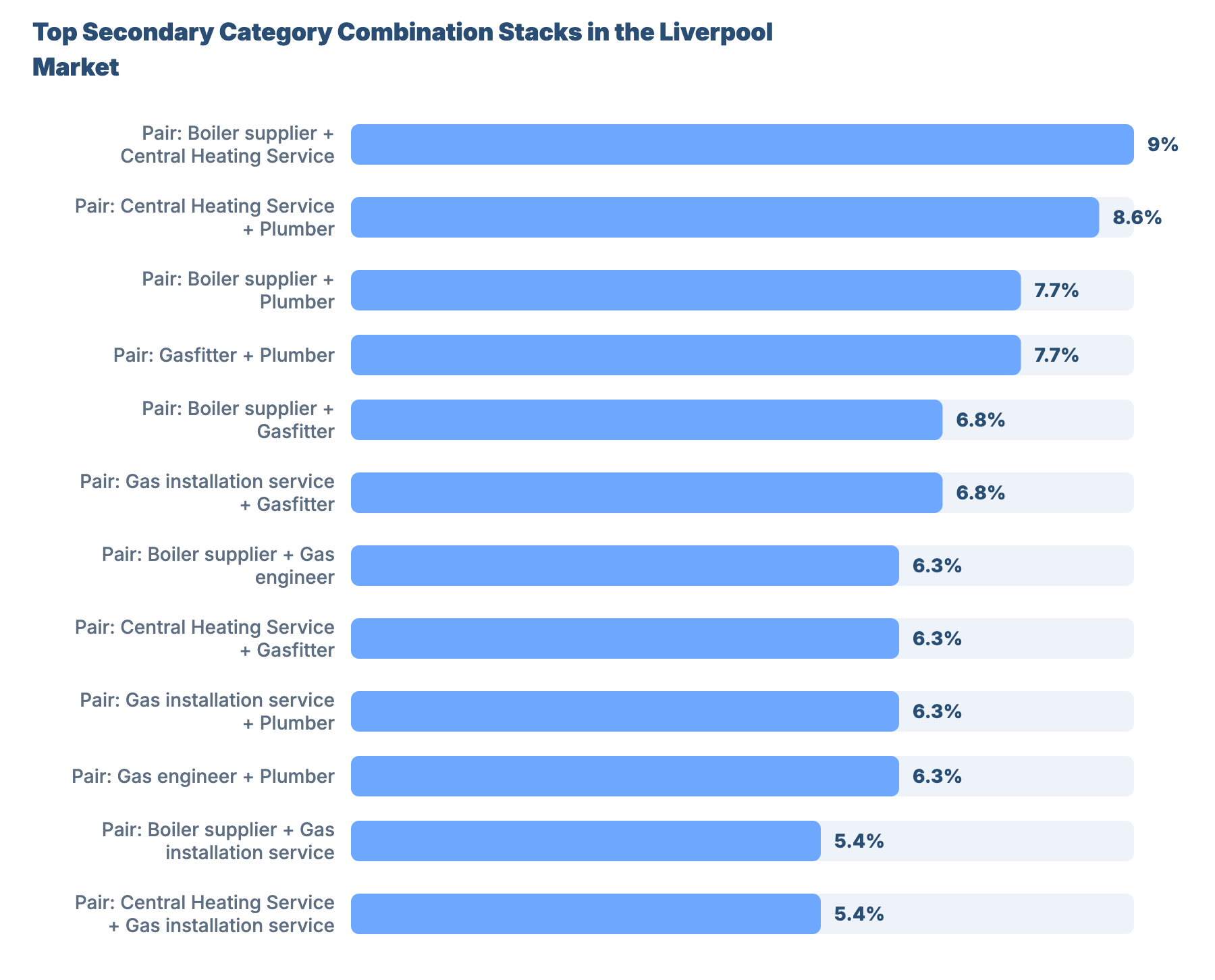
Clustering patterns demonstrate clear service alignment amongst top-ranking listings. The most prevalent secondary pair is Boiler supplier combined with Central Heating Service (9.0% of all profiles), followed closely by Central Heating Service paired with Plumber (8.6%). The most common three-way combination—Boiler supplier, Central Heating Service, and Plumber—is adopted by 5.4% of all Liverpool listings. These data clusters show that top-performing firms align their Google Business Profile categories directly with high-margin installation and maintenance workflows.

What the data proves
- 54.3% (120 out of 221) of Liverpool plumbing and gas listings do not select any additional secondary categories.
- Plumber is the most common secondary category selected (22.6% of all profiles; 49.5% of multi-category profiles).
- Boiler supplier + Central Heating Service is the most frequent category pairing, present on 9.0% of all sampled profiles.
- Only 6.3% of Liverpool profiles leverage 6 or more additional categories, with the maximum observed count being 9.
What can be inferred
- Firms omitting secondary categories likely experience narrower local pack visibility for non-primary service terms in Liverpool.
- Pairing trade-specific categories (e.g. Gasfitter with Plumber) helps Google contextualise multi-skilled heating engineers.
- Selecting peripheral categories (such as Carpet cleaning or Painter and Decorator) offers negligible search benefit for core plumbing intent.
For established businesses
- Audit existing profile categories to ensure core operational capabilities like Central Heating Service and Gas engineer are explicitly designated.
- Add Boiler supplier if actively quoting and replacing boiler units across Liverpool to capture commercial-intent queries.
- Avoid adding unrelated trade categories that could dilute profile entity authority or trigger Google re-verification checks.
For new entrants
- Select a primary category aligned with your principal trade, then immediately add 2 to 4 closely related secondary categories.
- Mirror proven Liverpool market stacks, such as Plumber + Central Heating Service + Gas engineer + Boiler supplier.
- Incorporate Bathroom Renovator if offering complete suite installations to target lucrative domestic refurbishment leads.
Optimising Google Business Profile Descriptions for Liverpool Plumbers and Gas Engineers
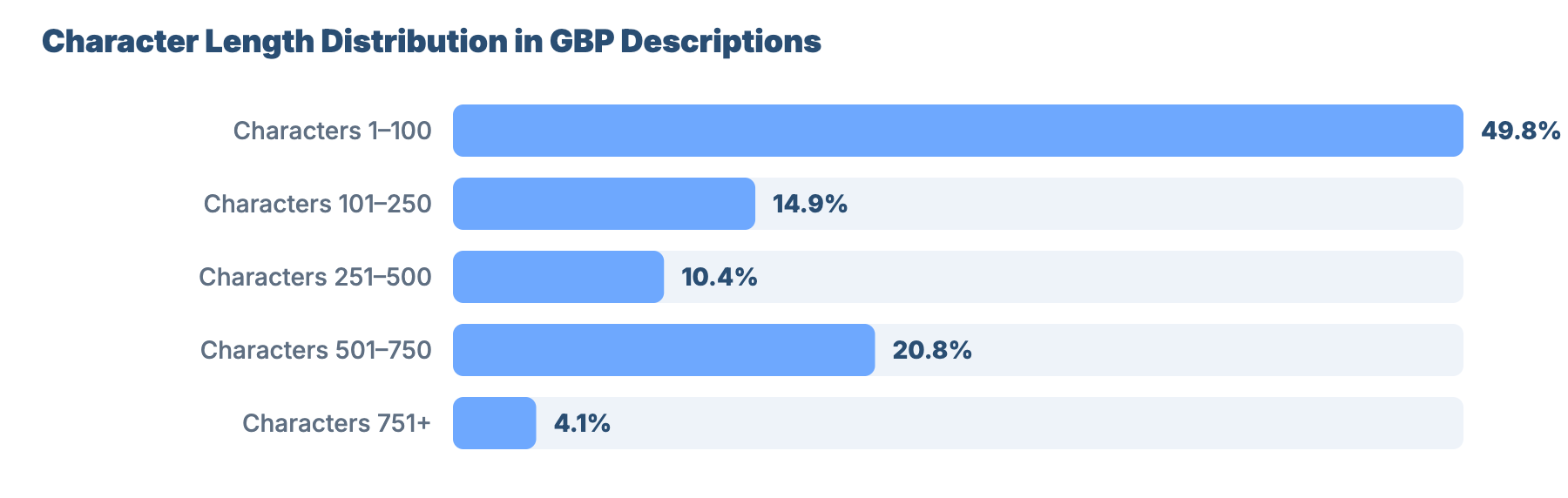
Every single one of the 221 analysed Google Business Profiles in Liverpool includes a description, yet half of all operators (49.8%) opt for brief summaries under 100 characters, resulting in a low median word count of just 15 words. While 20.8% utilise the fuller character limit (501–750 characters), the vast majority leave substantial digital real estate underutilised.
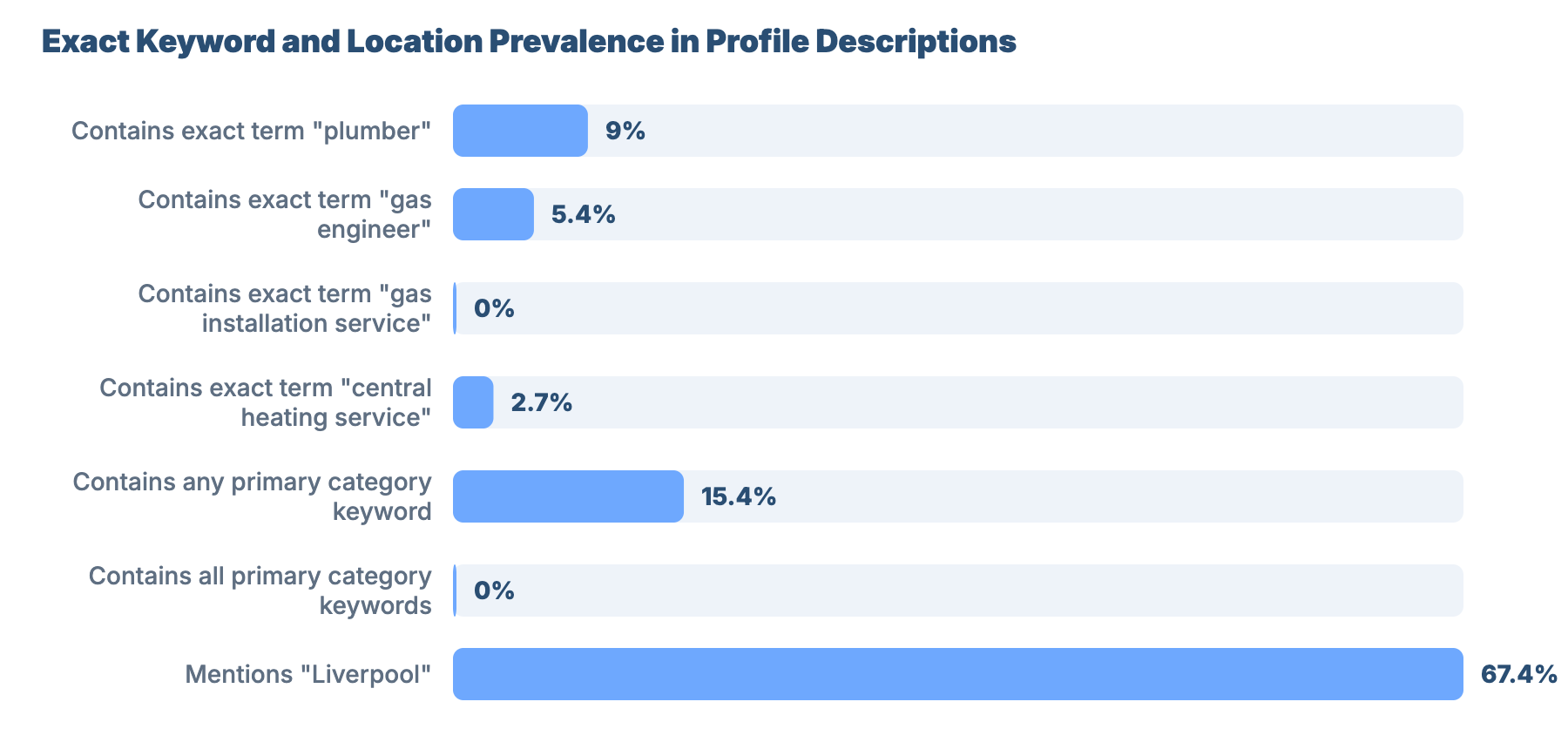
Keyword integration across profile descriptions is surprisingly sparse. Only 15.4% of profiles contain any exact primary category keyword—with ‘plumber’ appearing in 9.0% and ‘gas engineer’ in 5.4%—and zero profiles manage to incorporate all primary category phrases. However, explicit geographic grounding is strong, with 67.4% referencing ‘Liverpool’ directly and 43.2% targeting specific neighbourhoods or surrounding local areas.
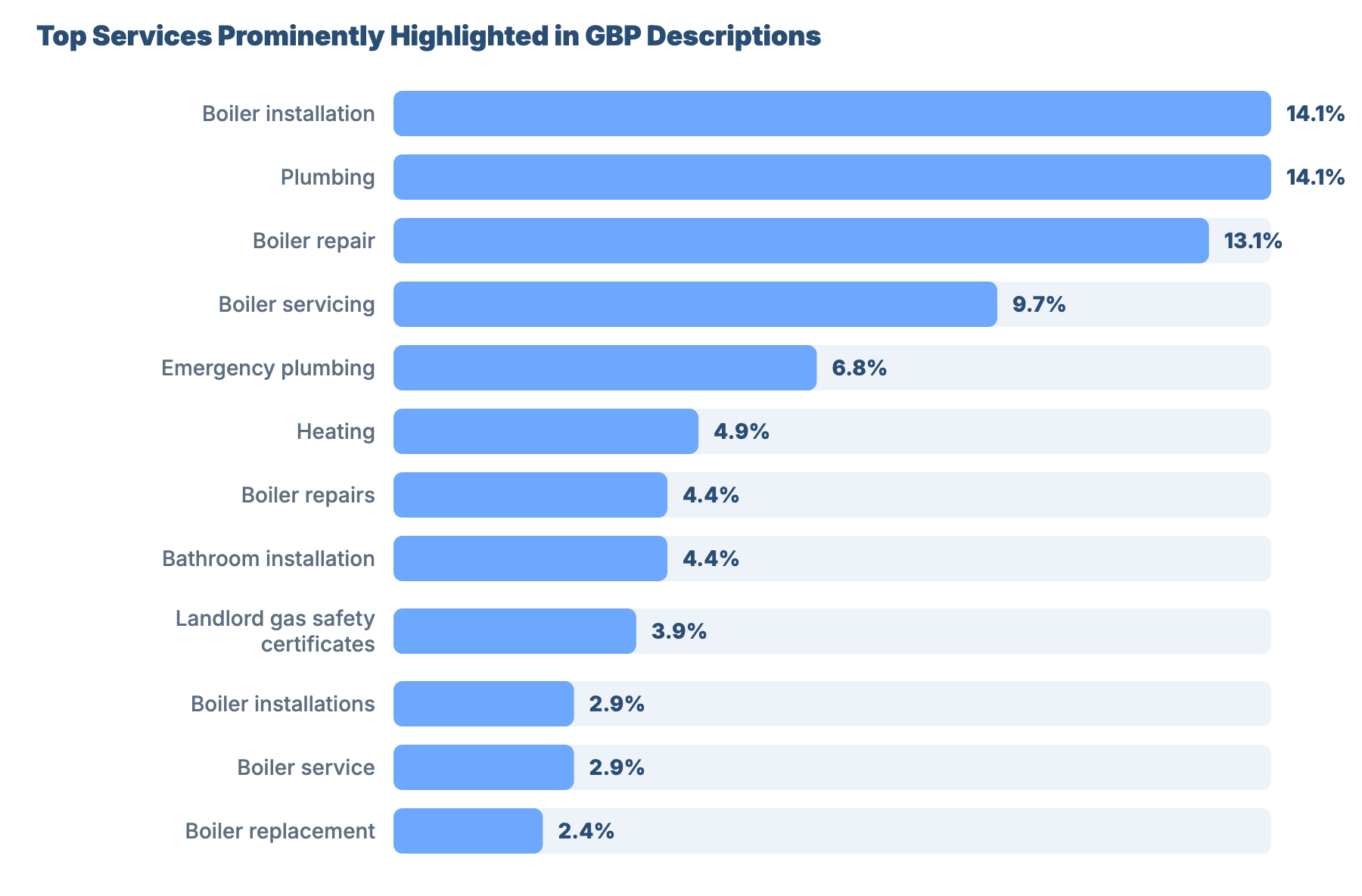
Service-level messaging is heavily concentrated on core heating tasks, led by boiler installation (14.1%), general plumbing (14.1%), and boiler repair (13.1%). Trust signals remain vastly underused: only 41.7% of profiles state at least one trust indicator, such as years of experience (21.4%) or official certifications (18.9%). Furthermore, a staggering 75.7% omit a direct call to action, leaving conversion opportunities unprompted.

What the data proves
- 100% of all 221 analysed profiles in Liverpool have completed the profile description field.
- Nearly half of businesses (49.8%) write descriptions under 100 characters, with a median length of 15 words.
- 67.4% of profiles explicitly include the word ‘Liverpool’ within their description text.
- Only 15.4% of profiles incorporate any exact primary category search phrase, with ‘plumber’ appearing in 9.0%.
What can be inferred
- Short character counts suggest many tradespeople view the GBP description as a minor setup formality rather than a conversion tool.
- High geographic inclusion rates indicate that Liverpool heating engineers intuitively recognise the value of local context for prospective customers.
- The low prevalence of direct calls to action (24.3%) represents an easy conversion opportunity for businesses that guide the user’s next step.
- Failing to explicitly mention Gas Safe registration or trade insurance in 58.3% of descriptions leaves valuable trust factors unused.
For established businesses
- Expand brief descriptions to 500+ characters, explicitly enumerating high-demand offerings like boiler servicing, unvented cylinders, and landlord safety certificates.
- Incorporate prominent trust signals including years in trade, Gas Safe details, and workmanship guarantees into the first two lines.
- End descriptions with a distinct call to action, such as prompting emergency calls or online booking requests.
For new entrants
- Capitalise on low competitor keyword density by including precise search phrases like ‘gas engineer Liverpool’ and ‘central heating service’.
- Define local service radii clearly by listing specific Liverpool suburbs alongside city-wide coverage terms.
- Adopt a professional, reassuring tone that clearly separates your brand from the 50.5% of competitors using basic, neutral summaries.
Primary Category Selection across Liverpool Heating and Plumbing Profiles
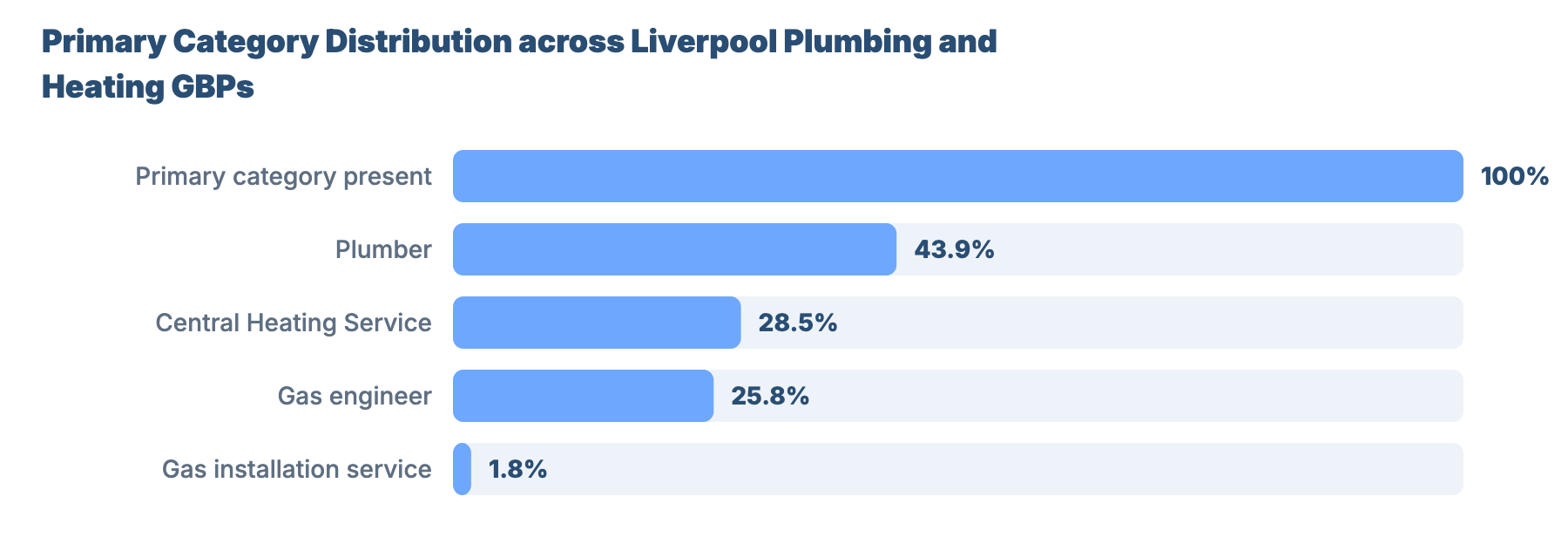
In Liverpool’s heating and plumbing landscape, 100% of the 221 analysed Google Business Profiles have designated a primary category. The market splits predominantly into three main classifications: ‘Plumber’ (43.9%, 97 profiles), ‘Central Heating Service’ (28.5%, 63 profiles), and ‘Gas engineer’ (25.8%, 57 profiles). Meanwhile, ‘Gas installation service’ represents a minimal niche at just 1.8% (4 profiles).
This distribution reflects how local tradespeople position their core services within the local search ecosystem. While ‘Plumber’ serves as the broad catch-all baseline for nearly half the market, more specialised trades choose ‘Central Heating Service’ or ‘Gas engineer’ to align directly with boiler installs and emergency heating repairs. The stark drop-off for ‘Gas installation service’ suggests operators rarely select hyper-specific installation tags over broader, higher-volume service categories.
For businesses targeting keywords like ‘SEO for Plumbers and Gas Engineers Liverpool’, this categorical split reveals where market density sits. Primary category selection establishes the core semantic baseline for local map pack visibility, making strategic alignment—and complementary secondary category usage—essential for capturing both general plumbing and specialist gas queries.
What the data proves
- 100% of analysed profiles (221 of 221) have an active primary category selected.
- Plumber is the dominant primary category, chosen by 43.9% (97 profiles) of businesses in Liverpool.
- Central Heating Service and Gas engineer combined represent 54.3% (120 profiles) of the market.
- Gas installation service is the least utilised category, held by only 1.8% (4 profiles) of operators.
What can be inferred
- Operators selecting ‘Plumber’ may be casting a wider net for general domestic repairs rather than specialising purely in heating.
- The low adoption of ‘Gas installation service’ implies business owners view it as too narrow for a primary GBP designation.
- Secondary categories are likely relied upon by the 54.3% of non-plumber listings to capture general plumbing leads.
For established businesses
- Audit secondary category coverage to ensure profiles set to ‘Central Heating Service’ or ‘Gas engineer’ also include ‘Plumber’ where relevant.
- Leverage Google Business Profile custom services and sub-categories to capture specific gas installation queries if your primary tag is broader.
- Review local map pack rankings across target Liverpool postcodes to assess whether aligning your primary category with specific boiler intent yields higher conversion rates.
For new entrants
- Select ‘Plumber’ as your primary category if your business model depends on high-frequency, general domestic call-outs.
- Choose ‘Gas engineer’ or ‘Central Heating Service’ as your primary category if you focus on high-ticket boiler replacements and gas safety certifications.
- Ensure all applicable secondary categories are populated from day one to cover all trade permutations without fragmenting your local search footprint.
Action playbooks
Established businesses
- Migrate legacy websites from HTTP to HTTPS immediately, resolving a critical security flaw shared by 57% of local competitors.
- Expand category mapping to include high-converting secondary categories such as ‘Boiler supplier’, ‘Gasfitter’, and ‘Central Heating Service’ to mirror top-tier profiles.
- Break through the top 10% review threshold (98+ reviews) by implementing automated SMS post-service review requests to compete with the 50.1% review concentration held by market leaders.
- Upgrade GBP photo assets from the market median of 9.5 to over 64 images (Top 10% threshold), showcasing geotagged job completions, branded vans, and Gas Safe registration.
- Implement UTM parameters on website CTA links (currently used by only 3.5% of listings) to accurately track organic map pack conversions in Google Analytics 4.
- Align operating hours with local demand: 28.1% of profiles gain extra late-night and weekend map pack visibility by listing 24/7 availability.
Starting out in this market
- Claim your Google Business Profile immediately, instantly vaulting ahead of the 24% of unclaimed trade listings in Liverpool.
- Establish local authority by configuring a local 0151 geographic phone number or dedicated mobile line (62.7% of competitors use mobile).
- Select ‘Plumber’ or ‘Gas engineer’ as your primary category, then add 2-3 secondary categories like ‘Central Heating Service’ to cover core search terms.
- Target the baseline review milestone of 14 reviews (market median) within your first 60 days to build conversion parity.
- Craft a comprehensive 500+ character description featuring explicit local neighbourhood references alongside ‘Liverpool’ (utilised by 67.4% of profiles).
- Publish at least 10 high-resolution photos of recent boiler installations and plumbing work on day one to exceed the baseline market median of 6 photos.
Frequently asked questions
Why is local SEO important for plumbers and gas engineers in Liverpool?
Local SEO ensures trade businesses appear in Google’s Map Pack when homeowners experience urgent heating or plumbing issues. With 50.1% of reviews controlled by just 10% of Liverpool firms, a structured SEO campaign allows independent engineers to gain visibility and compete against dominant market leaders.
Which primary category should a gas engineer select on Google Business Profile?
In Liverpool, 43.9% of analysed trade profiles select ‘Plumber’, while 25.8% choose ‘Gas engineer’ and 28.5% select ‘Central Heating Service’. If your core business is boiler servicing and gas work, select ‘Gas engineer’ or ‘Central Heating Service’ as your primary category, adding ‘Plumber’ as a secondary category.
How many reviews do I need to rank a plumbing business in Liverpool?
The median review count for plumbers in Liverpool is 14. However, entering the top 25% requires at least 45 reviews, and reaching the top 10% requires 98 or more reviews. Newer businesses should aim for 15-25 high-quality reviews to establish baseline competitiveness.
Does having HTTP instead of HTTPS hurt my local plumbing business?
Yes. Our research revealed that 57% of Liverpool trade profiles with websites still link to unencrypted HTTP URLs. Security warnings deter prospective customers and negatively impact user engagement signals, making HTTPS migration an urgent technical priority.
Should I list my plumbing business as open 24 hours on Google?
Currently, 28.1% of Liverpool trade profiles list 24-hour opening times. If you genuinely offer emergency callout services, listing 24/7 hours increases your map pack impressions during late-night and weekend searches when standard 8am-5pm competitors are closed.
What additional categories offer the biggest advantage for Liverpool gas engineers?
The most effective secondary categories identified in the Liverpool dataset include ‘Central Heating Service’ (41.6% adoption among profiles with secondary categories), ‘Boiler supplier’ (29.7%), and ‘Gasfitter’ (25.7%). Adding these ensures coverage across related search queries.
Methodology and caveats
Dataset of 221 Google Business Profiles categorised under ‘plumber’, ‘gas engineer’, ‘gas installation service’, and ‘central heating service’ in Liverpool (0151 telephone area code). Analysis encompasses listing completeness, category structures, review counts, photo volume, web security protocols, and description content.
This dataset reflects an observational audit of 221 public Google Business Profiles in the Liverpool area collected for market research purposes. While statistical correlations exist between profile completeness (such as claimed status, review volume, and photo density) and market presence, these observations do not represent official Google algorithm ranking factors. Local search engine algorithms evaluate complex, dynamic systems where proximity, organic website domain authority, and historical user engagement interact continuously.
