 Skip to content

You're probably doing what most small business owners do. You search your main service on Google, check Maps, don't see yourself where you want to be, then wonder whether you need more website pages, more backlinks, more posts, or just more time.
Most of the advice you'll find is a bloated checklist. That's the wrong way to approach Google Maps. If you want to learn how to rank in Google Maps, you need priorities, not noise. A handful of actions move the needle. The rest are supporting work.
Google Maps ranking isn't random. It follows a clear pattern. Get the profile right, build trust signals, stay active, strengthen authority off-profile, then measure properly so you stop guessing.
Table of Contents
- The Unmissable Foundation Your Google Business Profile
- Build Prominence with Reviews and Photos
- Signal Your Relevance with Active Engagement
- Establish Authority with Citations and Local Links
- Measure What Matters with Geo-Grid Rank Tracking
- Your Prioritised Google Maps Ranking Checklist
The Unmissable Foundation Your Google Business Profile
Your Google Business Profile is the first job. Not your homepage. Not a backlink campaign. Not a fancy content plan.
According to the 2026 Whitespark Local Search Ranking Factors survey summary, Google Business Profile signals account for exactly 32% of the total UK Local Pack ranking weight. The same source says review signals account for 20% and on-page website signals account for 15%. That means your profile has more direct ranking impact than your website's local content alone.
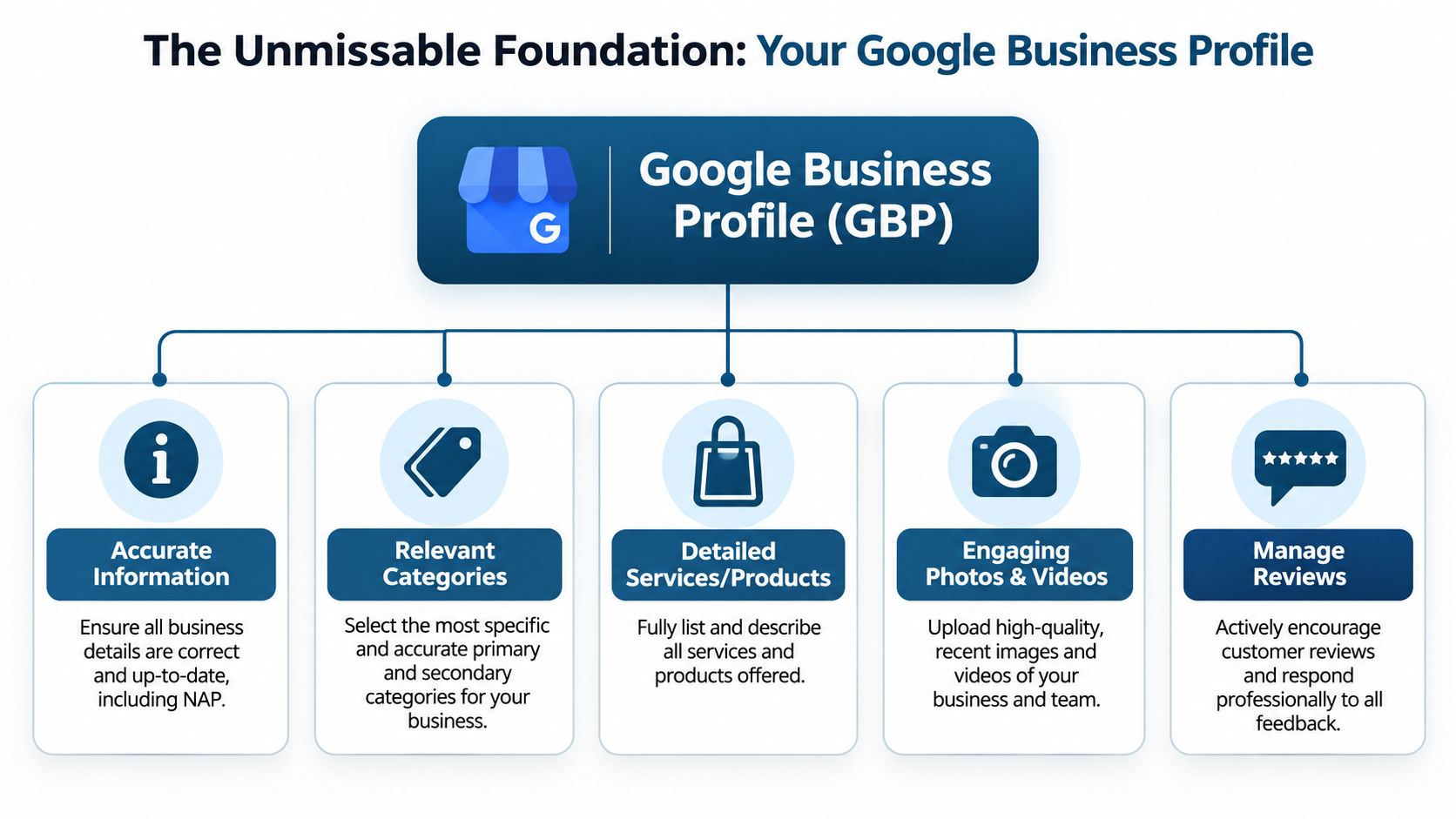
Get the core fields right first
A weak profile creates confusion. Google needs to understand exactly what you do, where you operate, and whether the business is real and maintained.
Start with these essentials:
- Business name. Use your real trading name only. Don't stuff in keywords or town names that aren't part of it.
- Primary category. This is one of the most sensitive fields in the whole profile. If you're a boiler repair specialist, don't choose something broad if a more precise option exists.
- Phone number. Use the number you answer.
- Address or service area setup. Present the business exactly as it operates in real life.
- Opening hours and special hours. If these are wrong, users lose trust and Google gets a stale signal.
Practical rule: if a field affects what you do, where you do it, or whether a customer can contact you, fill it in completely and keep it current.
The fields that matter most
The biggest mistake I see is treating profile setup like admin. It isn't admin. It's positioning.
Your primary category tells Google which searches you're relevant for. Your secondary categories widen the net without muddying the main signal. Your services and products give context. Your description helps reinforce what the business offers. Your photos prove the business exists and is active.
A simple way to look at it:
| Profile field | Why it matters |
|---|---|
| Primary category | Defines your main search relevance |
| Secondary categories | Expands coverage for related services |
| Services list | Connects your profile to specific jobs people search for |
| NAP consistency | Confirms legitimacy across the web |
| Photos and videos | Improve trust and user interaction |
NAP means Name, Address, and Phone number. If your business name is written one way on Google, another way on a directory, and your old phone number still appears elsewhere, Google gets mixed signals. That doesn't help you rank.
If you need a cleaner way to manage these fields without jumping around Google's interface, use a dedicated Google Business Profile Manager guide.
One more point. Completeness matters, but relevance matters more. Don't fill the profile with every possible phrase. Fill it with accurate, specific information that matches the way customers search and the way your business operates.
Build Prominence with Reviews and Photos
You can have a well-built profile and still lose the click to a competitor down the road. The difference is usually prominence. Google wants evidence that your business is known, trusted, and actively chosen by local customers.
That is why this section matters so much. Reviews and photos are not busywork. They are two of the fastest ways to strengthen trust, improve click-through rate, and give Google fresh signals that your business is active in the world.
MapLift's analysis of Google Maps ranking factors places heavy weight on prominence and review signals. You do not need to chase every possible tactic here. Get the basics right in a steady, disciplined way, and you will beat businesses that only pay attention in short bursts.
Reviews are your strongest proof of trust
Reviews influence rankings, but their bigger job is helping you win the click once you appear. A profile with weak reviews gets skipped. A profile with recent, specific, believable reviews gets calls.
Focus on review quality and consistency first. Total volume matters, but a long list of old reviews is less persuasive than a steady flow of fresh ones. Google and customers both care about recency because it shows the business is still delivering.
Use this order:
- Ask right after the job is done. That is when satisfaction is highest and response rates are best.
- Send a direct link by SMS or email. Remove friction or people will forget.
- Ask for honest detail. Service type, location, and outcome help far more than “great service”.
- Reply to every review. It shows the profile is managed and gives future customers more confidence.
- Fix operational problems that create bad reviews. Ranking follows reputation. It does not replace it.
One clear recommendation. Build a review request process your team can repeat every day. If requests and replies are slipping through the cracks, set up a proper Google review management workflow so follow-up happens on time and no review sits unanswered.
A business with 80 reviews from two years ago often loses to a business with fewer reviews coming in every month. Fresh trust usually wins.
Photos improve engagement, and engagement helps you rank
Photos shape first impressions fast. Before someone calls you, they want proof you are real, local, and active.
The best-performing photo sets are usually simple and specific:
- Team photos that show the people customers will deal with
- Branded vehicles that make you recognisable on arrival
- Completed work that proves quality
- Before and after photos where they fit the service
- Short videos showing real jobs, your premises, or your process
Generic stock-style images do very little. Real photos tied to real services do the job. They reduce doubt, improve clicks, and make it easier for customers to choose you over a profile that looks neglected.
Upload new media on a regular schedule. Do not dump a batch once, then leave the profile untouched for six months. A business that keeps adding current photos looks active. An outdated gallery sends the opposite message.
If you only have time for a few updates this month, do these first: ask for recent reviews, reply to every review already on the profile, and upload fresh photos from completed jobs. That small set of actions drives outsized gains because it improves both trust and engagement at the same time.
Signal Your Relevance with Active Engagement
A static profile slips behind. That's the pattern.
Google has shifted more weight towards activity signals. According to this analysis of 2025 Google Maps ranking changes, Google reduced proximity dominance and increased the importance of review response speed and engagement metrics such as click-to-call rate, direction requests, and website clicks. The same source says active Q&A participation, review responses, weekly Google Posts, and messaging responses are now baseline signals for competitive UK rankings.
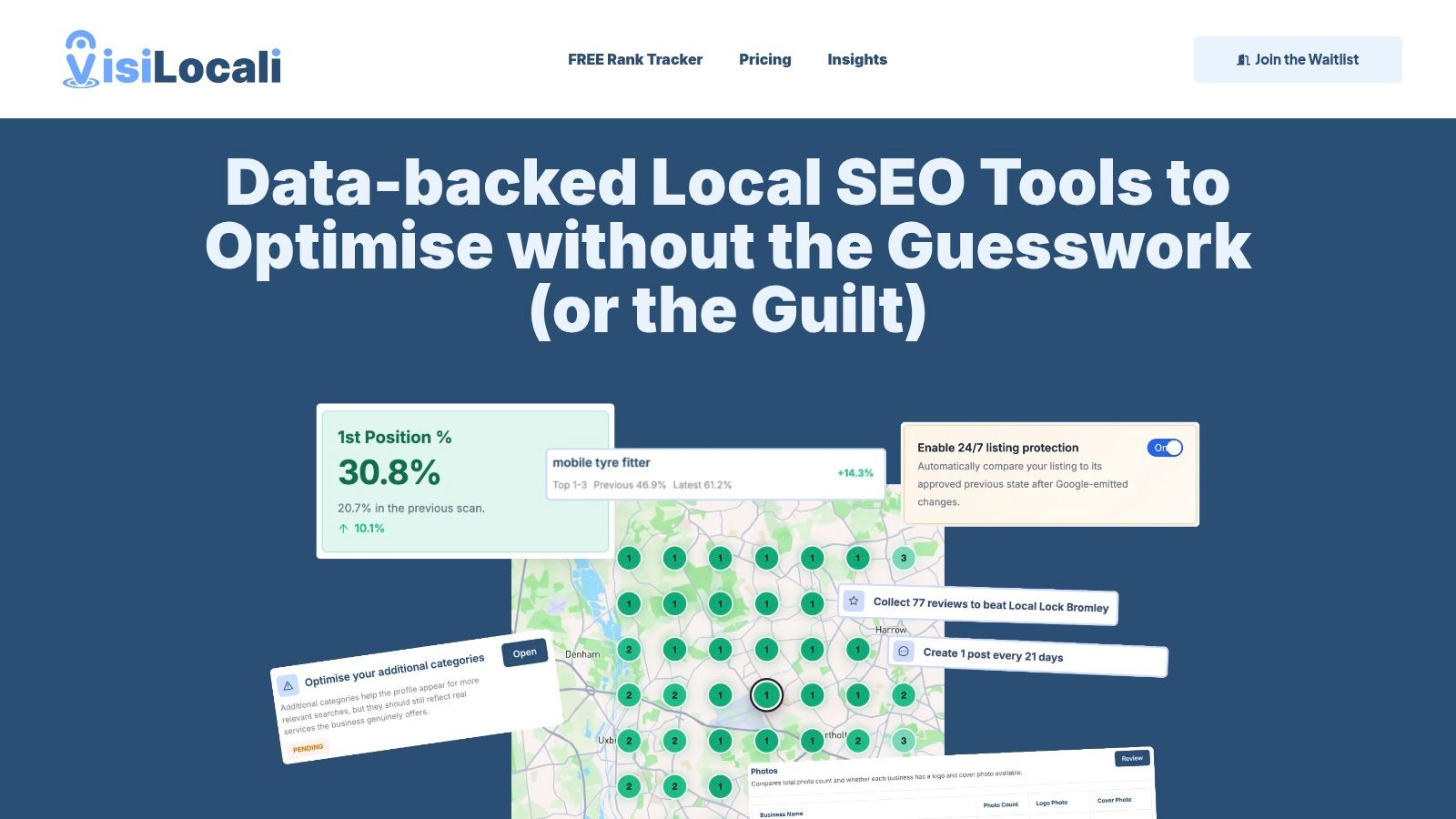
Use Google Posts like a relevance signal
Most businesses either ignore Posts or treat them like social media leftovers. That's lazy, and it shows.
A good Google Post should match real customer intent. If you're a roofer, post storm repair updates, not vague branding lines. If you're a dentist, post about emergency appointments, whitening, or new patient availability. If you're a solicitor, post clear service updates that match commercial queries.
Use Posts for:
- Current offers that a local searcher might act on
- Service-specific updates tied to your core jobs
- Seasonal demand shifts such as heating, drainage, or pest spikes
- Operational updates like changed hours or holiday coverage
Keep the writing plain. One image, one topic, one call to action.
Take control of Q and A and response activity
The Questions & Answers feature is badly underused. Worse, many owners don't realise that anyone can ask a question and anyone can answer it.
That means you should seed common questions yourself and answer them clearly. Think like a customer:
| Question type | Better example |
|---|---|
| Service scope | “Do you cover both Bath and nearby villages?” |
| Timing | “Do you offer same-day call-outs?” |
| Payment | “Do you accept card payments?” |
| Specialism | “Do you repair combi boilers?” |
Then stay active in the basics:
- Reply to reviews quickly
- Answer new questions promptly
- Check messages
- Update Posts weekly
- Refresh service information when anything changes
Worth doing today: write down the five questions customers ask on the phone most often, then add those answers to your profile.
Businesses often chase advanced tactics while ignoring the activity that proves they're open, responsive, and relevant. That's backwards. If Google sees one profile getting clicks, replies, and updates, and another sitting unchanged, it doesn't need much help choosing.
Establish Authority with Citations and Local Links
Local SEO used to produce terrible advice on this point. People were told to submit their business to every directory they could find and call it authority building.
That approach is outdated. You don't need more mentions. You need the right mentions.
Stop chasing directory volume
There are two broad types of business mention:
- Structured citations. These appear in directories and listings such as Yell-style business databases where your NAP details are formatted in clear fields.
- Unstructured mentions. These appear in articles, local blogs, sponsorship pages, event listings, community sites, or local news coverage.
The second type matters more than many owners realise. A 2025 UK Digital Insights report discussed here found that 68% of UK businesses ranking in AI Overviews for local service queries had 15+ unstructured mentions in the past 6 months, while only 12% of guides explicitly recommend this tactic.
That should change your priorities.
A decent local authority plan looks like this:
- Clean up core citations. Make sure your business details match across your main listings.
- Earn relevant mentions. Sponsor a local event, join a chamber or trade body, support a school raffle, contribute to a community page.
- Get named in context. A mention on a local article about “recommended electricians in York” carries more meaning than a random listing on a low-quality directory.
If another local website mentions your business in the context of real work, real places, and real community presence, that usually beats another duplicate directory entry.
Service area strategy needs restraint
If you're a service area business, be careful with how broadly you define your coverage. A huge service area sounds ambitious, but it often muddies local relevance.
The smarter approach is precision. Set service areas that reflect where you work, and support those places with matching proof across your profile, website, and mentions. If you serve three towns regularly, show that reality clearly. Don't pretend to cover half the country.
Local links fit into this same logic. The best links are usually boring in the best way. Trade associations, local business groups, charities you support, supplier stockist pages, community partnerships, event sponsors, and local press mentions. These aren't flashy. They're believable.
Measure What Matters with Geo-Grid Rank Tracking
You check Google Maps from your office, see yourself in the top three, and assume coverage is solid.
Then calls from the next town stay flat.
That gap is why rank tracking matters. Google Maps rankings change by searcher location, so one search from your phone tells you almost nothing about how visible you are across the area you want to win. If you want a prioritised plan instead of guesswork, measure the map the way customers experience it.
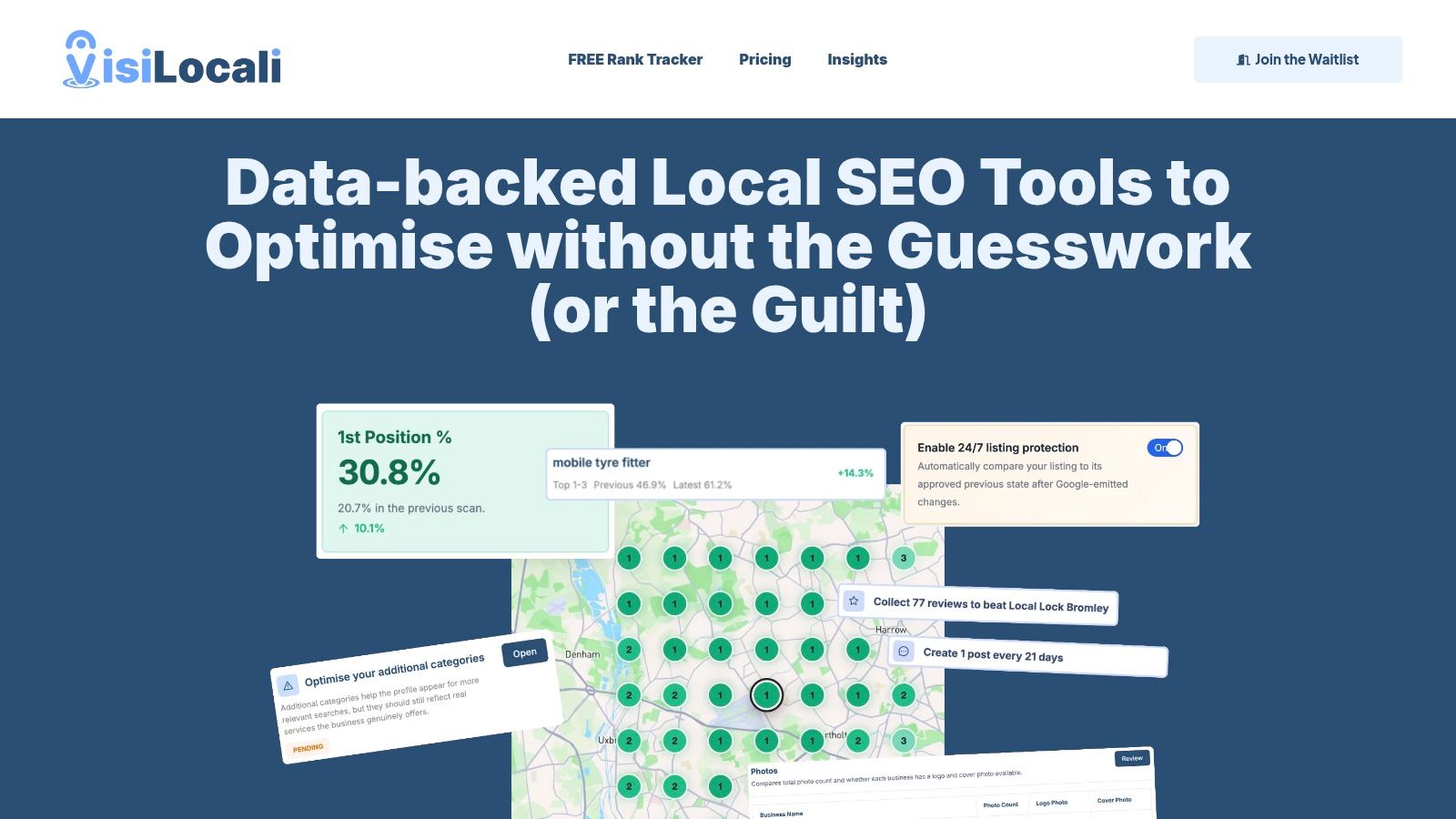
Why your own phone is a bad benchmark
Your device gives you personalised results. Location, search history, device settings, and proximity all skew what you see. That makes manual spot checks fine for curiosity and poor for decision-making.
A geo-grid scan fixes that. It maps rankings across multiple points in your service area, so you can see where you consistently show up, where you fade, and where competitors own the map. That matters because local SEO is rarely an all-or-nothing problem. You usually have strong pockets and weak pockets, and each one points to a different fix.
What a geo-grid actually helps you diagnose
Do not obsess over average rank. Look at the pattern.
If rankings are strong close to your address but fall apart in a nearby town, you have a relevance or authority gap in that area. If visibility is patchy in every direction, the issue is usually broader. Weak categories, thin location signals, poor review coverage, or a stronger competitor set.
Use the scan to answer practical questions:
- Where do we already rank well enough to protect?
- Which towns or postcodes are underperforming?
- Is the weakness tied to one service keyword or all of them?
- Are competitors beating us everywhere, or only in specific pockets?
Those answers stop you wasting time on the wrong fix.
The right way to use geo-grid tracking
Keep the process simple and repeatable.
Pick one primary keyword per core service
Track the terms that drive leads, not every variation you can think of.Scan the specific area you want to rank in
Include the towns, districts, or postcodes that matter commercially.Run scans on a schedule
Monthly is enough for many small businesses. Weekly makes sense if you're actively improving the profile and website.Compare map performance with your local SEO work
If one area improves after better review coverage, stronger service pages, or new local mentions, keep pushing there.Track competitors in the same grid
You need to know who owns the visibility you want and where they are weak.
If you want a simple place to start, use a geo-grid local SEO rank checker tool that shows visibility across an area instead of one vanity search result.
The point is not more reporting. The point is better priorities. Geo-grid tracking shows where the next hour of work is most likely to improve your Google Maps visibility.
Your Prioritised Google Maps Ranking Checklist
Most Google Maps advice fails because it treats everything as equal. It isn't.
Some tasks are foundational. Some are multipliers. Some only matter once the basics are already working. If you want a practical answer to how to rank in Google Maps, use this order and stick to it.
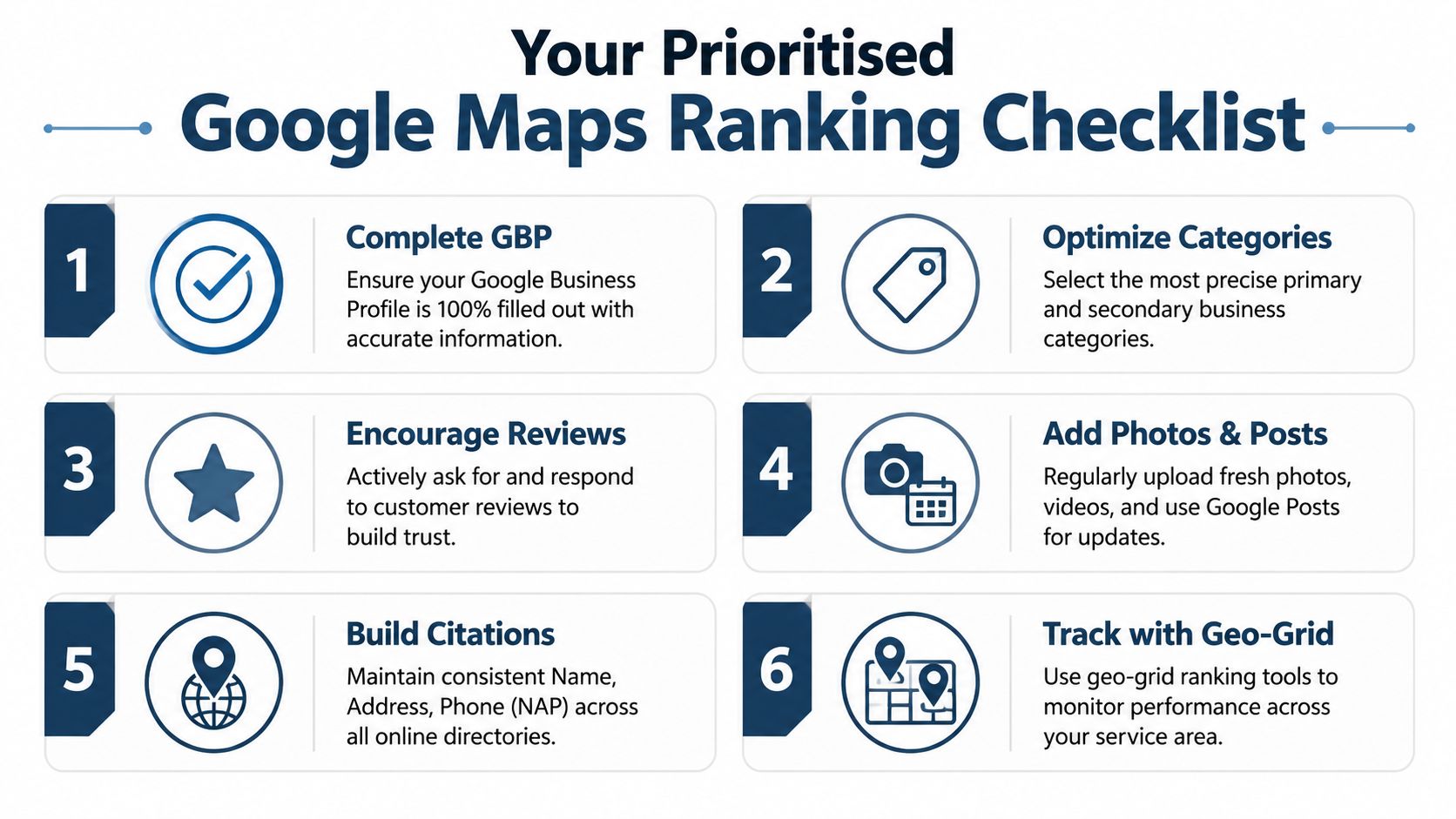
Do this this week
Start with the work that directly affects visibility.
- Complete your Google Business Profile. Fill every important field with accurate business information.
- Fix your primary category. Choose the most specific category that matches your main service.
- Add secondary categories carefully. Use them to support adjacent services, not to stuff keywords.
- Audit NAP consistency. Your name, address, and phone number should match across your main web mentions.
- Upload real photos. Team, work, vehicles, premises, and service examples beat generic branding every time.
This is your base. If this layer is sloppy, everything else underperforms.
Do this every month
Once the foundation is stable, build momentum with recurring actions.
Use a short operating rhythm:
| Frequency | Task |
|---|---|
| Weekly | Add a Google Post and check Q&A |
| Weekly | Ask for fresh reviews and reply to new ones |
| Monthly | Upload new photos or short videos |
| Monthly | Check citations and correct inconsistencies |
| Monthly | Review ranking coverage across your target area |
Keep it boring and consistent. That wins more often than sporadic bursts of effort.
Do this once the basics are working
At this point, you move from maintenance to strategic gains.
- Pursue unstructured mentions on local sites, community pages, and news features.
- Tighten service area targeting so your profile reflects the places you serve.
- Use geo-grid tracking to spot weak zones and act on them.
- Compare your listing against top local competitors to find practical gaps.
- Prioritise the next fix based on likely impact, not based on what feels easiest.
Good local SEO isn't about doing more tasks. It's about doing the right tasks in the right order.
That's the playbook. Build the profile properly. Earn trust through reviews and photos. Stay active. Strengthen authority off-profile. Measure by area, not by guesswork.
If you want help turning ranking data into a simple action plan, VisiLocali is built for exactly that. It shows where you rank in Google Maps, highlights the profile gaps holding you back, and tells you what to improve next without drowning you in bloated SEO reports.
