 Skip to content


You check Google Maps for your business before opening the doors. Yesterday, your plumber listing appeared in the local pack for an important service search. Today, it's lower, or missing from several nearby areas. You check again from your own postcode, see a different result, and still don't know whether you've found a genuine problem or ordinary local-search noise.
That uncertainty is why daily rank tracking needs to be operational, not passive. The useful question isn't, “What position am I in?” It's, “Where did visibility change, did customers respond, and what should I improve next?”
Table of Contents
- Why Daily Rank Tracking Matters for Local Businesses
- Choosing Keywords and Configuring Geo-Grid Scans
- Handling Volatility and Separating Signal from Noise
- Creating Alerts and Integrating GBP Performance Signals
- Prioritising Actions from Rank Changes
- Troubleshooting and Best Practices for Ongoing Tracking
Why Daily Rank Tracking Matters for Local Businesses
Local businesses don't compete for one universal ranking. A dentist can be highly visible near its surgery, less visible across the other side of town, and absent from a nearby location altogether. Google's own explanation says local results are mainly shaped by relevance, distance and prominence. Relevance reflects how well a Business Profile matches a search, distance reflects the searcher's location or the location used in the query, and prominence reflects how well-known the business is online and offline. You can read the full explanation in Google's guidance on local ranking.
That makes local rankings different from a standard organic position. Google Maps, the Local Pack, and traditional blue-link results are separate search surfaces, and a business can perform well on one while underperforming on another. A single manual search from the owner's phone can't show that pattern.
Map visibility is commercial visibility
Google dominates UK search behaviour. One UK local SEO source reports Google's share of desktop and mobile search in the UK at about 93.5% in July 2025 (UK local SEO search data). Ofcom-based reporting cited by the same source says 37% of UK adults use Google Maps monthly, while 30% use any traffic and maps service monthly. Google Maps reach among UK online adults also rose from 69% in May 2023 to 73% in 2024, a four-point increase, according to that source.
The implication is practical. A ranking movement in Maps can affect whether someone discovers a roofing company, calls a solicitor, requests directions to a restaurant, or chooses a competing clinic. Local pack visibility is also widespread across service searches. A UK study reported that the local pack appears on 95.6% of trades queries and above 90% of most other local-service sectors (UK local search ranking factors).
Practical rule: Track the places and searches that produce customers, not every keyword that happens to mention your town.
Daily monitoring doesn't mean reacting to every movement. It means building enough evidence to recognise meaningful changes early, connect them with Google Business Profile activity, and prioritise a sensible action before a monthly report hides the timing.
Choosing Keywords and Configuring Geo-Grid Scans
Start with commercial intent. A keyword deserves frequent monitoring when a customer searching it is close to contacting or visiting the business.
A plumber might prioritise “emergency plumber Leeds”, “boiler repair Leeds”, and “leaking pipe repair”. A dentist may focus on “emergency dentist Bristol”, “private dentist Bristol”, and “dental implants Bristol”. A restaurant could track “Italian restaurant York”, “Sunday lunch York”, and “restaurant near York station”. Brand terms and broad informational phrases can remain in a lower-frequency group unless they clearly influence enquiries.
Build a focused daily keyword set
UK-focused rank-tracking guidance recommends concentrating daily monitoring on the 10-20% of keywords that drive most revenue, while using a lower cadence for less volatile or less commercially important terms (daily versus weekly rank tracking). Treat that as a prioritisation principle, not a reason to guess. Use enquiries, booked jobs, phone calls, direction requests, and staff knowledge to identify the terms that matter.
Separate terms into three groups:
- Daily terms: Revenue-driving searches, launch targets, and phrases affected by active Google Business Profile work.
- Weekly terms: Useful service or location combinations that matter but rarely need an immediate response.
- Baseline terms: Broader discovery phrases retained for trend analysis and strategic review.
Then configure a geo-grid rather than relying on one postcode. VisiLocali's local search rank tracker uses map-based scans to show how visibility changes across a selected area.
Match the grid to the business area
Centre the first scan on the business address. For a shop, clinic, or restaurant, that reflects the strongest point of physical relevance. For a service-area business, add surrounding towns or areas where the company actively accepts work.
The grid format should reflect the decision you're making:
- 5×5: A compact view for a town centre, single neighbourhood, or tightly defined service area.
- 7×7: A broader view when customers come from several districts or suburbs.
- 9×9: A detailed coverage pattern for larger service areas or businesses comparing multiple towns.
Choose the radius based on the operating area, rather than stretching it until the map looks impressive. VisiLocali supports these grid formats and radii up to 10,000km, but a local business normally needs a radius that reflects its actual customers.
For a keyword containing a town name, manually select the scan centre in that town when appropriate. A business outside the town boundary may want to know whether it appears for “bathroom fitter Harrogate” from points inside Harrogate, not merely from its registered address. This separates address-based visibility from query-location relevance.
Handling Volatility and Separating Signal from Noise
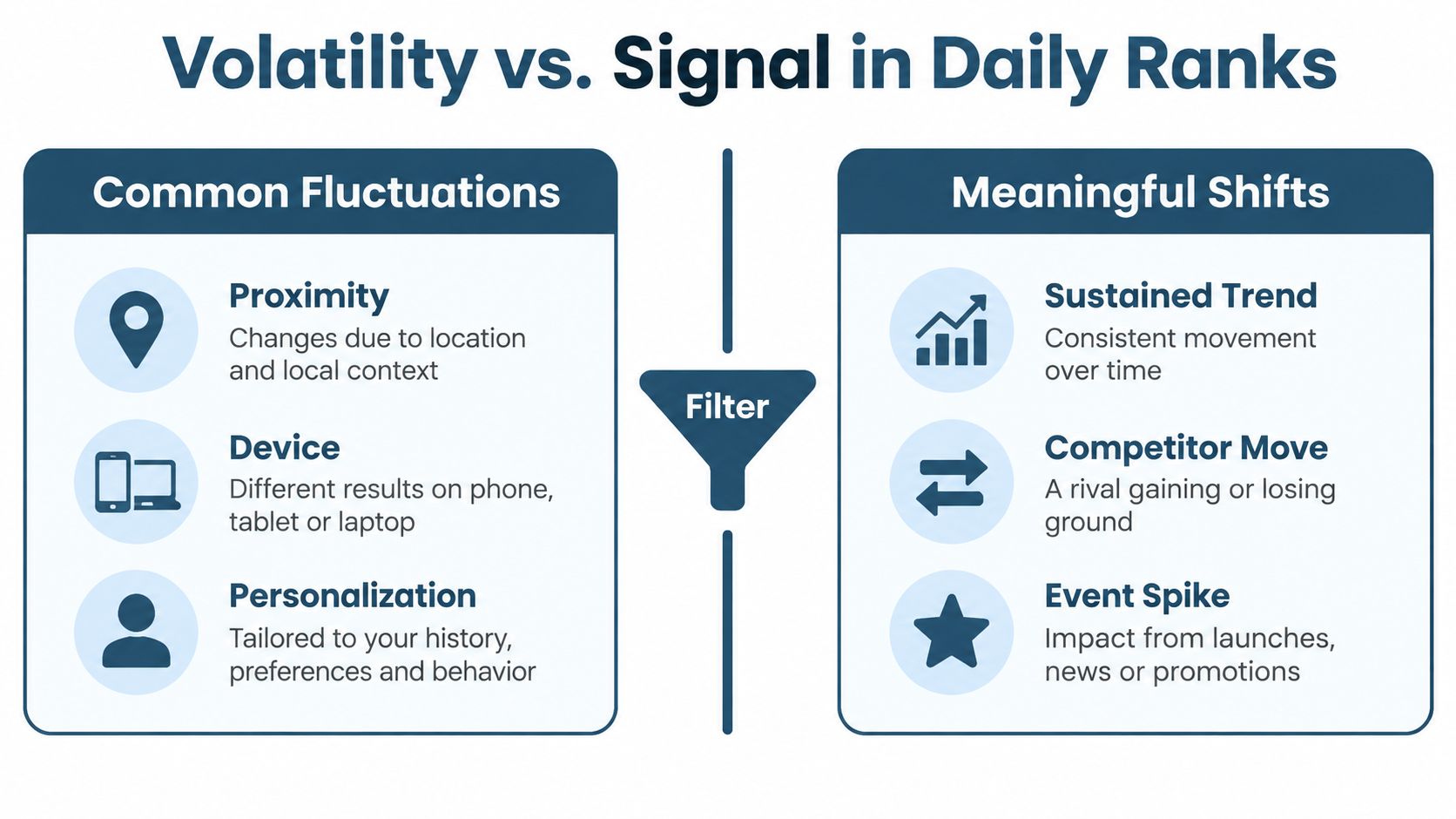
Daily data is valuable only when you interpret it with restraint. Local rankings can move because the searcher is closer to one competitor, the business is open or closed, a competitor has changed its profile, or Google has recalculated relevance. A small movement at one grid point is evidence, but it isn't automatically a task.
Google's local ranking factors explain why this happens. Whitespark's 2026 local search ranking factors survey places the primary Google Business Profile category at the top of local pack factors with a score of 227, followed by proximity at 225, keywords in the business title at 223, a physical address in the city of search at 213, and being open at the time of search at 189 (Whitespark-related UK local ranking summary). The same survey gives “dedicated page for each service” the top local organic factor score of 210.
Classify the movement before acting
Use the shape of the change, not just its size.
A single-position change at one point in a grid might reflect normal variation. A movement across several adjacent points, a sustained decline for a valuable term, or a disappearance from page one deserves investigation. UK guidance specifically recommends alerts for a five-position drop or any move from page one to page two (daily rank tracking thresholds).
A useful operating model looks like this:
- Low volatility: Review on a weekly basis and avoid reacting to isolated changes.
- Medium volatility: Monitor daily during profile edits, campaigns, or competitor activity.
- High volatility: Use daily alerts and check the affected grid points alongside GBP changes.
Suppose a restaurant drops slightly at two outer grid points but remains stable near its address. That's probably not an urgent failure. If it moves from page one to page two across the central area after its primary category changes, investigate the category, business relevance, and profile completeness before changing the website.
Wait for a pattern, act on a threshold, and always inspect the location attached to the ranking.
Daily tracking is particularly useful after operational updates. Changes to categories, opening hours, special hours, services, or business details can alter how Google interprets relevance and availability. A monthly report may show that visibility declined, but it won't show the timing clearly enough to connect the decline with a specific change.
Creating Alerts and Integrating GBP Performance Signals
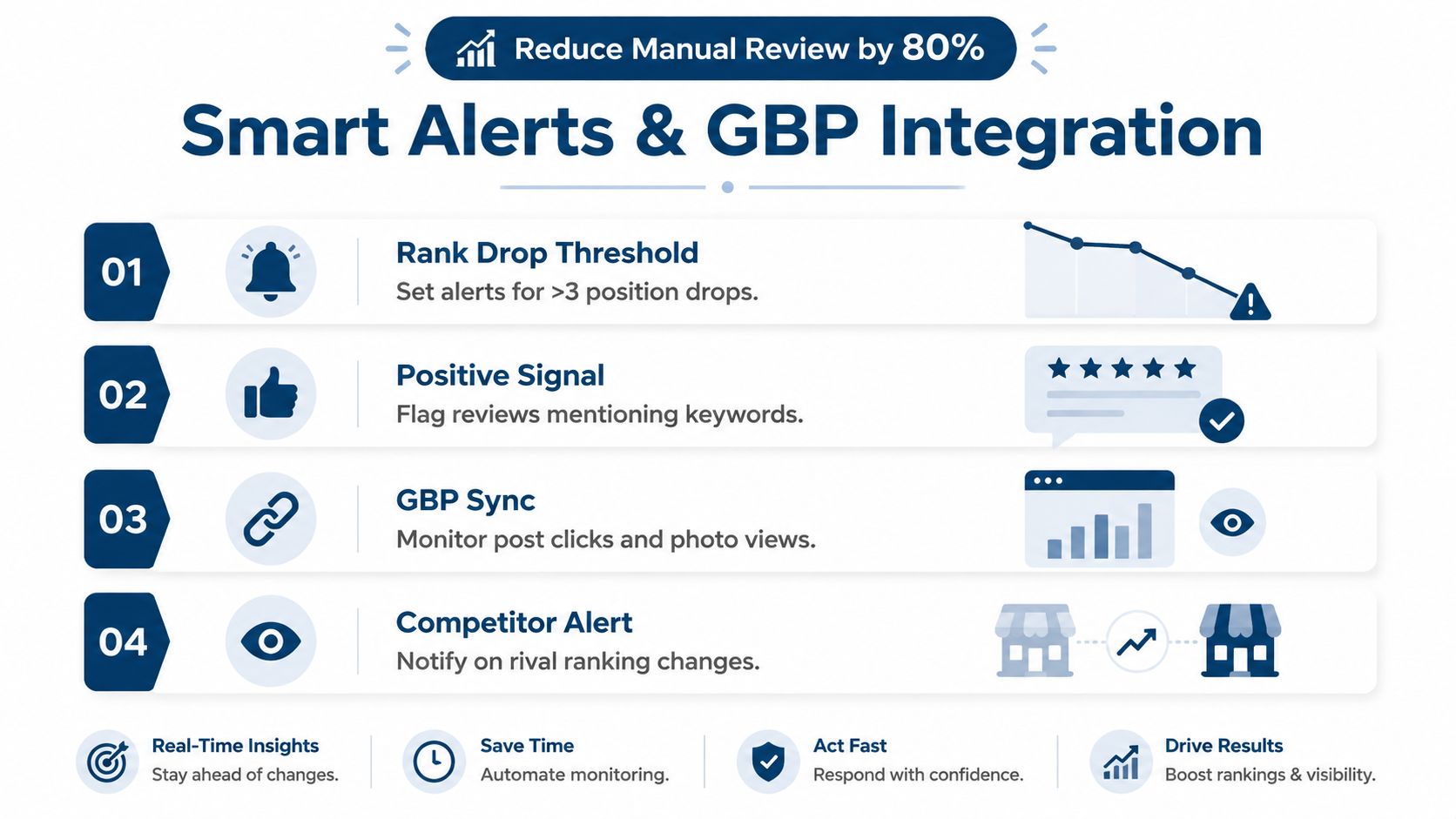
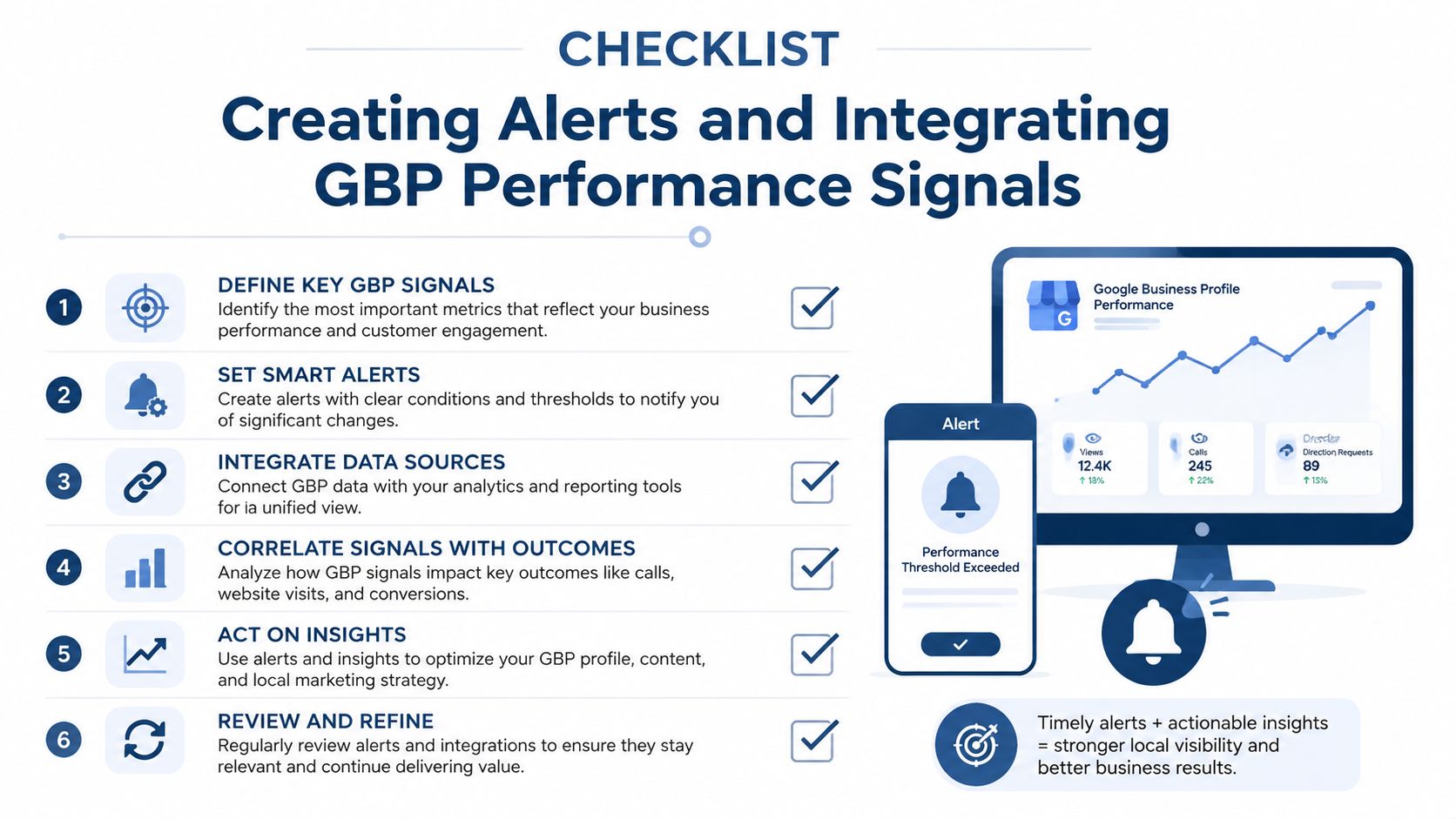
A rank alert should answer three questions quickly: what changed, where did it change, and what customer behaviour changed with it? If it only reports that a keyword moved, it creates more checking rather than better decisions.
Set alerts around business importance and movement size. A critical emergency-service term may deserve an alert when it drops five positions or crosses from page one to page two. A low-value informational term can wait for the weekly review. Segmenting this way keeps the alert queue useful.
Pair rankings with customer actions
Rankings are a visibility measure. Google Business Profile performance shows whether people responded to that visibility. UK local SEO guidance recommends monitoring search queries, profile views, direction requests and call clicks, and exporting 12 months of baseline data for comparisons (UK Google Maps rank tracking guidance).
Use those signals together:
- A ranking improvement with more call clicks is a stronger commercial signal than a ranking improvement with no behavioural change.
- A ranking decline with stable calls may indicate that customers are finding the business through another query or channel.
- More profile views with fewer direction requests can justify checking location accuracy, opening information, or the clarity of the offer.
- Query changes can reveal new wording that should be added to keyword monitoring.
Review velocity, photo count, and profile completeness also deserve context. UK local search analysis identifies GBP completeness, review velocity, photo count, and behavioural signals among strong correlates of map-pack performance, while warning against relying on total review count alone (local SEO ranking factors in the UK). Recent review growth may be more useful operationally than a large historic total, particularly when competitors are actively collecting reviews.
Keep reports readable
The daily view should be brief. Show priority keywords, affected grid areas, triggered alerts, and the related GBP signals. The weekly view can add competitor movement, review activity, photos, posts, and completed actions. Retain the longer baseline for trend analysis rather than forcing every detail into a daily email.
A good report tells the owner what changed and what to do next. It shouldn't make them interpret an undifferentiated export of every tracked term.
Prioritising Actions from Rank Changes
A ranking drop is not an instruction to edit everything. The quickest way to waste local SEO time is to change the website, categories, description, photos, and review process at once. You'll lose the ability to identify which action addressed the problem.
Start with the affected search surface and location. If the drop appears only in Maps, inspect the Google Business Profile and local relevance first. If organic visibility falls for a service phrase, inspect the corresponding service page and its local intent. If competitors move into the same grid area, compare what they're doing before assuming your profile has a technical fault.
Use competitor gaps as an action list
Side-by-side profile comparisons make prioritisation more concrete. Compare the primary category, secondary categories, opening information, services, business description, photos, reviews, posts, and completed profile fields. The aim isn't to copy a competitor. It's to identify a legitimate gap that prevents your profile from describing the business as clearly and completely.
The ranking survey data supports starting with relevance and location mechanics. Primary category, business-title relevance, proximity, city-boundary presence, native Google reviews, and profile verification are among the influential local pack factors highlighted in the Google Local Pack guide. You still need to apply judgement. Never add a category just because a competitor has it if the category doesn't accurately describe the business.
Choose the next action by evidence
Consider these decisions:
- Category mismatch: If the primary category doesn't describe the core service, investigate and correct it before spending time on cosmetic profile changes.
- Incomplete profile: If important services, hours, attributes, or contact fields are missing, complete the profile so Google and customers receive consistent information.
- Review weakness: If competitors receive recent, service-relevant reviews while your profile has little recent activity, create a compliant process for requesting genuine customer feedback.
- Visual gap: If competitors present a fuller, more current set of relevant photos, upload authentic images that help customers understand the premises, team, work, or experience.
- Stable rankings with weak actions: If positions hold but calls or direction requests lag, review the offer, opening information, photos, and customer-facing profile copy.
AI recommendations are useful when they explain the reason behind the task. VisiLocali combines ranking data with profile and competitor comparisons to identify gaps and produce recommendations that describe what to improve and why. That turns a movement on a map into a manageable GBP action rather than another item in a spreadsheet.
Use search engine ranking reports to document the movement, the diagnosis, the action taken, and the customer signal you'll review afterwards. A disciplined record prevents repeated work and makes it easier to distinguish a useful optimisation from a coincidental fluctuation.
Troubleshooting and Best Practices for Ongoing Tracking
Most tracking problems come from poor setup, not from the dashboard. If the scan centre sits at the business address but the business targets a nearby town, the results may answer the wrong question. If the keyword is too broad, it may produce little commercial insight. If it's too narrow, the daily data may be too sparse to guide decisions.
Audit the configuration when the business changes:
- New service areas: Add relevant towns and create scans that reflect where the business accepts customers.
- Additional locations: Give each location its own keywords, scan centre, competitors, and grid.
- Category expansion: Add service terms only when the business offers those services.
- Alert fatigue: Remove low-value terms from daily monitoring when they repeatedly create noise without prompting action.
- Search-centre errors: Manually choose a town-centre scan for town-named queries when the address alone doesn't represent the intended search location.
Maintain a reliable baseline
Export baseline data before substantial profile or website work. Use the longer history to identify direction and seasonality, while treating daily results as an early-warning system. Review the keyword list quarterly, and reset the baseline annually or after a major change in services, location, or business structure.
Validate the dashboard against reality. Ask whether staff are receiving more calls, whether customers mention Google Maps, whether direction requests are changing, and whether the tracked searches match the language customers use. A perfect-looking ranking chart that doesn't correspond with enquiries is not a useful success measure.
Daily rank tracking works when it creates a short list of decisions. Configure the right scan centre, monitor high-value terms, filter normal movement, connect rankings with GBP performance, and use competitor gaps to choose the next action.
Start your 14-day free trial of VisiLocali to track Google Business Profile rankings across geo-grids, compare competitor profiles side by side, and receive AI insights and recommendations for the actions most likely to improve visibility. Visit VisiLocali and turn daily ranking changes into a clear local SEO workflow.
