 Skip to content

Picture two plumbers in Leeds. Both have decent websites, both have a Google Business Profile with a few dozen reviews, and both have paid someone to “do citations”. One shows up in the Maps pack across most of the city. The other barely appears beyond his own postcode. The difference often comes down to where their business details live online, and what kind of mentions they’ve collected.
Most local business owners hear the word “citation” and assume it means submitting their details to every directory going. That’s part of the picture, but only part. There’s a second category of mention, often ignored, that can do just as much for your visibility, and sometimes more.
Choosing between structured and unstructured citations for local SEO isn’t really an either/or decision. It’s a question of balance, timing and budget. Get the mix right and your Google Business Profile has a solid foundation of trust behind it. Get it wrong and you can spend hundreds of pounds on listings that do very little. This guide covers what each type is, where it fits, and how to decide what deserves your time first.
The Fundamentals of Business Citations in Local SEO
A citation is any online mention of your business’s name, address and phone number, usually shortened to NAP. Some citations include a link to your website. Many don’t. Google uses these mentions as corroborating evidence: if your business appears with the same details across many trustworthy sources, it becomes more confident that you exist, operate where you say you do, and deserve to be shown to nearby searchers.
Think of it as references on a CV. Your Google Business Profile is the CV itself, the central document Google looks at when deciding whether to show you in Maps. Citations are the referees who confirm what’s written there. A CV with no references is weaker, and a CV whose references contradict it is worse still.
Citations sit alongside other local ranking signals rather than above them. Relevance, proximity and prominence are the broad factors Google describes, and citations feed mostly into prominence and trust. They won’t rescue a thin profile with poor reviews and a vague category choice. They will, however, reinforce a profile that’s already in good shape.
This is why the sensible order of work for most established businesses is:
- Get your Google Business Profile accurate and complete
- Make sure your core NAP details are consistent everywhere they already appear
- Build new citations selectively, choosing the type that fits your gaps
The two citation types play different roles in that third step, so it helps to understand each properly.
Defining Structured Citations for Directory Consistency
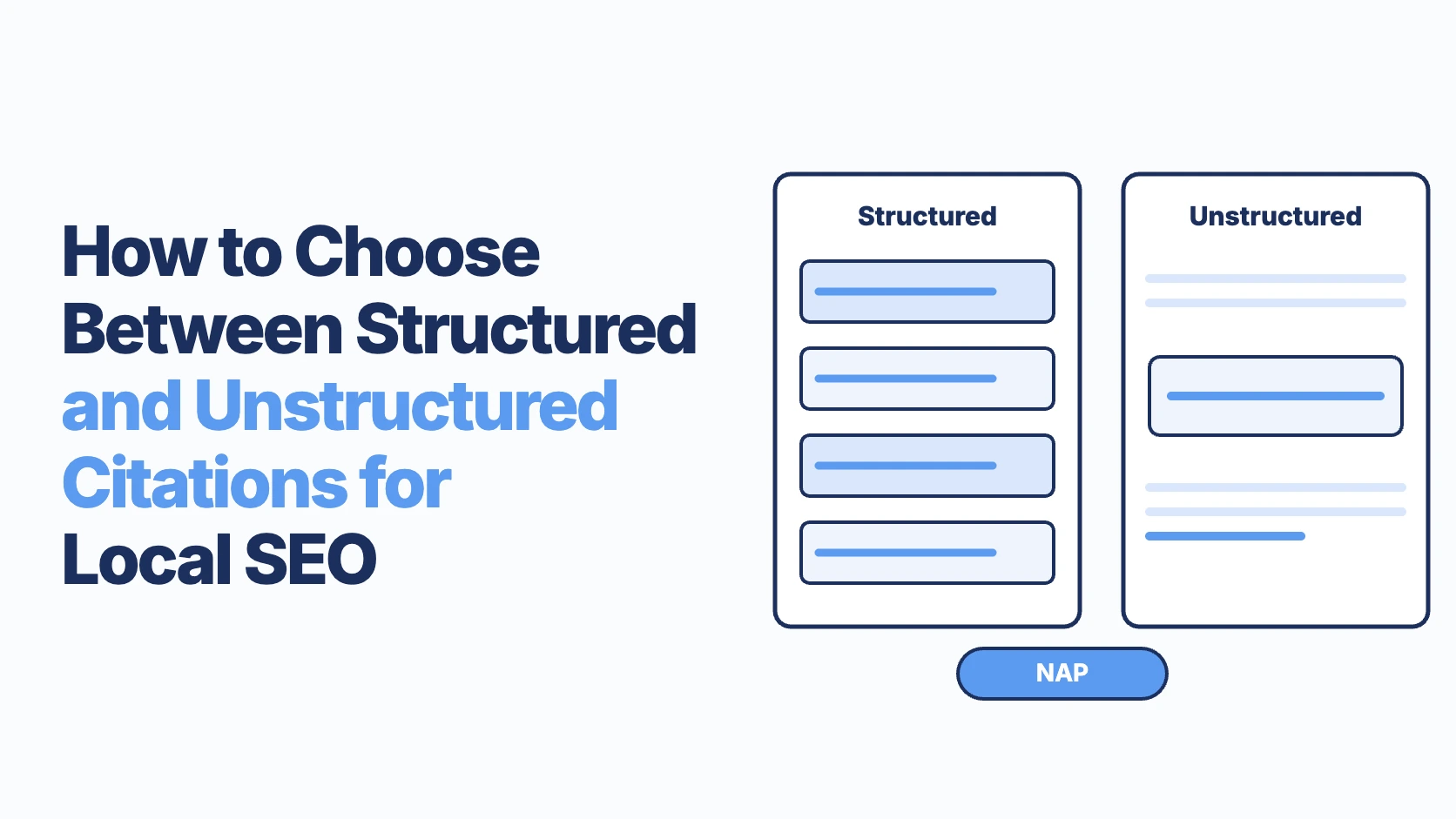
A structured citation is a business listing on a platform built specifically to hold business information in a fixed format. You fill in set fields: business name, address, phone number, website, opening hours, categories, sometimes photos and a description. The platform displays this in a predictable layout, which makes it easy for search engines to read and compare.
Yell, Thomson Local, Apple Business Connect, Bing Places, Facebook business pages and Yelp are typical examples for UK businesses. Industry platforms count too: Checkatrade and TrustATrader for tradespeople, Rightmove and Zoopla for estate agencies, NHS listings for GP surgeries and dental practices.
The main value of structured citations is consistency and coverage. They’re the baseline Google expects an established local business to have.
Primary Aggregators and Business Directories
In the US, a handful of data aggregators feed business information to hundreds of smaller sites, which is why American guides fixate on them. The UK picture is more fragmented. Some data does flow between platforms, but you can’t rely on one submission spreading everywhere.
For a UK business, the practical priority list usually looks like this:
- Core platforms: Apple Business Connect, Bing Places, Facebook and Yelp, because they power maps, voice assistants and widely used apps
- General UK directories: Yell, Thomson Local, Scoot and similar established names
- Industry-specific sites: the platforms customers in your trade actually use to compare providers
- Local directories: chamber of commerce listings, council business directories and town-specific guides
Industry and local listings are often worth more than the fiftieth generic directory. A Bristol electrician gains more from a solid Checkatrade profile than from twenty obscure listing sites nobody visits.
The Importance of NAP Uniformity
Structured citations only help if they agree with each other. If your profile says “Unit 4, Kirkstall Road” and three directories say “4 Kirkstall Rd” with an old mobile number, you’re sending mixed signals.
Minor formatting differences like “Rd” versus “Road” are rarely a problem. The damaging inconsistencies are the real ones: old addresses after a move, discontinued phone numbers, a former trading name, or a duplicate listing created by a previous agency. These confuse customers as much as search engines. A customer who rings a dead number from a Yell listing doesn’t try again; they ring your competitor.
The Role of Unstructured Citations in Digital PR
An unstructured citation is a mention of your business that appears outside a formatted directory. It might be a paragraph in a local news story, a recommendation in a blog post, a supplier listing on a partner’s website, or a thread on a community forum where someone names you as the roofer they’d use again.
These mentions don’t follow a template. Some include your full address and phone number. Many only mention your name and town. What they offer is context: they show that real people and real publications talk about your business in connection with a place and a service.
Leveraging Blog Mentions and News Features
The strongest unstructured citations tend to come from local media and respected blogs. A Manchester bakery featured in a city food guide, or a Glasgow accountancy quoted in a local business news piece about tax deadlines, gains a mention that’s both trusted and locally relevant.
You don’t need a PR agency to get these. Practical routes include:
- Sponsoring a local junior football team or charity event that publishes supporter pages
- Offering expert comment to local journalists on topics in your field
- Contributing to “best of” round-ups run by local bloggers
- Getting listed on suppliers’ or partners’ websites as an approved installer or stockist
- Hosting a free workshop or open day that a community site would cover
Each of these creates a mention that a directory submission simply can’t replicate, because it’s earned rather than self-entered.
Social Media Profiles and Community Forums
Social platforms sit in an awkward middle ground. A Facebook business page with filled-in fields behaves like a structured citation. A post in a neighbourhood Facebook group where someone tags your business and says “they fixed our boiler on a bank holiday” is unstructured.
Community forums, Nextdoor recommendations and Reddit threads for your city work similarly. You can’t control them, and you shouldn’t try to fake them, but you can encourage them by doing good work and making it easy for happy customers to name you. These mentions often carry the specific service and location language that customers search with.
Direct Comparison: Authority versus Contextual Relevance
The clearest way to understand the difference is to see the two types side by side.
| Factor | Structured citations | Unstructured citations |
|---|---|---|
| Control | High: you enter and edit the details | Low: someone else writes it |
| Speed | Fast: days or weeks | Slow: often months of relationship-building |
| Cost | Low to moderate; some paid listings | Varies; often time rather than money |
| NAP accuracy | Usually complete and editable | Often partial or unchangeable |
| Main benefit | Consistency, trust, baseline coverage | Context, local relevance, authority |
| Customer referrals | Some, from directory users | Can be strong from trusted publications |
| Risk | Inconsistent or duplicate listings | Outdated details you can’t fix easily |
Structured citations are about being verifiably present. They tell Google, “This business exists, here, with these details.” Unstructured citations are about being talked about. They tell Google, “People in this area recognise this business for this service.”
Neither replaces the other. A business with hundreds of directory listings but no genuine local mentions looks like it exists on paper only. A business with a glowing newspaper feature but missing from Apple Maps and Bing has obvious gaps in its basic footprint.
In practice, structured citations tend to give diminishing returns. The first thirty to fifty quality listings matter most; the next hundred rarely move the needle. Unstructured citations keep adding value because each one brings fresh context and, often, a link that strengthens your website too. That difference shapes how you should spend your effort once the basics are covered.
Strategic Factors for Choosing Your Citation Mix
So how do you decide where to focus? A sensible approach starts with two questions: how tough is the competition in your area, and what can you realistically commit each month?
Assessing Industry Competition and Niche Density
A dog groomer in a market town and a personal injury solicitor in central London face very different conditions. In low-competition niches, getting your structured citations complete and consistent might be enough to strengthen your position noticeably, particularly if competitors haven’t bothered.
In crowded markets, everyone credible already has the core directory listings. Structured citations become table stakes rather than an advantage. That’s where unstructured mentions, local press, partner pages and community recognition separate the businesses that dominate Maps from those stuck on page two.
The tricky part is knowing which situation you’re in. This is where seeing your visibility across your whole service area helps. VisiLocali’s Local Rank Tracker uses a visual ranking grid, plotting your Maps position at points across your target area, so you can see if you’re strong near your office but invisible three miles out. Pair that with a look at who outranks you in the weak zones, and you’ll quickly see whether competitors have a broad citation footprint you lack, or whether something else is holding you back.
Analysing Budget and Resource Allocation
Structured citation work is predictable. You can do it yourself over a few evenings, or pay a citation service a one-off fee. Some directories offer paid upgrades; most small businesses don’t need them.
Unstructured citations cost time more than money. Building a relationship with a local journalist or joining a business network takes months. If you’re a two-person team running jobs all day, be honest about what you can sustain. One genuine local mention per month, built steadily over a year, beats a frantic burst followed by nothing.
A rough rule: if your structured citations are incomplete or inconsistent, spend around 80% of your citation effort there first. Once they’re clean, flip the balance towards earning local mentions.
How to Audit Existing Mentions for Maximum Impact
Before you build anything new, find out what already exists. Most established businesses have a trail of listings, some created by them, some by previous agencies, some automatically scraped. An audit stops you duplicating work and uncovers the inconsistencies that actively hurt you.
Here’s a practical process you can run in an afternoon:
- Start with your Google Business Profile. Confirm your name, address, phone, categories, hours and website are exactly right. This is the master record everything else should match.
- Search your business name and phone number in Google. Include old numbers and previous addresses too. Note every listing that appears.
- Check the core platforms directly. Visit Apple Business Connect, Bing Places, Facebook, Yelp, Yell and your industry directories. Search for your business and record what each shows.
- Build a simple spreadsheet. List each source, the details it shows, whether it’s correct, and whether you have login access.
- Fix the most visible errors first. Prioritise wrong phone numbers and old addresses on high-traffic platforms over cosmetic formatting on obscure sites.
- Remove or merge duplicates. Duplicate listings split reviews and confuse customers.
- Note your unstructured mentions. Record press features, partner pages and blog mentions, and contact owners politely if details are outdated.
That first step matters more than people think. If your profile itself has gaps, every citation you build reinforces an incomplete picture. VisiLocali’s GBP Audit Tool reviews your business information, profile completeness, reviews, posts and other signals, then explains in plain language what to fix next, so you’re not guessing. Once the profile is right, the GBP Management Tool monitors it for unexpected edits, which matters because Google and third parties sometimes change your details without warning, and a wrong change can quietly undo your citation clean-up.
Hybrid Approaches for Long-Term Local Visibility
The businesses that hold strong Maps positions year after year rarely rely on a single tactic. They treat structured citations as foundations and unstructured mentions as the ongoing work that builds on them.
A realistic twelve-month plan for an established local business might look like this. In the first month, complete the audit and fix your Google Business Profile. In months two and three, clean up existing listings and fill gaps on the core and industry platforms. From month four onwards, shift to a steady rhythm of earning one or two local mentions a month while checking quarterly that your structured listings are still accurate.
Take a family-run estate agency in Bristol. After tidying its directory listings and claiming Rightmove and Zoopla profiles properly, it starts sponsoring a neighbourhood summer fair and writing a quarterly local property market update. Within months, local community sites are linking to those updates, a residents’ association lists the agency as a sponsor, and a local news site quotes its director on rental prices. None of these could be bought through a directory, yet each reinforces that the agency is a known part of the area.
The measurement side matters too. Rather than assuming your efforts work, check your ranking grid every few weeks. If visibility improves in the neighbourhoods where you’ve earned local mentions, you know the approach is working. If not, it’s time to look at other factors, such as reviews, categories or service area pages, rather than piling on more citations.
Future-Proofing Your Local Search Strategy
Local search keeps shifting. AI-generated answers, voice assistants and map apps increasingly pull business details from multiple sources at once, which makes consistent, trustworthy information more valuable rather than less. If an AI summary describes your business using an outdated address from a forgotten directory, that’s a real customer sent to the wrong place.
The safest long-term position is the one this guide has built towards. Keep your Google Business Profile as the accurate centre of everything. Maintain a tidy, complete set of structured listings on the platforms that matter. Then keep earning genuine mentions from local people, publications and partners, because that kind of recognition is very hard for competitors to copy and keeps paying off as search changes.
Treat the work as maintenance, not a project. A quarterly check of your key listings, an alert system for profile changes, and a steady trickle of earned mentions will outlast any one-off citation blast. When something changes in your rankings, you’ll have clean data to work out why.
If you’d like to see where your business actually stands, VisiLocali’s audit, management and rank tracking tools show what’s holding your profile back and which neighbourhoods need attention, all backed by a 90-day Improvement Guarantee. You can start with a 14-day free trial on any plan, whether that’s Monitor, Entrepreneur or Agency. Card details are needed at sign-up, purely to prevent trial abuse, and two weeks is plenty of time to run an audit and spot your first quick wins.
