 Skip to content
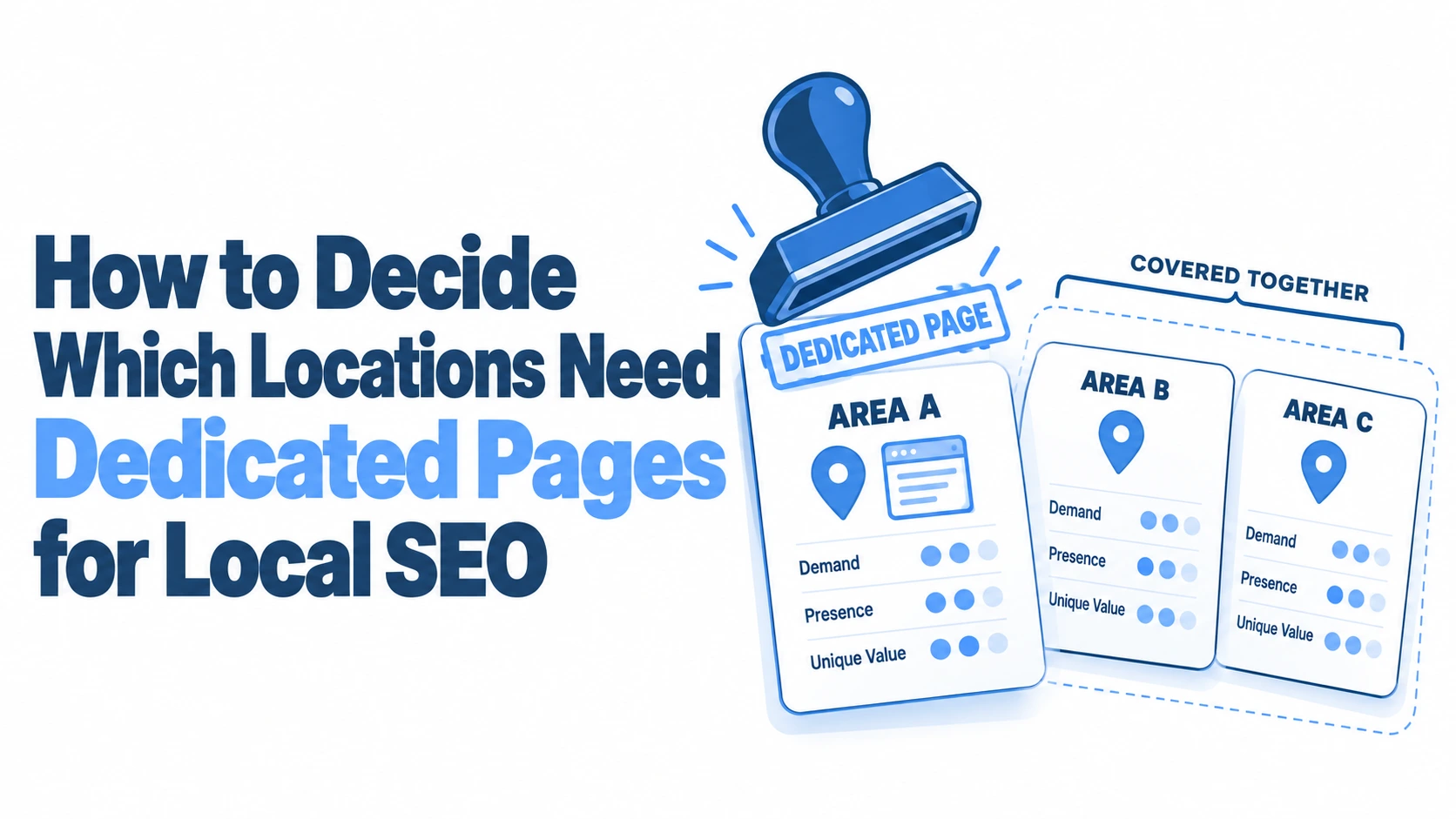
Every multi-location business hits the same question eventually: should you build a separate page for each place you serve, or will a single page listing all your areas do the job?
Get it right and you earn targeted visibility across Google Maps and local search. Get it wrong and you either spread yourself too thin with dozens of low-quality pages or miss out on valuable local traffic entirely.
The decision about which locations deserve their own dedicated pages is less about following a rigid formula and more about reading the signals: search demand, physical presence, competition, and your own capacity to maintain quality content over time.
A plumber based in Leeds who also covers Harrogate, Wetherby, and Ilkley faces a very different calculation than a dental practice with actual clinics in three cities.
This guide breaks down the practical criteria for making that call, from analysing search intent and competitor behaviour to knowing when a simple “areas we serve” directory is the smarter move. If you’ve been unsure whether your business needs five location pages or fifty, you’re about to get some clarity.
Core Indicators for Local Landing Page Necessity
Before you start building pages, you need honest answers to a few foundational questions. Not every location you serve warrants its own page, and creating one without justification can actually hurt your site’s performance. The indicators below help you separate genuine opportunities from wasted effort.
Presence of a Physical Office or Storefront
This is the simplest test. If you have a staffed location where customers can walk in, that location almost certainly needs its own page. Google treats physical addresses as strong relevance signals, and a dedicated page gives you a place to display your address, opening hours, parking details, and location-specific photos.
A dental practice with surgeries in both Manchester and Stockport should have separate pages for each. Each page can feature its own Google Business Profile embed, staff bios for that branch, and directions specific to the area. This isn’t just an SEO exercise: it’s genuinely useful for patients trying to find you.
Distinct Service Areas for Mobile Businesses
If you’re a mobile business (locksmiths, electricians, cleaning companies), you don’t have a shopfront in every town. But you still serve specific areas, and those areas may have enough search demand to justify their own pages. The key distinction is whether you actively and regularly serve that location, not whether you theoretically could.
A roofing company based in Bristol that regularly takes jobs in Bath, Weston-super-Mare, and Clevedon has a reasonable case for dedicated pages in each. A company that once did a single job in Taunton two years ago does not. Google’s guidelines are clear: claim areas you genuinely serve, and your content strategy should follow the same principle.
Significant Local Search Volume and Demand
Search volume is the deciding factor for borderline cases. If nobody is searching for your service in a particular town, a dedicated page won’t generate meaningful traffic. Use keyword research tools to check geo-modified terms like “boiler repair Harrogate” or “estate agent Wetherby.” If the monthly search volume is negligible (under 10-20 searches per month), that location probably doesn’t need its own page yet.
You can also check Google Trends to see whether demand in a particular area is growing. A new housing development on the outskirts of a city might signal rising demand that justifies building a page now rather than later.
Analysing Search Intent and Competitor Landscapes
Raw search volume only tells part of the story. You also need to understand what Google is already showing for local queries in your target areas, and what your competitors are doing.
Evaluating Localised Search Engine Result Pages
Search for your primary service plus each target location and study the results page carefully. Are you seeing a local pack (the map with three listings)? Are the organic results dominated by location-specific pages from other businesses, or are they generic national sites?
If Google is returning a local pack and location-specific pages from competitors, that’s a strong signal that a dedicated page is expected for that area. If the results are mostly generic, you might rank well enough with a broader service area page.
Pay attention to the “People also ask” section and related searches. These reveal what real users are looking for and can inform the content you’d put on a location page.
Benchmarking Against Competitor Location Strategies
Look at what your direct competitors are doing. If the top three plumbing companies in your region each have dedicated pages for the same six towns, and you don’t, you’re at a structural disadvantage. This doesn’t mean you should blindly copy their approach, but it does tell you what Google is rewarding in your niche.
VisiLocali’s Local Rank Tracker can be particularly useful here. Its visual ranking grids show exactly where your business ranks on Google Maps across different locations in your target area, making it easy to spot the towns where competitors are outperforming you and where there’s room to close the gap.
Identifying Geo-Modified Keyword Opportunities
Beyond your primary service, look for secondary keywords that pair well with location names. A solicitor might find that “conveyancing solicitor [town]” has decent volume in several nearby towns, while “family law solicitor [town]” only has volume in the main city.
This analysis can help you prioritise which locations get pages first. Start with the areas where multiple geo-modified keywords show demand, then expand to locations where only one or two terms have traction. Building a spreadsheet with locations as rows and keyword variations as columns gives you a clear picture of where the opportunities cluster.
Balancing SEO Value Against Resource Costs
Here’s where many businesses go wrong: they build 30 location pages in a weekend, each with 150 words of near-identical text, and wonder why none of them rank. The cost of creating and maintaining quality location pages is real, and you need to weigh it against the expected return.
Avoiding Content Cannibalisation Across Regions
Content cannibalisation happens when multiple pages on your site compete for the same search queries. If your “plumber Leeds” page and your “plumber Headingley” page are essentially identical except for the town name swapped in, Google may struggle to decide which one to rank, and both could suffer as a result.
The fix is ensuring each page has genuinely distinct content. This goes beyond changing the town name in a template. Each page should reference local landmarks, specific challenges common to that area (older housing stock, hard water issues, listed building restrictions), and ideally include testimonials from customers in that location. If you can’t create at least 400 words of unique, relevant content for a location, it probably shouldn’t have its own page.
Scalability and Maintenance of Local Content
Twenty location pages means twenty pages that need updating when your phone number changes, your services expand, or Google shifts its best practices. Before committing to a large number of pages, ask yourself honestly: can you maintain them?
Outdated location pages with wrong opening hours or discontinued services damage trust and can hurt your rankings. If you’re a small team, start with pages for your top five or six locations and expand only when you have the capacity to keep them current. A VisiLocali GBP Audit can help you identify which of your existing profiles and pages have gaps or outdated information, so you’re not guessing about what needs attention.
Criteria for Grouping Minor Locations
Not every town or village you serve needs the full treatment. Some locations are better handled as part of a grouped page, and knowing when to group versus when to separate is a skill that saves you time and protects your site quality.
When to Use a ‘Areas We Serve’ Directory
An “Areas We Serve” page works well when you cover a large number of small towns or villages where individual search demand is low. Think of a removal company based in Glasgow that covers dozens of surrounding towns: Paisley, East Kilbride, Clydebank, Motherwell, Hamilton, and many more.
Rather than creating 25 thin pages, a well-structured directory page can list all served areas with brief descriptions, organised by region or distance from your base. Each area listing can include a short paragraph about your service there, and you can always promote a listing to its own page later if demand grows.
This approach works best when:
- Individual locations have fewer than 20 monthly searches for your primary service
- You don’t have a physical presence in those locations
- The areas are geographically close and share similar characteristics
- You lack the resources to create truly unique content for each
Consolidating Low-Traffic Satellite Towns
Some locations sit in the orbit of a larger town and don’t generate enough independent search demand to justify their own page. A good rule of thumb: if a satellite town’s search volume is less than 15-20% of the nearby main town, consider covering it within the main town’s page.
For example, if “accountant Sheffield” gets 300 monthly searches but “accountant Rotherham” gets 90, Rotherham probably deserves its own page. But if “accountant Dronfield” gets 10 searches, it makes more sense to mention Dronfield on the Sheffield page with a line like “We also serve clients in Dronfield, just 15 minutes south of our Sheffield office.”
This keeps your site clean, avoids thin content penalties, and still signals to Google that you serve those smaller areas. You can always revisit the decision in six months if search patterns change.
Essential Elements for High-Performing Location Pages
Once you’ve decided which locations warrant dedicated pages, the quality of those pages determines whether they actually rank. A location page that’s just your homepage with a different town name plugged in won’t perform. Here’s what separates pages that rank from pages that sit on page four.
NAP Consistency and Google Business Profile Integration
NAP stands for Name, Address, Phone Number, and consistency across your website, Google Business Profile, and third-party directories is a fundamental local ranking factor. Each location page should display the correct NAP details for that specific branch or service area, matching exactly what appears on your Google Business Profile.
If you have a Google Business Profile for the location, embed a Google Map on the page and link to or reference your profile. For service-area businesses without a physical address in that town, use your main business address but make it clear on the page which areas you serve from that base.
VisiLocali’s GBP Management Tool can help you keep multiple profiles accurate and active from a single dashboard: managing business information, posting updates, responding to reviews, and monitoring for unexpected edits that could introduce inconsistencies. This is especially valuable if you’re managing profiles for three or more locations, where manual upkeep becomes genuinely time-consuming.
Hyper-Local Content and Unique Regional Value
This is where most location pages fail. Generic content with the town name swapped in doesn’t fool Google, and it certainly doesn’t impress potential customers. Each location page should feel like it was written specifically for people in that area.
Strong hyper-local content includes:
- References to specific neighbourhoods, streets, or landmarks (“Our team regularly works on properties along the Harrogate Road corridor and in the Chapel Allerton conservation area”)
- Local challenges relevant to your service (“Many homes in this part of Bath were built with limestone, which requires specialist pointing techniques”)
- Testimonials from customers in that specific area
- Local case studies or project examples with photos
- Information about parking, public transport access, or directions from local landmarks
- Mention of any community involvement, local sponsorships, or partnerships
The goal is a page that a local resident reads and thinks “these people actually know my area,” not “they’ve just copied and pasted this from another page.”
Measuring Success and Iterating Your Local Strategy
Building location pages isn’t a one-and-done project. The businesses that get the best results from local SEO treat it as an ongoing programme of testing, measuring, and refining.
Track each location page’s performance individually. At minimum, monitor organic traffic, keyword rankings for geo-modified terms, and conversions (phone calls, form submissions, direction requests). Google Search Console lets you filter performance by page, so you can see exactly which location pages are earning impressions and clicks.
If a page has been live for three to six months and still isn’t generating traffic, revisit your initial decision. Maybe the search demand isn’t there, or maybe the content needs strengthening. If a page is getting impressions but few clicks, your title tag and meta description probably need work.
VisiLocali’s Local Rank Tracker is particularly useful for this ongoing measurement. The visual ranking grids show you exactly where you’re visible on Google Maps across your target area, so you can see whether your new location pages are translating into improved map visibility in those specific towns. If you’ve built a page for Harrogate but your map rankings there haven’t budged, that’s a clear signal to investigate what’s missing.
Revisit your location page strategy every quarter. Search demand shifts, competitors enter and leave the market, and Google’s local algorithm continues to evolve. A location that didn’t justify its own page last year might now, and a page you built two years ago might need a content refresh to stay competitive.
The businesses that win at local SEO aren’t the ones with the most pages: they’re the ones with the right pages, kept current, and backed by genuine local relevance. Start with the locations where the evidence is strongest, build pages that genuinely serve local searchers, and expand methodically as your capacity and data support it.
If you’re unsure where your visibility stands right now across the areas you serve, VisiLocali offers a 14-day free trial on any plan, giving you access to rank tracking grids, GBP audits, and profile management tools. It’s a practical way to see which locations are already working and where the gaps are before you commit to building new pages. Developed by a local SEO specialist with over 10 years of experience, the platform is built to tell you what to do next rather than just hand you raw data.
