 Skip to content

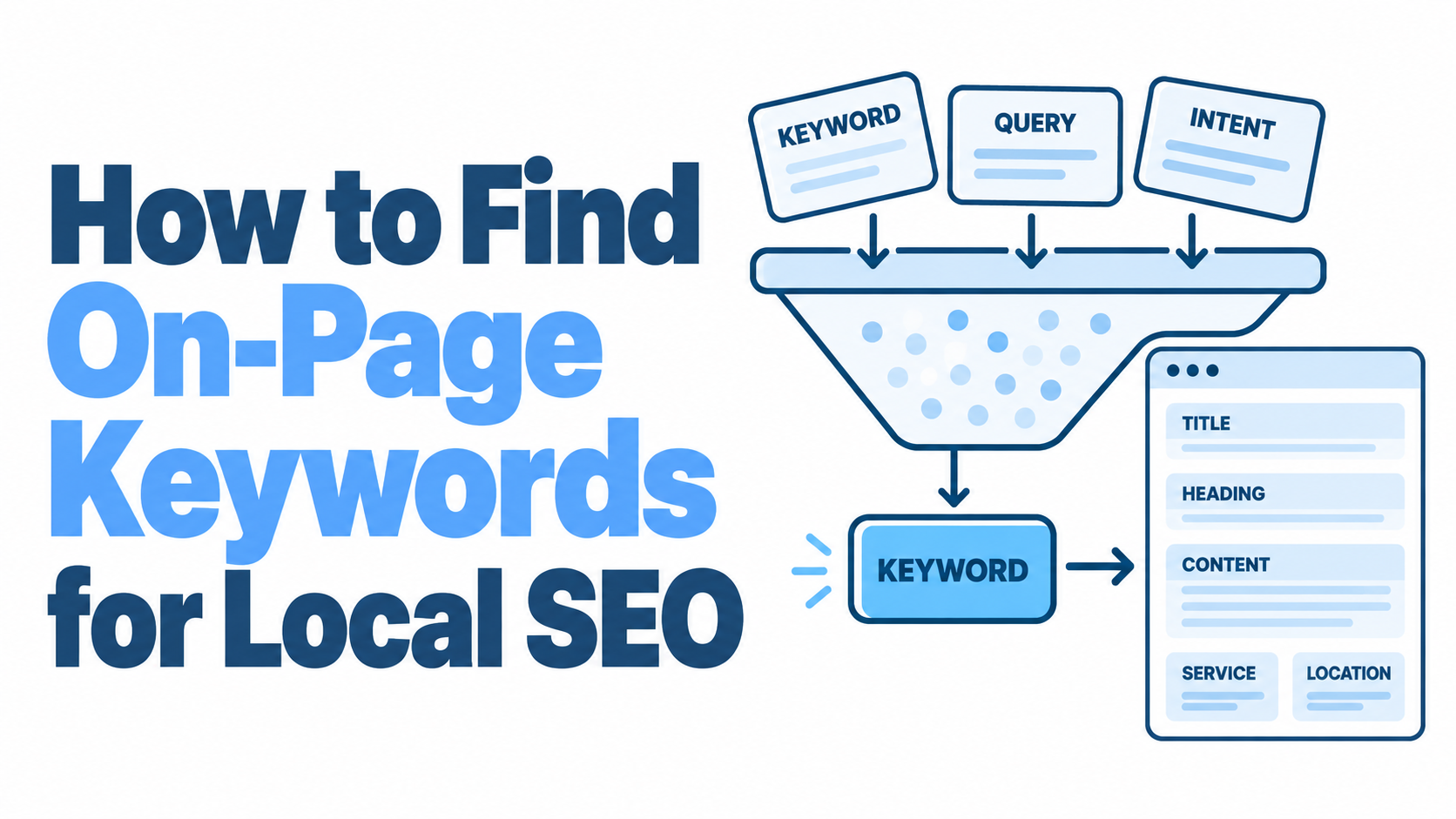
Most local businesses already know they need to rank better in Google Maps and local search results. The real challenge is figuring out which keywords to target on their website pages and how to identify the terms that actual customers in their area are typing into Google. A plumber in Bristol and a plumber in Glasgow might offer identical services, but the phrases their potential customers use, and the competition they face, can differ wildly. Getting this right is the difference between a website that generates enquiries and one that sits idle. Finding the right on-page keywords for local SEO isn’t about guesswork or stuffing city names into every paragraph. It’s a structured process that starts with understanding how local searchers think, then works through competitor analysis, tool-based research, and careful placement across your site’s pages. The steps below walk through exactly how to do this, with practical examples drawn from real UK business scenarios.
The Fundamentals of Local Keyword Intent
Local keyword intent is fundamentally different from generic search intent. Someone searching “emergency locksmith” could be anywhere in the country, but someone searching “emergency locksmith Leeds city centre” or “locksmith near me” has a specific, immediate need tied to a physical location. Understanding this distinction shapes every keyword decision you make.
Local intent typically falls into three categories. The first is explicit location queries, where the searcher includes a place name: “estate agent in Cheltenham” or “boiler repair Manchester.” The second is implicit local queries, where Google infers location from the searcher’s device: “best curry house” typed by someone in Bradford will return Bradford results. The third is “near me” queries, which have grown consistently since 2020 and now account for a significant share of mobile local searches.
Your keyword strategy needs to account for all three types. Many businesses focus exclusively on explicit location terms and miss the implicit and “near me” opportunities entirely. A dental practice in Edinburgh, for instance, should target “dentist Edinburgh New Town” but also consider terms like “NHS dentist accepting patients” that Google will serve locally based on the searcher’s position.
The intent behind a local keyword also tells you what kind of page should rank. Informational queries like “how much does a new boiler cost in Leeds” suit blog content, while transactional queries like “boiler installation Leeds” belong on a dedicated service page. Mixing these up wastes your effort and confuses both Google and your visitors.
Analysing Your Service Area and Target Locations
Before you open any keyword tool, you need a clear picture of where your customers actually are. This sounds obvious, but most businesses either target too broadly (an entire county when they realistically serve two or three towns) or too narrowly (just their home postcode when they happily travel 30 miles for jobs).
Start by reviewing your existing customer data. Where have your last 50 or 100 customers come from? If you’re a tradesperson, check your invoicing records. If you run a clinic or salon, look at appointment postcodes. This data reveals your real service area, not the one you imagine.
Once you have this mapped out, break your service area into tiers. Your primary area might be the city or town where you’re based: this gets the most keyword focus and its own dedicated pages. Secondary areas are nearby towns where you regularly get work. Tertiary areas are places you’ll travel to but don’t actively market in yet.
A roofing company based in Nottingham, for example, might define Nottingham city as primary, then Beeston, West Bridgford, and Arnold as secondary, and Derby or Mansfield as tertiary. Each tier gets a different level of keyword investment. Tools like VisiLocali’s Local Rank Tracker can show you exactly where your business currently appears on Google Maps across these different locations using visual ranking grids, so you can see which areas already have decent visibility and which need more attention.
Mining Google Business Profile Data for Insights
Your Google Business Profile is a goldmine of keyword data that most businesses never look at properly. Google actually tells you what search terms triggered your profile to appear, and this information is sitting right there in your GBP performance data.
Log into your profile and check the search queries report. You’ll see the actual phrases people used before finding your listing. These aren’t hypothetical keyword suggestions from a tool: they’re real searches by real people in your area. A carpet cleaning business might discover that “carpet cleaning after flood” appears frequently, suggesting a service page specifically addressing water damage recovery could capture more traffic.
Pay attention to queries where your profile appeared but didn’t receive clicks. These represent terms where you’re visible but not compelling enough, which often means your website lacks a relevant landing page to support the listing. If “commercial carpet cleaning Sheffield” shows impressions but few clicks, creating a dedicated commercial services page with that geographic focus could change the picture.
VisiLocali’s GBP Audit Tool can help here by analysing your profile’s performance signals and identifying where gaps exist between what searchers want and what your profile currently communicates. Rather than just presenting raw data, it translates findings into specific recommendations you can act on, which is particularly useful if you’re not comfortable interpreting analytics reports yourself.
Competitor Research Strategies for Local Markets
Your competitors have already done keyword research for you, whether they realise it or not. Every page on their website, every service they’ve listed, and every location they’ve targeted represents a keyword decision you can learn from.
Start with the businesses that consistently outrank you in Google Maps and local search. Open their websites and look at their page structures. How many location-specific pages do they have? What services do they break out into individual pages versus lumping together? A solicitor in Manchester who ranks well might have separate pages for “divorce solicitor Manchester,” “conveyancing solicitor Salford,” and “employment law Stockport,” while you’ve crammed everything onto a single “Services” page.
Check their title tags and meta descriptions by viewing page source or using a browser extension. These elements reveal which keywords they’ve prioritised. Look at their heading tags too: the H1 and H2 structure often maps directly to their target keyword list.
Don’t just copy what competitors do. Instead, look for gaps they’ve missed. Maybe every plumber in your area targets “boiler installation” but nobody has a page for “boiler replacement grants” or “heat pump installation,” both of which carry strong local intent. These gaps are where you can gain ground fastest. VisiLocali’s competitor analysis features let you see exactly why certain businesses outrank yours, which helps you identify practical opportunities rather than guessing at what might work.
Utilising Keyword Research Tools for Regional Variations
Keyword tools are essential, but they’re most useful after you’ve done the groundwork above. Starting with tools before understanding your service area and competitors means you’ll drown in data without context.
The key with any tool is filtering for local relevance. National search volumes for “plumber” are meaningless to a business serving Harrogate. You need location-filtered data that reflects how people in your specific area search.
Leveraging Google Keyword Planner for Postcode Data
Google Keyword Planner remains one of the most reliable free tools for local keyword research because it lets you filter by geographic area. Set your location targeting to your specific city, county, or even postcode area rather than the entire UK.
Enter your core services as seed keywords and review what Google suggests. For a dog groomer in Bristol, starting with “dog grooming” filtered to the Bristol area might reveal that “dog grooming Clifton” has meaningful search volume while “dog grooming Bedminster” does not, which tells you where to focus your location pages first.
Compare the suggested bid prices for different keyword variations. Higher bid prices generally indicate higher commercial intent: these are the terms where businesses are willing to pay for clicks, which means they convert well. A keyword like “emergency plumber tonight” with a high suggested bid is worth more than “plumber reviews” with a low one.
Identifying Long-Tail ‘Near Me’ Queries
Long-tail local queries are where smaller businesses can compete most effectively. These are longer, more specific phrases that larger competitors often ignore because individual search volumes look small, but collectively they add up to significant traffic.
Google’s autocomplete is your simplest research tool here. Start typing your service into Google from a device located in your target area and note what suggestions appear. “Electrician near me” might expand to “electrician near me open now,” “electrician near me free quote,” or “electrician near me for rewire.” Each of these represents a distinct intent you can target.
Google’s “People also ask” boxes and “Related searches” at the bottom of results pages are equally valuable. These show you the questions and variations real people are searching for. A search for “damp proofing Leeds” might reveal related queries like “how much does damp proofing cost in Yorkshire” or “damp proofing specialist near me reviews,” each of which could inform a blog post or FAQ section on your site.
Mapping Keywords to Specific Landing Pages
Having a list of keywords is only half the job. Each keyword needs a home on your website: a specific page designed to rank for that term. The biggest mistake local businesses make is trying to rank one page for dozens of different keywords, which dilutes the page’s relevance and confuses search engines.
The general principle is one primary keyword per page, supported by two or three closely related secondary terms. Your homepage targets your broadest term (e.g., “plumber in Leeds”), while individual service pages and location pages handle more specific phrases.
Optimising City-Specific Service Pages
Every location you serve should ideally have its own page, and each of those pages needs to be genuinely useful rather than a thin template with the city name swapped in. Google has been penalising doorway pages for years, and a set of identical pages with only the location name changed will hurt more than help.
A strong city-specific page includes at least 400 words of unique content that references local landmarks, area-specific challenges, and ideally testimonials from customers in that location. A pest control company’s page for “pest control Islington” might mention the prevalence of mice in Victorian terraced housing common to the area, reference proximity to specific estates or streets, and include a review from an Islington customer.
Map your primary keyword to the page’s title tag and H1, then weave secondary keywords into H2 subheadings and body content naturally. If “pest control Islington” is your primary term, secondary terms might include “rat control North London” and “emergency pest removal Islington.”
Structuring Localised Blog Content for Topical Authority
Blog content serves a different purpose from service pages. While service pages target transactional keywords (people ready to buy), blog posts capture informational queries that build your authority and bring potential customers into your orbit earlier in their decision process.
A heating engineer in Glasgow might write blog posts targeting queries like “how to bleed a radiator,” “signs your boiler needs replacing,” or “best time to service your boiler in Scotland.” These posts attract local readers who may not need a heating engineer today but will remember the helpful article when their boiler breaks down in January.
Structure your blog content calendar around seasonal local trends. Search volumes for “gutter cleaning” spike every autumn, “garden landscaping” peaks in spring, and “emergency boiler repair” surges during cold snaps. Planning content around these patterns means your pages are indexed and ranking before demand peaks, not after.
Integrating Keywords into On-Page HTML Elements
Once you know which keywords belong on which pages, the technical placement matters. Google reads certain parts of your page with more weight than others, and getting your keywords into these high-priority elements correctly can make a measurable difference to rankings.
The priority order for keyword placement is: title tag, H1 heading, URL slug, meta description, H2/H3 headings, first 100 words of body content, image alt text, and internal link anchor text. You don’t need to force your keyword into every single element, but covering the top four or five is essential.
Writing Effective Local Meta Titles and Descriptions
Your title tag is the single most important on-page element for keyword targeting. It appears in search results as the clickable blue link, and Google uses it heavily to understand what your page is about. Keep it under 60 characters to avoid truncation, and place your primary keyword near the beginning.
A good local title tag follows a pattern like: “Boiler Repair in Manchester | Same-Day Service | CompanyName.” This hits the primary keyword, adds a compelling selling point, and includes the brand. Avoid keyword stuffing: “Boiler Repair Manchester, Boiler Fix Manchester, Boiler Service Manchester” reads terribly and Google recognises it as spam.
Meta descriptions don’t directly affect rankings, but they influence click-through rates, which indirectly affect your position. Write them as a compelling pitch in under 155 characters. Include your location and a call to action: “Trusted boiler repairs across Manchester and Salford. Fixed-price quotes, no call-out charge. Call today or book online.”
Using Geo-Modifiers in Header Tags and Alt Text
Your H1 tag should contain your primary keyword and appear exactly once per page. For a location page, this might be “Professional Carpet Cleaning in Brighton” rather than just “Our Carpet Cleaning Services.” The H1 tells both Google and visitors immediately what the page is about and where it’s relevant.
H2 and H3 tags are where you work in secondary keywords and related geo-modifiers. Under your Brighton carpet cleaning H1, you might have H2s like “Residential Carpet Cleaning in Hove and Portslade” and “Commercial Carpet Cleaning for Brighton Businesses.” Each subheading targets a slightly different keyword variation while keeping the content organised and scannable.
Image alt text is often overlooked but provides another opportunity for local keyword placement. Rather than alt=”carpet cleaning” or the even worse alt=”IMG_4532,” use descriptive, keyword-aware alternatives like alt=”professional carpet cleaning in a Brighton living room.” This helps with image search visibility and reinforces your page’s local relevance to Google’s main algorithm.
Measuring Success and Refining Your Local Strategy
Finding and placing keywords isn’t a one-time task. Search behaviour changes, competitors adjust their strategies, and Google’s algorithm evolves. You need a system for tracking whether your keyword choices are actually producing results, and a process for refining them when they’re not.
Track rankings for your target keywords at least monthly, but pay attention to the right metrics. For local SEO, your position in the regular organic results tells only part of the story. Your visibility in Google Maps, which can vary street by street across your service area, often matters more. VisiLocali’s Local Rank Tracker provides visual ranking grids that show your Maps visibility across your entire target area, revealing pockets where you’re strong and areas where competitors dominate. This kind of granular data tells you whether a new location page is actually improving your visibility in that specific area or whether it needs more work.
Beyond rankings, monitor which pages are generating actual enquiries. A page ranking third for “roofer in Stockport” that produces five calls per month is more valuable than a page ranking first for “roof tile types” that produces none. Connect your keyword tracking to real business outcomes: phone calls, form submissions, and direction requests from your Google Business Profile.
Review and update your keyword strategy quarterly. Check whether new competitors have entered your market, whether search volumes have shifted, and whether you’ve expanded into new service areas that need targeting. The businesses that treat local keyword research as an ongoing programme rather than a one-off project are the ones that maintain and grow their visibility over time.
If you want to see where your business currently stands across your local area and identify exactly what to improve next, VisiLocali offers a 14-day free trial across all plan tiers. Built by a local SEO specialist with over a decade of experience and backed by a 90-day improvement guarantee, it’s a practical way to turn the keyword research process described here into measurable results.
