 Skip to content


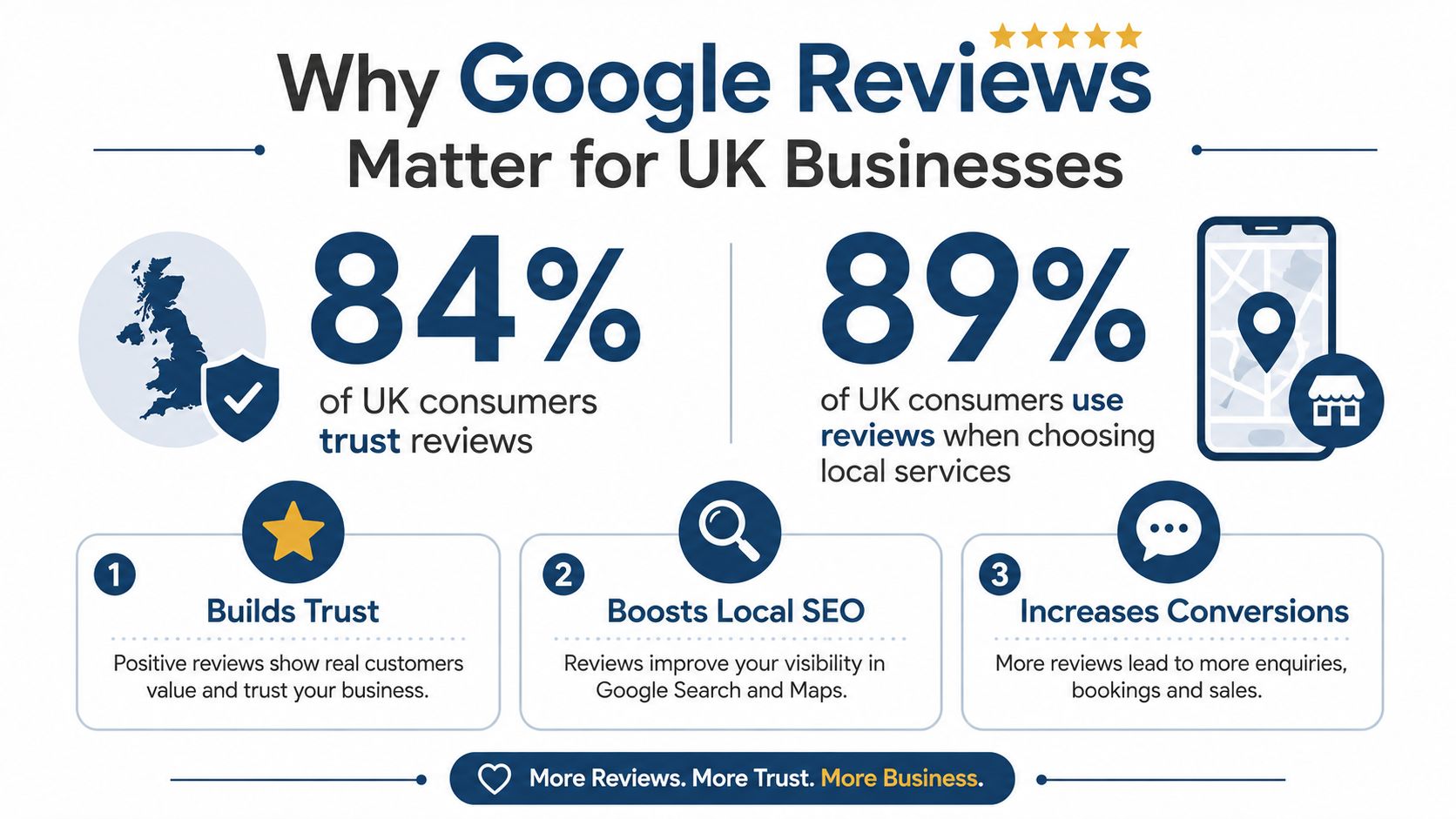
84% of UK consumers trust customer reviews, while 89% use online reviews when researching products or services, according to a UK-focused evidence summary from Review Runner's consumer statistics. If your Google Business Profile has only a handful of old reviews, you're not missing social proof. You're missing a regular source of trust, local relevance and insight into what customers value.
The difficult part is learning how to get more Google reviews without buying them, filtering out criticism or creating a process that breaches UK rules. Since the CMA's April 2025 fake-review rules, review acquisition has needed both marketing discipline and compliance discipline. The strongest approach is straightforward: deliver a genuine service, ask at the right moment, make the action easy, and treat every response as part of your public reputation.
Table of Contents
- Why Google Reviews Matter More Than Ever for UK Businesses
- Building a Review Request Workflow That Actually Works
- Staying Compliant with UK Review Regulations
- Message Templates and Staff Scripts That Convert
- Turning Negative Reviews into Trust Signals
- Measuring Review Impact on Local Rankings
Why Google Reviews Matter More Than Ever for UK Businesses
A strong Google review profile influences decisions while customers compare local providers. UK evidence reports that 84% of consumers trust customer reviews and 89% use online reviews when researching products or services. The same summary reports that 71% of UK consumers wouldn't use a business with an average rating below three stars. That can affect whether a prospect calls, visits or chooses another listing. The wider context is covered in the UK review behaviour evidence summary.
Reviews also strengthen local relevance signals. Natural references to a service, neighbourhood or customer experience help searchers judge whether a business fits their needs. A steady stream of genuine feedback shows that the profile represents an active business. Reviews do not determine local rankings on their own, and a high star rating cannot guarantee visibility. Quantity, quality, recency and thoughtful responses should still form part of a practical Google Business Profile strategy.
That work should sit within broader Google review management, not operate as a one-off campaign. Since the CMA's April 2025 fake-review rules, businesses need to increase authentic review volume without incentives, selective review requests or other practices that could breach consumer protection requirements or Google's policies.
Recency beats a neglected five-star profile
A handful of old five-star comments leaves a straightforward question unanswered: are customers still choosing and recommending this business now? UK consumer research published in 2026 found that 71% of adults check reviews or ratings before buying from an unfamiliar online store, 60% consider verified purchaser reviews the most important trust signal, and 49% consider recency important. Those findings come from YouGov's UK research on how shoppers assess online stores.
Review volume and review velocity describe different conditions. Volume is the total number of reviews. Review velocity is the regularity with which new reviews arrive, giving customers a clearer view of current service quality as they compare alternatives.
| Weak pattern | Healthier pattern |
|---|---|
| A small group of old reviews | A consistent flow of genuine recent feedback |
| No replies from the business | Timely, useful responses to positive and negative comments |
| Generic comments with little detail | Natural descriptions of the service and experience |
| A perfect-looking profile with no visible criticism | A credible profile with complaints handled openly |
Do not manufacture a five-star record. Build a credible profile through genuine customer experiences, clear requests for honest feedback and public responses that show how the business handles praise and criticism.
Building a Review Request Workflow That Actually Works
The most reliable process starts with an operational trigger, not a reminder to someone in the office. Link the request to a confirmed positive service event, such as a completed job, a successful appointment or a customer who has explicitly expressed satisfaction. The experience is still fresh, and the request feels connected to something real rather than to an unrelated marketing campaign.
Practical rule: Ask for an honest Google review after a completed experience, not for a particular star rating.
Use one clear request
Create your direct Google review link from your Google Business Profile and place it wherever customers already communicate with you. A QR code can work well on an invoice, appointment card, counter display or vehicle handover document, provided it takes the customer directly to the review action rather than to a general homepage.
Keep the message short and give the customer one job. Don't combine a review request with a survey, referral offer and newsletter subscription. Each extra action adds friction and makes the request feel like a campaign.
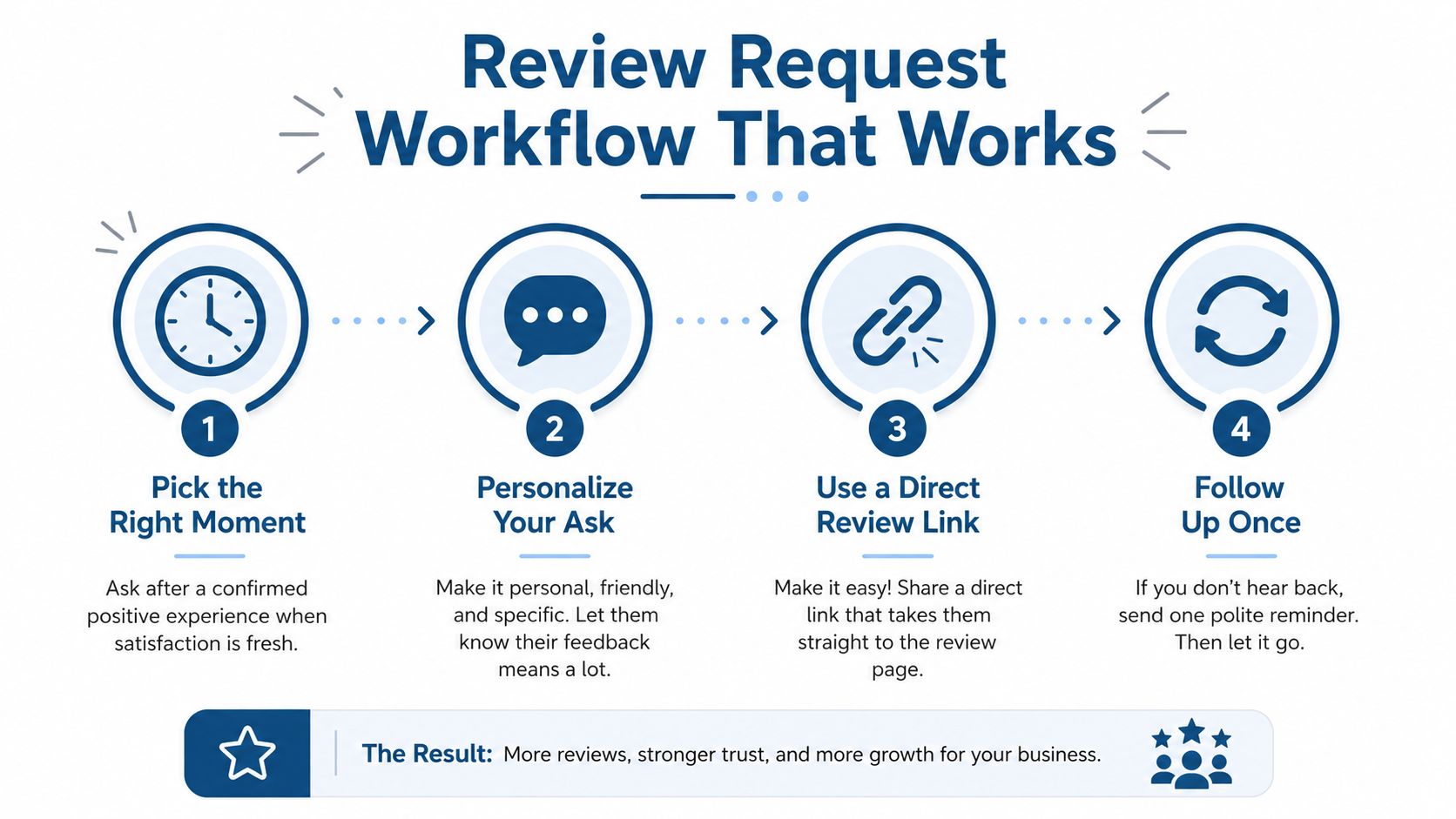
The UK-facing guidance on asking for Google reviews without sounding pushy recommends a single request followed by one follow-up for non-responders. Repeated reminders can make an otherwise reasonable ask feel aggressive. Bursty campaigns also create an uneven pattern, whereas a regular workflow produces a steadier flow of feedback.
Adapt the trigger to the business
A plumber can send the request once the customer confirms that the leak has been fixed and the work area is clean. A dentist might ask after an appointment when the patient has confirmed that the visit went smoothly. A restaurant can make a brief in-person request at the end of a meal, then provide a QR code on the receipt if the customer responds positively.
The workflow should record the event, the channel used and the outcome. A simple spreadsheet can track the date of service, request date, SMS or email delivery, response and review link. Larger teams can connect the trigger to their booking, billing or CRM system, but automation must preserve the customer's context and must not send multiple requests for the same interaction.
Review the process, not just the count
If requests aren't converting, check the moment, message and link before blaming customers. A message sent several days after service may arrive too late. A link that opens a generic profile page creates unnecessary steps. A message that says only “please leave us five stars” sounds transactional and can create compliance problems.
Test one change at a time. Compare channels qualitatively, note which service events produce useful responses, and ask staff whether customers seem confused or uncomfortable. The best workflow becomes part of normal service delivery, so customers recognise it as a polite invitation to share an honest experience.
Staying Compliant with UK Review Regulations
Good service does not make every review request lawful. The CMA's April 2025 fake-review rules put review acquisition firmly within UK compliance responsibilities. The CMA's online consumer review case describes enforcement activity involving businesses and a live review of more than 100 companies. Treat review collection as a documented business process, not an informal marketing shortcut.
Authenticity is the central test. Under CMA guidance on fake reviews, a fake review is not based on a person's genuine experience. The guidance also covers concealed incentives, offers to submit fake reviews, and arrangements that commission fake or hidden incentivised reviews for traders.
Tactics to remove from your process
Do not offer a discount, prize, gift or payment in return for a positive review. Do not ask an agency, supplier or colleague to post as though they were customers. Leave customer comments in their own words rather than rewriting them to sound more favourable. Your process must not divert unhappy customers away from Google while sending only satisfied customers to the platform.
A feedback survey can identify service problems, but it must not become a review gate. That means a system that sends happy respondents to a public review platform while directing dissatisfied respondents elsewhere. Ask every customer for honest feedback and allow the outcome to remain open.
Use these controls:
- Request genuine experiences: Contact customers connected to a real transaction or service.
- Avoid rating instructions: Invite an honest review rather than requesting five stars.
- Disclose incentives: If feedback carries an incentive, explain that arrangement clearly and do not conceal it.
- Keep criticism visible: Do not suppress, hide or selectively remove legitimate negative feedback.
- Monitor suspicious activity: Check unusual submissions and report fake content through the relevant platform process.
Google sanctions can damage the profile itself
Google's January 2025 undertakings with the CMA require sanctions for UK businesses that improve ratings through fake reviews. Possible measures include warning alerts on profiles, disabling the review function so new reviews cannot be received, and deleting all reviews for repeat offenders for six months or more. Google must also prevent people who repeatedly post fake or misleading reviews from posting again.
Cheap review packages therefore carry a direct profile risk. A sudden rise in questionable reviews may improve appearances briefly, then leave the business with a damaged profile and no way to collect new feedback. Keep request wording, customer eligibility and incentive records clear enough to explain to a customer, Google or a regulator. Before changing review or profile practices, check Google Business Profile listing suspension causes so an aggressive acquisition tactic does not create a separate suspension problem.
Message Templates and Staff Scripts That Convert
A review request should sound like a continuation of the service, not a demand for marketing help. Mention what the customer bought or experienced, keep the language natural and link directly to Google.
SMS template
Hi [Name], thanks for choosing [Business]. We're pleased we could help with [specific service]. If you've got a moment, would you share an honest Google review here? [Direct review link]
This works because it identifies the interaction and asks for an honest account. It doesn't prescribe a rating or imply that the customer owes you praise.
Email template
Subject: How did we do with your [service]?
Hi [Name],
Thank you for using [Business] for [specific service]. Your feedback helps future local customers understand what to expect. If you'd like to share your experience, you can leave an honest Google review using this link: [Direct review link]
Thank you,
[Staff member]
Don't add a long explanation about how reviews help your business. Customers are more likely to act when the request is brief and the next step is obvious. Use the channel the customer already prefers, and send the request after the service event has been confirmed.
In-person scripts for staff
A technician can say, “I'm glad we've got that sorted. If you're happy with the work, we'd appreciate an honest Google review. The QR code is on the invoice.”
A receptionist might use, “Thanks for coming in today. If you'd like to share how the appointment went, I can give you our Google review link.”
A restaurant team member can say, “Thank you for joining us. If you enjoyed your meal, we'd welcome an honest review. The QR code is on your receipt.”
The wording should never pressure the customer. Train staff to ask once, accept “no” immediately and avoid standing nearby while someone writes a review. They should also know how to respond if a customer raises a concern. In that situation, the priority is resolving the service issue, not steering the customer towards a rating.
Turning Negative Reviews into Trust Signals
A credible Google Business Profile does not need to look untouched. Customers can question a page filled with identical praise, especially when the business never addresses criticism. As noted earlier, shoppers pay attention to whether review content appears authentic, so a negative review can add context when the business handles it properly.
Use four steps when replying:
- Acknowledge the experience: Thank the customer for raising the issue without confirming facts you have not checked.
- Address the specific point: Refer to the service, delay or communication problem they mentioned.
- Explain the next step: State what you will investigate or improve.
- Move private details offline: Give the customer a direct contact route instead of discussing personal information publicly.
A suitable response might say: “We're sorry the appointment didn't meet expectations. We're checking what happened with the booking and would welcome the opportunity to discuss it directly. Please contact [name] at [channel] so we can review the details.” It shows accountability without turning the reply into a public argument.
The CMA guidance for online review sites expects appropriate rigour when platforms handle both positive and negative reviews. UK businesses should apply the same standard. Do not ask customers to remove legitimate criticism, bury complaints with manufactured praise or report a review solely because it is unfavourable. Report reviews that appear fake, abusive or unrelated to a genuine customer experience.
A calm public response can reassure people comparing local providers. The complaint may remain visible, but prospective customers can see that the business monitors its profile and takes service failures seriously. Record recurring complaints and use them to improve staff training, scheduling, communication and quality checks.
The strongest trust signal is a better customer experience, followed by an open invitation for honest feedback. That approach supports authentic review growth and reduces the temptation to manipulate the profile, which can create compliance and platform risks.
Measuring Review Impact on Local Rankings
Counting new reviews is useful, but it isn't enough to explain whether your local SEO work is helping. Track review velocity, recency, response activity, rating movement and the subjects customers mention, then compare those changes with Google Business Profile visibility for your priority services and locations.
A geo-grid is useful because local rankings vary by searcher location. A business may appear prominently near its premises but perform poorly across a nearby town. Record visibility for the same search terms and scan area over time, then look for patterns rather than assuming that one new review caused a ranking change.
Compare the profile with nearby competitors
Benchmark your profile against comparable local businesses. Review count matters, but so do the age of recent reviews, the detail in review content, response coverage and the services customers describe. A competitor with fewer total reviews may still look more current if its feedback arrives regularly and receives thoughtful replies.
VisiLocali's Review Analyser can place your profile alongside statistically competitive and selected competitor profiles, using review quantity, frequency, content and reviewer profile information to identify gaps. Its AI recommendations turn those findings into prioritised actions, such as requesting recent feedback or responding to unanswered reviews. Use those recommendations alongside your own service knowledge, because the correct action must fit the customer experience and remain compliant.

Connect review activity to business outcomes
Review work should ultimately support customer acquisition. Compare review activity with calls, direction requests, website visits and enquiries in your Google Business Profile performance data. Ask whether improvements in visibility are reaching the services and locations that matter, not just whether the review count has increased.
Keep a monthly record of the workflow, including which service events triggered requests, how many follow-ups were sent and whether response times improved. This gives you an audit trail for compliance and a practical way to refine timing, messaging and staff training. A healthy strategy produces authentic feedback, useful customer insight and a profile that remains defensible as it grows.
Start a 14-day free trial of VisiLocali to track Google Business Profile rankings, compare your profile side by side with competitor data and use AI insights and recommendations to identify the right review and local SEO actions. Turn your review activity into clear tasks you can monitor, prioritise and implement.
