 Skip to content


Most advice on how to optimise business description on Google Business Profile gets the starting point wrong. People talk as if the description is a ranking hack, then pad it with keywords and pretend that will move a map pack. Google's own local-ranking guidance points to relevance, distance, and prominence as the drivers, and the description field does not appear there at all, which is why keyword stuffing is such a poor trade to make for UK service businesses trying to win local enquiries Google's local ranking guidance.
The better way to think about the description is bluntly practical. It is a relevance-support and conversion field, not a magic ranking lever. Use it to tell people what you do, where you work, and why they should trust you, then make the first 250 characters do the heavy lifting because that is the part most users see first Google Business Profile description guidance.
Table of Contents
- Why Most GBP Description Advice Misses the Point
- Understanding the 750 and 250 Character Windows
- A Description Template Built Around Your First 250 Characters
- Writing for UK Compliance and Profile Consistency
- Connecting the Description to Reviews, Posts and Photos
- How Often to Review and Rewrite Your Description
- Frequently Asked Questions About GBP Descriptions
Why Most GBP Description Advice Misses the Point
The biggest myth is simple. People think a longer, denser description will push a business higher in Maps. It won't, at least not in any direct way you can rely on, because Google's own ranking guidance centres on relevance, distance, and prominence, not on the description field itself Google's local ranking guidance.
What the description actually does
The description still matters, just not in the lazy way others describe it. It helps a searcher understand your service faster, and it gives Google more natural-language context to match against what people are looking for. That means the field supports relevance and conversion, but it's not the place to chase phantom ranking gains with repeated phrases and stuffed locations.
Practical rule: if a sentence sounds written for an algorithm, rewrite it for a customer.
For UK service-area businesses, that distinction matters more than people admit. In a dense city market, proximity and prominence can outweigh clever copy, so the description should not be treated like some secret ranking switch. It should be treated as a compact business summary that confirms, in plain English, what the profile already says elsewhere.
Why keyword stuffing backfires
Keyword stuffing is still the quickest way to ruin a GBP description. It reads badly, it duplicates information already visible in categories or services, and it makes the profile look like it's trying too hard. UK optimisation guidance also stresses accurate business information and consistency across fields, which is exactly where stuffed copy starts to fall apart GBP optimisation guide for UK businesses.
A cleaner approach wins. Say what you do, say who you serve, and say where you operate. That's enough to support the listing without turning the description into noise.
Understanding the 750 and 250 Character Windows
The description field gives you 750 characters in total, but that full length is not what most people see first. The first 250 characters do the important work because they sit in the visible preview before anyone expands the profile Google Business Profile character limit guidance. That opening should state the primary category, core service, and service area straight away. If you bury those details, you waste the bit of the profile that gets read.

Treat the first 250 characters as prime space
Lead with the search intent that matters. If you are a plumber in Manchester, say plumber, say the service, and say the area. Do not spend those first characters on a slogan, a founder story, or your business name if that name already appears elsewhere on the profile.
That opening is not there to impress anyone. It is there to make the listing instantly clear.
The rest of the field still matters. Use it for proof points, differentiators, and a soft call to action. Keep the first line tight, then use the remaining space to add useful detail without turning the description into keyword clutter.
Use the rest of the field properly
The full 750-character ceiling supports the profile, it does not carry the profile on its own. The hidden part can cover emergency cover, family-run positioning, same-day response, or a specialist service line, as long as those details are true and already reflected somewhere else in the account. That keeps the description credible and stops it reading like a copy of your services page.
For UK businesses, the clean way to manage this is to keep the description tied to the rest of the profile workflow. If you update categories, services, and service areas in your business profile manager workflow, the wording in the description needs to stay in step with those changes. If it drifts, the profile looks messy and the message becomes harder for customers to trust.
Draft the opening first, check that the service and location are obvious, then use the back half for differentiators and a short close. Skim-read it aloud. If it sounds padded or repetitive, strip it back.
A Description Template Built Around Your First 250 Characters
A strong GBP description has five jobs. It must name the primary category, describe the core service, state the service area, add a proof point, and finish with a soft invitation. That's the sequence I use again and again for UK service businesses because it keeps the opening tight and the rest of the copy useful.
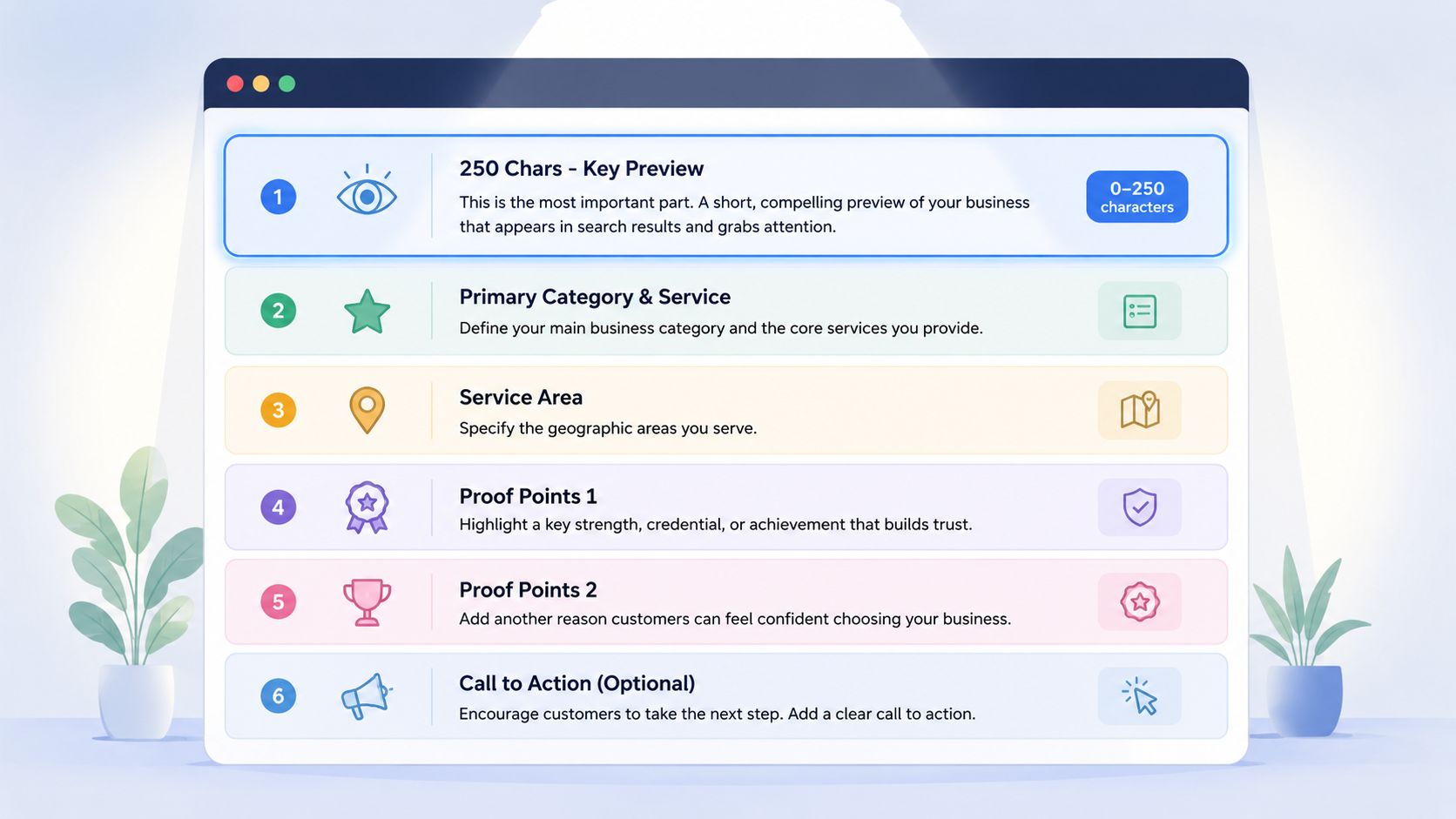
A clean structure that actually works
Use this order:
- Primary category and service. Lead with the thing people would search for.
- Service area. Name the town, borough, region, or multi-area footprint you cover.
- Proof point. Add one concrete reason to trust you, such as specialist experience, emergency availability, or a particular customer type.
- Differentiator. Say what makes you different in plain language, not marketing fluff.
- Soft CTA. End with an action that feels natural, like asking people to call, request a quote, or check the services list.
That structure is simple because it needs to be. The description is not the place for literary flair. It's the place for fast comprehension.
A worked UK example
A weak version sounds like this. “Smith & Co is a trusted local business offering quality solutions and great customer service across the region.” It says almost nothing useful.
A better version is service-led. “Emergency plumber serving Manchester, Salford and Stockport. We handle leaks, burst pipes, blocked drains and boiler issues for homes and landlords. Same-day visits available where possible, with clear pricing and work completed by experienced engineers. Call for help or check our services for the full list.”
The second version is stronger because it mirrors how customers search and how the profile is organised. It says what the business does, where it works, and why the customer should care. You can adapt the same pattern for solicitors, accountants, electricians, cleaners, or any other service-area business.
Before you publish
Use your own voice, not a template that sounds copied from a dozen other listings. The best descriptions sound human because they're grounded in real jobs, real geography, and real service boundaries. That's what makes them believable.
Writing for UK Compliance and Profile Consistency
A GBP description can read well and still be wrong for the profile. If it clashes with your categories, services, or service-area settings, it creates confusion, not clarity. UK public guidance puts real weight on accurate business information and consistency across profile fields, which matters most for service-area businesses working across a defined footprint UK GBP optimisation guidance.
A lot of bad advice treats the description like a place to stuff in every service, every town, and every sales line. That is the wrong move. The description should support the profile, not fight it. For a practical breakdown of how service-area businesses should structure the rest of the profile, see this service-area business optimisation guide.
The compliance traps worth avoiding
The first trap is claiming places you do not serve. If your team only works in South Manchester, do not write as if you cover the whole North West. The second trap is repeating information that already sits elsewhere in the profile, especially when the repetition turns into keyword clutter.
The third trap is promotional noise. Google's guidance does not want your GBP description to read like a sales page packed with links and hard-sell language. Keep it factual, concise, and aligned with the business details the user can already verify in the listing.
A safe rewrite versus a risky one
Risky copy usually sounds inflated. It loads up service claims, broad geography, and sales language in one paragraph. Compliant copy does the opposite. It narrows the claim to the actual operating area, the actual service, and the actual offer.
| Risky draft | Better rewrite |
|---|---|
| “We're the leading experts across the UK for every plumbing and heating need, with unbeatable service and special offers available now.” | “Plumbing and heating service for homeowners and landlords in Leeds and nearby areas. We handle repairs, maintenance and emergency call-outs, with clear communication and practical, tidy workmanship.” |
The rewrite works because it is believable and consistent. It also matches the profile fields that support it, which is where the trust signal comes from.
For service-area businesses, the safest habit is to compare the description against the categories, service list, and location settings before publishing. If the wording cannot be supported elsewhere in the profile, it does not belong in the description.
Connecting the Description to Reviews, Posts and Photos
A rewritten description by itself rarely changes much. A small Bristol accountancy practice can polish its copy, publish it, and see no movement because the rest of the profile still looks thin. That's not a failure of the description. It's proof that the description is only one part of a wider content system.
What the description can support
The description gives Google and the user a clean relevance signal. Reviews then add trust, posts add freshness, and photos make the profile feel active and real. When those pieces line up, the listing becomes more credible and easier to choose.
That's why profile completeness and freshness keep showing up in optimisation workflows. They're not cosmetic extras. They're the signals that make the description believable.
A Bristol accountancy practice that rewrites its description to focus on bookkeeping, payroll and tax returns still needs recent reviews and current posts to look alive. If the services list is thin and the photos haven't changed in months, the new copy doesn't have much to latch onto.
What to tighten around the description
- Services: Make sure the services list matches the wording in the description.
- Posts: Publish updates that echo the same service focus without repeating the exact same sentence.
- Photos: Add current work, team shots, premises images or job-site visuals where appropriate.
- Reviews: Ask for genuine reviews after real jobs, then respond properly so the profile doesn't look abandoned.
A linked review workflow helps here too, because review handling is one of the few areas where many UK businesses can improve visibility without touching the description at all Google review management guide.
A stronger description doesn't rescue a stale profile. It sharpens an already active one.
The practical point is simple. Rewrite the description, but don't stop there. If the profile still feels static, the copy won't carry enough weight on its own.
How Often to Review and Rewrite Your Description
Treat the description as a live field, not a one-time task. A quarterly review rhythm is enough for most UK service businesses, with extra updates only when the business changes in a meaningful way. That keeps the copy current without turning optimisation into busywork.

Recheck the right things
Every review should answer the same questions. Does the opening still lead with the main service and area? Does the wording still match the primary category? Does the remaining text still reflect the services, posts and reviews people can see elsewhere in the profile?
If the answer is no, rewrite it. If the answer is yes, leave it alone and spend your time on something that will move the listing more, like reviews or fresh photos.
Rewrite only when there's a real trigger
A rewrite makes sense when you launch a new service line, expand into a new town, reposition against a new competitor, or see a shift in customer language that affects how people search. It doesn't make sense just because you want to tweak a sentence that already works.
Measure the effect after publishing by watching profile engagement, calls, and direction requests in your GBP reporting, then compare that to the period before the change. If nothing improves, the problem may not be the description. It may be the rest of the profile.
Keep the rhythm disciplined. Quarterly review, triggered rewrite, then monitor. That's enough.
Frequently Asked Questions About GBP Descriptions
Does the description affect map-pack rankings directly? Not in the way many might expect. Google's ranking guidance focuses on relevance, distance and prominence, so the description is better treated as supporting copy than as a primary ranking lever Google's local ranking guidance.
How often should I update it? Review it quarterly, then rewrite only when the business changes, the service mix changes, or the opening no longer matches what people search for.
What if Google rejects the rewrite? Strip out promotional claims, exaggerated geography, and repetition. Keep it factual, concise, and consistent with the rest of the profile.
Is it a problem to reuse the same description across multiple listings? Yes, if the businesses serve different areas or offer different services. Duplicate copy weakens the local relevance signal and often creates inconsistency where you need precision instead.
If you want a cleaner way to manage GBP copy, rankings, and review work in one place, use VisiLocali to audit the profile, spot the gaps, and decide what to improve next.
