 Skip to content


“Get more reviews” is the standard local SEO advice. It's also incomplete.
A large review count can look impressive while telling prospective customers very little. A profile filled with old, generic praise may be less persuasive than one with fewer, recent reviews that mention the exact service, staff member, problem solved, or area served. Google's own explanation of local results points to relevance, distance and prominence, and reviews contribute to prominence, but review strategy works best when you treat it as an active operating process rather than a one-off reputation project.
That matters because UK consumers already use reviews as part of ordinary buying behaviour. Government analysis found that 54% of UK adults read online reviews, while 76% to 80% of consumers who had used reviews before purchasing considered them very likely or fairly likely to be trustworthy, according to the UK government paper on online reviews and endorsements. The question isn't whether local business reviews matter. It's which signals deserve your attention first, and how you turn them into actions that improve visibility and trust.
Table of Contents
- Why Reviews Matter More Than Ever for Local Search
- How Google Uses Reviews to Rank Local Businesses
- How to Earn Genuine Reviews Without Breaking the Rules
- How to Respond to Reviews the Right Way
- What a Competitive Review Profile Looks Like
- How to Measure Whether Your Reviews Are Moving the Needle
- Turning Review Insight Into Ranking Action
Why Reviews Matter More Than Ever for Local Search
Review quantity alone does not win the Map Pack. A large historical total can still underperform when newer competitors provide fresher, more relevant evidence. Freshness, service detail, response activity and authenticity make a review profile useful to Google and to customers.
Compare a plumber with a modest set of recent reviews mentioning emergency callouts, boiler repairs and punctual arrivals with an accountant carrying many generic five-star reviews from years ago. For someone searching for urgent plumbing help, the plumber's language offers stronger evidence because it matches the current service need.
UK consumers actively use this information. One UK market view reports that 89% of UK adults use online customer reviews when researching a product or service, and the Competition and Markets Authority has estimated that reviews may influence as much as £23 billion of UK consumer spending, as reported in UK local SEO statistics from Reboot Online. Review visibility affects whether existing demand reaches your business.
Most UK guides hammer “get more reviews” as universal advice. The data requires a sharper approach. 81% of consumers trust Google reviews, so relevance, quality and recency deserve attention alongside volume.
The signals behind a useful profile
A healthy profile has a recognisable shape:
- Recent feedback: New reviews show that customers still use the business and that its service remains active.
- Specific language: Mentions of services, products, staff and locations give readers practical reassurance and add context around relevance.
- Natural variety: Different customers describe different experiences. Repeated, vague wording can make a profile feel manufactured.
- Owner responses: Replies show that the business is present, accountable and willing to engage.
- Authenticity: A consistent pattern of genuine experiences matters more than a sudden unexplained burst.
Trust is harder to establish while consumers watch for manipulation. A 2024 UK survey found that 68% of consumers use online reviews as their primary source for purchase decisions, while 87% struggle to distinguish genuine feedback from AI-generated feedback and 49% are concerned about AI-generated reviews, according to Reputation.com's UK consumer research.
Practical rule: Build a profile that looks current, specific and believable. A raw total is only one part of the assessment.
Review strategy needs a repeatable process. Earn genuine feedback, reply properly, compare gaps with category competitors, and fix recurring customer problems. VisiLocali's Review Analyser helps turn that review data into prioritised actions, so you can focus on the weaknesses most likely to affect trust and local visibility.
How Google Uses Reviews to Rank Local Businesses
Google says local results are mainly based on relevance, distance and prominence. Relevance asks whether the profile matches the search. Distance considers how close the business is to the searcher or the location used in the query. Prominence reflects how well-known or established the business appears, with Google specifically noting that review quantity and positive ratings can contribute to local prominence in its official guidance on improving local ranking.
Reviews don't replace categories, business information, links, proximity or a complete Google Business Profile. They act more like evidence attached to those signals. Your primary category tells Google what you are. Review text can reinforce what customers hired you to do.
A star rating works as a quick trust cue for the person scanning the Map Pack. Review count gives context around that rating. Recent activity suggests the profile isn't abandoned. Service-specific wording helps a potential customer decide whether the business fits their need. Owner replies add another layer of visible context, although you shouldn't treat them as an excuse to stuff keywords into every response.
Translating review signals into local ranking factors
| Review signal | What it tells Google | Local ranking factor |
|---|---|---|
| Review wording | The services and customer experiences associated with the business | Relevance |
| Star rating | Broad customer sentiment and likely user confidence | Prominence |
| Review count | Depth of public customer evidence | Prominence |
| Review recency and velocity | Whether the business continues to receive customer feedback | Prominence and trust |
| Owner responses | Whether the business actively manages customer interaction | Trust and conversion |
| Topic diversity | Range of services, products, staff or locations mentioned | Relevance |
Review velocity means the pace at which a profile earns new reviews. It isn't a target to manufacture. A natural flow after completed jobs is healthier than a campaign that produces a suspicious cluster and then goes silent.
Sentiment language means the emotional and practical meaning in the text, not just the number of stars. “The electrician found the fault quickly” gives a future customer more useful information than “great service”. Topic diversity works in the same way. A restaurant may benefit from reviews that naturally mention breakfast, private dining or a particular location, while a solicitor's profile may contain detail about conveyancing, probate or employment advice.
For a deeper explanation of the relationship between reviews and local visibility, see how reviews help local rankings. The useful conclusion is simple: reviews are one ranking input among many, but they're also one of the easiest areas for competitors to neglect.
How to Earn Genuine Reviews Without Breaking the Rules
The safest review-generation system follows the customer journey. Ask after a real interaction, make the process easy and leave the customer free to write whatever reflects their experience. Google allows practical prompts such as direct review links, follow-up emails and in-store signage, provided the feedback comes from genuine customers and isn't controlled through pressure or rewards.
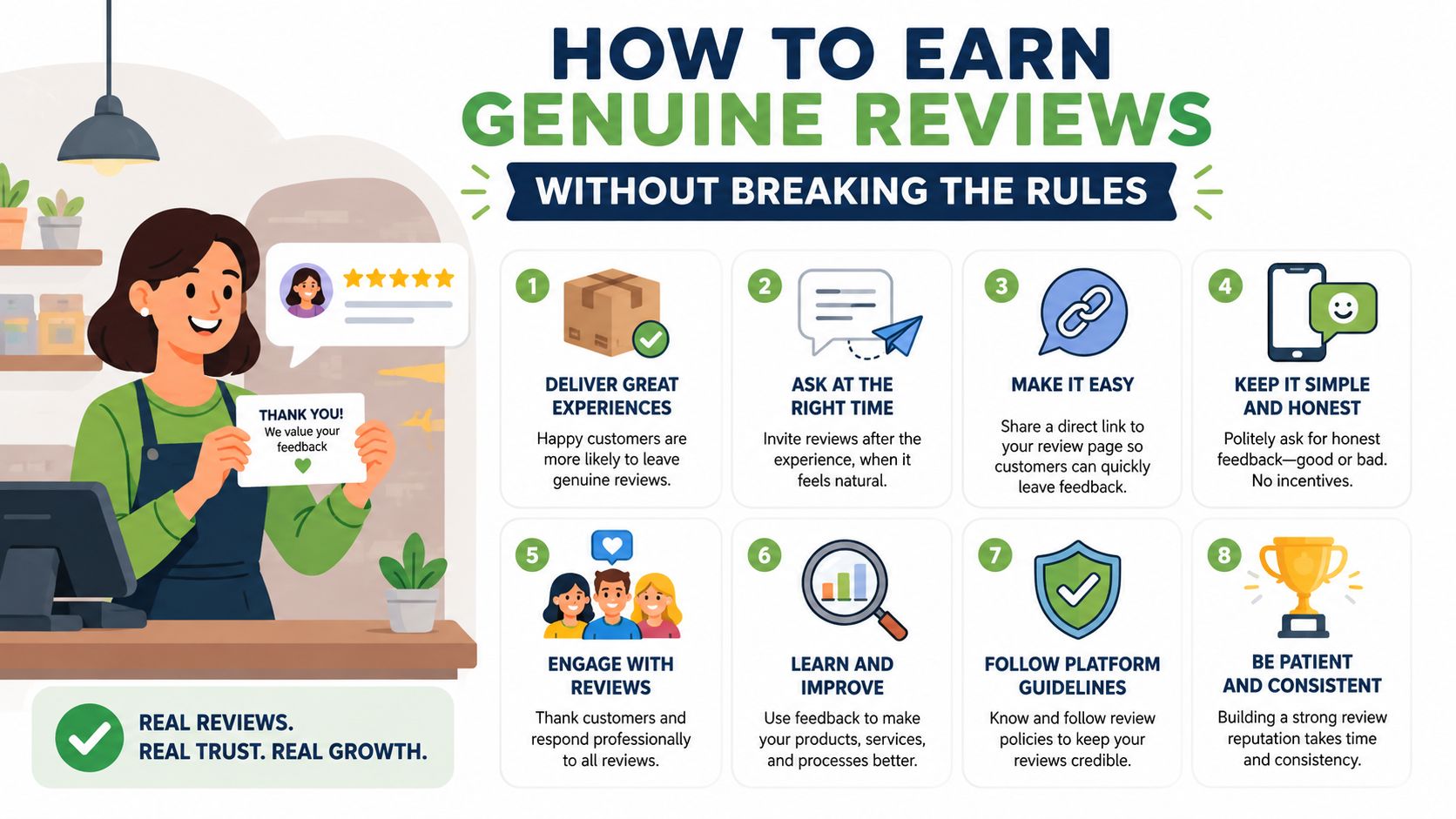
A compliant request sequence
Ask at the right moment. For a service business, that might be immediately after the customer confirms the work is complete. For a restaurant, it could follow a positive interaction with staff or a completed booking.
Send a direct link. A short message after the job can say that feedback is welcome and include the Google review link. Keep the wording neutral. Don't tell customers what rating to leave or provide a pre-written sentence they must copy.
Use a follow-up email. Send it soon enough that the experience remains fresh. Personalise the message with the service provided rather than sending an indistinguishable bulk request to every contact.
Add a QR code to an existing touchpoint. A receipt, thank-you card or completion document can point customers towards the review form. The QR code should make access easier, not replace a genuine request.
Ask repeat customers in person. A long-standing customer can be invited to share an honest experience, but staff mustn't pressure them or imply that a positive review is expected.
What to avoid
- Review gating: Don't ask unhappy customers to contact you privately while directing only happy customers to Google.
- Incentives: Don't offer discounts, cash, gifts or preferential treatment in exchange for reviews.
- Manufactured submissions: Don't create reviews yourself, ask staff or relatives to pose as customers, or submit repeated feedback from coordinated devices.
- Selective editing: Don't rewrite a customer's words to add your target keyword or remove criticism.
- Pressure tactics: Don't keep asking after a customer declines.
Google can remove reviews that breach its policies, and fake-review enforcement has become more consequential. The Competition and Markets Authority said Google introduced measures that can deactivate a business's review function, preventing it from receiving new reviews, as described in the CMA announcement on Google's fake-review changes.
A compliant process protects more than your listing. It preserves the credibility that makes reviews useful in the first place.
How to Respond to Reviews the Right Way
A review response should sound like a business owner who has read the message, not a template generator that has inserted the customer's name. Use a simple framework, then adjust it to the actual situation.
For a positive review, thank the customer, mention the service or product they discussed and invite them back naturally. If someone praises an emergency boiler repair, refer to the repair rather than replying with a generic “thanks for your feedback”. For a neutral review, acknowledge what worked, address the limitation and explain the next step without arguing.
Negative reviews need control. Start with empathy, recognise the specific problem and apologise where appropriate. Move detailed troubleshooting away from the public thread to a phone call or private message, while leaving enough public context to show future customers that you took the complaint seriously.
A practical response standard
- Positive: Thank the reviewer, refer to the specific experience and sign off with a real staff name where appropriate.
- Neutral: Accept the useful criticism, clarify the facts and state what you can do next.
- Complaint: Stay calm, avoid blame, protect personal information and offer a direct route to resolution.
- Suspicious: Check the customer record, avoid accusing the reviewer publicly and report the content through the Business Profile if it appears to breach policy.
Response speed matters operationally because a customer with an unresolved complaint can continue forming an opinion while the business stays silent. Set internal targets that your team can meet, such as replying to positive feedback within a day and prioritising serious complaints promptly. Don't promise an exact ranking benefit from a response. The clear benefit is improved public reassurance and a visible sign of active management.
Businesses handling trades and home services can use this guide for home service contractors for further response examples. For a workflow that helps draft replies from the review itself, see Google review response management.
AI tools can reduce repetitive work when they draft from the actual review text, your brand voice and previous owner responses. Someone on your team should still check every draft for accuracy, tone and privacy before publishing. Speed is useful, but a fast, wrong or robotic reply damages trust.
What a Competitive Review Profile Looks Like
There is no universal UK review target. A busy category may require a larger review footprint than a specialist provider with fewer customers. A low-volume service can still look credible when its profile is current, relevant and consistent.
UK category data shows why generic targets mislead. In a large home-improvement dataset, the overall average was 164.7 reviews per company, while the median was 28. Category averages included 20 reviews for electricians, 30 for plumbers, 52 for carpet cleaning services and 41 for gutter cleaning services, according to UK online review statistics from Trustmary. The difference between the average and median is enough to reject one universal benchmark.
Compare profile shape, not a vanity target
| Profile signal | What to compare | Why it matters | Priority |
|---|---|---|---|
| Review count | Your total against visible local competitors | Shows the size of the gap | High |
| Rating | Your average against businesses above you | Indicates customer confidence | High |
| Freshness | Recent activity and periods of silence | Shows whether trust is current | High |
| Service coverage | Mentions of your main services | Connects reviews with search intent | High |
| Detail | Specific jobs, products or treatments | Makes feedback more credible | Medium |
| Replies | Whether the business responds consistently | Shows active profile management | Medium |
The right comparison set is the businesses that repeatedly appear above you for searches that generate enquiries. Review count alone cannot explain why one profile outranks another. Compare businesses in the same town, category and service set, then record gaps in recency, rating, relevance and response coverage.
The signals worth comparing
Review the spread of recent feedback rather than focusing only on the latest entry. Check whether customers mention the services people search for, whether the profile contains useful photographs and whether the business replies across positive and negative feedback.
A strong competitive profile usually has:
- Current activity: Reviews arrive naturally instead of stopping for long periods.
- Service coverage: Customers mention different products, jobs or treatments.
- Human detail: Reviews describe real experiences rather than repeating vague praise.
- Visible engagement: The business replies consistently and professionally.
- Category context: The review count fits the business type and local market.
Trustpilot's UK research found that 91% of businesses believe positive online reviews can drive revenue growth, while consumers ranked independent review platforms as their most important source of purchase information at 84%, ahead of company websites at 52%, as reported in Trustpilot's UK growth research. The recommendation is clear: build evidence customers can trust, then use VisiLocali's Review Analyser to identify which gaps deserve attention first.
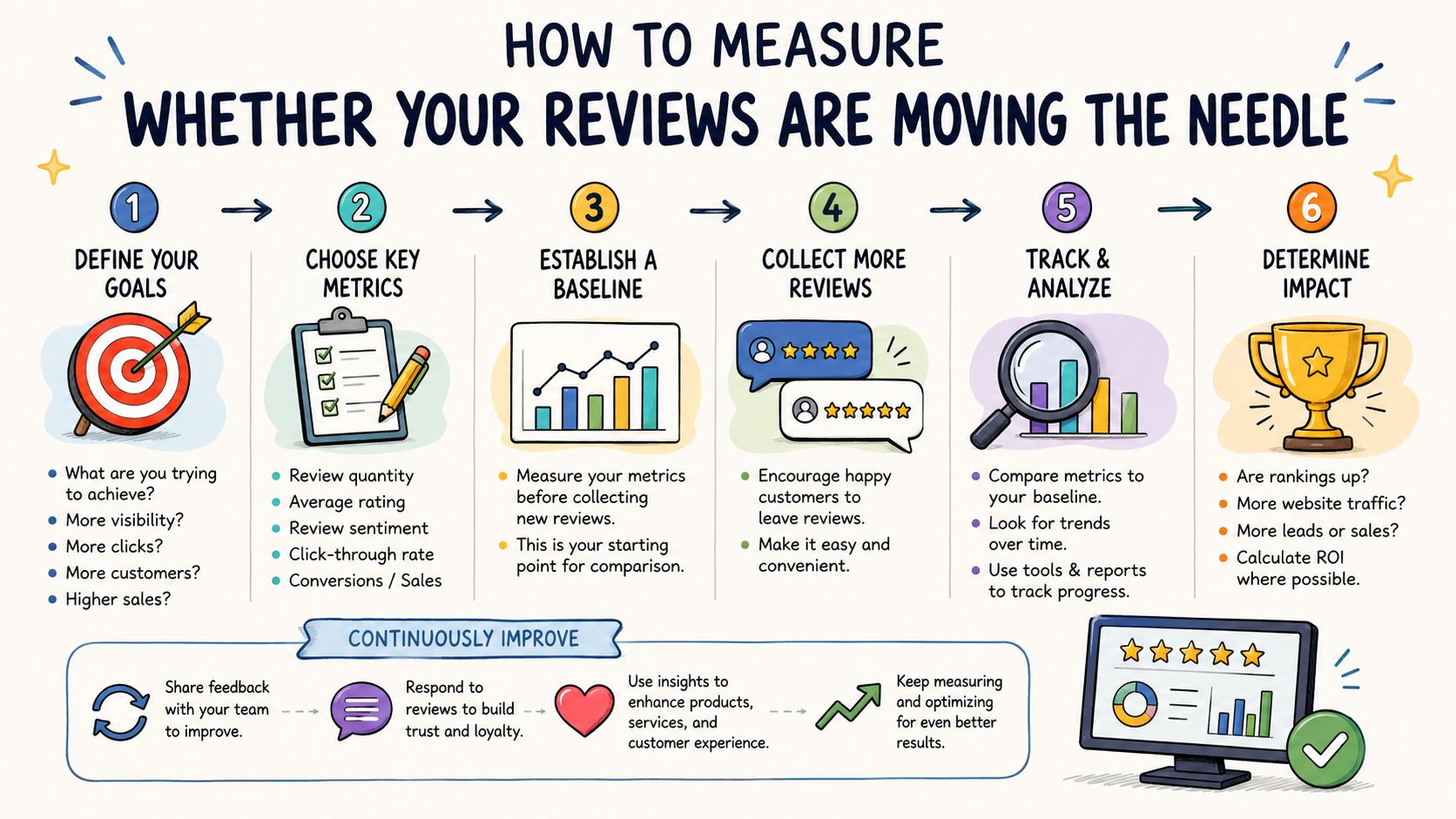
How to Measure Whether Your Reviews Are Moving the Needle
Don't judge review performance through sentiment alone. Sentiment can tell you whether customers sound pleased or frustrated, but it won't tell you whether your profile is appearing for the right searches or producing enquiries.
Use three measurement lenses and keep them separate.
Start with discovery actions
Review your Google Business Profile performance data alongside review activity. Watch for changes in the searches that surface your profile, calls, direction requests and website clicks. A review increase occurring beside more discovery actions is useful evidence, but it doesn't prove that reviews caused every change. Seasonality, competitor activity, profile edits and demand can influence the same period.
Record the date of each meaningful review change. Note whether the profile received a natural cluster, a new service theme or a shift in rating. This creates a timeline you can compare with performance rather than relying on memory.
Track positions by location
A single search from the business address isn't a reliable local ranking measurement. Track target services across a postcode grid or other consistent locations, then record the movement over time. Compare changes in map visibility with review recency, review themes and competitor activity.
Compare the businesses above you
Choose the businesses that repeatedly outrank you, not a random national brand. Compare review count, rating, recent activity, response coverage and the services mentioned in review text. The gap tells you what to fix next.
A practical weekly routine can be brief:
- Record rankings: Save the same service and location searches each week.
- Review new feedback: Tag recurring topics, complaints and positive service language.
- Check competitor movement: Note who gained reviews and which themes appear in their profiles.
- Choose one action: Fix the most commercially important gap before adding another task.
A review management tool for local businesses can consolidate this work. The important part is the loop. Measure visibility, inspect the evidence, take a specific action and then check whether the relevant metric changes.
Turning Review Insight Into Ranking Action
Review analysis matters only when it changes the next business decision. A spreadsheet of complaints, service terms and competitor gaps is not a strategy. Rank the findings, assign an owner and measure the outcome.
Start with repeated complaints. If several customers mention delayed arrival, unclear pricing or poor communication, fix the operational issue before requesting more reviews. More review volume will not repair a poor experience. It can expose the problem to more potential customers.
Then examine the language customers use in positive feedback. If reviewers repeatedly mention a treatment, repair type or service area, check that your Google Business Profile, website service pages and relevant posts describe that offering clearly. Do not force customer wording into replies. Use it to understand how customers describe the business and what they value.
A prioritised review action list
Fix the largest trust problem first. Repeated complaints usually identify a customer-experience problem, not a copywriting task.
Reinforce proven service themes. Use genuine phrases from positive reviews to check whether your categories, description, services and supporting pages reflect customer priorities.
Close a competitor gap. If comparable businesses have fresher activity or clearer service coverage, improve the review request process and monitor how the profile changes.
Respond with judgement. Acknowledge useful detail in positive reviews, address criticism professionally and report suspected policy violations through Google's correct process. Open the Business Profile, select Read reviews, choose Report beside the review, select a reason such as spam or profanity, then submit it through the official review reporting instructions.
Measure the ranking outcome. Connect each action to map positions, discovery searches, calls, direction requests or website visits.
VisiLocali's Review Analyser compares ratings, review quantity, publishing frequency, content and reviewer signals against selected competitors. Its AI recommendations turn those gaps into prioritised actions, while review monitoring and response workflows keep the work tied to daily profile management.
Use this checklist before the next review cycle:
- Audit profile freshness and topic coverage.
- Fix the most repeated customer complaint.
- Add a relevant photo or post tied to a genuine service theme.
- Respond to every review above three stars with a specific, human reply.
- Track Map Pack positions weekly against the same competitors.
- Improve lead handling as well as visibility with this speeding up lead response blog.
Start a 14-day trial when you are ready to connect the work. VisiLocali tracks Google Business Profile rankings, compares competitor profiles side by side and uses AI recommendations to show which review and profile actions deserve attention first. Use the findings to replace guesswork with a clear action plan for improving local visibility.
