 Skip to content
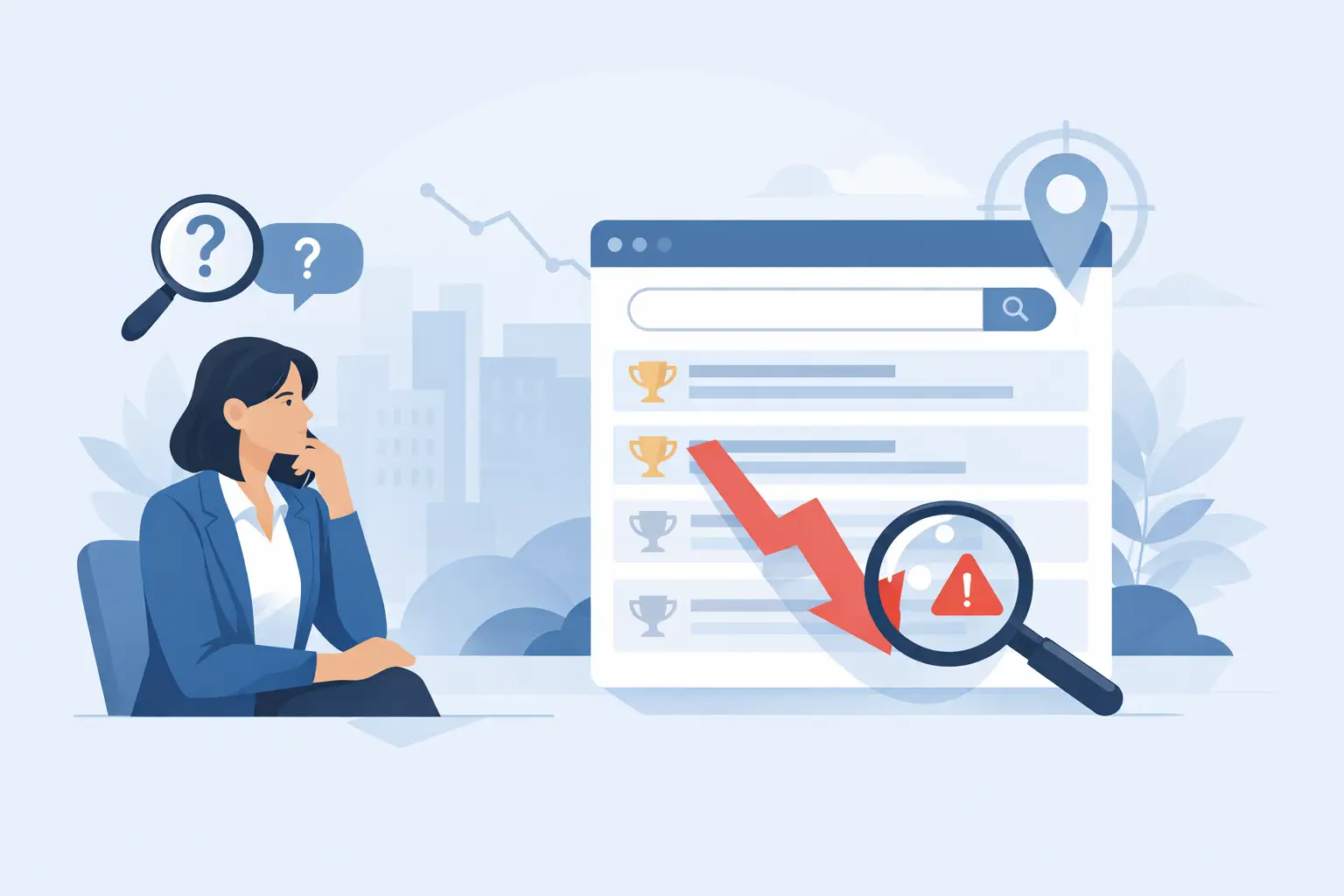
A plumber can appear in the Google Map Pack two streets from their office, then disappear entirely a few miles away. A clinic with dozens of five-star reviews can still sit below a competitor with fewer reviews. Local rankings are not a single score, which is why the question, why is my business not ranking, rarely has one simple answer.
Google weighs relevance, distance and prominence differently depending on the search, the searcher’s location and the competition around you. The practical answer is not to make random edits to your Google Business Profile. It is to identify where you are losing ground, compare your profile against the businesses ahead of you, and fix the gaps most likely to affect calls, bookings and visits.
Why is my business not ranking in local search?
First, establish what you mean by not ranking. Your business may rank well in ordinary Google results but not in Maps. It may appear for your business name but not for a service search such as emergency electrician. Or it may rank in the town where your address is based but not across the wider area you serve.
These are different problems. Google Business Profile rankings are especially sensitive to proximity. For service-area businesses, this can be frustrating: removing your address does not make Google treat every postcode in your service area as equally close. You may be highly visible near your verified location and less visible further out, even when you genuinely work there.
That does not mean location is the only factor, or that improvement is pointless. It means you need to measure rankings across the places that matter to your business, rather than relying on one search from your own phone. Checking from the office often gives an overly optimistic picture.
Your profile is not relevant enough to the search
Google needs clear evidence of what you do, where you do it and which searches your business should be considered for. An incomplete, inconsistent or vaguely written profile makes that harder.
Your primary category carries significant weight. A general category may feel safe, but it can leave you less relevant than a competitor using the most accurate category for their core service. Secondary categories help Google understand the broader services you offer, but only when they are true to the business. Adding every remotely related category is not a shortcut. It can dilute the signal and create a profile that looks less trustworthy.
The same principle applies to services, products, the business description and posts. They should reflect the language customers use when searching, while remaining specific and factual. A heating engineer should not rely on a generic description about quality service. They need a complete profile that confirms the types of work they carry out, their operating areas and the practical reasons a customer should contact them.
Website relevance also matters. If your profile links to a homepage that barely mentions the service or location being searched, Google has less supporting context. For businesses with several genuine locations or distinct services, relevant on-site pages can strengthen the connection. Avoid producing dozens of thin location pages for every nearby village. They add little value and can become a maintenance problem.
Your competitors have stronger local proof
A business can have a polished profile and still rank below competitors because the competitors have built more evidence of prominence over time. Prominence is Google’s assessment of how established and recognised a business appears across the web and in the real world.
Reviews are one visible part of that. It is not just the average rating. Review volume, recency, the detail customers provide and the way you respond all contribute to the overall picture. A steady flow of genuine reviews is more credible than a sudden burst followed by months of silence. Do not incentivise reviews with discounts or selectively ask only happy customers. That can create policy issues and does not build a reliable process.
Citations also play a role. Your name, address and phone number should be accurate wherever your business is listed. Conflicting information, duplicate profiles and old telephone numbers create uncertainty. For a service-area business, ensure the format of your details is consistent while respecting Google’s rules about displaying an address.
Competitors may also have stronger local signals because they are mentioned by relevant local organisations, appear in trusted directories, receive regular customer attention, or have been operating with a well-maintained profile for longer. You cannot copy their history overnight. You can see where the gap is and make the next best improvement rather than guessing.
Your Google Business Profile is incomplete or poorly maintained
A profile is not a set-and-forget listing. Missing details make it harder for Google and customers to understand the business, while outdated details can directly cost enquiries.
Check the essentials first: verified status, accurate business name, correct primary and secondary categories, opening hours, holiday hours, telephone number, website, service areas and attributes. For customer-facing premises, make sure the pin is correctly placed. For service-area businesses, make sure the address settings follow Google’s eligibility rules.
Then look at the quality of the information. Are your services properly listed? Are photos current and representative of real work, your team, vehicles, premises or products? Have you answered questions that customers regularly ask before booking? Have you responded to recent reviews, including the less flattering ones, professionally and specifically?
Posts can support profile activity and customer confidence, particularly when they promote a timely offer, service or update. They are unlikely to compensate for a poor category choice or weak review profile on their own. Treat posts as part of a maintained profile, not as a ranking trick.
You are tracking the wrong searches or locations
Broad rankings can look disappointing even when they are not commercially useful. Ranking first for a vague search from across a county may be less valuable than appearing consistently in the areas where your best customers live and where you can profitably serve them.
Choose a focused set of terms that reflect high-intent work. A roofer may care more about flat roof repair and emergency roofer than a broad search for roofing. A dental practice may prioritise the treatments that bring new patients, not every phrase associated with dentistry.
Track those terms across a grid of relevant local areas. This reveals the shape of your visibility: where you are strong, where competitors dominate and where distance is likely to limit progress. It also stops you reacting to normal ranking fluctuations as though something has gone wrong.
If your business has recently moved, changed names, changed categories or merged listings, expect a period of inconsistency while Google processes the changes. The right response is careful checking, not repeated edits that create more confusion.
Your website and profile send mixed signals
Google Business Profile does not operate in isolation. Your website, local listings and profile should tell the same clear story.
If the profile says you specialise in boiler repairs, but the website focuses on bathroom installations and contains no clear service information, relevance is weakened. If the website displays a different phone number, old address or different trading name, customers and search engines have conflicting details to reconcile.
Make your website useful before trying to make it clever. Give customers clear service information, genuine coverage details, visible contact options and proof that you are a real local business. For multi-location businesses, each location needs its own accurate information and a genuine operational presence. Creating listings for virtual offices, employee homes or areas where you do not meet customers is risky and can lead to suspension.
What to fix first when rankings are flat
Do not try to improve everything at once. Start with the issue most likely to be holding back your visibility. A sensible order is to confirm eligibility and profile accuracy, compare categories and services with the businesses ranking above you, resolve duplicate or inconsistent citations, then build a sustainable review process.
After that, assess your website’s support for the services and locations that matter. Keep measuring results at regular intervals. Rankings move because competitors act, reviews arrive, search behaviour changes and Google updates its systems. The goal is not to find one permanent fix. It is to run a repeatable process based on evidence.
A platform such as VisiLocali can bring rank tracking, competitor comparisons, profile analysis, reviews and posts into one view, so the next action is based on your actual local market rather than generic advice. The value is not more data for its own sake. It is knowing exactly what to improve first.
Local search rewards businesses that make it easy for Google to understand them and easy for customers to choose them. Check where you are losing visibility, make one meaningful improvement, and let the results tell you what to tackle next.
