 Skip to content
Your business can be excellent locally and still disappear from Google Maps when a nearby customer searches for the service you provide. You may appear for “plumber in Leeds” but miss “emergency plumber Leeds”, while a rival with a similar service profile captures the calls. That gap usually isn't solved by adding more generic website content. It starts with understanding the local searches, profiles and ranking areas where competitors are already winning.
Competitor keyword analysis for local SEO should therefore focus on Map Pack demand capture, not only organic blue-link rankings. The practical question is simple: which local-intent searches are producing visibility for competing businesses, and what should you change in your Google Business Profile to compete?
Table of Contents
- Why Competitor Keyword Analysis Matters for the Map Pack
- How to Identify Your True Local Search Competitors
- Collecting and Prioritising Competitor Keywords Without Guesswork
- Turning Keyword Gaps Into Google Business Profile Improvements
- A Faster Workflow Using VisiLocali Analysers and AI Recommendations
- Your Next Steps and How to Keep Improving Local Rankings
Why Competitor Keyword Analysis Matters for the Map Pack
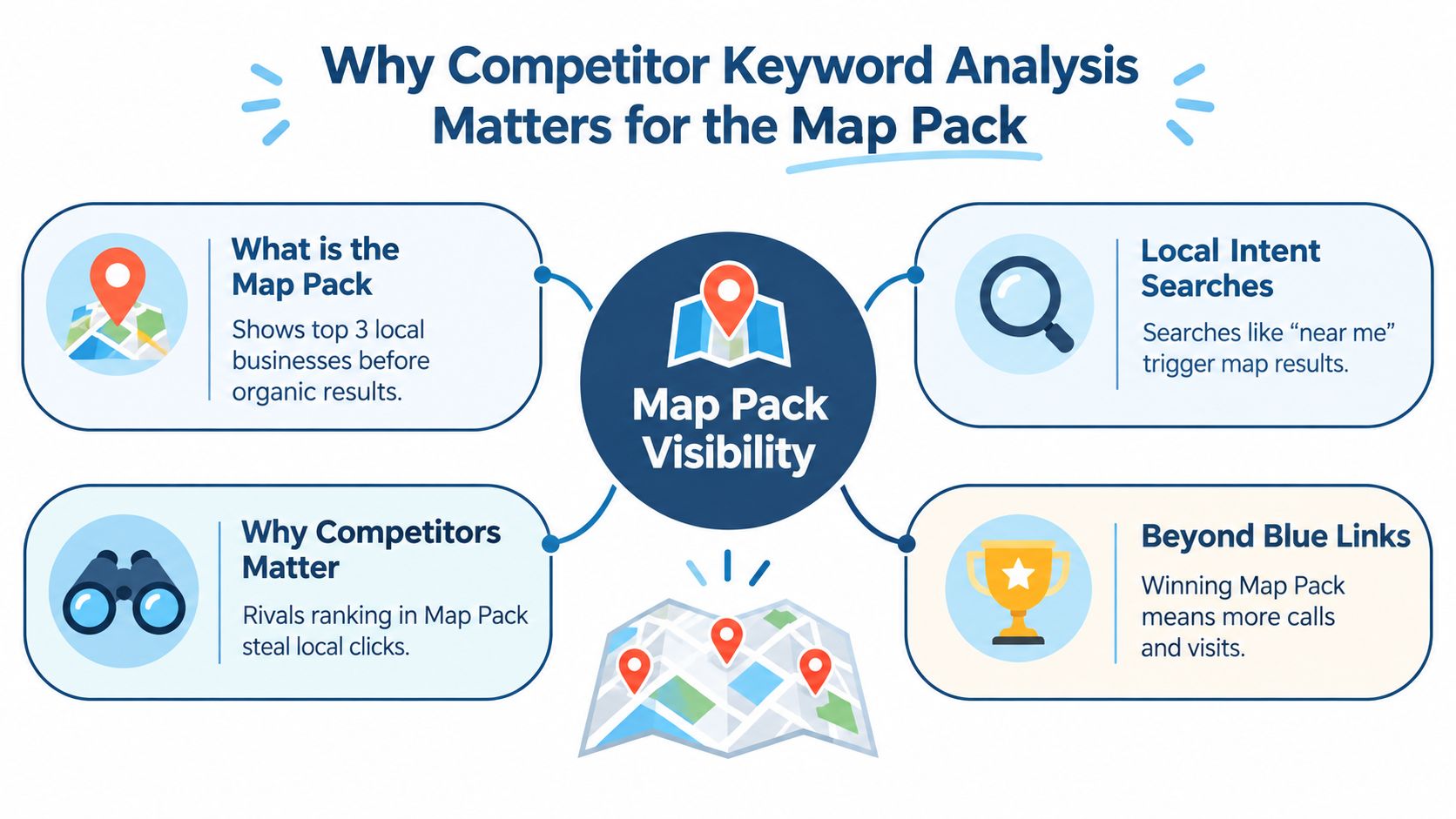
A dental practice can hold a strong position for “family dentist Manchester” and still lose urgent enquiries for “emergency dentist Manchester” or “dentist near me”. The services may overlap, but the searches express different search intent, meaning the reason behind the query. One search suggests routine provider selection. Another signals urgency, while “near me” places greater weight on proximity and availability.
The Map Pack is the group of local business listings Google displays for searches with local intent. It can appear above the traditional organic results, with a map, business names, ratings, opening information, phone details and directions. For a service-area business, that placement can affect calls, quote requests and which provider receives the enquiry. A practical Google Map Pack guide explains how these local results fit into the wider search experience.
Industry sources estimate that about 46% of Google searches have local intent. Google Maps use among UK online adults rose from 69% in 2023 to 73% in 2024, according to UK local SEO research on Maps and local search behaviour. Those figures support a specific approach to competitor research: measure the local queries rivals capture in Maps, then connect each gap to an action in your Google Business Profile.
The three signals behind local visibility
Google mainly assesses relevance, distance and prominence in local results. Relevance measures how closely a Business Profile matches the search. Distance considers the business's position relative to the searcher or named location. Prominence reflects how established the business appears, including signals such as links and review volume, as summarised in this UK local SEO guide.
These signals explain why rankings can change across the same city. They also prevent a common mistake: treating every competitor keyword gap as a request for another website page. A gap may point to a missing service, unsuitable primary category, absent attribute, weak review coverage or incomplete profile detail. The right response depends on the signal involved.
Keyword difficulty estimates how hard it may be to rank for a term. “Plumber” has broad intent and usually attracts strong competition. “Boiler repair in Harrogate” is narrower, carries clearer local intent and may offer a more practical visibility opportunity, even with lower estimated demand.
The LLMrefs competitor keyword analysis resource is useful for treating competitor terms as evidence of demand rather than a list to copy. For Map Pack work, the output should be a prioritised set of local opportunities linked to profile changes, such as service entries, categories, attributes, posts or review prompts. Side-by-side competitor Analysers and AI recommendations help rank those actions by relevance, competitor coverage and likely local value.
The UK search market makes Google's local ecosystem particularly important. Google held 91.17% of UK search market share in May 2026, while Bing held 6.22%, according to UK local SEO statistics for 2026. Competitor keyword analysis should therefore finish with decisions inside Google Business Profile, not a spreadsheet of copied organic terms.
How to Identify Your True Local Search Competitors
Your most important competitor isn't always the business you meet in the marketplace. It's the business that appears where your potential customer searches.
A national brand may compete with you commercially, but a smaller local firm could be the more valuable search competitor if it repeatedly appears in the Map Pack for your target services and locations. Conversely, a business you know well may have little relevance to your local visibility if it rarely ranks for the searches that matter.
Start with the search results, not your assumptions
Use Google UK and search the services customers request. Include variations such as:
- Core service: “accountant Birmingham”
- Urgent service: “emergency locksmith Birmingham”
- Specific need: “first-time buyer mortgage adviser Birmingham”
- Location modifier: “commercial electrician in Solihull”
- Proximity wording: “roofer near me”
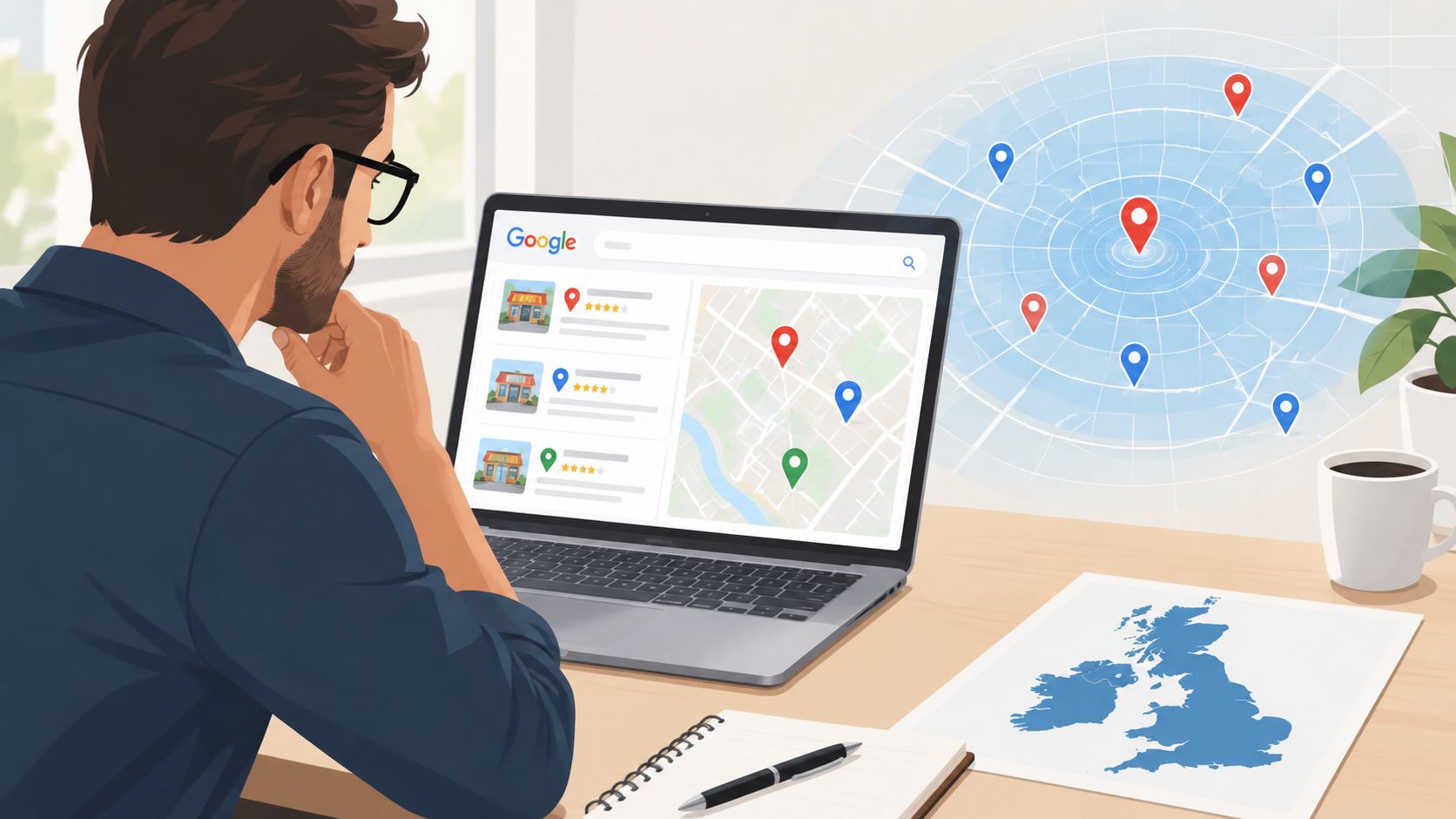
Record the businesses appearing in the Map Pack, then repeat the process from different locations around your service area. A manual search from your office gives you only one view. A geo-grid checks rankings from multiple points on a map, revealing whether visibility is concentrated around your address or extends into nearby neighbourhoods.
Select a small set of businesses that appear consistently for valuable searches. The practical UK workflow is to identify real search rivals in Google UK, extract their keyword footprint and cross-reference it with your own rankings to create a prioritised gap list. One UK agency describes using the top five organic competitors in Google UK, then combining Google Search Console with Ahrefs and SEMrush to map search volume, keyword difficulty, trend direction and SERP feature presence before exporting opportunities, as explained in its UK keyword research workflow.
Validate the competitor set
Don't choose rivals only because they offer the same service. Check whether they compete for the same locations and intent.
A useful competitor record includes:
- Business name and profile URL, so you know which listing you're comparing.
- Target keyword, including the exact service and location.
- Scan location, such as a town centre, suburb or selected service area.
- Observed Map Pack position, recorded consistently.
- Profile characteristics, including categories, services, reviews, photos and recent posts.
Keep the final set focused. Three to five statistically competitive profiles usually provide enough contrast to identify repeated patterns without turning the analysis into an unmanageable spreadsheet. Include businesses that rank across several scan centres, not a profile that appears once for an unusual query.
The UK market must be assessed separately. A domain or business can perform well in one country and be absent in another, so headquarters location isn't a substitute for UK search evidence. Filtering by the correct market also prevents irrelevant keyword data from distorting your conclusions.
For a more detailed process covering profile comparison and local rivals, use VisiLocali's guide to analysing local competitors. The important distinction is between a brand competitor, which competes for customers, and a search competitor, which competes for visibility on a specific local query.
Collecting and Prioritising Competitor Keywords Without Guesswork
Once you have the right local competitors, extract the terms associated with their rankings and group them by intent. Don't treat every keyword as an equal opportunity.
A keyword list becomes useful when it answers four questions:
- What is the customer trying to do?
- Where is the customer located?
- How difficult is the search?
- What profile change could support visibility?
Search volume estimates the number of searches for a term. Keyword difficulty estimates the strength of competing results. Commercial intent describes how close the searcher is to taking action. “Plumber near me” has local discovery intent, while “emergency plumber Bristol” is more urgent and commercially direct. SERP features are result elements such as the Map Pack, review displays or AI Overviews that change how visibility is won.
Use concentration as a warning
Head terms can look attractive while being poor first targets. A UK pest-control case study recorded 27,100 average monthly searches, 70% keyword difficulty and £2.16 estimated CPC for its head term, while the top 10 competitors captured 83.71% of monthly search traffic, according to the UK pest-control competitor analysis.
That pattern matters. Strong demand doesn't make a term strategically accessible. If a small group of competitors controls most visibility, local variants and service-specific searches may offer a more practical route into the market.
A keyword extraction process can be documented using a resource such as this keyword extraction guide for teams. The output should then be filtered against your own profile, rankings and service coverage.
Prioritisation Matrix for Local Competitor Keywords
| Keyword Type | When to Prioritise | Local Action Signal |
|---|---|---|
| Service plus location | The term closely matches a profitable service and a defined town or city | Check categories, services, description and location relevance |
| Urgent service query | The search suggests immediate need, such as emergency repairs | Strengthen service clarity, opening information, calls to action and review themes |
| Near-me query | The user wants a nearby provider rather than a specific brand | Compare distance patterns, category relevance, prominence and coverage across the area |
| Long-tail service query | The query names a specific problem or customer need | Add the service only if it's genuinely offered, then support it with profile content and reviews |
| High-difficulty head term | Competitors dominate and the intent is broad | Treat it as a longer-term target while pursuing more specific local gaps |
Prioritise terms that combine genuine service relevance, strong local intent and a credible profile action. A keyword with attractive demand but no matching service shouldn't drive an optimisation decision. Likewise, don't add awkward phrases to a Business Profile to force a match. Google and customers both respond better to accurate, natural information.
Turning Keyword Gaps Into Google Business Profile Improvements
A keyword gap matters only when it produces a clear Google Business Profile action. Suppose a competitor appears for “private dentist implants Leeds”, while your profile barely mentions implant services. The useful response is to review the service list, category structure, description and review themes. Publishing a blog post may have no effect on Map Pack visibility if the profile itself remains unclear.
Local visibility depends on relevance, distance and prominence. Relevance connects the profile with the searcher's need. Distance limits how far a business can compete for a local query. Prominence reflects recognition and authority, including links and review activity. Those factors should shape the action you take after comparing keyword gaps, rather than turning every missing term into a content task.
Translate each gap into a profile task
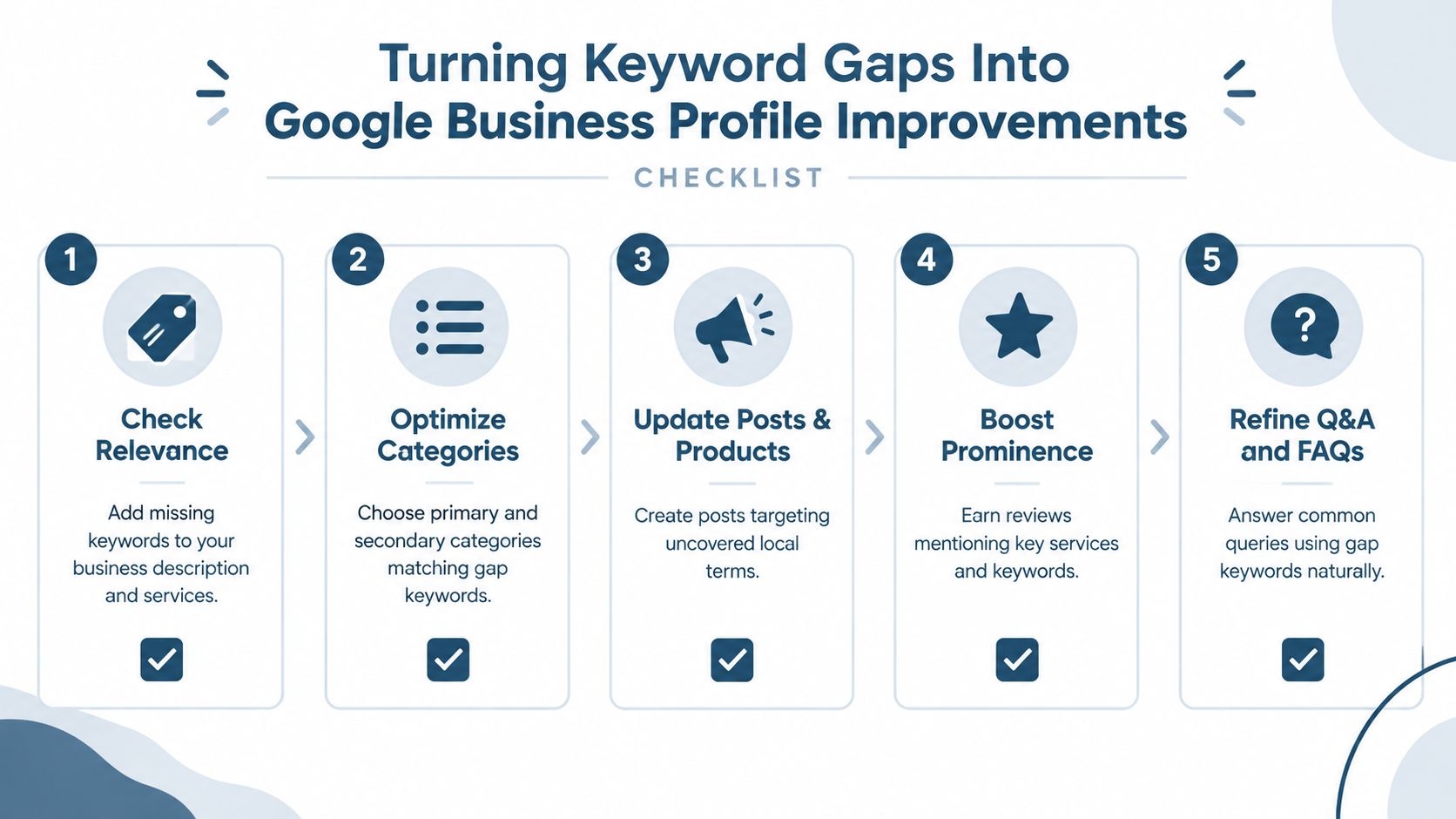
Work with one keyword cluster at a time. A cluster groups closely related searches that express the same need, such as “boiler repair”, “boiler breakdown repair” and “emergency boiler repair”. The keyword gap analysis workflow helps organise the comparison, but the outcome should be a profile change with an owner and a reason.
Check each cluster against these questions:
- Is the service offered? Exclude terms for work the business does not provide.
- Does the primary category describe the main business? Review the category only when it accurately represents the core offer.
- Are secondary categories relevant? Add categories only for genuine additional services.
- Does the services section explain the work clearly? Use customer language naturally and avoid keyword stuffing.
- Do attributes answer a real concern? Booking options, accessibility and service details can affect customer choice.
- Do reviews reflect the service? Invite honest feedback about completed work. Do not script or incentivise particular wording.
For practical guidance on Google Business Profile optimisation, connect each gap to the profile field or customer evidence that can address it. A report row is not an improvement until someone can implement and measure the resulting change.
Sequence the work by signal and feasibility
Profile edits can strengthen relevance, but they cannot remove distance constraints. A business outside a searcher's area should not claim that location. Service-area businesses need the same discipline, because adding places without genuine operational coverage creates misleading information and weakens trust.
Use this order:
- Correct the profile foundation, including the business name, primary category, address or service area, phone number and opening information.
- Fix the main relevance gap, using accurate services, description wording and suitable secondary categories.
- Strengthen customer evidence, by collecting and responding to genuine reviews and addressing recurring service questions.
- Add supporting activity, including relevant photos, posts and frequently asked questions.
- Track the same keyword from the same locations, so broader visibility is not confused with a single search fluctuation.
Reviews require careful handling. The UK Competition and Markets Authority secured changes from Google in 2025 after concerns about fake reviews. Google can also deactivate a review function, preventing a business from receiving new reviews, according to this UK local SEO business guide. Keep review requests genuine, consistent and properly moderated.
For service-area businesses, match every gap to a real operational promise. If a competitor ranks for “same-day appliance repair York”, update the profile only when the business provides that service in York. Accurate coverage protects customer trust and gives Google a clearer reason to associate the profile with the query.
A Faster Workflow Using VisiLocali Analysers and AI Recommendations
Manual competitor keyword analysis often ends with a spreadsheet full of terms and no clear owner for the next task. A faster workflow starts with the location, then compares the profiles that appear in the same competitive environment.
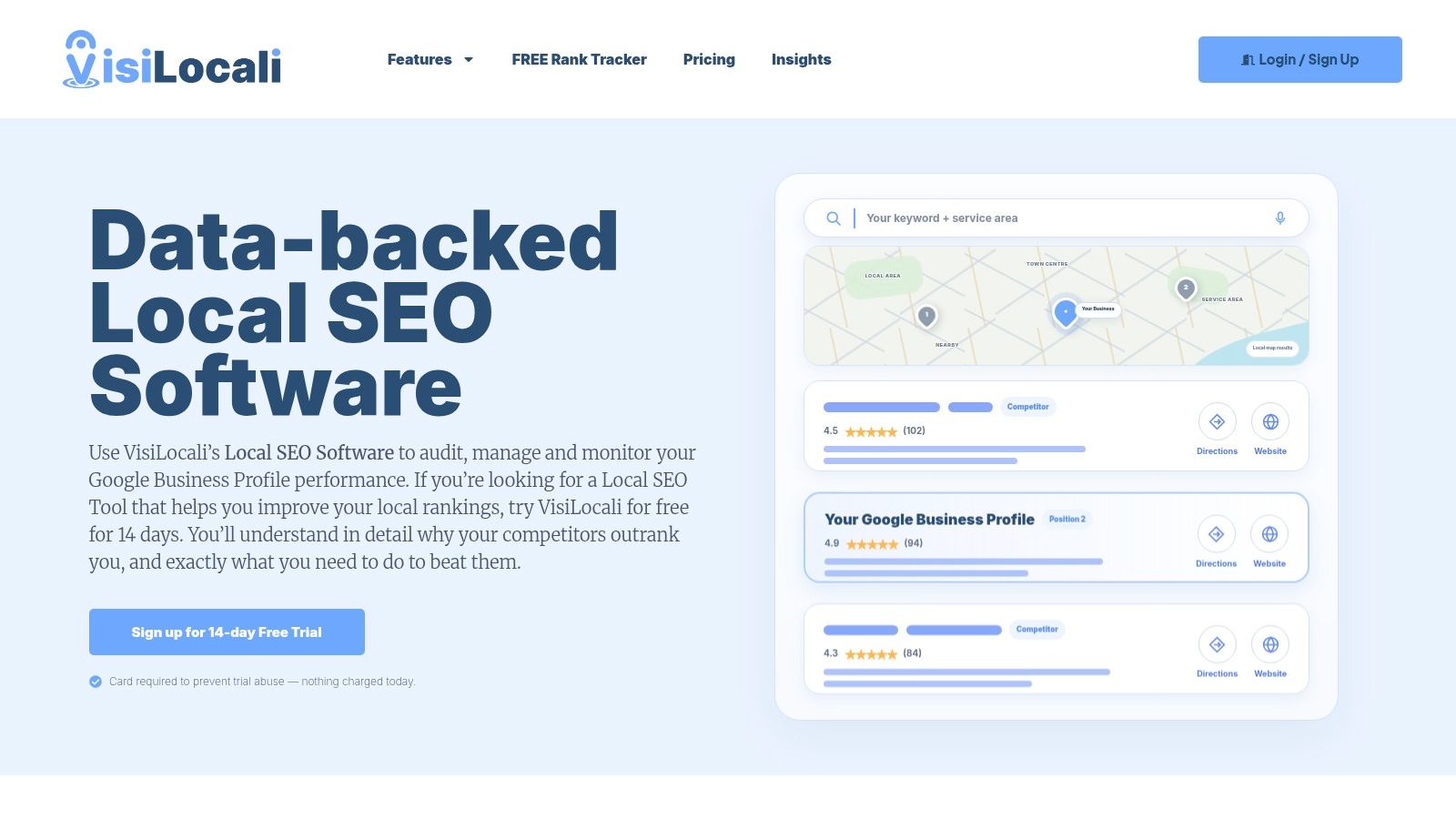
Begin with a Google Business Profile geo-grid. A geo-grid checks rankings from multiple points around a chosen centre, rather than relying on one search from the business address. VisiLocali supports 5×5, 7×7 and 9×9 grids, flexible radii up to 10,000km, and manual scan-centre selection. That matters when a business wants to understand performance in a nearby town for a keyword containing that town's name.
Compare the profile, reviews and posts
Use side-by-side Analysers to compare your profile with statistically competitive and selected competitors:
- Profile Analyser: Compare core profile information, categories, services, attributes, photos and other visible profile details.
- Review Analyser: Examine review activity, response patterns and the service themes customers mention.
- Post Analyser: Compare whether competitors use Google Business Profile posts to communicate current services, offers or local relevance.
The comparison shows where a rival has a stronger or more complete profile. It doesn't prove that one isolated element caused a ranking position, and it shouldn't be treated as a precise ranking formula. A UK-focused guide summarising Whitespark's 2026 Local Search Ranking Factors survey says 47 local search practitioners scored 187 factors, with Google Business Profile signals estimated at 32% of local pack weight, review signals at 20% and on-page signals at 15%. The source describes these as expert estimates rather than measured weights, so use them directionally rather than as guaranteed scoring rules, as explained in this UK summary of local ranking factors.
Let AI turn comparisons into a queue
The useful role of AI isn't to generate a pile of generic SEO suggestions. It should interpret your business data, competitor differences and ranking map, then explain:
- What is missing or weaker.
- Why that difference may matter for the target search.
- What action should happen next.
- Which task should wait.
VisiLocali's Analysers use business and competitor profile data to support AI-powered recommendations. You can then manage profile details, respond to reviews with AI, create or schedule posts and review daily performance reporting in the same workflow. That reduces the gap between finding a keyword opportunity and implementing the relevant profile improvement.
The best comparison is not between a large number of metrics. It's between the local query, the ranking pattern, the competitor profile and the next practical action.
Your Next Steps and How to Keep Improving Local Rankings
Competitor keyword analysis works best as a repeatable operating routine:
- Find real Map Pack rivals: Search Google UK for your service and location combinations, then validate those businesses across several scan centres.
- Capture the keyword footprint: Group competitor terms by service, location, urgency and customer intent.
- Choose realistic priorities: Favour relevant local gaps where your business can make a genuine profile improvement.
- Apply the change: Update categories, services, description, attributes, photos, posts or review processes only where the information is accurate.
- Track the result: Use geo-grid rankings to see whether visibility improves across the area rather than at one search point.
- Review competitors again: Look for new services, profile changes, review themes and posts that alter the local search environment.
Avoid the familiar traps. Brand rivals aren't always search rivals. A national keyword list won't automatically describe the UK market. A high-difficulty head term may consume time while a specific local service query remains unattended. Reviews shouldn't be treated as a shortcut, and profile edits shouldn't claim services or locations you don't provide.
The most useful competitor question isn't “what keyword should we copy?” It's “which local demand is a competitor capturing, and what accurate profile improvement should we make next?”
VisiLocali brings that routine into one workspace, combining Google Business Profile geo-grid tracking, side-by-side Profile, Review and Post Analysers, AI recommendations and profile management. Start the 14-day free trial to track Google Business Profile rankings, compare competitor profile data and receive AI insights that help you choose the right local actions.
Start your VisiLocali 14-day free trial to map Google Business Profile rankings across your target area and see where competitors outrank you. Use the side-by-side Analysers and AI recommendations to turn those keyword gaps into specific profile improvements, then monitor your daily progress.
