 Skip to content


The Google Map Pack appeared on 95.6% of UK trades-related queries in 2026, making it the dominant discovery layer for local service businesses. If customers search for a plumber, electrician, roofer or builder nearby, your position in the Map Pack can matter more than where your website appears in the standard organic results.
That changes the order of priorities. Local SEO isn't only about publishing pages and earning links. It starts with the Google Business Profile, the reviews attached to it, and the way your visibility changes across the places you serve. The practical question is simple: which profile changes are most likely to help your business appear in the top local results?
Table of Contents
- What the Google Map Pack Is and Why It Dominates Local Search
- How Google Decides Which Businesses Appear in the Map Pack
- The Ranking Factors That Move the Needle
- Auditing Your Profile Against Local Competitors
- Optimisation Tactics That Improve Map Pack Visibility
- Tracking Your Visibility Across Your Service Area
- Your Action Plan for Map Pack Success
What the Google Map Pack Is and Why It Dominates Local Search
The Google Map Pack, also called the Local Pack or 3-Pack, is the group of local business listings that Google displays prominently for searches with local intent. It usually includes a map and a small selection of businesses, with details such as the business name, category, rating, review count, opening hours, telephone number, website and directions options.
For a search such as “emergency plumber in Leeds”, Google isn't only returning web pages. It's trying to connect the searcher with nearby businesses that appear relevant and trustworthy. A customer can compare providers, call one, request directions or visit its website without first opening a traditional organic result.
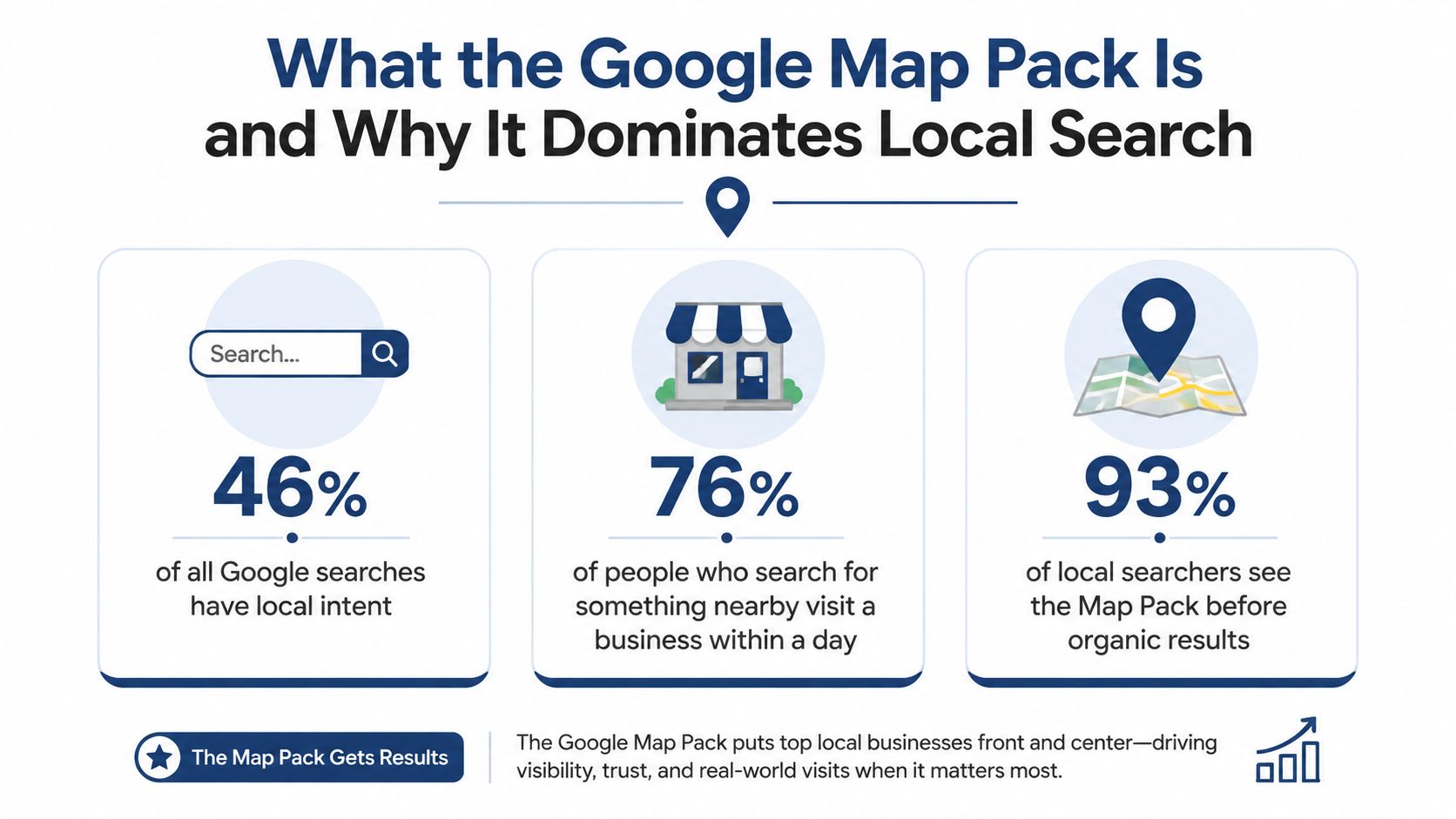
The scale of this feature makes it difficult for service businesses to treat Maps as an optional extra. A 2026 UK local-service search analysis found that the local pack appeared on 95.6% of trades-related queries. It also appeared on above 90% of most other UK service-sector queries examined. In other words, the Map Pack is present for the overwhelming majority of relevant searches in those sectors.
Why the top three listings matter
Presence alone isn't enough. Position within the local results affects how much attention and activity a business can receive. A UK-focused local SEO review reported that around 44% of local search clicks go to the Google Map Pack. It also found that businesses in the map pack receive roughly 93% more actions than businesses outside the top local results, and about 126% more traffic than businesses ranked four to ten.
“Actions” can include calls, website visits and direction requests. These are closer to commercial intent than a simple impression. Someone comparing tradespeople in Maps may be ready to contact a provider, whereas someone browsing an informational article may still be researching the problem.
Practical rule: Treat Map Pack visibility as a customer acquisition channel, not as a decorative addition to your website listing.
The distinction between organic SEO and local SEO still matters. Organic results help your website answer questions and build topical relevance. The Map Pack puts your business details in front of people who may need a service in a particular place. For many UK service-area businesses, the customer journey begins with the profile, not the homepage.
How Google Decides Which Businesses Appear in the Map Pack
Google's local ranking system rests on three connected ideas: relevance, distance and prominence. They work together rather than as separate switches. A profile can match the service well but still rank differently across towns because the searcher's location and the strength of nearby competitors change the result.
Relevance connects the profile to the search
Relevance measures how closely a business matches the customer's wording and underlying need. Google assesses the Business Profile, its service details and other local signals to decide whether the listing belongs in that search.
Consider two plumbing businesses. One selects a category that accurately describes its main service and clearly lists boiler repairs, leak detection and emergency plumbing. The other chooses a broad or unsuitable category and provides little service information. For a search about emergency boiler repair, the first profile gives Google clearer evidence that it fits the request.
The primary category deserves careful attention. UK rankings research published in 2026 reported that it was the single most influential factor for Map Pack winners, ahead of review volume and review velocity. Choose the most accurate category, not just the one that appears most commercially attractive. The service list should then reinforce that choice with specific, customer-facing descriptions.
A useful way to view the profile is as evidence for a case. The category establishes the main subject, while services and business information show which jobs the business handles.
Distance creates a proximity effect
Distance describes the relationship between the searcher, the search location and the business. A service-area business may cover several towns, but Google will not necessarily show it in the same position throughout that area.
An electrician might appear strongly for a customer near its registered location and less prominently for someone searching from a more distant town. The profile, service list and reviews may remain unchanged. The searcher's position and Google's assessment of which providers are realistically relevant to that place have changed.
That makes one manual search a poor measure of visibility. A search performed from outside the service area reveals only one point in a much wider pattern.
Prominence reflects recognition and trust
Prominence describes how established and trusted a business appears in its market. Reviews, profile quality, mentions across the web and website signals can all contribute, although no single activity guarantees a ranking.
Review patterns provide useful context. Recent, genuine feedback with thoughtful responses can show continuing customer activity more clearly than a profile that gathered many reviews in the past and has since gone quiet. Review volume alone therefore gives an incomplete picture. Recency, authenticity and the way a business responds also matter when assessing the profile's credibility.
Google applies policies to profile content, including reviews, photos and videos. The Google Business Profile policy guidance discussed in UK Map Pack research reinforces that these formats are subject to the same rules, rather than being informal exceptions.
Relevance gets a business considered, distance changes the competitive set, and prominence helps Google decide which relevant options deserve attention.
The Ranking Factors That Move the Needle
UK service-area businesses often spread their effort across directories, blog posts, photos and review requests without a clear order of priority. Map Pack visibility is easier to improve when you treat the profile as a set of signals. Each field should help Google identify what the business does, where it operates and which searches match it.
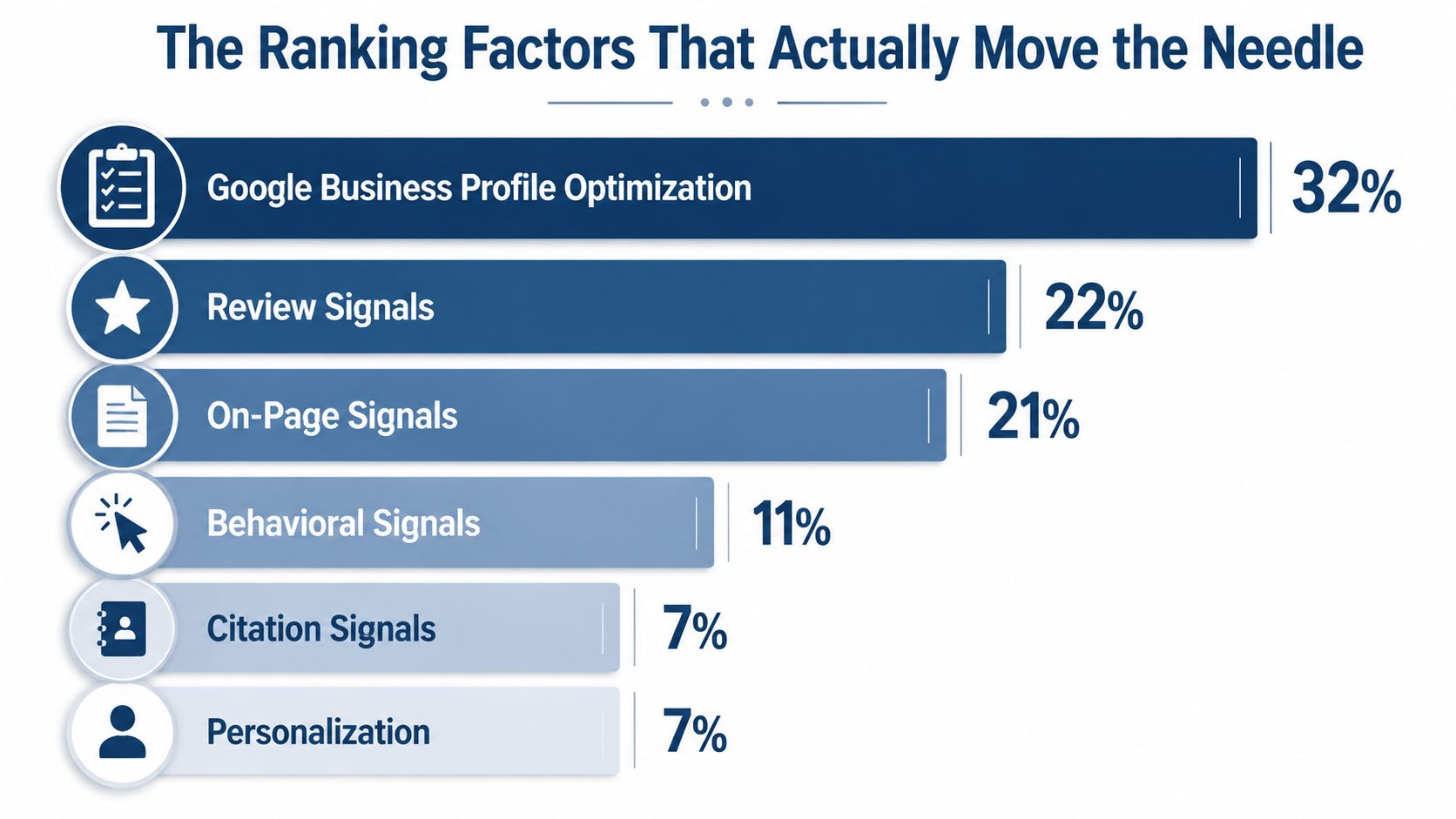
A factor breakdown in independent local ranking research attributes 32% of Map Pack ranking weight to Google Business Profile signals, 20% to review signals and 15% to on-page signals. These figures are not a visible formula applied to every listing. They offer a useful working model: set the profile fields correctly first, build steady review activity, then strengthen the website that supports both.
Set the primary category accurately
The primary category tells Google what the business mainly is. For a domestic electrician, “Electrician” gives clearer relevance than a loosely related category. Secondary categories can add context, but selecting every remotely connected option weakens the profile's focus.
Record the current category before changing it. Choose the most specific accurate option available, then check that the services listed support that choice.
Use services to match customer intent
The service list should describe work customers can request. A plumber could include boiler repairs, tap repairs, burst pipe repair and bathroom plumbing, provided those jobs are offered.
Use the wording customers understand, while keeping each entry distinct. Locations and repeated keyword variations make the list look like an artificial catalogue rather than a clear description of the business.
Build a steady review pattern
The review signal includes more than the average star rating. Volume, recency, language and response activity describe the profile's reputation together. Recent, genuine feedback gathered at a consistent pace gives Google and prospective customers a clearer picture than a large historical total followed by a long period of silence.
Ask for honest feedback after a completed job, without incentives or scripted wording. Businesses can use this guide to get more Google reviews when creating a practical request process.
Let the website reinforce the profile
On-page signals help connect the profile with the services and locations the business serves. A clear service page, consistent contact details and useful information about the areas covered give Google supporting context.
Backlinks and citations can assist, but they should not displace accurate profile information and healthy review activity. Complete the category, service list and review process before assigning most of the available time to lower-priority tasks.
Auditing Your Profile Against Local Competitors
A profile audit becomes useful when it answers a specific question: what does a nearby business communicate more clearly than we do?
Take a domestic heating business serving a group of nearby towns. Its owner searches for the main service terms and records the businesses appearing in the local results. The aim isn't to copy those profiles. It's to compare the information Google and customers can see.
Build a side-by-side view
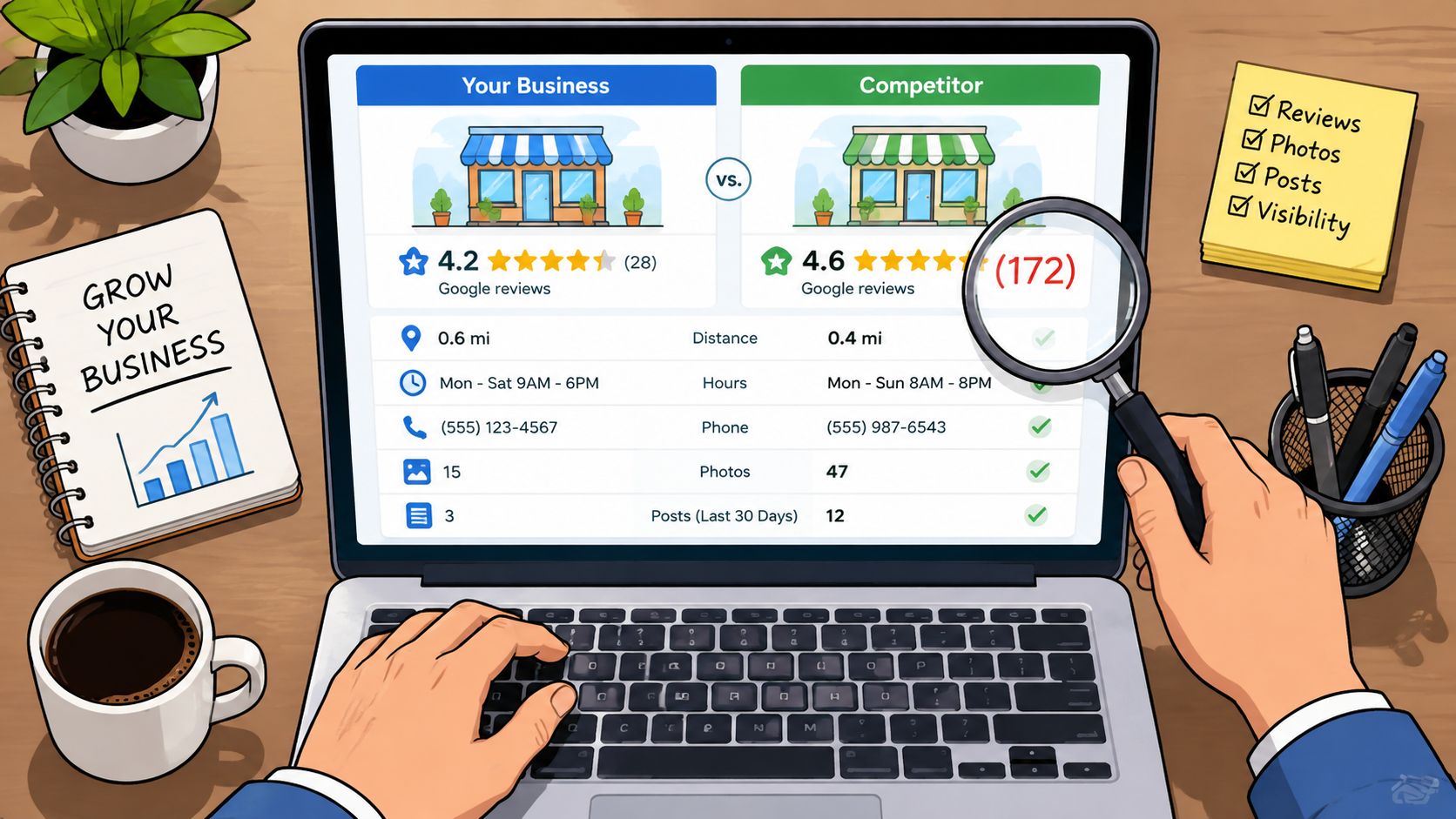
Compare your profile with the businesses that consistently appear for the same services and locations. Look at:
- Primary category: Is your main category as specific and accurate as theirs?
- Services: Does your profile describe the actual jobs customers request?
- Reviews: Compare volume, rating, recency and whether owners respond.
- Photos and videos: Check whether the profile shows real work, staff, vehicles and premises where appropriate.
- Business information: Check the name, telephone number, address, opening hours and service-area details.
- Posts: Note whether competitors publish useful updates or leave the profile dormant.
One 2026 benchmark reported an average Google Business Profile with 47.4 reviews and a 4.42-star rating. Use that as market context rather than a target that every business must mechanically match. A business with fewer reviews may compete through a more accurate category, stronger service relevance or better coverage of a particular customer need.
Prioritise gaps instead of copying activity
Suppose the heating business has a suitable category but a thin service list, fewer recent reviews and no fresh visual evidence of completed work. Those gaps deserve attention before a large citation project. If the business already has a complete profile but ranks weakly in surrounding towns, the next diagnostic step is location-based tracking rather than another round of text edits.
A local SEO audit should record the current state before changes are made. That creates a baseline and helps separate genuine progress from normal daily movement.
A competitor's profile is evidence of what Google is rewarding in that search environment, not a template you should duplicate without checking accuracy.
Optimisation Tactics That Improve Map Pack Visibility
Start with the field that shapes how Google classifies the business. As noted earlier, UK research identifies the primary business category as a leading factor among Map Pack results. Choose the most specific category that truthfully describes the core operation, then check whether the secondary categories still fit.
Make the service list precise. A roofer should not rely on a broad description such as “roofing services”. Listing genuine offerings, including roof repairs, gutter repairs and flat-roof installation, gives Google clearer context and helps customers confirm that the business handles their problem.
Improve the profile customers see
Complete the fields that support trust and customer action:
- Business description: Explain the main service, customer type and places served in natural language.
- Opening hours: Keep regular and special hours current, so customers do not rely on outdated information.
- Phone and address: Check that contact details are accurate and consistent.
- Attributes: Select only attributes that apply to the business.
- Photos and videos: Upload authentic images of completed work, staff, vehicles or premises where relevant.
- Posts: Share useful updates, seasonal advice, completed-project information or service announcements.
These fields should describe the business as it operates, not as it hopes to appear. Google's policies apply to every format, so avoid misleading images, manipulated reviews and unsupported claims in posts.
Build a healthier review pattern
Ask for feedback at a natural point after the job is complete. Use a direct link, explain that honest feedback is welcome and avoid asking customers to include particular keywords. Reply to positive and negative reviews professionally, referring to the service where relevant without revealing private customer details.
The useful pattern is ongoing and genuine. A large historical review total cannot compensate for a profile that appears neglected today. A recent review also should not be treated as a guaranteed ranking trigger. Review activity works as part of the wider profile, alongside accurate information and clear service relevance.
Strengthen supporting relevance
Create useful website pages for important services and locations. Each page should provide original information rather than copied town names, and it should agree with the Business Profile about the service, business name and contact details.
For a UK service-area business, this alignment prevents a common mismatch: the profile names one service, while the website describes another. Fix classification first, clarify services second, improve review activity third, then develop the website and supporting local presence.
Tracking Your Visibility Across Your Service Area
A business can rank well near its address and poorly elsewhere. That isn't necessarily a reporting error. Distance is built into local search, so Google may show different businesses when the searcher's location changes.
Manual checks are useful for a quick impression, but they don't provide a reliable view across a whole service area. Results can vary by search location, device, search history and the exact wording used. A business owner who searches from the office may see a stronger result than a customer in a nearby town.
Geo-grid tracking addresses this problem by checking rankings at multiple points on a map. Each point represents a search location, allowing you to see where the business appears in the top local results and where competitors take the available positions.
Read the map as a visibility footprint
A grid with a small radius can show the immediate area around the business. A wider radius can reveal whether visibility extends into the towns the company actively serves. You can also use different grid layouts, including 5×5, 7×7 and 9×9, and select a scan centre manually when a nearby town deserves its own test.
That flexibility matters for a service-area business. A landscaping company might rank well around its registered address but need separate tracking centred on a nearby town where it wants more enquiries. Use a keyword containing the town name when that reflects real customer behaviour, then compare the result with the broader service term.
Turn ranking patterns into decisions
A weak area doesn't tell you automatically which profile field to change. Compare the grid with competitor profiles and the search intent behind the keyword. If competitors dominate because their primary categories and services are more relevant, update those fields first. If your profile is well matched but reputation signals are weaker, focus on authentic review generation and responses.
Google Business Profile rank tracking can make these patterns easier to monitor over time. Look for changes across clusters of locations rather than reacting to one isolated position. The useful outcome isn't a colourful map by itself. It's a clearer decision about which part of the business profile needs attention in each area.
Your Action Plan for Map Pack Success
Use a short, prioritised cycle rather than trying to change everything at once.
- Audit the profile: Confirm the primary category, services, contact details, hours, attributes, photos, videos, reviews and posts.
- Compare competitors: Record the gaps in relevance, review recency, profile completeness and visible activity.
- Fix classification: Choose the most specific accurate category and align the service list with the jobs you provide.
- Improve reputation activity: Request genuine feedback after completed work and respond professionally to every review.
- Strengthen supporting pages: Make your website clearly explain the services and locations you serve.
- Track the service area: Use geo-grid results to identify places where proximity-sensitive visibility is weak.
- Review, learn and repeat: Measure changes across locations, then act on the next highest-impact recommendation.
The Google Map Pack rewards clarity, local relevance and credible evidence of an active business. You don't need to chase every metric. You need to identify the profile changes most likely to improve visibility for the searches that matter commercially.
Start a 14-day free trial of VisiLocali to track Google Business Profile rankings across your service area, compare competitor profiles side by side, and receive AI insights and recommendations. Use the findings to decide what to improve next, then monitor whether those changes expand your visibility in the places your customers search.
