 Skip to content

You can spend months adding posts, tweaking titles, and waiting for the phone to ring, then discover the actual problem was simpler. Your Google Business Profile might be incomplete, your Map Pack visibility may drift by postcode, and your citations could be sending mixed signals across the web. A proper local SEO audit finds that gap fast, then turns it into a fixed list of actions instead of another vague SEO project.
Table of Contents
- Why a Local SEO Audit Pays Off Quickly
- Scoping Your Audit Before You Check Anything
- Auditing Your Google Business Profile and Real Map Visibility
- On Site Content and Citation Consistency That Builds Trust
- Reviews Reputation Local Links and Technical Health Checks
- Your Prioritised Action Plan and Next Steps
Why a Local SEO Audit Pays Off Quickly
A local business often loses customers for a simple reason. Nearby searchers never see the right listing at the right moment, or they land on a profile that looks unfinished and choose someone else.
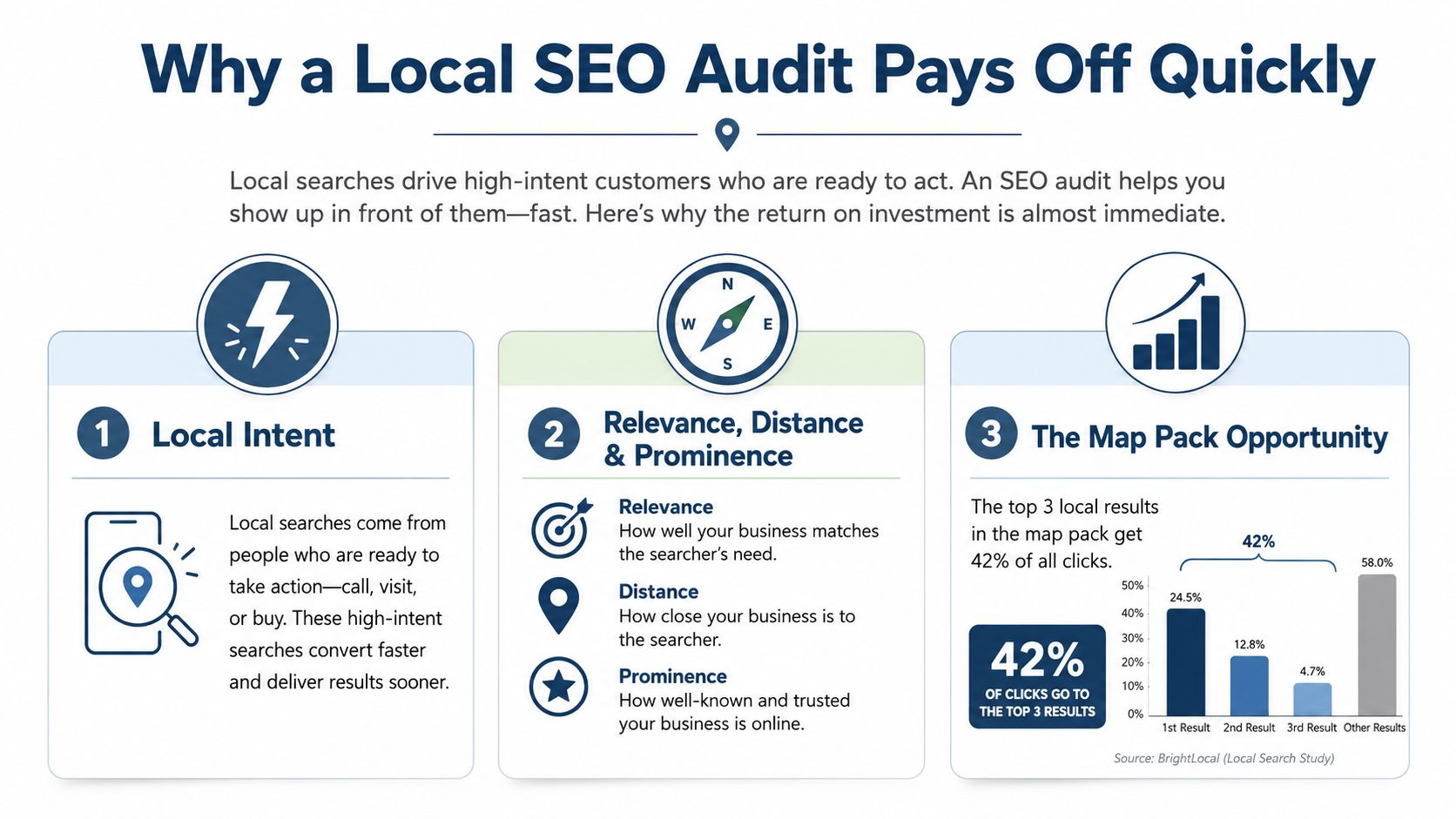
Google's UK Think with Google research says 46% of all searches have local intent, and 76% of people who search for something nearby on a smartphone visit a related business within a day (SEMrush summary of Google's UK local search research). That makes local visibility a commercial issue, not a vanity metric. If a searcher is ready to act on the same day, the audit has to focus on the assets that influence discovery and trust, not on busywork.
What drives the result
Google's local systems rely on relevance, distance, and prominence. In plain English, that means the business has to match the query, be close enough for the searcher's location, and look credible enough to earn a visible place in the Map Pack. If one of those pieces is weak, rankings wobble by location and device.
Practical rule: do not start by “improving SEO” in general. Start by checking whether the profile is visible, complete, and consistent where the customer looks.
That is why the first pass of a local SEO audit should be a baseline, not a brainstorm. You need to know whether the business appears in Google Maps, whether the listing matches the website, and whether nearby competitors have stronger review signals or fuller profiles. Once that baseline exists, every fix has a job to do.
Why geo-grid evidence beats guesswork
A single ranking check from one postcode can hide the pattern. A business can look fine in its own town-centre search and still disappear a few streets away, especially for service-area businesses that travel to the customer.
Geo-grid evidence makes the problem visible. Side-by-side competitor comparisons make it actionable. Together, they show whether the issue is profile completeness, proximity, review strength, or a competitor with a cleaner entity signal.
Scoping Your Audit Before You Check Anything
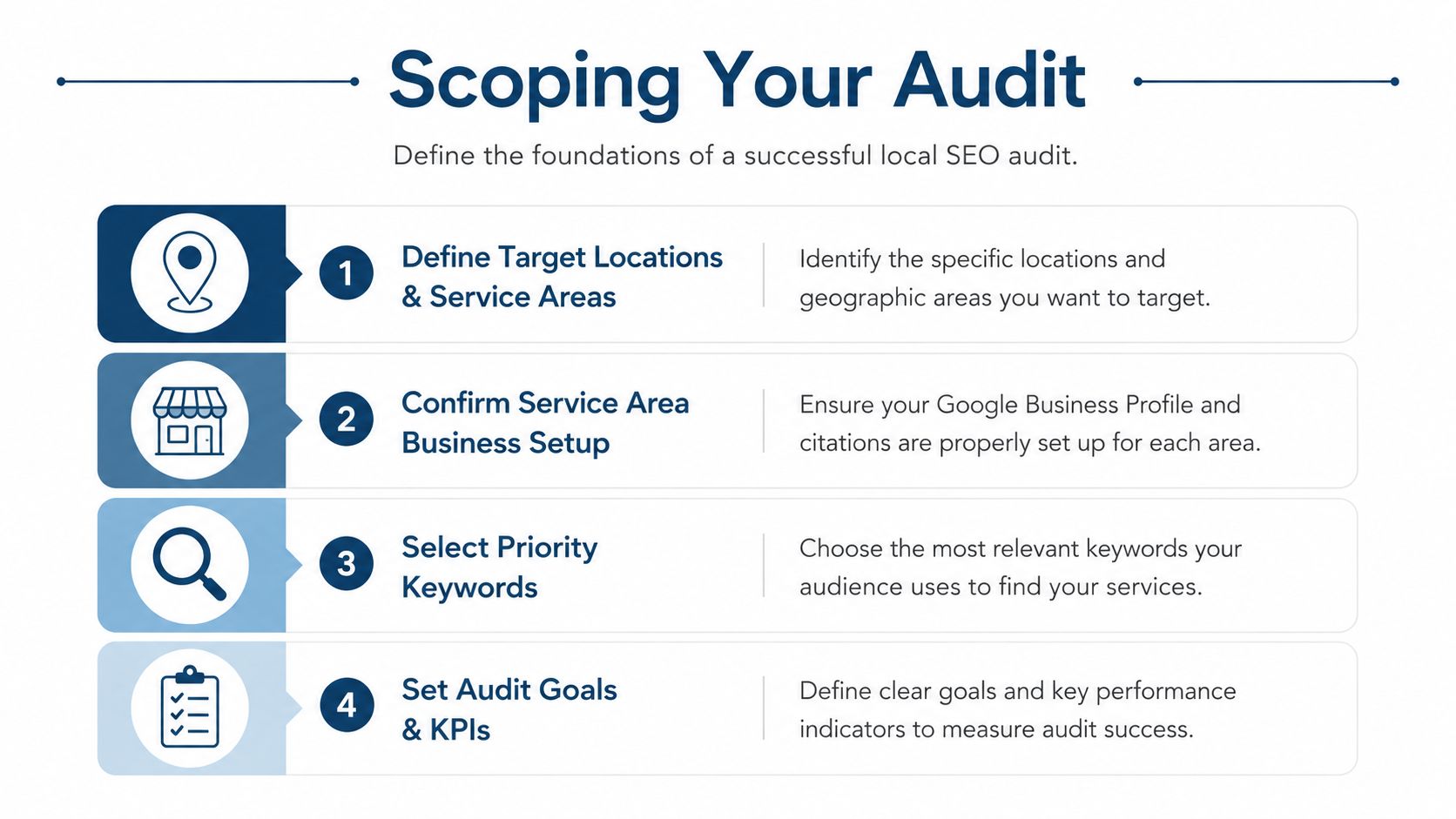
An audit goes wrong when the scope is fuzzy. If the business serves a town, two nearby suburbs, and a wider service area, but nobody agrees which searches matter, the findings will be noisy and hard to prioritise. The fix is to define the location, the audience, and the reporting method before touching any data.
Lock the geography first
Start with the exact towns, postcodes, or service areas that matter commercially. If the business is a service-area operator, confirm how it's set up in Google Business Profile, because the profile and the website need to tell the same story about where the company works.
Then choose the keyword set. A solicitor, for example, might need “family solicitor Manchester” and “divorce solicitor Salford” rather than a broad, non-local head term. The point is to test the phrases that map to real buying intent, not the ones that sound important in a strategy deck.
A clean scope prevents wasted work. If the business does not sell in a location, don't waste audit time proving it can't rank there.
Set the benchmark list before the audit begins
Every serious audit needs a competitor set. That usually means the businesses already appearing in the Map Pack for the target terms, plus a few direct competitors that dominate nearby areas. Side-by-side comparison only works when the comparison set is stable.
Gather access before you start as well. You'll need Google Business Profile access, website access, and analytics visibility if you want to separate a listing problem from a website problem. Without that, you end up guessing which channel is holding the business back.
A simple pre-audit checklist keeps the work tidy:
- Target locations: confirm the towns, postcodes, and service zones being measured.
- Primary keywords: list the local phrases that matter most to sales.
- Competitor set: note the businesses that repeatedly appear in the Map Pack.
- Access and ownership: confirm who can edit the website and Google Business Profile.
- Reporting cadence: agree how often rankings and fixes will be reviewed.
That scope gives the audit a job. It also makes the next step, the profile and visibility review, much easier to interpret.
Auditing Your Google Business Profile and Real Map Visibility
A profile audit is only useful when it checks the parts that users see. That means the business name, address, phone number, primary and secondary categories, services, hours, photos, videos, posts, Q&A, attributes, and overall completeness, not just the top of the page (Search Engine Journal local audit checklist). If one field is off, the listing can still exist but look less trustworthy, less relevant, or harder for Google to classify correctly.
What a proper GBP review catches
The first pass is mechanical. Check whether the business name matches the actual trading name, whether the address is formatted consistently, whether the phone number routes correctly, and whether the categories reflect the service the business sells. Then inspect hours, special hours, attributes, photos, videos, posts, and Q&A for omissions or stale information.
The second pass is commercial. Compare the profile with the strongest nearby competitors and look for gaps in review count, review freshness, profile completeness, and how convincingly the business presents itself. That comparison is often more useful than a generic score, because it shows why one listing keeps winning the same query.
Practical rule: if the profile cannot answer basic customer questions quickly, the audit is incomplete.
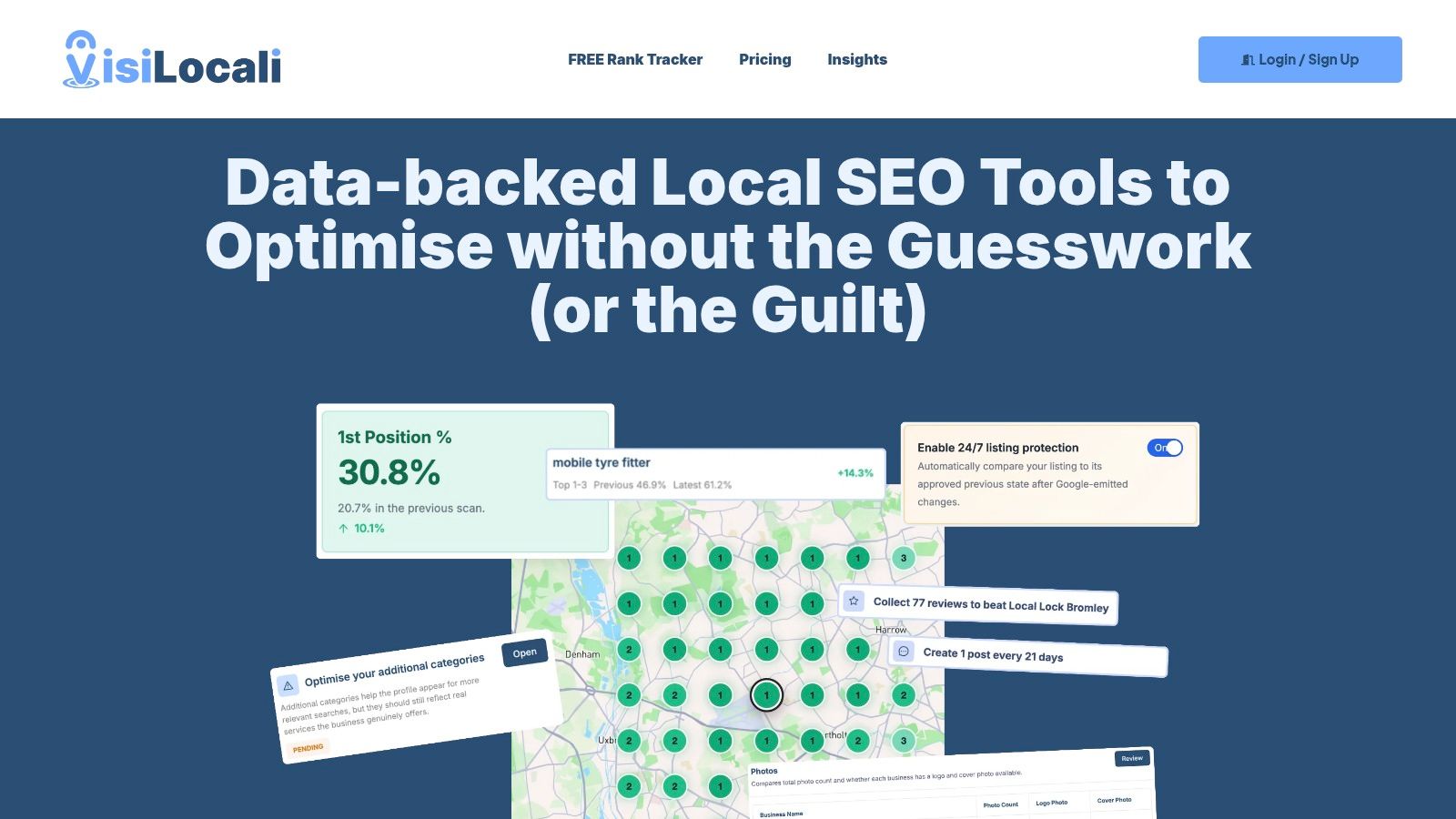
For teams using VisiLocali's GBP audit view, the useful feature is the side-by-side comparison. It shows the business profile beside selected competitors, so gaps are easier to spot without jumping between tabs or spreadsheets.
How geo-grid tracking exposes real visibility
Map Pack visibility changes by place, which is why location-centred tracking matters. A business should be checked from its own location, then from nearby towns or postcode-centre points, because that reveals whether visibility holds steady or drops off as geography changes. That drift is especially important for service-area businesses, where the customer may search from outside the trading address.
An interactive grid makes those patterns obvious. Some points in the grid may be strong, others weak, and the shape of that pattern usually tells you more than a single ranking number ever will. A business with a flat, healthy grid is in a different situation from one with a strong centre and weak outer rings.
The useful interpretation is simple. If the grid weakens far from the business, the issue may be proximity or competitor strength. If the profile is incomplete and the grid is weak everywhere, the business probably has an entity problem that needs a cleaner profile and stronger matching signals before anything else.
VisiLocali is built around that workflow. It combines geo-grid ranking data, competitor profile comparisons, and AI recommendations so the next action is based on evidence, not hunches.
On Site Content and Citation Consistency That Builds Trust
The website and the citation ecosystem should tell one coherent story. When they don't, Google has to reconcile conflicting entity signals, and users see inconsistency instead of confidence. This part of the audit is less glamorous than rank tracking, but it often removes the friction that stops good profiles from performing properly.
Treat the website as the source of truth
Start with the website contact page, location pages, and service pages. Check whether the business name, address, and phone number are written the same way everywhere, then compare those details with the Google Business Profile and the main directory listings. One local audit checklist says NAP should be 100% identical across the website, Google Business Profile, and directories, with no drift such as “St.” versus “Street” (Mr Green Marketing local SEO audit checklist).
That level of consistency matters because it reduces confusion about which entity the business represents. If the website says one thing, the profile says another, and a directory uses a third format, the signal becomes weaker than it needs to be.
Fix the top citation sources first. That usually means the main website pages and the high-authority directories the business is most likely to be indexed from, before tidying the long tail. This order helps avoid the same bad data being re-syndicated while you're still cleaning it up.
Check the page structure, not just the wording
A local business site needs pages that make sense to both people and machines. Crawlability and indexation matter for location and service pages, HTTPS matters for trust, broken links and 404s frustrate users, and LocalBusiness schema helps search engines and AI systems parse the details cleanly (Spark Local HQ local SEO audit guide).
Look at the structure like a customer would. If someone lands on the service page, can they tell where the business operates, what it does, and how to contact it in a few seconds? If not, the site is under-supporting the profile.
A few common problems show up over and over:
- Abbreviated addresses: “Rd.” on one page and “Road” on another.
- Old phone numbers: the website footer updates, but old citations still point at a stale number.
- Thin location pages: pages that mention a town once but don't prove local relevance.
- Missing schema markup: no structured data on pages that should clearly define the business.
The safest approach is to correct the source of truth first, then update the dependent citations. That keeps the entity clean and prevents the same contradiction from being repeated across the web.
Reviews Reputation Local Links and Technical Health Checks
Reviews, links, and technical health often get audited separately. In practice, they affect each other. A strong profile with weak review handling and a slow, broken location page still sends the wrong signal to both customers and search engines.
Make review management operational
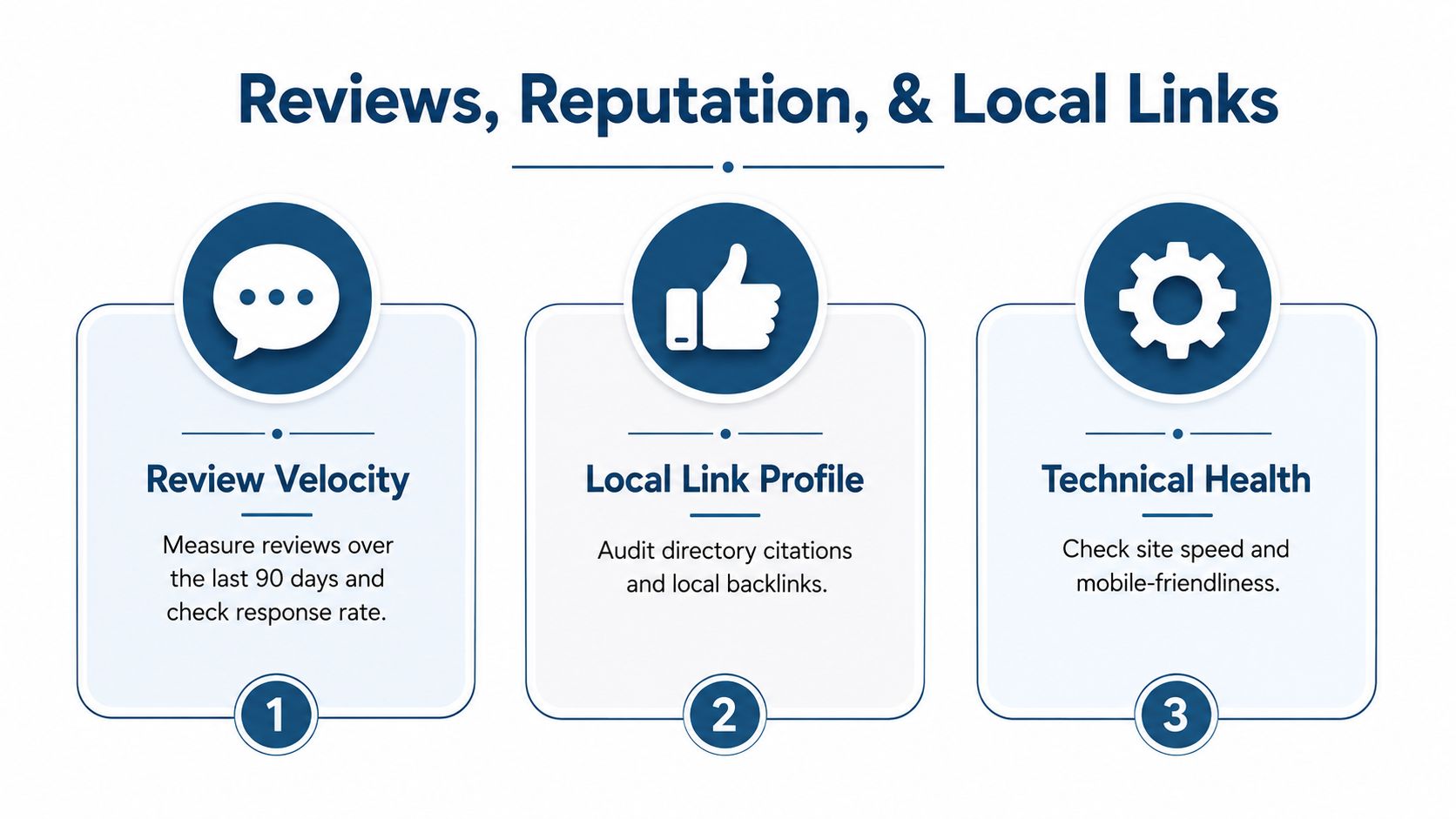
Average star rating is only part of the story. Review velocity and response speed matter too. One local audit checklist defines review velocity as reviews per month over the last 90 days and recommends replying to every unresponded review within 24 hours (Flento local SEO audit).
That changes the work from vague reputation management into a repeatable process. Weekly review checks make it easier to spot a quiet profile before it becomes a trust problem, and response speed shows whether the business engages with customers promptly.
For teams that need a practical workflow, VisiLocali's review management area is built around responding quickly and keeping the process visible. The point is not to chase praise, it's to keep the profile active and credible.
Practical rule: unresponded reviews are audit items, not admin noise.
Judge local links by relevance, not raw count
A local link profile should look like the business belongs in its area. That means local relevance, mention context, and source quality matter more than a pile of unrelated backlinks. A chamber of commerce, supplier, association, or local partner link can do more good than a random citation on an irrelevant domain.
The same logic applies to directories. A solid citation from a trusted local source supports the entity. A weak, duplicate, or inconsistent citation does the opposite. The audit should therefore ask, “Does this link or listing reinforce who the business is and where it operates?”
Check the technical basics in a fixed order
Audit the location pages in this sequence, because it avoids mixing visibility issues with quality issues:
- Crawlability and indexation: confirm the pages can be found and indexed.
- HTTPS security: make sure the site uses secure connections.
- Broken links and 404s: catch dead ends on key paths.
- Structured data: check whether LocalBusiness schema is present and clean.
- Page performance: look for obvious friction on mobile, especially on service and contact pages.
That sequence works because it starts with whether the page can be found, then checks whether it is trustworthy, then checks whether users hit dead ends, and finally checks whether machines can understand the business details. If the basics fail, ranking work gets expensive fast.
Your Prioritised Action Plan and Next Steps
A good audit doesn't end with a pile of notes. It ends with a sequence of fixes that tells the team what to do next week, next month, and next quarter. Without that prioritisation, even accurate findings can sit untouched.
Score each issue by impact effort and risk
Use a simple filter. First, ask how much the issue affects visibility in Maps, organic results, or user trust. Second, ask how hard it is to fix. Third, ask whether leaving it alone creates ongoing risk, such as mismatched NAP data or an unmanaged profile field.
That gives you a practical order. High-impact, low-effort fixes go first. Bigger structural problems, like location page rewrites or schema work, move into the next block. Lower-priority items, such as cosmetic updates or lesser citations, can wait until the high-value work is done.
A useful rhythm looks like this:
- Next week: correct profile fields, clean core citations, and reply to open reviews.
- Next month: rebuild weak location pages and fix local schema or crawl issues.
- Next quarter: improve local link signals, expand content support, and revisit geo-grid performance.
Add AI-era visibility checks to the audit
The modern audit now needs one more layer. Prompt-based discovery and AI Overviews can show a business before a customer ever reaches the Map Pack, so the profile data has to stay legible across those surfaces. Newer audit approaches already test prompts in tools like ChatGPT, Claude, Perplexity, and Google's AI Overview, but too many checklists still treat that as an extra rather than a standard check.
That matters because the same data problems that hurt Maps can also make AI answers less reliable. If the business description, service wording, and review signals are inconsistent, the machine has less clean information to work with. A practical audit should therefore check whether the business is understandable both in classic local search and in AI-generated summaries.
Google Business Profile optimisation guidance is a sensible follow-up when the profile itself needs tightening before wider citation or content work starts.
The final move is simple. Turn the findings into one owner, one list, and one review cadence. That keeps the business moving, instead of re-running the same audit six months later with the same problems still sitting there.
If you want a faster way to turn audit findings into action, start a 14-day free trial of VisiLocali. You can track Google Business Profile rankings with geo-grids, compare your profile side by side with competitors, and use AI insights to decide what to fix first. Visit VisiLocali to see how the audit turns into clear next steps.
