 Skip to content

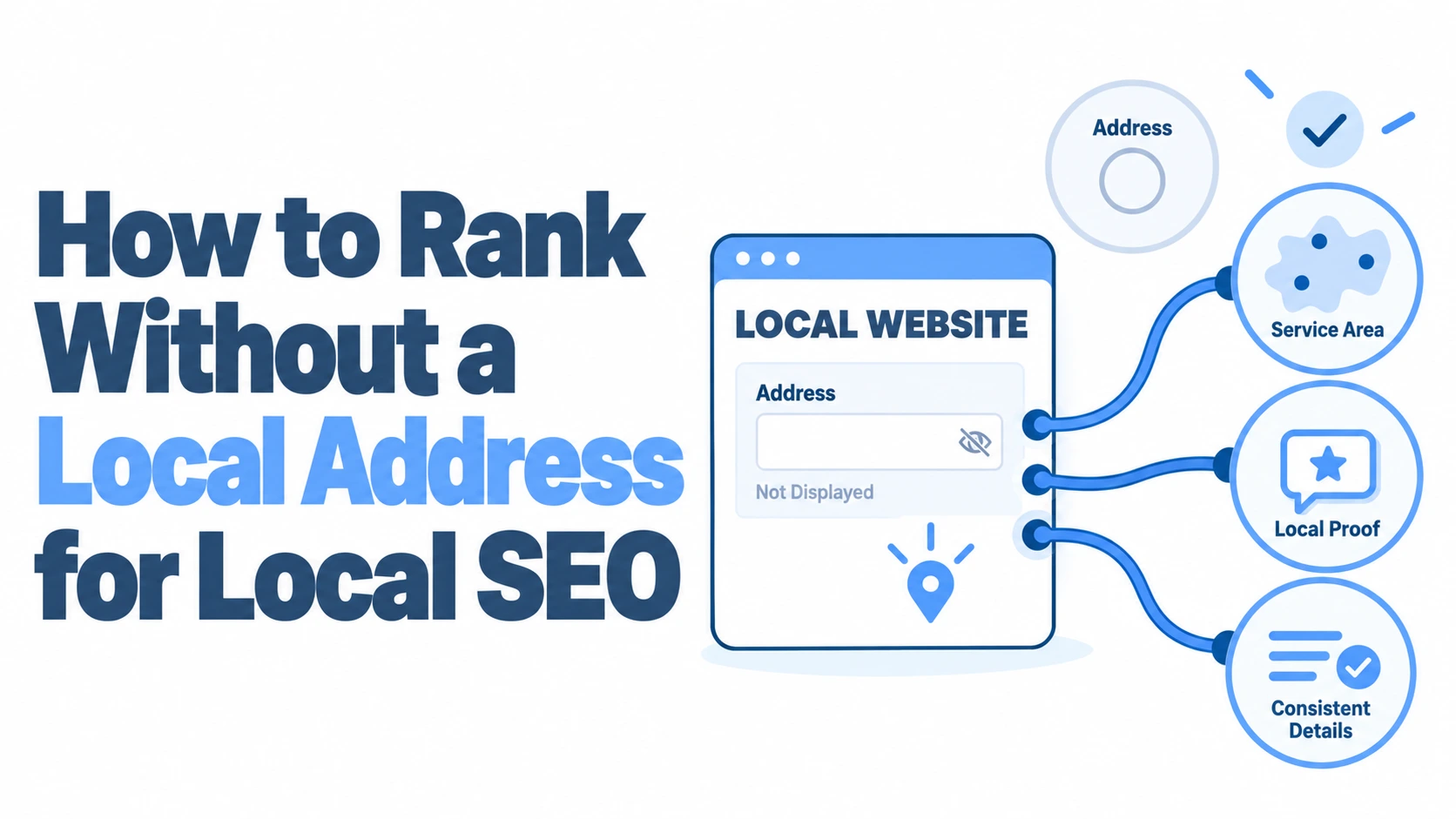
Thousands of service-based businesses across the UK operate without a shopfront or office that customers visit.
Plumbers, mobile hairdressers, dog walkers, IT consultants, cleaning companies: they all travel to the client rather than the other way around.
Yet local search results still heavily favour businesses with a visible, verified address. So how do you rank for local SEO without a physical address that’s open to the public?
The honest answer is that it takes more deliberate effort than it does for a high-street shop, but it’s entirely achievable. Google has built specific pathways for service area businesses, and the broader local SEO toolkit (citations, reviews, landing pages, schema markup) works just as well for a locksmith operating from a van as it does for a solicitor’s office in central Manchester.
The strategies below are practical, tested, and designed for UK businesses that already have a website and a Google Business Profile but need to close the gap on competitors who happen to have a prominent address.
Understanding the Service Area Business Model
The Difference Between Storefronts and Service Area Businesses
Google draws a clear line between two types of local business. A storefront business has a physical location where customers visit: a bakery, a dental practice, a gym. A service area business (SAB) travels to customers instead. Think of an electrician based in Leeds who covers a 30-mile radius, or a mobile dog groomer operating across several Bristol postcodes.
The distinction matters because Google treats these two models differently in search results. Storefront businesses display their address on their Google Business Profile and benefit from proximity signals tied to that exact location. SABs, by contrast, can define the areas they serve without showing a street address at all. Google’s own guidelines have supported this model since 2014, and the rules were last updated in 2024 to clarify eligibility for hybrid and service area businesses.
The practical effect is that SABs compete for local pack rankings based on service area relevance rather than pinpoint proximity. That’s both a challenge and an opportunity: you won’t appear for “near me” searches as easily, but you can target a much wider geographic area than a single-location storefront.
Google Business Profile Eligibility for Non-Physical Locations
If you serve customers at their location, you qualify for a Google Business Profile even without a public-facing address. Google’s guidelines are specific: you must make in-person contact with customers within your stated service areas, and you cannot simply list a PO Box or virtual office.
Businesses that operate from a home address are eligible too, but Google expects you to hide that address from public view (more on that below). The key requirement is that your business genuinely serves the areas you claim. A carpet cleaner in Glasgow who lists Edinburgh, Dundee, and Aberdeen as service areas will face scrutiny if there’s no evidence of actual work in those cities.
One common mistake is setting up a profile with a virtual office address from a co-working space. Google has been cracking down on this since 2023, and profiles using shared virtual addresses are frequently suspended. Stick to a genuine home address (hidden from public view) or a legitimate commercial premises where you actually receive post and conduct some business activity.
Optimising Your Google Business Profile Without a Public Address
Setting Up Service Areas by Postcode and City
When you configure your Google Business Profile as a service area business, you replace the public address with a list of areas you serve. Google allows up to 20 service areas, and you can define these by city, town, county, or postcode.
Be strategic here rather than greedy. Listing every city in England won’t help: Google will struggle to determine relevance for any of them. Instead, focus on the areas where you genuinely operate and want to attract customers. A window cleaner based in Sheffield might list Sheffield, Rotherham, Chesterfield, Barnsley, and Doncaster. That’s specific enough for Google to connect the dots.
If you’re unsure which areas to prioritise, a tool like VisiLocali’s Local Rank Tracker can show you exactly where your business currently appears in Google Maps results across different postcodes. The visual ranking grids reveal gaps: you might discover you’re ranking well in S1 and S2 postcodes but invisible in S10, which tells you where to focus your optimisation efforts.
The Importance of Hiding Your Residential Address
If you work from home, Google lets you use that address for verification purposes while hiding it from public view. This is not optional: displaying a residential address creates privacy issues and can also confuse customers who might try to visit.
To hide your address, go to your Google Business Profile, select “Edit profile,” then “Business location,” and toggle off the option to show your address. Your profile will then display your service areas instead. This change doesn’t weaken your local rankings: Google still knows your location for proximity calculations, but the public won’t see your home address.
A word of caution: if you previously displayed your address and then hide it, your profile may temporarily drop in rankings while Google recalculates. This usually resolves within two to four weeks.
Verifying Your Business via Alternative Methods
Verification is where many SABs hit a wall. Google’s standard method is a postcard sent to your business address, which works fine for home-based businesses. But if you’ve recently moved or your address has verification issues, alternatives exist.
Video verification has become increasingly common in 2025 and 2026. Google may ask you to record a short video showing your business premises, branded materials, and proof of location. Phone and email verification are also offered to some businesses, though Google determines which method you’re eligible for: you can’t simply choose.
If your verification is stuck, check that your business name, address, and category match exactly across your profile and any existing citations. Inconsistencies are the most common reason verification stalls or fails.
Developing Location-Specific Landing Pages
Creating Unique Content for Target Towns and Boroughs
This is where businesses without a fixed address can genuinely outperform competitors who rely solely on their Google Business Profile. By creating dedicated landing pages for each area you serve, you give Google (and potential customers) clear signals about your geographic relevance.
Each page needs to be genuinely useful, not a copy-paste template with the town name swapped in. For a pest control company serving West Yorkshire, a page targeting Wakefield should mention local factors: the types of properties common in the area, seasonal pest issues specific to the region, and ideally a testimonial from a Wakefield customer. Aim for at least 400 words of unique content per page.
A strong location page typically includes your services as they relate to that area, a brief description of the towns or neighbourhoods you cover within it, customer reviews from that location, and practical details like typical response times. This isn’t about keyword stuffing: it’s about demonstrating genuine local knowledge and presence.
Incorporating Local Schema Markup for Better Visibility
Schema markup tells search engines exactly what your page is about in a structured format they can parse easily. For service area businesses, the LocalBusiness and Service schema types are most relevant.
On each location page, include schema that specifies your business type, the area served (using the areaServed property), your contact details, and your opening hours. If you have reviews specific to that area, mark those up with Review schema too.
You don’t need to be a developer to implement this. Most popular CMS platforms have schema plugins, and Google’s own Structured Data Markup Helper can generate the code for you. The key is consistency: your schema data should match what’s on the page and what’s in your Google Business Profile.
Embedding Local Maps and Directions for Proximity Signals
Embedding a Google Map on each location page reinforces the geographic connection. Rather than embedding a map centred on your home address, centre it on the town or area the page targets. You can use Google Maps’ embed feature to show the service area itself.
Some businesses also include a short section with directions or travel times: “We typically reach customers in Harrogate within 40 minutes of booking” or “Our team covers all of the BS postcode areas in Bristol.” These details serve dual purposes: they’re useful for customers and they reinforce location relevance for search engines.
Building Authority Through Local Citations and Backlinks
Finding Niche and Industry-Specific Directories
Citations (mentions of your business name, address, and phone number on other websites) remain a significant ranking factor for local SEO. For service area businesses, the challenge is ensuring consistency when you don’t display a public address.
The solution is straightforward: use your business name, phone number, and service areas consistently across all directories. Some directories require an address for listing: in these cases, use your registered business address (even if hidden on Google) and ensure it matches your GBP information exactly.
Start with the major UK directories: Yell, Thomson Local, Yelp UK, FreeIndex, and Checkatrade or TrustATrader if you’re in a trade. Then look for industry-specific directories. A mobile physiotherapist might list on the Chartered Society of Physiotherapy’s directory. A self-employed accountant would benefit from listings on ICAEW or AAT directories. These niche citations carry more weight than generic ones because they signal expertise and legitimacy.
Leveraging Local Press and Sponsorships for Authority
Backlinks from local news sites, community blogs, and event pages are gold for service area businesses. They establish you as a genuine part of the local community, which is exactly the signal Google looks for when deciding whether to show your business in local results.
Practical approaches that actually work include sponsoring a local sports team or community event (which typically earns you a link on their website), contributing expert quotes to local journalists, and writing guest posts for community blogs. A heating engineer in Newcastle who sponsors a junior football team in Gateshead gets a relevant local backlink and community goodwill: both of which feed into local search visibility.
Don’t overlook local business associations and chambers of commerce either. Membership often includes a directory listing with a backlink, and these sites tend to have strong domain authority.
Maximising Social Proof and Local Engagement
Strategies for Generating Reviews from Specific Locations
Reviews are one of the strongest ranking signals for local SEO, and for businesses without a fixed address, they’re arguably even more important. They prove to Google that real customers in real locations are using your services.
The most effective approach is simple: ask every customer for a review shortly after completing a job. Send a follow-up text or email with a direct link to your Google review page. Timing matters: within 24 hours of the job is ideal, while the experience is fresh.
To build location-specific review signals, encourage customers to mention their area naturally. You can’t dictate what people write, but a prompt like “We’d love to hear about your experience with our service in [area]” often results in reviews that include the town or neighbourhood name. These location mentions within reviews help Google associate your business with specific areas.
VisiLocali’s GBP Audit Tool can help you understand how your review profile compares to competitors and whether gaps in review volume or recency might be limiting your visibility. The audit identifies what’s working and what needs attention, then translates those findings into clear next steps: so you’re not left guessing what to prioritise.
Using Geotagged Images and Business Posts
Photos uploaded to your Google Business Profile carry EXIF data, including location information if geotagging is enabled on your phone’s camera. When you take photos at job sites across your service area, those geotags tell Google you’re physically present in those locations.
Make it a habit to photograph completed work (with customer permission) and upload these images to your GBP regularly. A gardener who uploads geotagged photos from jobs in Solihull, Sutton Coldfield, and Edgbaston is building a visual trail of geographic activity that supports their service area claims.
Google Posts are another underused tool for SABs. Publishing weekly posts about recent jobs, seasonal offers, or local tips keeps your profile active and signals to Google that the business is engaged. VisiLocali’s GBP Management Tool makes this easier by letting you generate posts from uploaded photos and manage your entire profile from one place, which is particularly useful when you’re spending most of your day on the road rather than at a desk.
Future-Proofing Your Local SEO Strategy
Google’s local search algorithm continues to evolve, and 2026 has already brought changes to how service area businesses appear in results. The growing influence of AI-generated search summaries means that structured data, consistent information, and genuine local authority matter more than ever.
Three things will keep your strategy resilient regardless of algorithm shifts. First, maintain absolute consistency across your Google Business Profile, website, and citations: any discrepancy gives Google a reason to doubt your legitimacy. Second, keep producing fresh, location-specific content. A static website with pages that haven’t been updated since 2023 sends the wrong signals. Third, treat your review strategy as ongoing rather than something you set up once and forget.
The businesses that rank well for local searches without a public address are the ones that work harder on every other signal. They build better location pages, earn more relevant backlinks, collect more reviews, and keep their Google Business Profile consistently active. There’s no single trick: it’s the compound effect of doing all of these things well.
If you’re a service area business that knows it should be more visible in local search but isn’t sure where the gaps are, VisiLocali offers a 14-day free trial across all plans. The platform was built by a local SEO specialist with over a decade of experience, and it’s designed to show you not just where you rank, but exactly what to do next. A card is required at sign-up to prevent trial abuse, but there’s no commitment if it’s not the right fit.
