 Skip to content
A complete Google Business Profile is the strongest single predictor of top-three map-pack placement in the UK, and most owners should prioritise their profile and reviews during the first 90 days before investing heavily in website work. UK data links local mobile searches directly to visits, calls and purchases, so small business local SEO starts with being found and trusted in Google Maps.
That changes the order of work. Many owners begin with blog posts, technical audits or new location pages while their profile has missing services, inaccurate hours, weak categories or no review process. Those tasks can matter later, but they don't fix the most immediate barrier between a nearby customer and a phone call.
Local search is also no longer a single Google results page. People move between Search, Maps, reviews, websites and social profiles before choosing a local provider. A practical strategy therefore needs to improve the profile first, measure visibility by location, and turn competitor gaps into tasks someone can complete during the next working week.
Table of Contents
- Why Local SEO Matters for UK Small Businesses
- How Google Decides Which Local Businesses Show
- The Prioritised Action Sequence That Moves the Map Pack
- A Week One and Month One Example for a UK Service Business
- Measuring Local SEO Progress Without Drowning in Data
- Common Mistakes and Quick Wins Most Small Businesses Miss
- Your Next 14 Days and Putting It All Together
Why Local SEO Matters for UK Small Businesses
A local search often happens close to the point of purchase. One UK-focused guide reports that 76% of people who search for something nearby on a smartphone visit a related business within 24 hours, while 78% of local mobile searches lead to an offline purchase (UK local SEO guide for small businesses). The same source reports that 88% of consumers who perform a local mobile search call or visit within a week, and estimates that around 46% of Google searches have local intent.
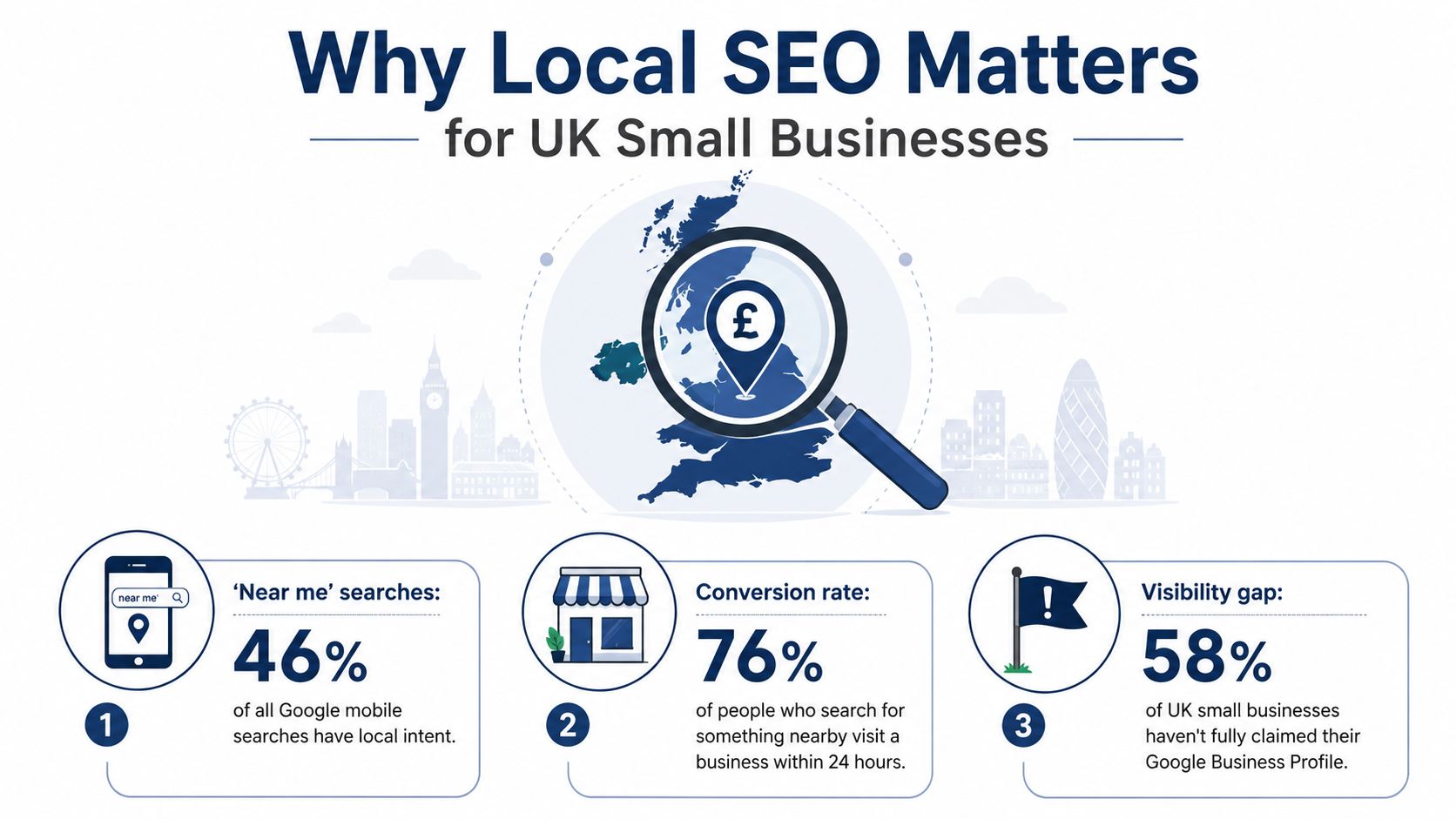
For a high-street shop, this can mean a customer checking opening hours and directions. For a service-area business, it may mean comparing a plumber, electrician or cleaning company from a mobile phone while deciding who to call. Local SEO is the work of improving your visibility and credibility across Google Business Profile, Google Maps, the local pack and local organic results, so nearby customers can find and choose you.
Local SEO is not just smaller general SEO
General SEO tends to focus on making a website relevant and authoritative for a search topic. Local SEO includes those signals, but it adds proximity, map data, categories, reviews and local trust. A website can explain a service well and still lose a local enquiry if a competitor has a more complete profile, a clearer category and stronger customer feedback.
The UK has about 5.5 million private-sector businesses, and 99.9% are small or medium-sized enterprises, according to UK-focused business statistics summarised by RankCraft's UK local SEO statistics. A small firm isn't competing with every business in the country for every search, but it may be competing with several nearby firms for the same urgent enquiry.
Practical rule: Treat your Google Business Profile as a customer-acquisition asset, not a directory entry.
Consumer journeys reinforce that point. UK-facing research reports that 52% of consumers begin their latest local-business search on Google Search, 9% begin on Google Maps, 75% use more than one channel, and 73% begin on mobile (UK local business SEO guidance). That means your profile, reviews, website and contact experience need to agree.
For more useful small business local SEO tips, focus on the order of operations rather than collecting an endless checklist. The rest of this guide explains Google's local ranking logic, the actions most likely to move map visibility, a realistic trades example, a lean reporting system, common mistakes and a practical 14-day sprint. You can also review the broader benefits of local SEO when deciding how local visibility fits into your acquisition strategy.
How Google Decides Which Local Businesses Show
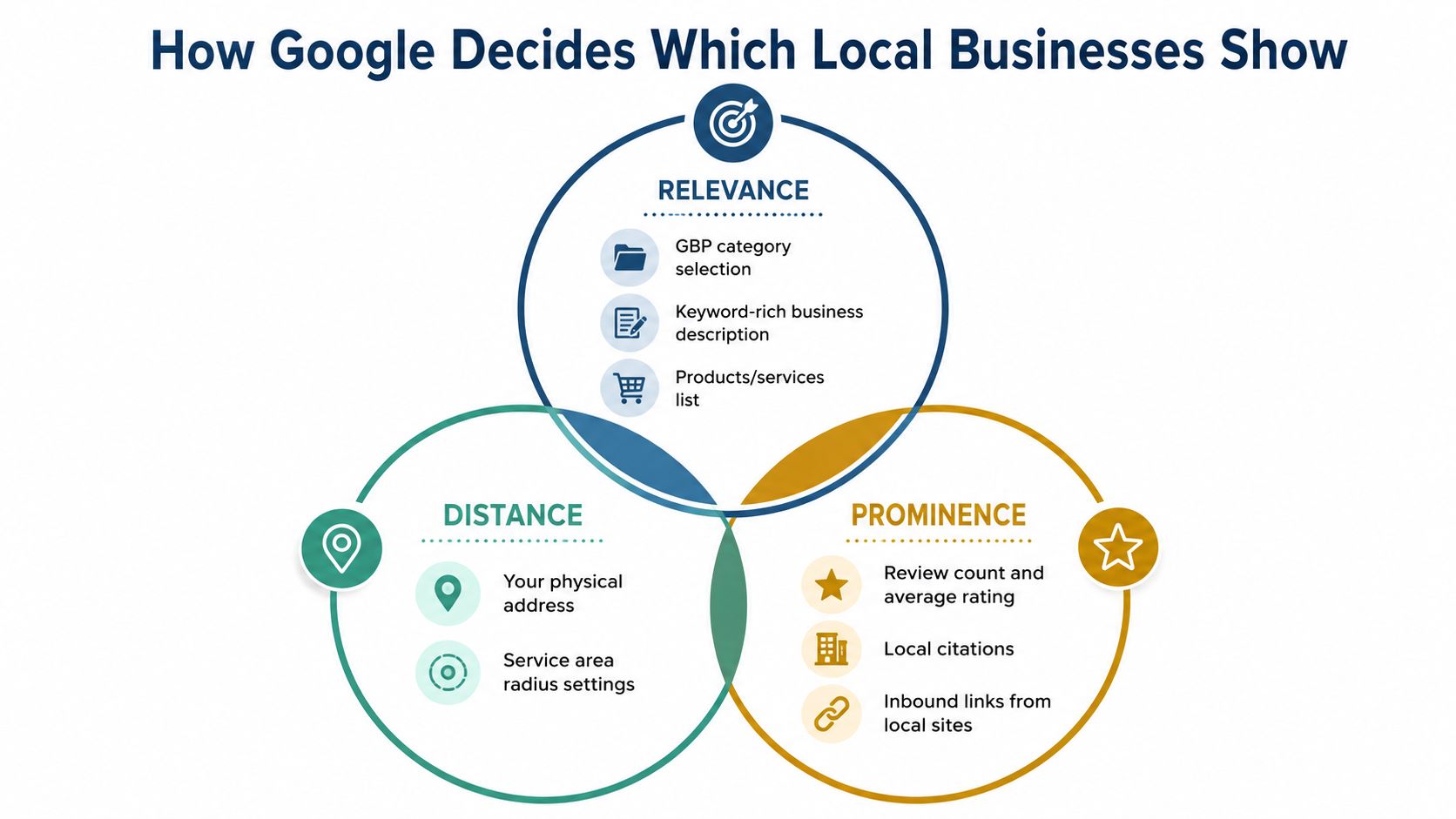
Google says local results are based primarily on relevance, distance and prominence, and its UK guidance also confirms that review count and review score can influence local ranking (Google's explanation of local ranking). These aren't abstract ideas. Each one maps to decisions a small business can make, although distance has a firm limit.
Relevance starts with accurate profile data
Relevance asks whether your business matches the search. The primary category carries particular weight because it tells Google what the business mainly does. Secondary categories, services, products, attributes and the business description add context, but they must describe the actual offer rather than a list of every phrase you want to rank for.
A roofer shouldn't select unrelated categories because they appear popular. A mobile dog groomer should describe the services offered and the areas served, while the website should use consistent business name, address and phone details. Attributes such as accessibility or business ownership can help customers make a decision when they're accurately accurate.
A 2026 practitioner survey reported that GBP signals represented 32% of local-pack and Google Maps weighting, based on responses from 47 experts evaluating 187 factors (Digital Applied's GBP strategy research). The survey identified the primary category, business title, profile completeness, photos and posts among the highest-impact GBP inputs. That supports a sensible priority, fix structured profile information before chasing complex authority work.
Distance is partly outside your control
Distance refers to the relationship between the searcher and the business location, or the location Google understands for a service-area business. An accurate address matters for a shop or office. A tradesperson who visits customers should configure service areas appropriately and avoid implying a staffed premises that doesn't exist.
You can't make a business physically closer through optimisation. You can make the location clearer, remove conflicting address information and ensure customers understand where you work. Service-area settings should reflect the areas you can reach, not every town in the region.
Prominence combines reputation and authority
Prominence describes how established and trusted a business appears. Review quality, review volume, recent activity, responses, local mentions and relevant links can all support this picture. Your review profile also affects the customer's decision after you appear, so ranking and conversion are connected.
UK datasets show how map-led this environment has become. One 2026 study reported local packs on 95.6% of trades queries and above 90% for most sectors studied, while GBP completeness had a reported 0.71 Spearman correlation with top-three local-pack ranking, compared with 0.41 for review count (UK local-pack ranking factor study). Correlation isn't proof that filling one field guarantees a ranking, but it does support a practical conclusion: complete the profile before treating review accumulation as the only objective.
For the review component, this guide to boosting local visibility with reviews is a useful complementary resource. VisiLocali's local ranking tracker can then show whether those improvements hold across the places your customers search.
The Prioritised Action Sequence That Moves the Map Pack
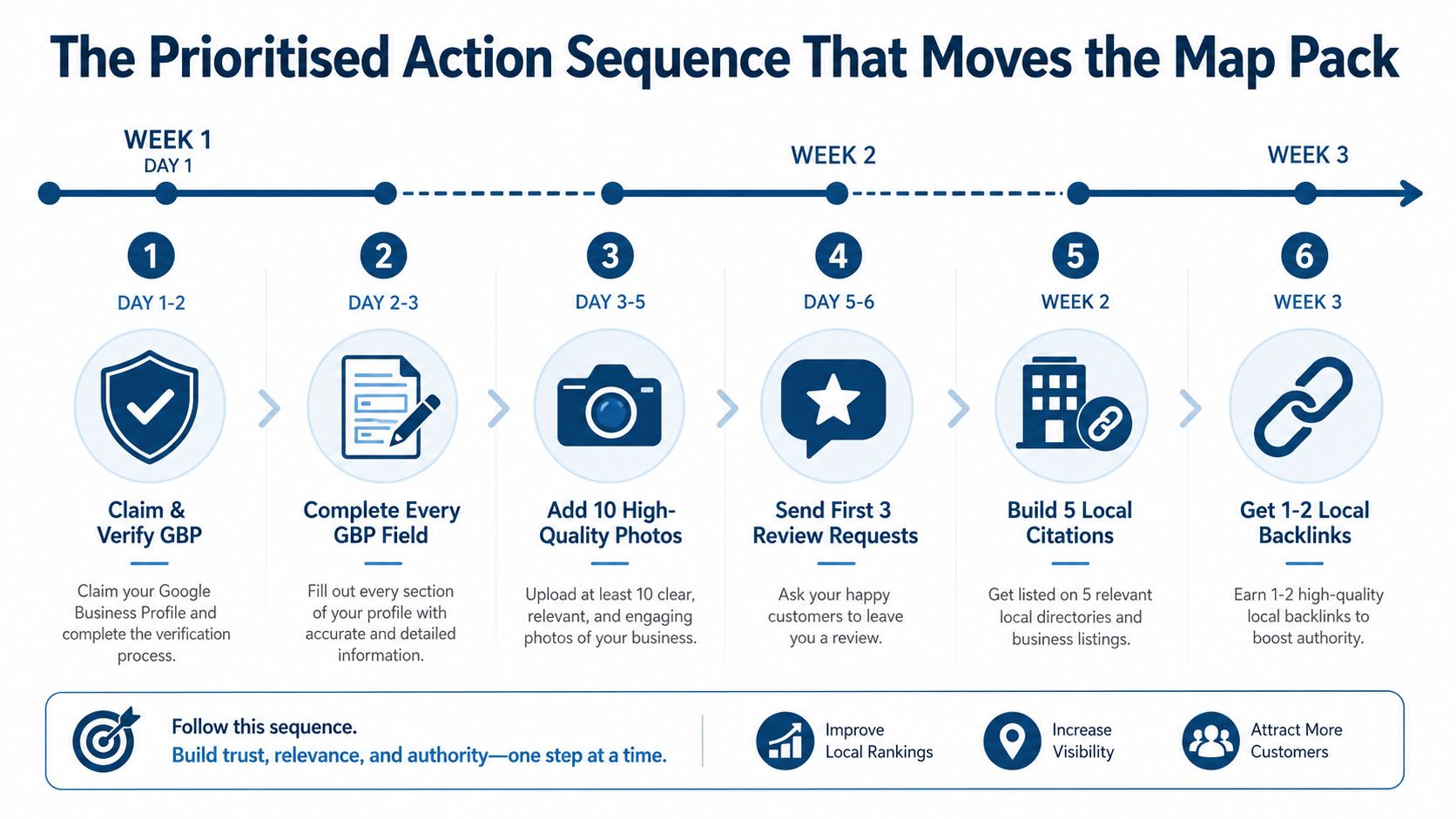
The order matters more than the size of the checklist. A business with an incomplete profile shouldn't spend its first month publishing broad blog content. Fix the information Google and customers use immediately, then add reputation and website support.
Week one fixes the profile foundation
Days one and two, claim, verify and complete the profile. Confirm ownership and verification, then work through every available field. Use the actual business name, choose accurate opening and special hours, add the phone number and website, write a natural description, list services, and select relevant attributes. Don't add keywords to the business name unless they form part of the true name. A complete profile gives Google more reliable relevance information and gives customers fewer reasons to leave.
Day three, audit categories. Select the most specific primary category that describes the core business. Add secondary categories only where they represent genuine services. Category changes can alter the searches for which a profile is considered relevant, so this deserves more attention than a generic keyword list.
Day four, add useful photographs. Upload clear exterior, interior, team, work and vehicle images that help a customer recognise the business and judge its professionalism. For a tradesperson, recent project photos are more persuasive than generic stock imagery. File organisation can include location context where practical, but don't treat image metadata as a substitute for accurate profile information.
Day five, publish a useful post and seed legitimate questions and answers. A post can explain a seasonal service, availability or a customer concern. Q&A content should answer real questions, not create artificial keyword blocks. Keep the information current.
A detailed Google Business Profile optimisation guide can help owners check the mechanics while they complete this work.
Week two builds trust and cleans the local ecosystem
Create a repeatable review request process. Ask recent customers after the job is complete, use Google's short review link, and make the request easy to understand. Don't offer incentives, request only positive reviews, or write reviews for customers. Reply to every review professionally, including criticism, and use responses to clarify service details without exposing private information.
Then correct major directory listings. Use the exact same business name, address and phone number across Yell, Thomson Local, Bing Places and Apple Maps. Citation consistency supports confidence in the business identity, but it shouldn't displace GBP work when the profile remains incomplete.
Week three and four amplify the foundation
Once the profile and review process are working, improve the website. Build useful location pages where the business serves distinct areas, add an embedded map where appropriate, use LocalBusiness schema, and link relevant service pages together. Make phone numbers easy to tap on mobile.
This sequence works because the first tasks affect the map-facing entity directly. Website content and links can strengthen relevance and authority, but they rarely compensate for wrong hours, a poor category or missing services.
A Week One and Month One Example for a UK Service Business
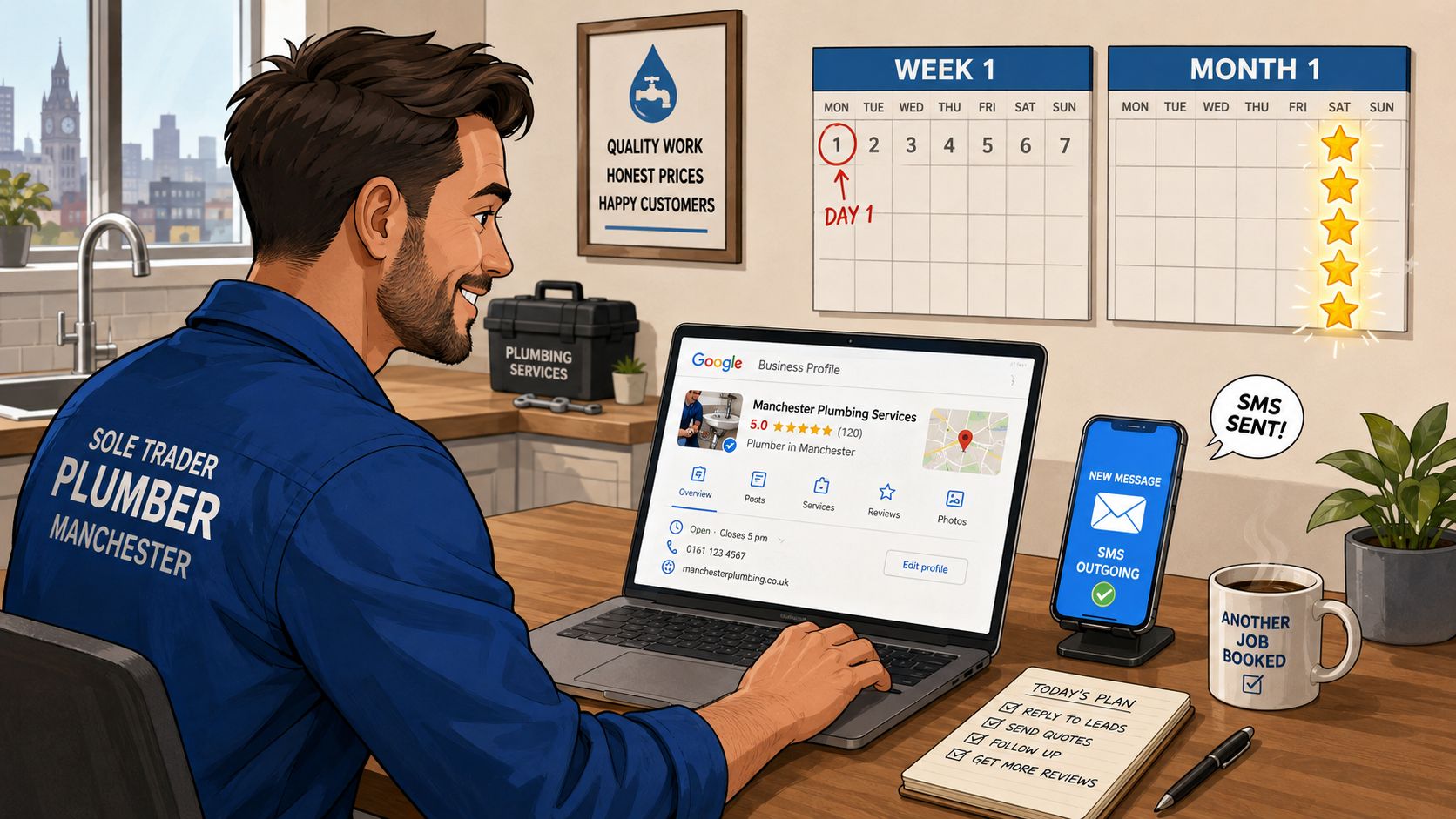
Consider a representative sole-trader plumber serving Manchester. He has a functioning website and a claimed profile, but the listing uses a broad category, shows incomplete services, has old photographs and doesn't explain the areas he covers. He can't spend hours each day on marketing, so the work has to fit around jobs.
The first week
On day one, he confirms the business name, phone number, website and working hours. He adds emergency plumbing, boiler repairs, leaking taps and radiator work to the services area, writes a plain description that names Manchester naturally, and checks that the service-area configuration reflects where he travels.
On day two, he reviews ownership and verification, then checks the primary category against the service he most wants to be known for. He adds only relevant secondary categories. Day three is reserved for photographs, including the van, branded workwear, tools, completed jobs and a recognisable exterior or workspace image.
On day five, he publishes a post answering a common winter plumbing question and adds a clear next step for urgent enquiries. After each suitable completed job, he sends a review request SMS while the work is still fresh in the customer's mind. He doesn't promise a particular rating or ask customers to use specific wording.
The first month
By day 30, the profile has accurate hours, a complete service list, current photographs, a maintained Q&A area and a visible pattern of review activity. He records enquiry source consistently, asking callers whether they found him through Google Search, Maps, the website or a recommendation. If he uses call tracking, he keeps the tracking number aligned with the profile's purpose and checks that calls aren't being misclassified.
The important outcome isn't a dramatic ranking claim. It's a cleaner profile, a clearer customer journey and better evidence about which searches and areas produce useful enquiries. That gives him a basis for deciding whether the next hour belongs to review follow-up, a service page or a local partnership.
Measuring Local SEO Progress Without Drowning in Data
Small businesses don't need a wall of dashboards. They need to know whether visibility is improving in the places they serve and whether that visibility produces calls, visits or direction requests.
Start with a geo-grid rank check around the business location. A 3×3 or 5×5 grid shows how rankings vary across nearby points instead of pretending that one rank at the business address represents the whole market. For a service-area business, scan locations that reflect real target towns, including searches containing a town name where relevant.
Review GBP insights weekly for search activity, calls and direction requests. These measures are closer to commercial intent than raw website sessions. A profile view without a contact action may still help, but it shouldn't receive the same attention as a growing stream of qualified calls.
Use a simple attribution loop for phone enquiries. Ask every caller how they found the business, then compare those answers with GBP and organic data. Don't judge performance from impressions alone, and don't treat a single ranking position as revenue.
| Metric | Source | Cadence | Trigger Action |
|---|---|---|---|
| Map visibility by area | Geo-grid rank tracker | Weekly | Investigate weak locations and compare competitor profiles |
| Profile searches | GBP insights | Weekly | Refine categories, services or description where relevant |
| Calls | GBP insights and call records | Weekly | Review call quality and response handling |
| Direction requests | GBP insights | Weekly | Check address, opening hours and customer access information |
| Reviews and responses | GBP | Weekly | Send legitimate requests and respond promptly |
| Profile and competitor gaps | GBP audit | Monthly | Turn the largest gap into the next task |
Search engine ranking reports are useful when they help a business decide what to change, not when they add another vanity metric. VisiLocali can combine GBP ranking data, profile comparisons and AI recommendations into practical priorities, so a weak grid area or missing competitor signal becomes a defined action.
Common Mistakes and Quick Wins Most Small Businesses Miss
The most expensive local SEO mistakes are often ordinary. An owner changes the business name to include a town and service, leaves holiday hours untouched, or collects reviews without checking whether the process follows Google's rules.
Google's UK policy environment is particularly clear about fake reviews. Following action by the Competition and Markets Authority, businesses found boosting star ratings through fake reviews can receive prominent warning alerts, lose the ability to receive new reviews, and, for repeat offences, have existing reviews deleted for six months or more (UK government information on Google's fake-review changes). If you find a policy-breaking review, Google's process is to open the profile, select Read reviews, choose Report beside the review, select the reason and submit it (Google's review reporting guidance).
Fix the risks before adding more activity
- Remove keyword stuffing: Restore the business name and avoid unnecessary suspension risk.
- Check hours: Update regular and special hours before a bank holiday or seasonal change.
- Define service areas: Remove places you don't serve and clarify the areas you can reach.
- Complete missing services: Add accurate services with plain descriptions customers understand.
- Answer Q&A: Resolve unanswered questions and remove information that is no longer correct.
- Standardise NAP: Correct major directories using the same business name, address and phone.
- Add customer evidence: Upload genuine work photographs and request reviews without incentives.
- Tag links properly: Use campaign parameters on the GBP website link if your analytics setup can read them.
A GBP statistics summary reports that only 35% of UK SMBs have a Google Business Profile, while 86% of GBP impressions come from category-based searches rather than branded queries (UK Google Business Profile statistics). That makes basic profile hygiene more valuable than many owners assume. The most impactful change this week is usually not another article. It's completing the profile accurately, verifying the category and putting a compliant review request process in place.
Your Next 14 Days and Putting It All Together
Local SEO is a customer-acquisition process, not a website-only project. The useful question isn't whether a page received more visits. It's whether the right customers can find the business, trust it and take the next action.
Use the following sprint:
- Days one and two: Audit ownership, verification, categories, hours, services, attributes, description, contact details and photographs. Record a baseline for profile views, calls and direction requests.
- Day three: Refine the primary and secondary categories, then check that the service list matches the actual offer.
- Days four and five: Upload useful photographs and publish the first Google Post. The intended outcome is clearer relevance and a stronger customer decision process.
- Days six and seven: Put the review request system live. Ask recent customers after completed work and respond to every new review.
- Days eight to ten: Begin citation cleanup across the main UK directories, using consistent business information.
- Day twelve: Run the first geo-grid rank check across the target area. Note where competitors appear and your profile doesn't.
- Days thirteen and fourteen: Compare GBP insights with the baseline, review calls and direction requests, and choose the next task from the largest verified gap.
The process is deliberately narrow. A complete profile, accurate categories, useful evidence and honest reviews create a stronger base than scattered activity across a dozen channels. Website improvements and local links can then support a profile that already gives Google and customers the information they need.
Start a 14-day free trial of VisiLocali to track Google Business Profile rankings, compare your profile side by side with competitors, and receive AI insights and recommendations. Use the scan to identify the gaps holding back your map-pack visibility and turn them into the right actions for your trade and postcode.
