 Skip to content

A family-run plumbing business in Bristol can deliver excellent work, answer every call promptly and still watch enquiries fall. The problem may not be service quality. If the business slips out of the Google Maps Local Pack for a search such as “emergency plumber near me”, customers may choose a competitor before they ever reach the website.
That's why local ranking deserves commercial attention. British consumers search, compare and find nearby businesses through Google's search results and Maps. Google held about 93.5% of UK desktop-plus-mobile search share in July 2025, while Google Maps reached 73% of UK online adults in 2024, up from 69% in May 2023, according to UK local search data on Google's market position.
The practical challenge is that local visibility changes by neighbourhood. A business can appear prominently near its address and become difficult to find a few miles away. You need a reliable way to define local ranking, measure it from consistent locations, compare the businesses appearing beside you and choose improvements based on likely impact rather than the length of a checklist.
Table of Contents
- Why Local Ranking Matters to Your Business
- Understanding the Key Concepts
- Google Maps Ranking Factors Explained
- Measuring Your Local Ranking
- Reading Geo-Grid Visibility Patterns
- Prioritising Improvements That Matter
- Practical Checklists for Businesses and Agencies
- Start Improving Your Local Ranking
Why Local Ranking Matters to Your Business
The Bristol plumber notices the problem through the phone, not through an algorithm report. Fewer homeowners call, fewer people request directions and a competitor begins appearing in the three-business Local Pack for urgent searches. The plumber's workmanship hasn't changed, but the business has become less visible at the moment customers are ready to act.
Local search captures high-intent behaviour. Google has long estimated that 46% of searches have local intent, and searches for nearby services can lead directly to visits, calls and purchases. One UK summary reports that 76% of people who search for something nearby on a smartphone visit a related business within 24 hours, while 28% of local searches lead to a purchase within 24 hours. These figures are cited in UK local SEO statistics and search behaviour.
Commercial reality: local ranking determines whether a nearby customer sees your business before choosing another option.
The Local Pack often sits above traditional organic website results. A strong Maps presence can therefore bring enquiries from people who haven't yet decided which business to contact. Losing visibility doesn't automatically produce a fixed percentage drop in leads, because conversion rates vary by category, location, reputation and response speed. However, moving from a visible top result to a less prominent position can reduce the number of people who notice, call or visit you.
Google's dominance makes this especially important for UK businesses. The same UK-focused source reports that 37% of UK adults use Google Maps monthly, while 30% use any traffic or maps service monthly. For a tradesperson, restaurant, clinic or local retailer, Google Maps isn't a secondary directory. It's one of the places where customers form a shortlist.
Businesses that want a broader operational framework can also use this practical local SEO playbook to organise foundational work across their profile, website and local presence. The key is to connect each task to a measurable visibility question: which service should rank, in which area, against which competitors and from what scan location?
Understanding the Key Concepts
Local ranking describes how prominently a business appears in Google Maps and the Local Pack for a search connected to a place. A search for “Bristol emergency plumber” has an explicit location. A search for “emergency plumber near me” uses the searcher's current or selected location. Both can produce different results for the same business.
Maps and the Local Pack are not the same as organic rankings
The Local Pack is the map-led group of businesses displayed within the main Google search results. Google Maps provides a dedicated map and business discovery experience. Both surfaces influence whether a searcher sees your business details, reviews, opening hours, website, phone number and directions before visiting a traditional web page.
Organic ranking refers to the position of a website page in the standard unpaid results. A plumber can rank well organically for a useful service page and still have weak Maps visibility. Conversely, a business may appear in the Local Pack while its website needs substantial improvement. You should track these as related but separate channels.
The shop-window analogy
Think of Google's local results as a busy high street.
- Relevance is the sign above your shop. Your primary category, services, business description and website content need to show what you offer and where it applies.
- Distance is the walk from the customer to your premises or service location. A nearby business usually has a practical advantage, particularly for searches with strong local intent.
- Prominence is the reputation of the shop. Reviews, local mentions, links and consistent business information help Google understand whether the business is established and trusted.
Google Business Profile ranking guidance commonly frames local visibility around relevance, distance and prominence, with prominence supported by review quantity and quality, citation consistency, local backlinks and profile activity such as photos, posts and Q&A responses. The explanation in this UK Google Business Profile ranking guide is useful for translating those concepts into practical checks.
These signals blend together. A highly relevant business may still struggle outside its realistic service area. A nearby business with weak categories may lose visibility to a more prominent competitor. Personalisation also changes results according to the searcher's exact location, search history and device, so there isn't one universal local position for every customer.
Google Maps Ranking Factors Explained
Practitioner estimates help with prioritisation, but they aren't official Google weights. A UK guide summarising Whitespark's 2026 survey of 47 local search practitioners scoring 187 factors estimates the relative influence of factor groups in Local Pack and Maps results. The figures are best treated as directional evidence, not a published formula from Google. VisiLocali's Google Map Pack resource provides useful context for the difference between map visibility and standard organic results.
Estimated factor groups
| Factor Group | Estimated Impact | Why It Matters |
|---|---|---|
| Google Business Profile signals | 32% | Categories, business information, services, attributes and profile activity help Google match the business to relevant searches. |
| Review signals | 20% | Review quantity, quality, recency, sentiment and owner responses contribute to trust and prominence. |
| On-page signals | 15% | Service pages, location relevance and consistent business details support the profile's geographic and topical meaning. |
| Behavioural signals | 9% | Calls, website visits, direction requests and other interactions indicate whether searchers find the listing useful. |
| Link signals | 8% | Locally and topically relevant links can reinforce authority and place association. |
| Citation signals | 6% | Consistent name, address and phone details help confirm the business entity. |
| Personalisation | 6% | Searcher location, device and history alter the results shown to individual users. |
The estimates come from the UK local SEO ranking-factor summary, which explicitly presents them as expert estimates rather than measured algorithm weights. That distinction matters. A profile audit showing a missing service may justify action, but it doesn't prove that completing the field will produce a particular ranking change.
For one query, Google may combine a well-matched primary category with the searcher's proximity, recent reviews, relevant website content and evidence that customers engage with the listing. A business with accurate citations but an unsuitable category may remain poorly matched. Another with strong reviews but thin location pages may appear near its address while losing relevance in nearby towns.
Review work also involves judgement. Asking genuine customers for feedback and responding thoughtfully can strengthen trust, but chasing volume without improving the customer experience won't solve a relevance or distance problem. Similarly, adding directory listings has limited value if the business name, address or phone details conflict across the web.
For practical ideas on improving visibility in Maps, the Growth 4 Trades local SEO tips offer a useful supplement. Use any checklist as a prioritisation aid, not as proof that every task deserves equal time.
Measuring Your Local Ranking
Start with a keyword set that reflects how customers search. Include a core category term, important services and local intent variations. For a plumber, that might include emergency plumbing, boiler repair and a town-specific service phrase. Keep the list stable while you establish a baseline, otherwise ranking changes may reflect different queries.
Choose one scan centre
A manual search from your laptop isn't a reliable measurement unless you control the location. Select a fixed scan centre, ideally using a precise point, and run searches from that same location. A selected latitude and longitude reduce the effect of changing device location and make comparisons between dates more meaningful.
A changing location can be useful when you want to understand what a real customer sees in another neighbourhood. It isn't suitable for a clean trend line. Keep the browser session as neutral as possible, avoid relying on personal search history and, where practical, check at a similar time of day. Local results can fluctuate, so one observation shouldn't trigger a major strategy change.
Match the method to the decision
Daily tracking helps identify volatility after a profile or website change, but it creates more noise and requires more interpretation. Weekly checks are often easier for a small business to maintain and can reveal directional movement without encouraging reactions to every ranking variation. A single-point check tells you what happens at one location. It doesn't show coverage across the whole service area.
Geo-grid tracking samples several points around a selected centre. It can show whether visibility is concentrated near the address or extends into nearby areas. Record the keyword, scan centre, grid settings, date and notable changes to the Google Business Profile or website. Daily rank tracking for local visibility can support that habit when you need a consistent record rather than occasional manual checks.
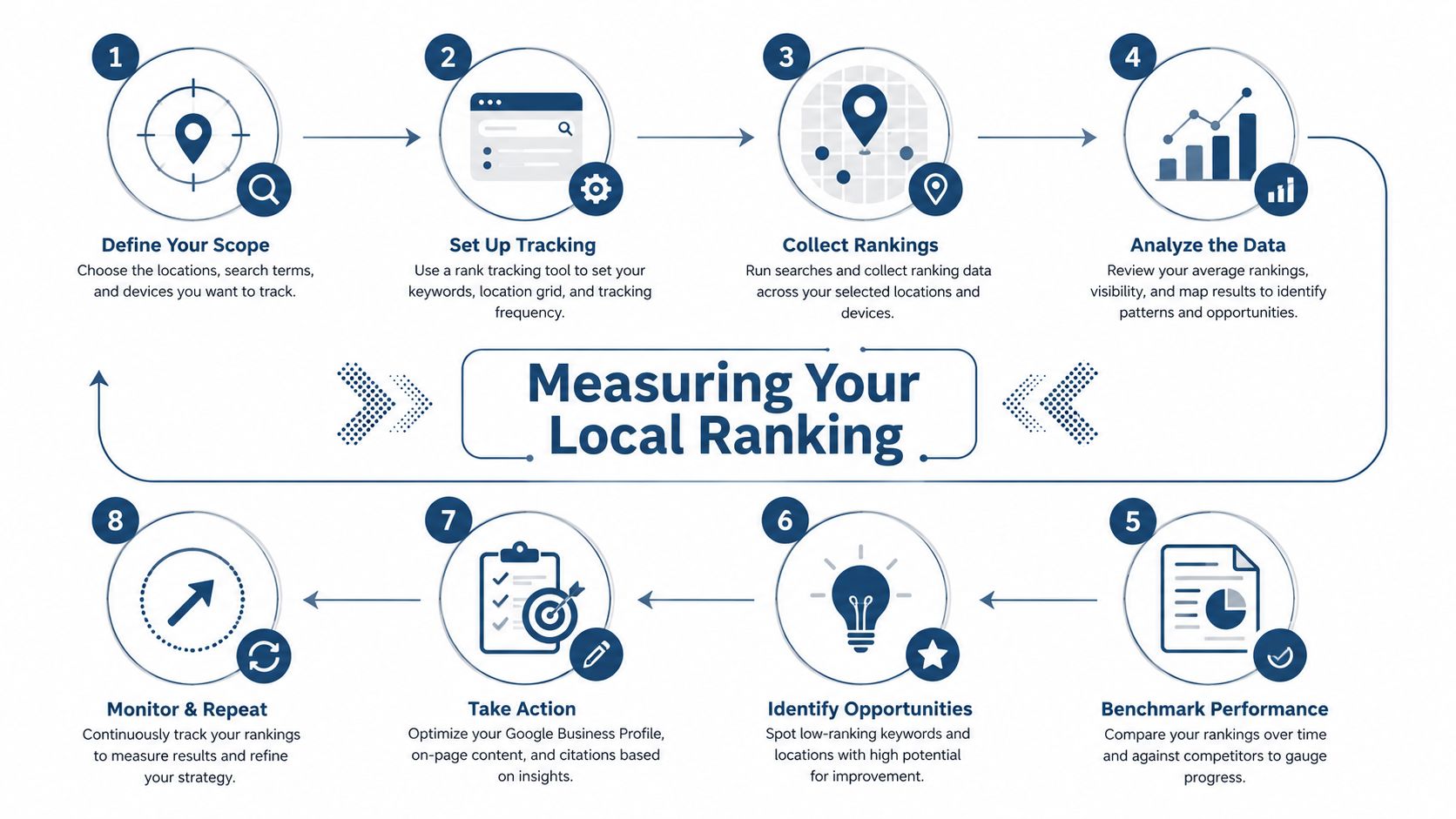
A useful log connects actions to observations. If you change the primary category, update service pages and improve review responses within the same period, you may see movement without knowing which change contributed most. Controlled batches produce clearer learning, although urgent accuracy fixes, such as incorrect hours, shouldn't wait for a perfect experiment.
Reading Geo-Grid Visibility Patterns
A geo-grid turns local ranking into a map of observations. Each point shows how the business performed from a particular location for a selected keyword. It doesn't represent every search, and it shouldn't be treated as an exact boundary between visibility and invisibility.
Select grid density carefully
A 5×5 grid suits a business with a tight service area, such as a shop serving a compact neighbourhood. A 7×7 grid gives a broader view for a business serving a town and its surrounding communities. A 9×9 grid is more appropriate for a multi-location business or a service with a wide catchment. The radius should reflect how customers travel and how far the business can realistically serve, not just the largest area the software allows.
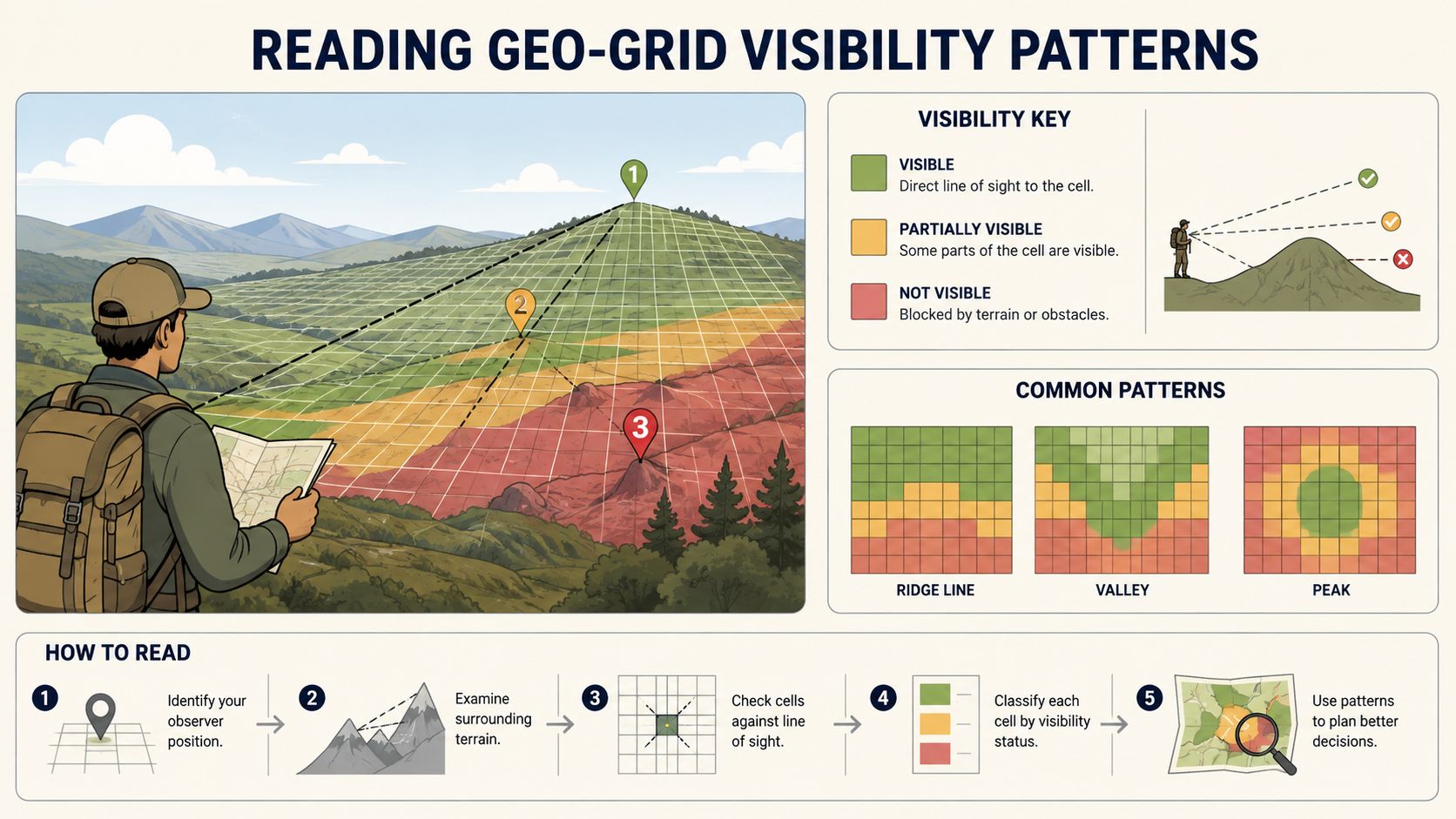
Look for patterns rather than isolated dots. A strong cluster around the business address suggests proximity is helping. A weak outer ring may indicate that the business has limited geographic relevance or is competing with stronger nearby profiles. If a nearby town shows a bright patch for competitors while your business disappears, the issue may involve town-specific relevance, service-area expectations or a lack of local prominence.
Turn patterns into decisions
A compact grid around a Bristol plumber might show strong visibility near the premises but poor coverage towards a neighbouring town. That doesn't automatically justify creating a new location page. First check whether the business serves that town, whether the website explains the service area and whether competitors have stronger local signals.
Two scans may disagree because the keyword, centre, radius, device context or result set changed. Compare like with like before drawing a conclusion. A single bright point can be an anomaly, while a repeated pattern across comparable scans is more useful evidence.
Geo-grid results can inform three practical choices:
- Service-area boundaries: focus effort where the business can fulfil demand profitably.
- Content targeting: improve a genuine town or neighbourhood page when the business has a real connection to that place.
- Advertising decisions: use weak coverage to identify where paid visibility may support testing, without pretending that advertising fixes organic local ranking.
Prioritising Improvements That Matter
The biggest mistake is treating local SEO as a list where every unchecked field deserves equal attention. The practitioner estimates place Google Business Profile signals and review signals ahead of on-page, behavioural, link and citation groups, so the order of work should reflect likely impact, evidence and effort. The figures are estimates, not guaranteed outcomes.
A practical priority model
| Tier | Action | Estimated Impact | Example Tactic |
|---|---|---|---|
| High impact | Profile relevance and review management | 32% GBP, 20% reviews | Confirm the primary category, complete relevant services, maintain accurate hours and respond to genuine reviews. |
| Mid impact | Website, behaviour, citations and links | 15% on-page, 9% behaviour, 8% links, 6% citations | Improve location-specific pages, make contact details consistent and earn relevant local links. |
| Supporting work | Activity and useful profile content | Part of the GBP and supporting signal mix | Add accurate photos, answer Q&A and publish useful updates without treating activity as a substitute for relevance. |
A fuller Google Business Profile optimisation workflow can help organise the high-impact profile work. Don't start by uploading random photos if the primary category is wrong or the business hours are inaccurate. Activity supports a sound profile, but it can't compensate for a fundamental mismatch.
A worked plumbing example
For a small plumbing business, the first pass might confirm that the primary category accurately describes the main service and that secondary categories don't dilute the profile. Next, establish a steady, genuine review request process and respond to new feedback in a useful way. The aim isn't to manufacture reviews. It's to keep the profile aligned with the quality of service customers experience.
The website then needs support for the services and locations that matter commercially. A page about emergency plumbing in Bristol should explain the service clearly, use accurate contact details and provide genuine local context. Local trade directories and community organisations may offer more relevant link opportunities than unrelated high-authority sites.
Track the geo-grid after each coherent set of changes over six to eight weeks, while recognising that movement can have several causes. Compare the profile with competitors appearing consistently nearby. AI-supported recommendations can surface gaps quickly, but manual comparison still matters because an automated suggestion may overlook service capacity, commercial priorities or a competitor's obvious advantage.
Practical Checklists for Businesses and Agencies
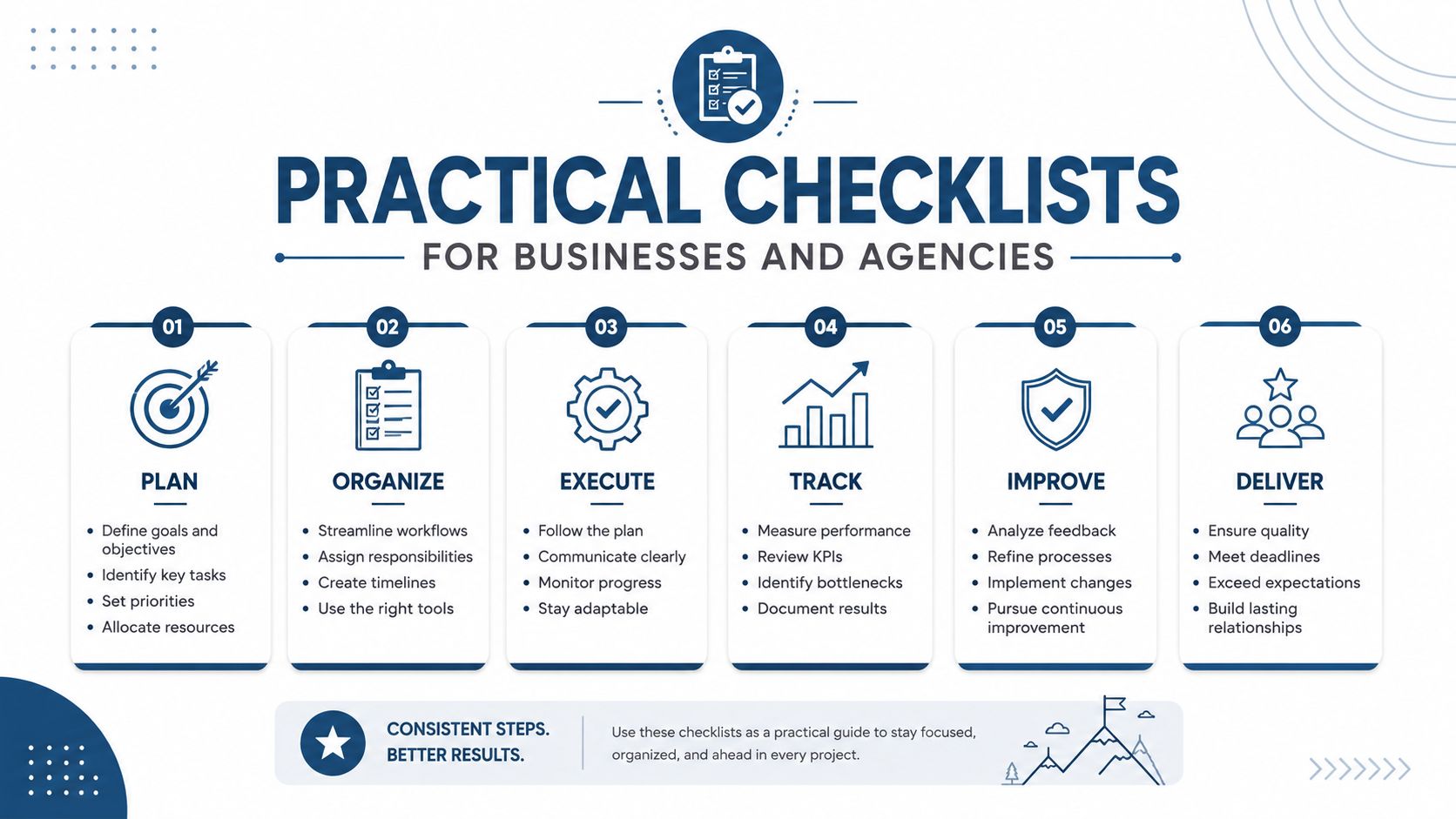
Small businesses need a repeatable routine, not a large technical project.
Small business checklist
- Define priorities: Choose the services and locations that generate valuable enquiries.
- Set a baseline: Record Maps and Local Pack visibility from a selected scan centre.
- Verify the profile: Check categories, services, contact details, hours, attributes and service-area information.
- Improve trust: Resolve unanswered reviews and maintain accurate customer-facing information.
- Support the profile: Strengthen relevant website pages, citations and local links.
- Rescan consistently: Compare results over time, not from one isolated search.
Agencies need stronger documentation because several clients, locations and keyword sets can otherwise become difficult to compare.
Agency checklist
Maintain a fixed keyword-location list, record dated baseline scans and separate selected scan centres from changing-location investigations. Track recurring competitors, document recommendations and label each action by likely impact, effort and supporting evidence.
Report grid coverage, position movement and changes in the local competitive set. Review performance monthly, after substantial profile or website changes and when the search interface changes. Reassess category relevance, review themes, page quality, citations and links instead of presenting one score as the complete diagnosis.
Start Improving Your Local Ranking
Begin with measurement, not guesswork. Choose one valuable service and location, record Maps and Local Pack visibility from a consistent scan centre, then compare the businesses that appear beside you.
Look for the highest-value gap across profile relevance, geographic coverage, reviews, website support, citations and links. Make one coherent set of improvements, rescan from the same centre and use geo-grid patterns to understand where visibility changed.
Local ranking is location-specific, so success in one neighbourhood doesn't prove coverage across the entire service area. Treat recommendations as prioritised hypotheses rather than guaranteed fixes. VisiLocali combines location-level Google Business Profile tracking, side-by-side competitor profile comparisons and AI insights to help identify the next practical action. Start with a 14-day free trial, establish a baseline and assess movement before expanding the programme.
Use VisiLocali to track Google Business Profile rankings across locations, compare competitor profiles side by side and receive AI insights and recommendations for the actions most likely to improve visibility. Start your 14-day free trial today, record your baseline and turn local ranking data into a focused improvement plan.
