 Skip to content
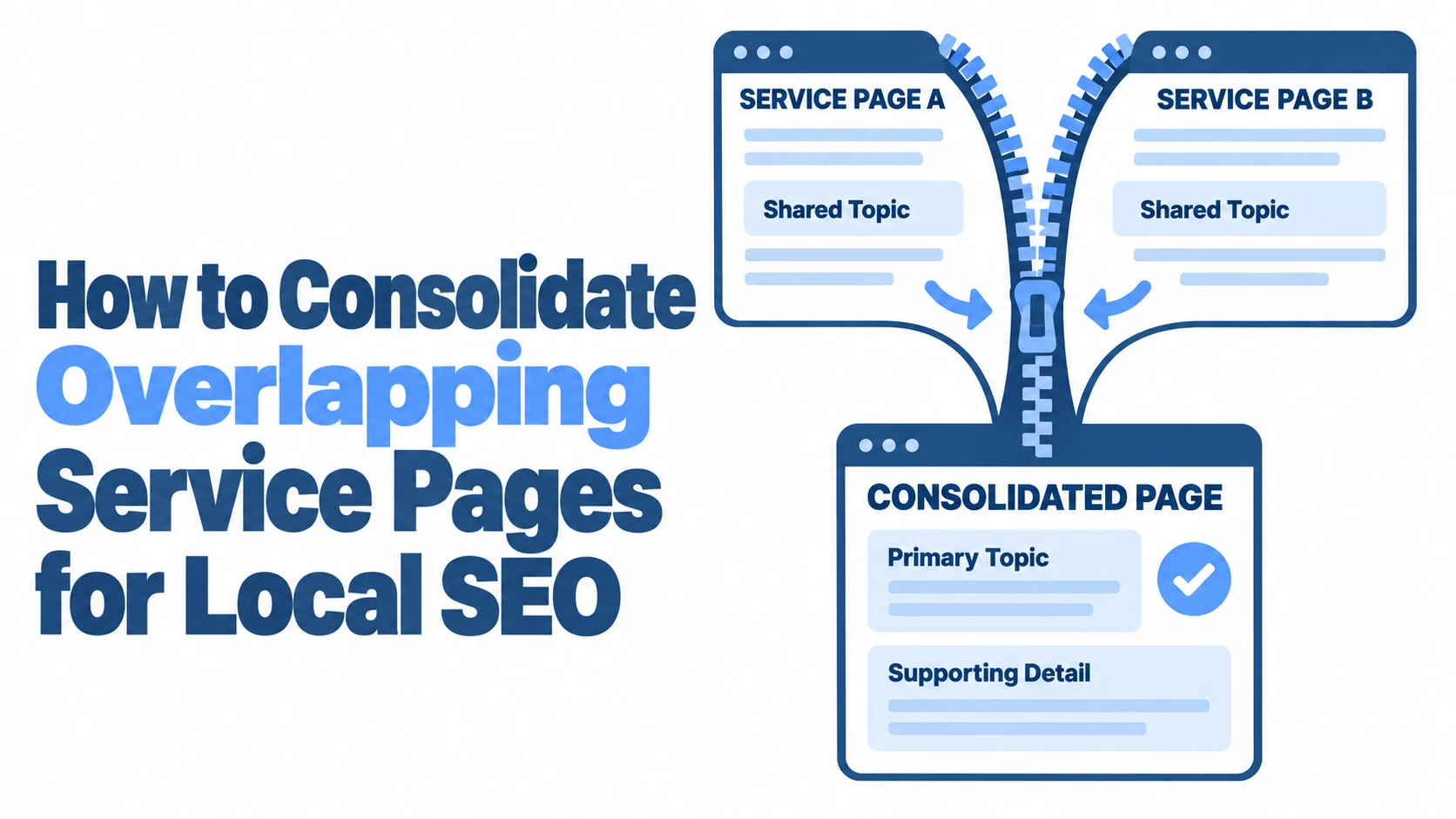
Most local service businesses don’t set out to cannibalise their own rankings.
It happens gradually: a plumber adds a page for “boiler repairs,” then another for “boiler servicing,” then “emergency boiler repair,” and before long, Google isn’t sure which page to rank for any of those terms.
The result? None of them perform well.
Consolidating overlapping service pages for local SEO is one of the most effective fixes available to established businesses, yet it’s rarely discussed with the specificity it deserves.
If your site has multiple pages competing for the same local searches, you’re likely splitting authority, confusing search engines, and diluting the very signals that should be pushing you higher in Maps and organic results.
This guide walks through the entire process: from identifying the problem to executing the fix and measuring results afterwards.
The approach here is practical and grounded in what actually works for UK-based service businesses in 2026, not theoretical advice borrowed from enterprise SEO playbooks.
Identifying Cannibalisation and Overlapping Service Pages
The first step is recognising you have a problem, and that’s harder than it sounds. Many business owners assume more pages mean more chances to rank. In reality, Google often struggles to choose between similar pages, and the outcome is that both rank poorly rather than one ranking well.
A good starting point is simply listing every service page on your site and the primary keyword each one targets. If two or more pages target phrases that a reasonable person would consider the same search, you’ve likely got overlap. A locksmith with separate pages for “lock replacement Leeds” and “lock change service Leeds” is a classic example: the intent behind those searches is identical.
Analysing Search Intent for Similar Service Keywords
Search intent is the deciding factor. Two keywords might look different on paper but mean the same thing to Google. Try searching each target keyword in an incognito browser and compare the results. If Google returns largely the same set of pages for both terms, the intent is shared, and you don’t need separate pages.
Pay attention to the type of content Google rewards for each query. If the top results are all service pages rather than blog posts or directories, that confirms commercial intent. If the same competitors appear for both keywords, consolidation makes sense. You’re not losing coverage by merging: you’re concentrating it.
Spotting Keyword Cannibalisation in Google Search Console
Google Search Console is your best free diagnostic tool here. Head to the Performance report, filter by a specific query, and check which pages are receiving impressions. If two or more URLs appear for the same query, that’s cannibalisation in action.
Look for patterns where pages alternate in the rankings. One week your “drain unblocking” page ranks at position 8, the next week your “blocked drain repair” page appears at position 12, and neither holds steady. This fluctuation is a strong signal that Google can’t decide which page deserves the ranking. VisiLocali’s Local Rank Tracker can make this even clearer by showing you visual ranking grids across your target area, so you can see exactly where each page appears in local results and where the overlap is hurting you.
Auditing Thin Content and Redundant Service Variations
Beyond keyword overlap, look at the actual substance of each page. Many overlapping service pages are thin: 200 words of generic copy with a slightly different heading. If you stripped the H1 tags off two pages and couldn’t tell them apart, they should be merged.
Run through your service pages and ask honestly whether each one offers something genuinely distinct. A page for “residential plumbing” and another for “commercial plumbing” likely serve different audiences and deserve separate pages. But “bathroom plumbing installation” and “bathroom plumbing fitting” almost certainly don’t. Be ruthless in this audit. The goal is fewer, stronger pages rather than a bloated collection of weak ones.
Selecting the Primary Target Page for Local Authority
Once you’ve identified which pages overlap, you need to pick a winner. This is the page that will absorb the content, links, and authority from the others. Choosing the wrong one can set you back, so this decision matters.
Evaluating Backlink Profiles and Existing Rankings
Start with data. Check which of the overlapping pages has the most backlinks, the strongest referring domains, and the best current ranking positions. Tools like Ahrefs or Moz can help here, but even a basic check in Google Search Console will show you which page gets the most clicks and impressions.
The page with the strongest existing signals is usually the right choice as your primary URL. Redirecting a page with five quality backlinks to a page with none wastes those links. If one page already ranks on page one for a related term, that’s your foundation. Build on what’s already working rather than starting from scratch.
Prioritising Pages with Higher Conversion Potential
Rankings aren’t everything. If one page consistently generates enquiries or phone calls while another gets traffic but no conversions, the converting page deserves priority. Check your analytics for goal completions, form submissions, or call tracking data tied to each URL.
Consider the URL structure too. A clean URL like /boiler-repair/ is preferable to /services/heating/boiler-repair-and-maintenance-services-leeds/ both for users and search engines. If your best-performing page happens to have a messy URL, you can always update it as part of the consolidation, but factor that into your redirect planning.
Merging Content to Create a Definitive Service Guide
This is where the real work happens. You’re not just picking a page and deleting the others. You’re building something better than any of the individual pages were on their own.
Integrating Unique Selling Points from Secondary Pages
Go through each page you’re retiring and pull out anything valuable. Maybe your “emergency boiler repair” page mentioned your 24-hour callout guarantee, while your “boiler repair” page didn’t. That’s useful content that belongs on the merged page.
Create a spreadsheet with columns for each retiring page and note:
- Unique service details or specifications
- Customer-facing benefits not mentioned elsewhere
- Location-specific references (neighbourhoods, postcodes)
- Any testimonials or case studies
The merged page should be comprehensive without being bloated. A well-structured 800 to 1,200 word service page that covers all variations of a service will outperform five thin 200-word pages every time.
Optimising for Local Semantic Relevance
Your consolidated page needs to signal local relevance strongly. This means going beyond just dropping your city name into the title tag. Reference specific areas you serve, local landmarks or context where natural, and the types of properties or businesses you work with in your area.
For an estate agent in Bristol, for instance, the merged property valuation page might reference Clifton, Redland, and Southville specifically, mention typical property types in those areas, and address local market conditions. This kind of specificity helps Google understand both what you do and where you do it. It also builds trust with potential customers who can see you genuinely know the area.
Implementing Local Business Schema Markup
Schema markup helps search engines understand your page content in a structured way. For a consolidated service page, LocalBusiness and Service schema types are the most relevant. At minimum, include your business name, address, phone number, service area, and the specific service described on the page.
If you’re not comfortable editing JSON-LD directly, plugins like Rank Math or Yoast (for WordPress sites) can handle the basics. The key is ensuring your schema data matches what’s on the page and in your Google Business Profile exactly. Inconsistencies between your schema, your GBP listing, and your page content can undermine trust signals. VisiLocali’s GBP Audit Tool is useful here: it analyses your profile and flags inconsistencies that could be limiting your local search performance, then turns those findings into clear recommendations.
Technical Execution of the Consolidation Strategy
Getting the content right is half the battle. The technical implementation determines whether you preserve the authority you’ve built or accidentally throw it away.
Setting Up 301 Redirects to Preserve Link Equity
Every retired page needs a 301 redirect pointing to the consolidated page. This tells search engines (and any users with old bookmarks or cached links) that the content has permanently moved. A 301 redirect passes the vast majority of link equity from the old URL to the new one.
If you’re on WordPress, a plugin like Redirection handles this cleanly. For other platforms, you’ll typically add redirect rules to your .htaccess file or server configuration. Test every redirect after implementation: visit the old URL in an incognito browser and confirm it lands on the correct page without redirect chains or errors.
Don’t skip this step or use 302 (temporary) redirects instead. A 302 tells Google the old page might come back, which means it won’t fully transfer authority. For consolidation, 301 is always the right choice.
Updating Internal Links and Site Navigation
Redirects catch external links and bookmarks, but you should also update your own internal links to point directly to the new URL. Relying on redirects for internal navigation adds unnecessary load time and looks sloppy to search engines.
Audit your entire site for links to the retired pages. Check your main navigation, footer links, sidebar widgets, blog posts that reference the old services, and any landing pages. Update each one to point to the consolidated URL. This is tedious but important: internal links are a strong signal to Google about which pages matter most on your site.
Refreshing the XML Sitemap and Requesting Re-indexing
After setting up redirects and updating internal links, regenerate your XML sitemap. The retired URLs should no longer appear in it. If you’re using a plugin that auto-generates your sitemap, it should handle this automatically once the old pages are deleted or redirected, but verify manually.
Then head to Google Search Console and use the URL Inspection tool to request indexing of your consolidated page. You can also submit the updated sitemap. Google will eventually discover the changes through normal crawling, but requesting re-indexing speeds things up. Expect the process to take anywhere from a few days to a few weeks before you see the full effect in rankings.
Managing Local Citations and External Signals
Your website isn’t the only place these old URLs might live. Citations, directory listings, and your Google Business Profile could all be pointing to pages that no longer exist independently.
Aligning Google Business Profile Links with New URLs
If any of the retired pages were linked from your Google Business Profile (as a website URL, appointment link, or service link), update those immediately. Your GBP is arguably the single most important local ranking factor, and broken or redirected links there can hurt both your rankings and user experience.
Log into your GBP (or use VisiLocali’s GBP Management Tool to handle this from one place) and check every URL field. Update any that pointed to retired pages. While you’re there, ensure your primary website link, service descriptions, and categories all align with the consolidated page structure.
Updating Third-Party Directory Listings
Beyond your GBP, check major directories like Yell, Thomson Local, Yelp, and any industry-specific directories where your business is listed. If you previously submitted deep links to specific service pages, those need updating.
This is admittedly the most tedious part of the process. A practical approach is to prioritise the directories that actually send you traffic or are most authoritative. Check your analytics referral data to identify which directories matter. For the rest, the 301 redirects will handle any link equity, even if the directory listing itself still shows the old URL.
Monitoring Post-Consolidation Performance and Rankings
The work doesn’t end once the redirects are live. You need to watch closely for the first 8 to 12 weeks to ensure the consolidation is working as expected and catch any issues early.
Tracking Keyword Position Shifts in Local Map Packs
Expect some ranking fluctuation in the first two to four weeks. Google needs time to process the changes, and it’s normal to see temporary drops before things stabilise. What you’re looking for is a trend: the consolidated page should gradually pick up rankings that were previously split across multiple URLs.
Track your target keywords in both organic results and the local Map Pack. VisiLocali’s Local Rank Tracker is particularly helpful here because its visual ranking grids show your position across different locations in your target area. You might find that consolidation improves your visibility in some parts of your service area more than others, which gives you useful data for future optimisation.
Analysing User Behaviour and Bounce Rates on Merged Pages
Rankings tell you whether Google approves of the change. User behaviour tells you whether your customers do. Monitor the consolidated page’s bounce rate, average time on page, and conversion rate in Google Analytics.
If bounce rates spike after consolidation, the merged page might be too long or poorly structured. Consider adding jump links or a table of contents so users can find the specific service variation they’re looking for. If conversions drop, check that your calls to action are still prominent and that contact forms or phone numbers haven’t been buried beneath the expanded content. The goal is a page that serves both search engines and the real people who land on it.
Getting the Most from Your Consolidation Efforts
Merging overlapping service pages isn’t glamorous work, but the results speak for themselves. Businesses that go from five weak pages to one strong, comprehensive service page typically see ranking improvements within six to eight weeks, along with better conversion rates because users land on a page that actually answers their questions fully.
The key principles are straightforward: identify genuine overlap through data rather than guesswork, choose your primary page based on existing authority and conversion performance, merge content thoughtfully, handle the technical details properly, and then monitor the results. Skip any of those steps and you risk losing ground rather than gaining it.
If you’re unsure where your local visibility stands right now, or which pages might be competing against each other, VisiLocali offers a 14-day free trial across all its plans. The Local Rank Tracker and GBP Audit tools can quickly highlight where consolidation would have the biggest impact, turning what feels like guesswork into a clear action plan. A card is required at sign-up to prevent trial abuse, but there’s no obligation to continue if it’s not the right fit.
