 Skip to content

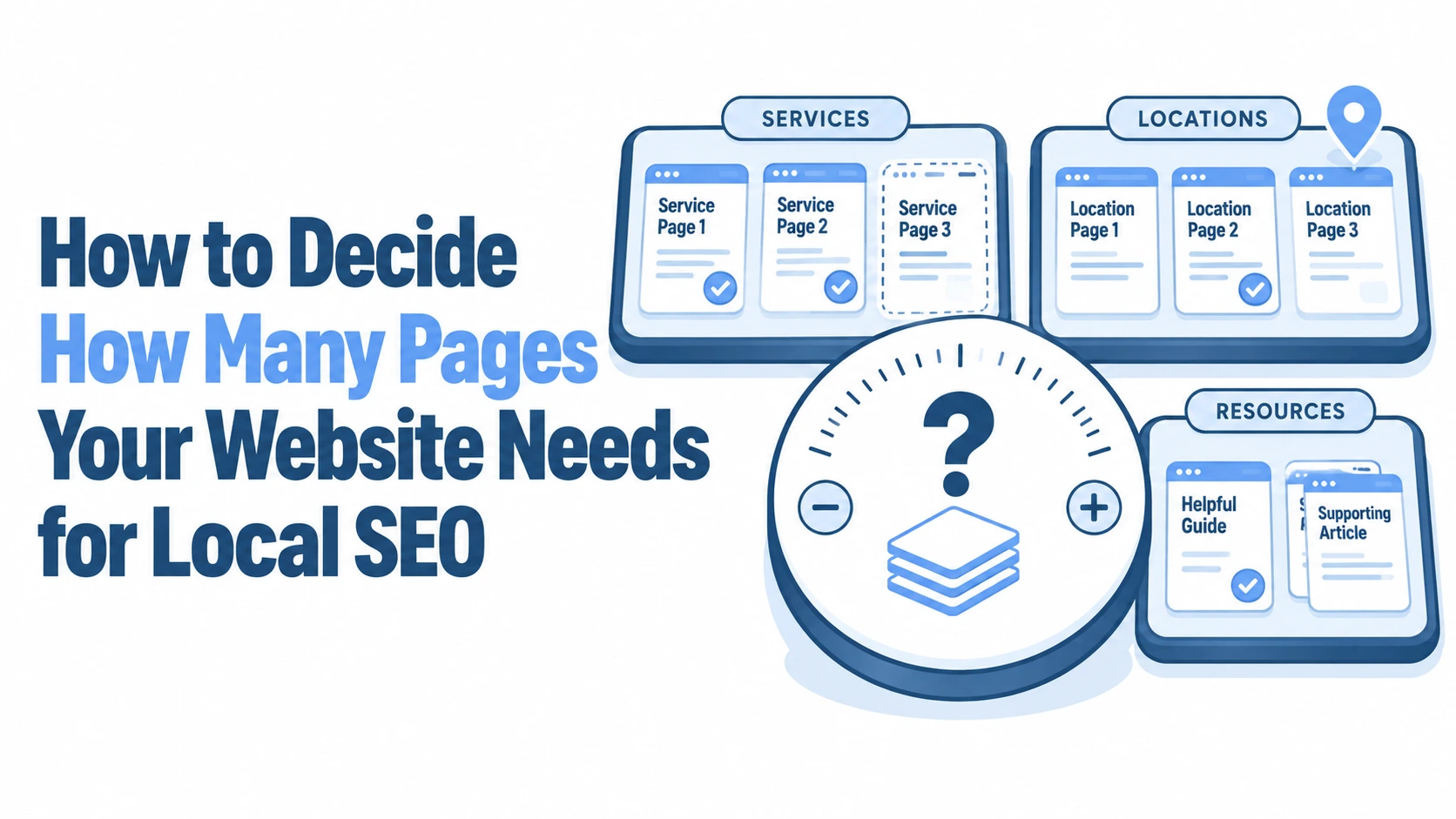
One of the most common questions local business owners ask their web designer or SEO consultant is deceptively simple: how many pages does my website actually need?
A plumber in Bristol might have a five-page site and rank brilliantly, while an estate agent in Manchester has forty pages and barely shows up on Google Maps.
The answer isn’t a magic number. It depends on your services, your locations, your competitors, and how Google interprets local search intent in your specific market.
Getting the page count right means building enough content to signal relevance and authority without creating thin, pointless pages that dilute your site’s value. This guide walks through a practical framework for deciding how many pages your website needs for local SEO, based on the factors that actually move the needle.
The Correlation Between Page Count and Local Search Visibility
There’s a persistent myth that more pages automatically equal better rankings. That was arguably true in 2012, but Google’s algorithms have matured considerably since then. A bloated site with dozens of near-identical pages can actually harm your visibility, especially if those pages cannibalise each other’s keywords or offer little genuine value.
That said, having too few pages creates its own problems. A single-page website for a multi-service business sends weak topical signals to Google. If you’re a landscaper who does garden design, fencing, tree surgery, and patio installation, a single “Services” page gives Google very little to work with when someone searches “tree surgeon near me.”
The sweet spot sits somewhere between those extremes, and finding it requires understanding your specific business rather than following a generic template.
Why Quality Always Trumps Quantity in Local SEO
Google’s helpful content system, refined significantly through 2025 and into 2026, rewards pages that genuinely satisfy search intent. A well-written, detailed service page for “emergency boiler repair in Leeds” will outperform ten thin pages targeting every possible variation of that phrase.
Each page on your site should have a clear purpose and a distinct audience. If you can’t articulate who a page is for and what question it answers, it probably shouldn’t exist. The test is straightforward: would a real person landing on this page find it useful? If the answer is no, the page is dead weight.
Quality also means keeping content current. A page about your services that still references 2023 pricing or discontinued offerings signals neglect, both to visitors and to search engines.
Matching Your Site Structure to Local Search Intent
Local search intent falls into a few broad categories: people looking for a specific service in a specific area, people researching businesses before making contact, and people needing quick information like opening hours or directions.
Your site structure should mirror these intent patterns. Someone searching “solicitor Nottingham family law” expects to land on a page specifically about family law services, not a generic homepage. Someone searching your business name wants your About page or contact details, not a blog post.
Think of each page as an answer to a specific question a potential customer might type into Google. When you map your pages to real search queries, you naturally arrive at the right number of pages for your business.
Evaluating Your Service Areas and Physical Locations
Your physical presence is one of the strongest signals in local SEO. Every distinct location where you serve customers deserves careful consideration in your site architecture. A single-location business has simpler needs than a chain with branches across multiple cities, but even solo operators often serve a wider geographic area than their address suggests.
Building Dedicated Location Pages for Each Branch
If your business operates from more than one physical location, each branch should have its own dedicated page. This isn’t optional: it’s fundamental. A dental practice with surgeries in both Glasgow and Edinburgh needs separate pages for each, with unique content reflecting the specific team, services, and local details of each branch.
These pages should include the branch address, phone number, opening hours, embedded Google Map, and ideally some content unique to that location. Avoid the trap of duplicating the same text across location pages with only the city name swapped out. Google recognises this pattern and it rarely performs well.
Each location page also needs its own corresponding Google Business Profile. Tools like VisiLocali’s GBP Audit can help you identify whether each profile is fully optimised, flagging gaps in your business information, review responses, and posting activity that might be limiting that branch’s visibility.
Targeting Surrounding Towns with Geo-Specific Content
Many local businesses serve customers well beyond their immediate postcode. An electrician based in Cheltenham might regularly take jobs in Gloucester, Stroud, and Cirencester. Creating area-specific pages for these surrounding towns can capture searches you’d otherwise miss.
The key is making these pages genuinely useful rather than thin doorway pages. Include details about the types of work you’ve completed in that area, approximate response times, any local knowledge that’s relevant, and perhaps a testimonial from a customer in that town.
A reasonable rule of thumb: create a dedicated area page only for locations where you actively and regularly serve customers. Don’t build pages for fifty towns you’ve visited once. Google is increasingly good at spotting pages that exist solely for keyword purposes with no real substance behind them.
Mapping Out Your Core Service and Product Pages
Your services are the backbone of your site. How you structure them determines whether Google can understand what you do and match you to the right searches.
The Benefits of Individual Service Landing Pages
A single “Our Services” page with a bullet list of everything you offer is one of the most common missed opportunities in local business websites. Each distinct service you provide deserves its own page, particularly if people search for that service independently.
Consider a property maintenance company. “Guttering,” “roof repairs,” “damp proofing,” and “chimney repointing” are all separate searches with different intent. A dedicated page for each allows you to include relevant details: what the service involves, typical pricing indicators, how long jobs take, and photos of completed work. This depth is what separates a page that ranks from one that doesn’t.
Individual service pages also give you more opportunities to earn featured snippets and appear in local pack results for specific queries. They create natural internal linking opportunities too, connecting related services in a way that helps both users and search engines understand your business.
Organising Hierarchies for Complex Service Categories
Some businesses offer dozens of services that naturally group into categories. A law firm might handle family law, conveyancing, employment disputes, and personal injury, each with multiple sub-services beneath them.
The most effective approach is a tiered structure: a parent category page that provides an overview, linking down to individual service pages for each sub-topic. This creates clear topical clusters that Google can follow logically.
For example:
- Family Law (parent page)
- Divorce and Separation
- Child Custody Arrangements
- Financial Settlements
- Pre-nuptial Agreements
Each sub-page targets a more specific keyword while the parent page captures broader searches. This hierarchy also makes your site easier to navigate, which reduces bounce rates and keeps visitors engaged longer.
Analysing Competitor Footprints in the Local Market
You don’t operate in a vacuum. What your competitors are doing with their websites directly affects how many pages you need to compete effectively in local search results.
Identifying Topical Gaps in Your Current Content
Start by listing every service or topic your top-ranking competitors have dedicated pages for, then compare that list against your own site. The gaps are your opportunities.
If three competing plumbers in your area each have dedicated pages for “power flushing” and you don’t, that’s a clear signal. Google sees your competitors as more relevant for that search because they’ve created focused content around it.
This isn’t about blindly copying competitors. It’s about understanding what Google considers the baseline for your industry in your area. If every top-ranking accountancy firm in Birmingham has separate pages for tax returns, bookkeeping, payroll, and VAT registration, a site with just “Accounting Services” is fighting with one hand tied behind its back.
Benchmarking Against Top-Ranking Local Competitors
VisiLocali’s Local Rank Tracker is particularly useful here. Its visual ranking grids show exactly where you rank across different locations in your target area compared to competitors. If a rival consistently outranks you in certain parts of your service area, examining their site structure can reveal why.
Look at the total number of pages they maintain, how they structure their service pages, whether they have location-specific content, and how frequently they publish new material. You don’t need to match them page for page, but you do need to understand the competitive baseline.
Pay attention to the types of pages that rank, not just the quantity. A competitor might have 80 pages, but only 15 of them drive meaningful traffic. Focus your efforts on creating content that targets the queries actually bringing customers through the door.
Establishing Trust with Essential Supporting Pages
Not every page on your site needs to target a commercial keyword. Some pages exist to build trust, and they’re just as important for local SEO as your service pages.
Optimising the ‘About Us’ Page for Local Relevance
Your About page is one of the most visited pages on any local business website, yet it’s routinely neglected. This is where potential customers decide whether they trust you enough to pick up the phone.
For local SEO purposes, your About page should establish your connection to the area. Mention how long you’ve been operating locally, your involvement in the community, any local partnerships or sponsorships, and the specific areas you serve. This local context reinforces the geographic signals Google uses to determine relevance.
Include real photos of your team, not stock images. Name your key staff members and their qualifications. If you’ve won local business awards or hold relevant trade accreditations, this is where they belong. Google’s E-E-A-T guidelines (Experience, Expertise, Authoritativeness, Trustworthiness) apply strongly to local businesses, and your About page is the primary place to demonstrate these qualities.
Using Testimonials and Case Studies to Build Authority
Testimonials scattered across your site are fine, but a dedicated page or section for customer reviews and case studies serves a dual purpose. It builds trust with visitors and creates additional indexable content that reinforces your service and location keywords.
Case studies are especially powerful. A detailed write-up of a kitchen renovation in Harrogate, complete with before-and-after photos and the customer’s experience, naturally includes location and service keywords without any forced optimisation. It also gives potential customers a concrete picture of what working with you looks like.
Aim for at least three to five detailed case studies covering your main services and key locations. Update them regularly: a case study from 2022 feels stale. Fresh examples from 2025 and 2026 demonstrate that your business is active and thriving.
Developing a Long-Term Content Growth Strategy
Deciding your initial page count is only the starting point. Your site should grow deliberately over time, guided by data rather than guesswork.
Leveraging Local News and Blog Articles for Rankings
A blog or news section gives you a natural vehicle for publishing content that targets long-tail local keywords your service pages can’t cover. A roofing company might write about storm damage preparation before winter, or a veterinary practice could publish advice on seasonal pet health concerns specific to their region.
The most effective local blog content ties your expertise to your geography. “How to Prepare Your Garden for a Yorkshire Winter” is far more targeted than generic gardening advice. These posts attract local visitors, earn links from local websites, and signal ongoing activity to Google.
Don’t publish for the sake of it, though. One genuinely useful article per month beats four thin posts that nobody reads. Each piece should answer a real question your customers ask or address a topic relevant to your local community.
VisiLocali’s GBP Management tool can help here too, letting you turn blog content into Google Posts that keep your Business Profile active. This creates a virtuous cycle: your website content feeds your GBP activity, and both contribute to stronger local visibility.
Monitoring Performance to Refine Your Sitemap
The number of pages your site needs will change over time. Services get added or dropped. You expand into new areas. Competitors shift their strategies. What worked eighteen months ago might need rethinking.
Track which pages drive traffic and enquiries, and which sit idle. Google Search Console shows you impressions and clicks per page, while VisiLocali’s rank tracking grids reveal whether your individual pages are actually improving your visibility across your target area. Pages that generate zero traffic after six months of indexing either need improving, removing, or a check that they are properly listed in your sitemap.
Consolidation is just as valid a strategy as expansion. If you have three underperforming pages that could be combined into one comprehensive resource, do it. A single strong page will almost always outperform three weak ones.
Review your site structure quarterly. Ask yourself: has anything changed about my services, locations, or competitive environment that should be reflected in my website? This ongoing refinement is what separates businesses that maintain strong local rankings from those that build a site once and watch it slowly decline.
Getting Your Page Count Right
There’s no universal answer to how many pages a local business website should have. A solo tradesperson serving one town might need 8 to 12 well-crafted pages. A multi-location professional services firm could genuinely require 50 or more. The right number comes from honestly assessing your services, your locations, your competitors, and the search behaviour of your potential customers.
Start with the essentials: a homepage, individual service pages, location pages for each area you serve, an About page, a contact page, and a few trust-building pieces like case studies. Then grow strategically based on what the data tells you.
If you’re unsure where to begin, VisiLocali can help you understand where you currently stand. Its GBP Audit identifies what’s holding back your Google Business Profile, while the Local Rank Tracker shows exactly where you’re visible and where you’re not. Both are available across every plan, and you can try them with a 14-day free trial to see what your local SEO actually looks like before committing. Built by a specialist with over a decade of local SEO experience, it’s designed to tell you what to do next, not just hand you a report.
