 Skip to content

Most local businesses already know they need to show up when someone searches for their services nearby. The tricky part is figuring out which specific words and phrases to target, where to place them, and how to avoid the kind of keyword stuffing that Google penalises. Getting the mix of service terms and location modifiers right can mean the difference between appearing in the map pack for “emergency plumber Leeds” or being invisible entirely. This guide breaks down exactly how to pair service keywords with geographic terms to improve your local search visibility: from initial research through to measuring what’s actually working.
The Fundamentals of Service and Location Keywords in Local SEO
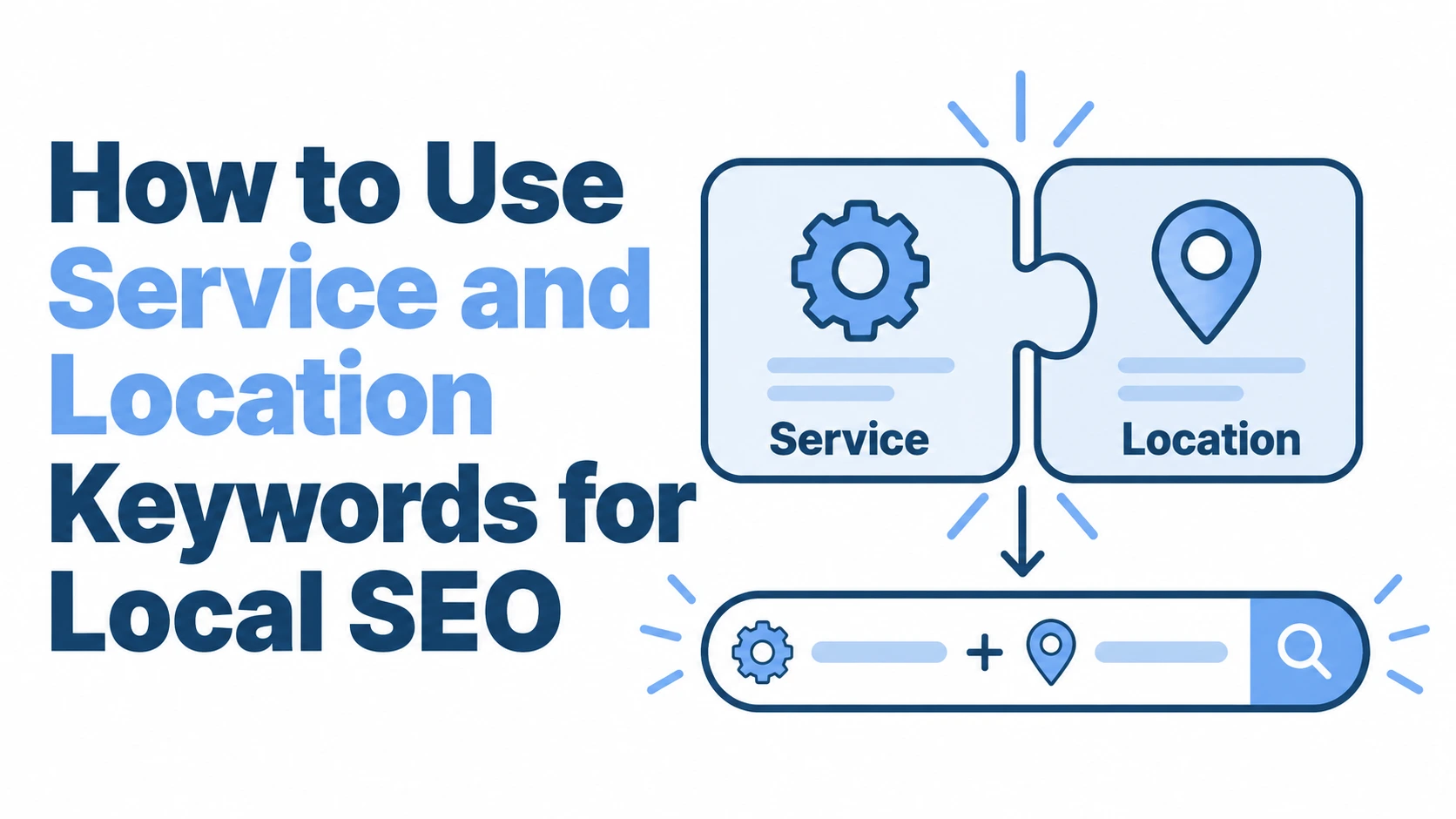
Service keywords describe what you do. Location keywords describe where you do it. The magic happens when you combine them in ways that match how real people search. A homeowner in Bristol doesn’t type “plumbing services” into Google: they type “emergency plumber Bristol” or “boiler repair near Clifton.” These combined phrases are the backbone of local SEO.
Google’s local algorithm weighs three primary factors: relevance, distance, and prominence. Service keywords address relevance (does this business offer what the searcher needs?), while location keywords signal geographic proximity. Your job is to make both crystal clear across your website, your Google Business Profile, and your wider online presence.
One common mistake is treating these as separate strategies. Businesses often optimise their site for service terms and then handle location targeting as an afterthought, maybe dropping a city name into the footer. That approach misses the point. Google needs consistent, specific signals that tie your services to the areas you serve. A page about “kitchen fitting” that never mentions Manchester, Stockport, or Salford won’t compete against a rival whose content explicitly connects their kitchen fitting expertise to those locations.
The other pitfall is going too broad. Targeting “solicitor UK” is practically useless for a high street firm in Glasgow. You want the phrases that carry genuine buying intent and geographic specificity: “family solicitor Glasgow,” “conveyancing solicitor Southside Glasgow,” or “divorce lawyer near me” (where Google uses the searcher’s location to determine relevance).
Identifying Profitable Keyword Combinations for Your Business
Not every service-plus-location combination is worth chasing. A locksmith in Manchester might find that “lock change Manchester” gets searched 590 times a month while “lock rekeying Manchester” barely registers. Prioritising the right combinations saves you from spending weeks building pages nobody will ever find.
Start by listing every service you offer, including variations your customers might use. A roofer, for example, should consider “roof repair,” “roof replacement,” “flat roofing,” “slate roofing,” “gutter repair,” and “chimney flashing.” Then pair each service with the locations you serve: your home city, surrounding towns, neighbourhoods, and postcodes where you actively want work.
The sweet spot is combinations with decent search volume, clear commercial intent, and competition you can realistically beat. A two-person estate agency probably won’t outrank Rightmove for “houses for sale Leeds,” but “independent estate agent Headingley” is a fight they can win.
Analysing Local Search Intent and Competitor Gaps
Search intent matters more than volume. Someone searching “how much does a new boiler cost” is researching. Someone searching “boiler installation engineer Sheffield” is ready to hire. Focus your service-location keywords on transactional and commercial intent phrases first: these drive actual enquiries.
Check what your competitors rank for that you don’t. If a rival plumber in your area ranks for “powerflush Leeds” and you offer the same service but have no content targeting it, that’s a gap worth filling. Tools like Google’s own autocomplete and “People also ask” sections reveal how locals phrase their searches. Type your service into Google with your city name and see what suggestions appear: these are real queries from real people.
Tools for Localised Keyword Research
Google Keyword Planner remains useful for volume estimates, though its ranges are broad. Pair it with Google Search Console data from your own site to see which queries already bring impressions but not clicks: these are often quick wins where better optimisation could push you into clicking range.
VisiLocali’s Local Rank Tracker is particularly useful here because it shows where you rank across a visual grid of your target area, not just a single location. You might rank well for “accountant Birmingham” in the city centre but be invisible two miles south. That kind of geographic detail tells you exactly which location modifiers to prioritise in your content. Paid tools like Semrush or Ahrefs can supplement this with competitor keyword data, but the local grid view is what separates generic SEO tracking from genuine local insight.
Optimising On-Page Elements with Service-Area Modifiers
Once you know which service and location keyword pairings to target, you need to place them where they’ll have the most impact on your pages. On-page optimisation isn’t about cramming keywords into every paragraph: it’s about signalling relevance in the places Google pays closest attention to.
Your primary service pages should each target a core service-location combination. If you’re a dental practice in Edinburgh, your teeth whitening page should clearly target “teeth whitening Edinburgh” through its URL, title tag, main heading, and opening paragraph. The rest of the content should read naturally, mentioning the location where it makes sense (perhaps referencing your practice location near Princes Street or noting that you serve patients across the Lothians).
Body content should include semantic variations rather than repeating the exact same phrase. Google’s natural language processing is sophisticated enough to connect “teeth whitening in Edinburgh” with “cosmetic dentistry Edinburgh” and “tooth whitening near Leith.” Use the full family of related terms.
Crafting Compelling Meta Titles and Descriptions
Your meta title is the single most important on-page ranking signal for a given keyword. Keep it under 60 characters where possible and lead with your primary service-location phrase. “Emergency Plumber Leeds | 24/7 Call-Outs | Smith Plumbing” works far better than “Smith Plumbing: Your Trusted Local Partner.”
Meta descriptions don’t directly affect rankings, but they dramatically influence click-through rates. Include your location, a specific benefit, and a reason to click. “Fast, reliable emergency plumber serving Leeds and West Yorkshire. No call-out charge. Available 24/7, including bank holidays. Call now for a free quote.” That tells the searcher everything they need: where, what, and why.
Structuring Header Tags for Geographic Relevance
Your H1 should contain your primary service-location keyword naturally. H2 and H3 tags are where you can introduce secondary locations and service variations. A page targeting “kitchen fitter Manchester” might use H2s like “Bespoke Kitchen Installation in South Manchester” and “Kitchen Refurbishment Services across Stockport and Trafford.”
Don’t force every heading to include a location: it reads terribly and Google will recognise the pattern as over-optimisation. A sensible ratio is location modifiers in roughly half your subheadings, with the rest focusing on service details, process explanations, or customer concerns.
Developing High-Converting Location Landing Pages
If you serve multiple areas, dedicated location pages are essential. A single “Areas We Serve” page with a list of town names does almost nothing for rankings. Each significant area needs its own page with unique, substantive content.
The key word there is “unique.” Google penalises thin, duplicated content, and the most common mistake businesses make is creating 20 location pages that are identical except for the town name swapped in. Each page needs at least 400 words of genuinely distinct content. Reference local landmarks, mention specific challenges in that area (Victorian properties in certain neighbourhoods might need particular roofing expertise, for example), and include testimonials from customers in that location if possible.
A good location page structure looks like this:
- A clear H1 combining your service and the specific area
- An opening paragraph explaining your services in that area with genuine local detail
- A section on common local needs or challenges you address
- Social proof from local customers
- Practical information: how to find you, how long it takes to reach that area, parking details if relevant
- A strong call to action with phone number and contact form
Each page should link to your main service pages and to adjacent location pages, creating a logical internal structure that helps both users and search engines understand your geographic coverage.
Leveraging Google Business Profile for Maximum Visibility
Your Google Business Profile is arguably the most important asset in your local SEO programme. It directly controls your appearance in the map pack, and the service and location signals within it carry enormous weight. A well-optimised GBP can outperform a mediocre website for local searches.
Make sure your primary business category matches your core service exactly. Google offers hundreds of categories, and choosing “Plumber” versus “Plumbing Service” versus “Emergency Plumbing Service” can affect which searches trigger your listing. Add secondary categories for every additional service you offer.
VisiLocali’s GBP Audit Tool is designed specifically for this: it analyses your profile to identify what’s limiting your performance and translates findings into clear recommendations. Rather than giving you an arbitrary score, it examines your business information, reviews, posts, and other profile signals, then tells you what to fix next. That kind of directed guidance is far more useful than staring at a dashboard wondering where to start.
Optimising Service Menus and Descriptions
Google Business Profile lets you add structured services with descriptions. Use every relevant service slot and write descriptions that naturally include your location terms. “Professional carpet cleaning for homes and offices across Leeds, Wakefield, and surrounding areas” is far better than a generic “We clean carpets.”
Your business description (750 characters maximum) should front-load your most important service-location combinations. Don’t waste the opening on your company history: lead with what you do and where. “Award-winning family dentist in central Bristol, offering NHS and private dental care including cosmetic dentistry, dental implants, and emergency appointments across BS1-BS16 postcodes.”
Utilising Local Posts to Highlight Regional Expertise
Google Posts are underused by most local businesses, which means they’re a genuine competitive advantage. Publish posts that tie your services to specific locations: a before-and-after of a kitchen renovation in Harrogate, a case study of commercial cleaning work at a Manchester office block, or a seasonal tip relevant to your area.
Posts should include service and location terms naturally. “Just completed a full rewire of a 1930s semi in Didsbury” does more for your local relevance signals than “Check out our latest project!” VisiLocali’s GBP Management Tool can help here: it lets you create and schedule posts using AI-generated content based on your photos and services, which dramatically reduces the time involved in keeping your profile active.
Consistency matters. Businesses that post weekly tend to see stronger local visibility than those posting sporadically. Set a realistic schedule you can maintain: even fortnightly posts put you ahead of most competitors.
Building Authority through Localised Link Building and Citations
Links from locally relevant websites send powerful signals to Google about your geographic authority. A link from the Leeds Chamber of Commerce or a Bristol community blog carries more local SEO weight than a link from a random national directory.
Citation consistency is equally important. Your business name, address, and phone number (NAP) must be identical everywhere it appears online: your website, GBP, Yell, Thomson Local, industry directories, and social profiles. Even small discrepancies (writing “Street” in one place and “St” in another) can dilute your local signals.
Practical ways to earn local links:
- Sponsor local events, sports teams, or charities (they typically link to sponsors)
- Contribute expert quotes or articles to local news sites
- Join your local Chamber of Commerce or trade association
- Partner with complementary businesses for mutual referrals and links
- Create genuinely useful local resources (a guide to planning regulations in your borough, for instance)
Prioritise quality over quantity. Ten links from respected local organisations outperform a hundred from generic directories. Focus on sources that real people in your area actually visit and trust.
Advanced Internal Linking Strategies for Multi-Location Sites
Internal linking is where many multi-location businesses leave rankings on the table. Your site architecture should make it obvious to Google which pages target which service-location combinations, and how they relate to each other.
The ideal structure creates a hierarchy: your homepage links to main service category pages, which link to specific service pages, which link to location-specific variations. A tree surgeon serving Yorkshire might have “Tree Surgery” as a main service page, linking down to “Tree Surgery Leeds,” “Tree Surgery York,” and “Tree Surgery Harrogate.” Each location page then links back up to the main service page and sideways to adjacent location pages.
Use descriptive anchor text that includes your target terms. Instead of “click here” or “learn more,” link with text like “our tree surgery services in Harrogate” or “emergency tree removal across West Yorkshire.” This tells Google exactly what the linked page is about and reinforces the service-location association.
Avoid orphan pages: every location page should be reachable within two or three clicks from your homepage. If Google can’t find a page easily through your site’s link structure, it won’t prioritise it in search results. Run a crawl of your site periodically to identify any pages that have fallen out of your internal linking network.
For businesses with dozens of locations, consider a hub-and-spoke model where regional hub pages (e.g., “Our Services in West Yorkshire”) link to individual town pages. This distributes link equity efficiently and creates a logical user journey for visitors browsing your coverage areas.
Measuring Success and Refining Your Local Keyword Strategy
Tracking local keyword performance requires different tools than standard SEO monitoring. National rank trackers that check from a single location won’t tell you how you rank for “electrician near me” when someone searches from Chorlton versus Didsbury. You need geo-grid tracking that shows rankings across multiple points in your target area.
VisiLocali’s Local Rank Tracker provides exactly this kind of visual ranking grid. You can see at a glance where you’re strong, where competitors dominate, and where there’s opportunity. If you’ve just published a new location page for Salford, you can track whether your visibility in that specific area improves over the following weeks.
Beyond rankings, track these metrics monthly:
- Google Business Profile insights: search queries, direction requests, phone calls, and website clicks broken down by search term
- Organic traffic to location pages via Google Search Console
- Conversion rates on location landing pages (form submissions, phone calls tracked through call tracking)
- Citation accuracy across your key directory listings
Refine your strategy based on data, not assumptions. If your “boiler repair Stockport” page gets traffic but few enquiries, the problem might be the page content or call to action rather than the keyword targeting. If a location page ranks well but generates no impressions, the search volume for that combination might be too low to justify the page: consider consolidating it with a broader area page instead.
Review your keyword targets quarterly. Search behaviour shifts, new competitors enter the market, and Google’s algorithm evolves. The businesses that maintain strong local visibility are the ones that treat their keyword strategy as an ongoing programme rather than a one-off project.
Where to Go from Here
The difference between businesses that dominate local search and those that struggle usually comes down to specificity. Generic pages targeting broad terms won’t compete with rivals who’ve done the work of mapping their services to precise locations, building dedicated pages, and maintaining a well-optimised Google Business Profile. The strategy outlined here: researching the right combinations, placing them where they matter, building local authority, and tracking performance at a granular geographic level: is what separates page-one visibility from obscurity.
Start with your highest-value service and your core location. Get that combination right across your website and GBP, measure the results, then expand outward to secondary services and surrounding areas. Small, consistent improvements compound over time.
If you want to see exactly where your business currently ranks across your target area and identify the specific gaps holding you back, VisiLocali offers a 14-day free trial across all plan levels. Built by a local SEO specialist with over a decade of experience, it’s designed to turn local search data into clear next steps: not just charts and scores, but practical actions you can take this week.
