 Skip to content

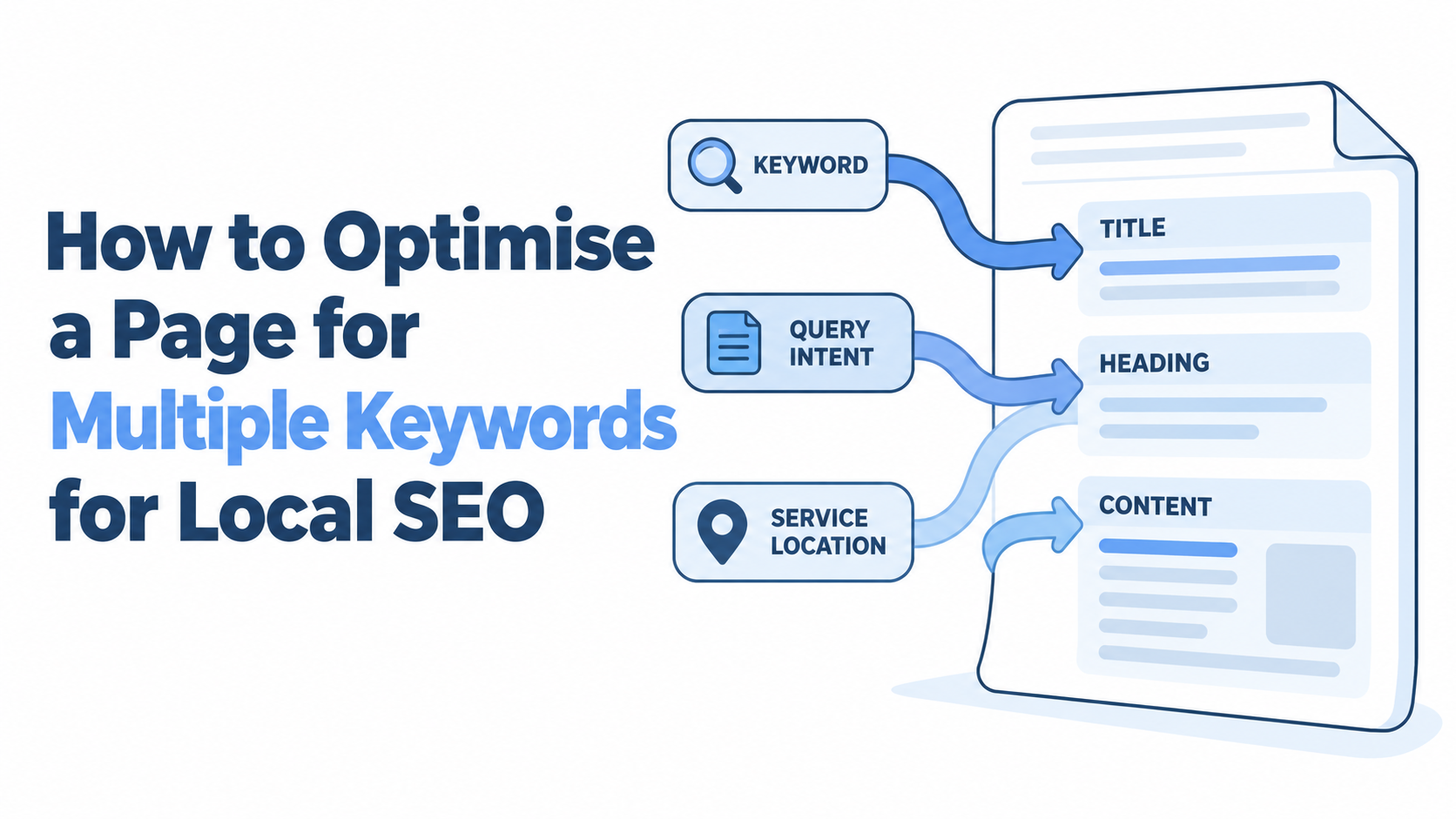
Most local businesses don’t rank for just one thing. A plumber in Bristol doesn’t only want to show up for “plumber Bristol”: they want visibility for boiler repairs, emergency callouts, bathroom installations, and a dozen other services across multiple nearby areas. The challenge is figuring out how to optimise a page for multiple keywords without creating a bloated mess that ranks for none of them. Getting this right means more calls, more footfall, and less wasted effort building pages nobody ever finds. But the approach is different from standard SEO. Local search has its own rules, its own signals, and its own quirks, and the businesses that understand those differences tend to dominate the map pack while their competitors wonder what they’re doing wrong.
The Fundamentals of Multi-Keyword Local Optimisation
Ranking a single page for multiple local keywords isn’t about stuffing every possible phrase into your content and hoping Google figures it out. It’s about understanding that Google groups related queries together and serves results based on relevance, proximity, and prominence. A well-structured page can absolutely rank for five, ten, or even twenty related terms if those terms share a common intent.
The key distinction with local SEO is that Google weighs your Google Business Profile, local citations, and review signals alongside your on-page content. Your website page needs to satisfy the informational query, but your broader local presence determines whether you appear in the map pack. This means optimising a page for multiple keywords locally requires work both on your site and off it.
Think of it this way: a single service page for “kitchen fitting” could also capture traffic for “kitchen installation,” “fitted kitchens near me,” “kitchen fitter [city],” and “bespoke kitchen design.” These aren’t separate topics requiring separate pages. They’re variations of the same service, and Google is smart enough to recognise that, provided your page is structured properly and your local signals are consistent.
The mistake most businesses make is either creating too many thin pages (one for every keyword variation) or cramming everything onto a homepage with no structure at all. Neither works well in 2026. Google’s helpful content systems penalise both approaches. What works is thoughtful grouping, clear structure, and genuine depth.
Grouping Related Keywords and Service Areas
Before you write a single word of content, you need to sort your target keywords into logical clusters. This step determines whether you need one page, three pages, or ten, and getting it wrong means wasted effort.
Identifying Semantic Relationships
Semantic relationships are simply connections between keywords that share the same underlying topic. “Emergency plumber Leeds,” “24-hour plumber Leeds,” and “burst pipe repair Leeds” all describe the same service scenario. They belong on one page.
A practical way to identify these relationships is to search each keyword on Google and compare the results. If the same pages rank for multiple keywords, Google considers them semantically related, and you should too. When results diverge significantly, that’s a signal you need separate pages. Tools like Google’s own “People also ask” and “Related searches” sections reveal how Google clusters topics, and they’re free to use.
Group your keywords into clusters where each cluster represents one distinct service or topic. A roofer in Manchester might end up with clusters like: roof repairs (including “roof leak repair,” “storm damage roof,” “emergency roofer”), roof replacement (including “new roof cost,” “re-roofing,” “roof replacement Manchester”), and flat roofing (including “flat roof repair,” “EPDM roofing,” “flat roof specialist”).
Analysing Local Search Intent
Local intent adds another layer. Someone searching “best electrician Glasgow” wants to compare options, while “electrician near me emergency” wants someone right now. These intents require different content approaches even if both relate to electrical services.
Pay attention to the modifiers people use. Terms with “near me,” “in [city],” or “[postcode]” signal strong local intent and typically trigger map pack results. Terms with “cost,” “how much,” or “price” signal research intent and often favour organic listings with detailed content. Your page needs to address both types if you want to capture the full range of local queries.
VisiLocali’s Local Rank Tracker can show you exactly where you’re visible across different locations using visual ranking grids. This helps you identify which keyword clusters are already gaining traction and which need more attention, so you’re not guessing about where to focus your effort.
Strategic Placement in Metadata and Headers
Once your keyword clusters are defined, placing them strategically across your page’s metadata and heading structure is where the real on-page work begins. Your title tag is the single most important on-page element, and it needs to include your primary keyword naturally while hinting at secondary terms.
For a page targeting kitchen fitting services in Bristol, a title like “Kitchen Fitting & Installation in Bristol | Custom Kitchen Design” covers the primary term and two secondary variations without reading like spam. Keep title tags under 60 characters where possible, though Google sometimes displays longer ones depending on the query.
Your H1 should closely mirror the title tag, but your H2 and H3 headings are where you distribute secondary and tertiary keywords from your cluster. Each subheading should address a specific aspect of the service that naturally incorporates a target phrase. An H2 like “Our Kitchen Installation Process” and another like “Kitchen Design Consultation in South Bristol” both serve users and search engines simultaneously.
Meta descriptions don’t directly influence rankings, but they affect click-through rates, which indirectly matters. Write descriptions that include one or two keyword variations and give searchers a genuine reason to click. “Professional kitchen fitting across Bristol and Bath. Free design consultation, 10-year guarantee, and over 200 kitchens completed since 2018” is far more compelling than a keyword-stuffed alternative.
Don’t overlook URL structure either. A clean URL like /kitchen-fitting-bristol/ signals relevance without overcomplication. Avoid cramming multiple keywords into the URL slug: it looks spammy and doesn’t help.
Crafting High-Quality Content for Multiple Local Intentions
Writing content that serves multiple keywords means addressing multiple questions, concerns, and scenarios on a single page without it feeling scattered. The goal is depth and relevance, not length for its own sake.
Natural Keyword Integration Techniques
The days of writing a keyword a specific number of times per hundred words are long gone. What matters now is topical coverage. If your page is about emergency plumbing in Leeds, you should naturally mention burst pipes, frozen pipes, leaking radiators, boiler breakdowns, and water damage, because that’s what the topic actually involves.
Write for the person reading the page. A homeowner with a burst pipe at 2am doesn’t want to read marketing copy: they want to know if you can come now, how much it’ll roughly cost, and what they should do while waiting. Answer those questions, and you’ll naturally incorporate dozens of keyword variations without trying.
Use your keyword clusters as a content outline. Each secondary keyword becomes a section or paragraph that addresses a specific sub-topic. This approach produces comprehensive content that genuinely helps users while sending strong topical signals to Google.
Using Location-Specific Case Studies
Nothing builds local relevance like genuine local detail. Instead of generic service descriptions, reference specific projects, neighbourhoods, or challenges unique to your area. A roofer in Glasgow might describe dealing with the city’s heavy rainfall and older tenement buildings. An estate agent in Bath could reference the particular challenges of selling listed properties.
Case studies work brilliantly here. A 150-word description of a real job you completed in a specific area, including the problem, your solution, and the outcome, adds unique content that no competitor can replicate. It also naturally incorporates location keywords and service terms without any forced placement.
If you’ve completed work in multiple areas you’re targeting, feature a brief case study from each. This signals to Google that you genuinely serve those locations rather than simply claiming to.
Leveraging Local Schema Markup for Rich Results
Schema markup is structured data you add to your page’s code that helps search engines understand your content more precisely. For local businesses targeting multiple keywords, two schema types matter most: LocalBusiness and Service.
LocalBusiness schema tells Google your business name, address, phone number, opening hours, and service area. This reinforces your local relevance and can trigger rich results like business panels and enhanced map listings. If you serve multiple areas, the areaServed property lets you specify each one without creating separate pages.
Service schema lets you define individual services with descriptions, price ranges, and service areas. A plumber could mark up “boiler installation,” “emergency plumbing,” and “bathroom fitting” as distinct services, each linked to specific locations. This gives Google explicit information about what you offer and where, which supports ranking for those specific service-plus-location combinations.
Implementing schema doesn’t require coding expertise. Plugins for WordPress and other platforms handle the technical side. What matters is accuracy: your schema data must match what’s on the page and what’s on your Google Business Profile. Inconsistencies confuse search engines and can hurt rather than help your visibility.
Test your implementation with Google’s Rich Results Test tool. If errors appear, fix them before moving on. Schema that’s incorrectly implemented is worse than no schema at all, because it can generate misleading signals about your business.
Optimising Images and Internal Links for Local Relevance
Images and internal links are two of the most underused tools for local multi-keyword optimisation. Most businesses upload photos with filenames like “IMG_4523.jpg” and alt text that says “image” or nothing at all. That’s wasted opportunity.
Rename image files to describe what they show, incorporating relevant keywords naturally. A photo of a completed loft conversion in Harrogate becomes “loft-conversion-harrogate-completed.jpg” with alt text like “Completed loft conversion with Velux windows in Harrogate.” This helps Google understand the image content and reinforces the page’s local and topical relevance.
Geo-tag your images before uploading them. Free tools can embed GPS coordinates into image metadata, which provides another subtle local signal. This is particularly useful for service-area businesses that work across multiple locations.
Internal linking is equally important. Every page on your site should link to related service pages using descriptive anchor text. If your emergency plumbing page mentions boiler repairs, link that phrase to your boiler repair page. This distributes authority across your site and helps Google understand the relationships between your services.
Create a logical linking structure where your main service pages link to location-specific pages and vice versa. A “Plumbing Services” hub page linking to “Emergency Plumber Leeds,” “Boiler Installation Leeds,” and “Bathroom Plumber Harrogate” creates a clear topical hierarchy that search engines can follow easily.
Integrating Google Business Profile and Local Citations
Your website is only half the equation. For local search, your Google Business Profile is arguably more influential for map pack rankings than anything on your site. Optimising your GBP to align with the keywords you’re targeting on your website creates a reinforcing loop that strengthens both.
Mapping NAP Consistency Across Platforms
NAP stands for Name, Address, Phone number, and consistency across every platform where your business appears is a foundational local ranking factor. If your website says “J. Smith Plumbing Ltd” but your GBP says “John Smith Plumbing” and Yell says “J Smith Plumbing Services,” Google struggles to confidently connect these listings to the same business.
Audit every directory, social profile, and citation source where your business appears. Ensure the business name, address format (including postcode), and phone number are identical everywhere. This sounds tedious because it is, but inconsistencies genuinely suppress local rankings.
VisiLocali’s GBP Audit Tool can identify gaps and inconsistencies in your profile that might be limiting your visibility. Rather than giving you an arbitrary score, it examines what you can actually improve and translates findings into clear recommendations. This removes much of the guesswork, especially if you’re not sure what “good” looks like for a Google Business Profile.
Beyond basic NAP data, make sure your GBP categories match your target keyword clusters. Your primary category should reflect your main service, and secondary categories should cover the additional services you want to rank for. A business offering both plumbing and heating services needs both categories selected to appear in relevant searches.
Encouraging Reviews for Target Keywords
Reviews influence local rankings directly, and reviews that mention specific services or locations carry extra weight. You can’t (and shouldn’t) script what customers write, but you can make it easy for them to leave detailed feedback.
After completing a job, send a follow-up message with a direct link to your Google review page. Ask a specific question like “How did we handle your boiler installation?” rather than a generic “Please leave us a review.” Specific prompts naturally lead to reviews that mention the service and often the location, which reinforces your keyword relevance.
Respond to every review, positive or negative. Your responses are another opportunity to naturally mention services and locations. A reply like “Thanks for the kind words about your bathroom refit in Headingley: it was a great project to work on” adds relevant local content to your GBP without being manipulative.
VisiLocali’s GBP Management Tool simplifies this ongoing work. You can manage reviews, create Google Posts, and keep your profile active from one place, with AI-assisted review responses that save time while maintaining a personal touch.
Measuring Success and Refining Your Local Strategy
Optimising a page for multiple local keywords isn’t a one-time task. Search results shift, competitors adjust their strategies, and Google’s algorithms evolve. You need a system for tracking what’s working and what needs attention.
Track rankings for each keyword in your clusters across different physical locations within your target area. A business might rank position one in the city centre but be invisible three miles away. Geo-grid rank tracking reveals this variation by showing your visibility on a visual map of your service area, highlighting exactly where you’re strong and where competitors are outperforming you.
Monitor organic traffic to your optimised pages through Google Search Console. Pay attention to which queries are driving impressions and clicks. You’ll often discover that a well-optimised page picks up traffic from dozens of keyword variations you never explicitly targeted, which validates the cluster approach.
Review your strategy quarterly. Look at which keyword clusters are performing, which pages need content updates, and whether new service areas or keywords have emerged. Local SEO is competitive, and the businesses that treat it as an ongoing programme rather than a one-off project are the ones that maintain their visibility over time.
If progress stalls, revisit the fundamentals: check NAP consistency, ensure your GBP categories are correct, verify your schema markup, and look at what top-ranking competitors are doing differently. Often the fix is something simple that’s been overlooked rather than a major strategic overhaul.
The businesses that consistently rank for multiple local keywords share a common trait: they treat their online presence as a connected system rather than a collection of separate pieces. Your website content, Google Business Profile, local citations, reviews, and schema markup all need to tell the same story about what you do and where you do it. When these elements align, Google has every reason to show your business to the people searching for exactly what you offer.
If you’re unsure where to start or what to prioritise, VisiLocali was built for exactly this situation: turning local SEO data into clear next steps. You can try it yourself with a 14-day free trial on any plan. Developed by a local SEO specialist with over a decade of experience, it’s backed by a 90-day improvement guarantee, so there’s genuine accountability behind the recommendations.
