 Skip to content

Most local businesses treat their website structure as an afterthought: something that just happens as pages get added over the years.
But the way you organise those pages into a hierarchy has a real effect on how Google crawls, understands, and ranks your site for local searches.
Choosing between a flat and deep site structure for local SEO isn’t a trivial design preference.
It shapes whether your neighbourhood landing pages get indexed properly, whether link equity flows where you need it, and whether a potential customer in Bristol or Glasgow can find the right service page in two taps on their phone.
The trouble is, there’s no universal right answer.
A single-location plumber in Leeds needs a fundamentally different architecture than a multi-city estate agency with 40 branches.
This guide breaks down how each model works, when each one makes sense, and how to match your structure to your actual business goals rather than copying what someone else did.
Core Differences Between Flat and Deep Architecture
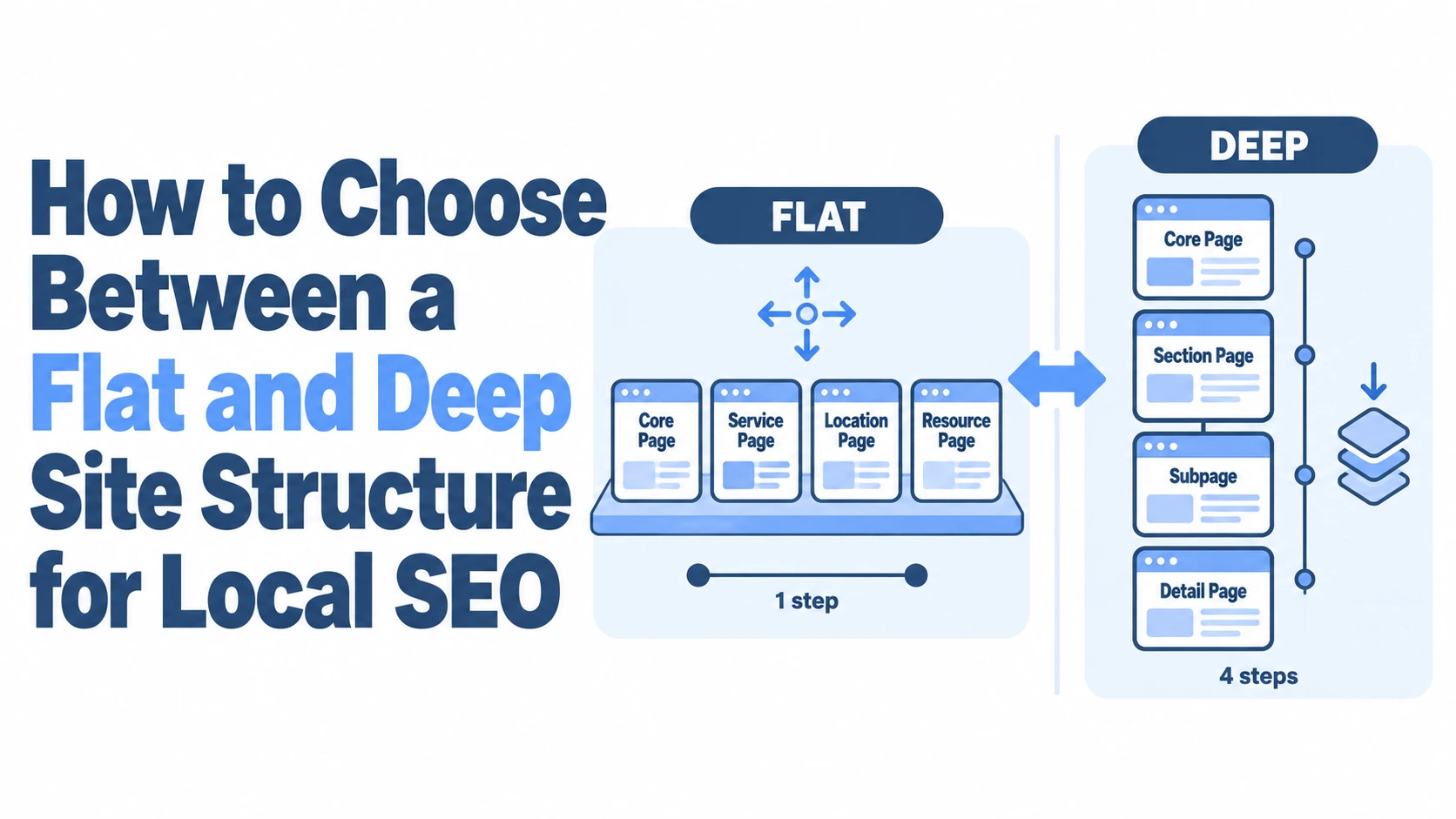
The distinction between flat and deep site structures comes down to how many clicks it takes to reach any given page from the homepage. A flat structure keeps most pages within one or two clicks of the homepage. A deep structure nests pages inside categories and subcategories, meaning some content sits three, four, or even five levels down.
Neither approach is inherently better. The right choice depends on how much content you have, how many locations you serve, and how varied your services are. A site with 15 pages doesn’t need deep nesting. A site with 300 pages can’t realistically keep everything one click from the homepage without turning the navigation into an unreadable mess.
Visualising the Flat Hierarchy Model
Picture a hub-and-spoke wheel. The homepage sits at the centre, and every important page connects directly to it. A typical flat structure for a local business might look like this:
- Homepage
- About
- Services (single page listing all services)
- Service Area
- Blog
- Contact
Each page is reachable from the main navigation. There are no subdirectories or parent-child relationships between service pages. If you’re an electrician in Manchester offering five services across one area, this works perfectly. Every page gets maximum link equity from the homepage, and Googlebot can crawl the entire site in seconds.
The trade-off is that flat structures become unwieldy once you add more than about 20 to 30 pages. Navigation gets cluttered, and there’s no topical grouping to help Google understand which pages relate to each other.
The Logic of Categorical Deep Structures
Deep structures use folders and subfolders to create a logical hierarchy. For a multi-location dental practice, that might look like:
- Homepage → Services → Teeth Whitening → Teeth Whitening in Birmingham
- Homepage → Locations → Birmingham → Birmingham Services
This creates clear parent-child relationships. Google can infer that the Birmingham teeth whitening page is a subset of both the broader teeth whitening topic and the Birmingham location. That contextual signal matters for local rankings.
The risk with deep structures is burying important pages too far from the homepage. If a critical landing page sits five clicks deep, it receives less internal link equity and may get crawled less frequently. The sweet spot for most local businesses is three levels maximum.
Impact of Site Depth on Local Search Visibility
How your site is structured directly affects two things Google cares about: crawl efficiency and the distribution of ranking signals. For local businesses competing in map pack results and organic local listings, these technical factors translate into real visibility differences.
How Googlebot Crawls Local Service Pages
Googlebot allocates a crawl budget to every site. For small local businesses, this budget is rarely a bottleneck, but the structure still matters because it determines discovery speed. Pages linked from the homepage or main navigation get found and re-crawled faster than pages buried in deep subdirectories.
If you’ve just created a new landing page for “emergency plumbing in Nottingham” and it’s only linked from a subcategory page that’s itself three levels deep, it could take weeks for Google to discover it. The same page linked from your main services menu gets indexed within days, sometimes hours.
Flat structures give Googlebot a shorter path to every page. Deep structures require more deliberate internal linking to ensure nothing important gets overlooked.
Distributing PageRank to Neighbourhood Landing Pages
PageRank, the internal authority that flows through links, dilutes as it passes through layers. Your homepage typically holds the most authority. Pages linked directly from it receive a larger share than pages linked from a second-tier page.
For local SEO, this matters because your neighbourhood or city landing pages often need to compete against other local businesses for the same search terms. If your “Plumbing Services in Headingley” page is buried three levels deep, it’s starting with less internal authority than a competitor’s equivalent page that sits one click from their homepage.
A tool like VisiLocali’s Local Rank Tracker can show you exactly where your visibility drops across different neighbourhoods in your target area. If you notice certain location pages underperforming, the cause might be structural rather than content-related. Those visual ranking grids make it straightforward to spot patterns: strong visibility near your physical location but weak rankings in surrounding areas often points to landing pages that aren’t getting enough internal link equity.
When to Opt for a Flat Structure
Flat architecture isn’t just simpler to build. For the right type of business, it’s genuinely the better choice for local rankings.
Single-Location Businesses and Niche Specialists
If you operate from one location and offer a focused set of services, a flat structure is almost always the way to go. Think of a single-location physiotherapy clinic in Edinburgh, an independent accountancy firm, or a specialist cake shop. These businesses typically have between 8 and 25 pages.
With a flat structure, every service page and your location page sit within one click of the homepage. All of them benefit from maximum internal authority. There’s no risk of important pages being orphaned or under-linked. The sitemap is clean, and Googlebot can process the entire site in a single crawl session.
The practical test: if you can fit every important page into your main navigation without it feeling crowded, a flat structure is probably right for you.
Simplifying the User Journey for Mobile Searchers
Over 75% of local searches happen on mobile devices. Mobile users are impatient: they want to find the right page in one or two taps, not drill through category after subcategory.
A flat structure naturally supports this behaviour. Someone searching “boiler repair near me” who lands on your homepage can see the boiler repair service page right there in the navigation. No guessing which category it falls under. No tapping through “Services → Heating → Boiler → Repair.”
This isn’t just a user experience argument. Google’s own ranking systems factor in engagement signals. If mobile visitors consistently bounce because they can’t find what they need, that affects your local rankings over time.
Strategic Advantages of a Deep Structure
For businesses with more complex operations, a flat structure creates more problems than it solves. Here’s when depth becomes an advantage.
Managing Multi-Regional and Multi-City Operations
An estate agency operating across 12 cities in the Midlands can’t put every location page in the top-level navigation. A locksmith franchise covering 30 postcodes needs a way to organise those landing pages logically.
Deep structures let you create location hubs. A parent page for “West Yorkshire” can link down to individual pages for Leeds, Bradford, Wakefield, and Huddersfield. Each city page can then link to specific service pages for that area. This creates topical clusters that help Google understand the geographic scope of your business.
The key is keeping the depth manageable. Three levels (Region → City → Service) works well. Four levels starts to dilute authority. Five levels is almost always too deep for a local business site.
Organising Complex Service Catalogues by Category
Some businesses offer dozens of distinct services. A building contractor might handle extensions, loft conversions, new builds, renovations, landscaping, and commercial fit-outs, each with multiple sub-services.
Grouping these into categories creates a logical taxonomy. Visitors can browse by category, and Google can understand the relationship between related services. A page about “loft conversion insulation options” makes more sense to Google when it sits under a “loft conversions” parent page than when it floats alongside 50 other unrelated pages in a flat structure.
Scaling SEO Content for Future Expansion
If you’re planning to expand into new areas or add services over the next 12 to 18 months, building a deep structure now saves you from a painful restructure later.
Adding a new city to a well-organised deep structure means creating a new location hub and populating it with service pages that follow the existing template. Adding the same content to a flat structure means cramming more pages into an already-crowded top level, eventually forcing a migration to a deeper architecture anyway.
Think about where your business will be in two years, not just where it is today. If growth is part of the plan, build the structure that accommodates it.
Technical Considerations for Local Site Mapping
Getting the conceptual model right is only half the job. The technical implementation, specifically your URL structure and internal linking, determines whether your chosen architecture actually delivers the SEO benefits you’re after.
Optimising URL Slugs for Local Relevance
Your URL slugs should reflect both your service and your target location. For a flat structure, this is straightforward:
- yoursite.co.uk/boiler-repair-leeds
- yoursite.co.uk/boiler-installation-leeds
For a deep structure, use folder paths that mirror your hierarchy:
- yoursite.co.uk/leeds/boiler-repair
- yoursite.co.uk/leeds/boiler-installation
Both approaches work, but the deep structure URLs give Google an extra contextual signal about the page’s place in your site hierarchy. The folder “leeds” tells Google that everything underneath it relates to Leeds.
Avoid stuffing keywords into URLs. Keep slugs short, descriptive, and human-readable. A URL like “yoursite.co.uk/best-emergency-plumber-24-hour-leeds-west-yorkshire” looks spammy to both users and search engines.
Implementing Internal Linking and Breadcrumbs
Internal linking is what makes any site structure actually function for SEO. Without deliberate internal links, even a well-planned hierarchy is just a collection of disconnected pages.
For flat structures, link related service pages to each other. Your boiler repair page should link to your boiler installation page and vice versa. Your location page should link to every service page, and every service page should link back to the location page.
For deep structures, breadcrumbs become essential. Breadcrumb navigation (Home → Leeds → Heating Services → Boiler Repair) does three things:
- Gives users a clear path back up the hierarchy
- Provides Google with structured data about page relationships
- Passes link equity upward through the chain
Implement breadcrumbs using schema markup so Google can display them in search results. This improves click-through rates for local searches because users can see at a glance that the page is relevant to their area.
Running a VisiLocali GBP Audit alongside your site structure work is worth the time. Your Google Business Profile and your website need to tell the same story about your services and locations. The audit identifies gaps in your profile that might be limiting your Maps visibility, and the recommendations help you align your GBP content with whatever site structure you’ve built. That alignment between your website hierarchy and your business profile signals is something Google pays attention to.
Choosing the Right Framework for Your Business Goals
The decision between flat and deep architecture isn’t really about SEO theory. It’s about matching your site structure to three practical realities: the number of locations you serve, the number of services you offer, and your growth plans.
Here’s a quick framework:
- 1 location, fewer than 10 services: flat structure, no question
- 1 location, 10 to 25 services: flat structure with logical grouping in navigation
- 2 to 5 locations, moderate services: shallow deep structure (two levels)
- 6 or more locations, broad services: full deep structure (three levels)
- Franchise or national brand with local pages: deep structure with location hubs
Whatever you choose, audit the result. Check that every important page is reachable within three clicks of the homepage. Verify that your most valuable local landing pages are receiving internal links from high-authority pages. Use your analytics to confirm that Googlebot is actually crawling the pages you care about.
The businesses that get this right tend to be the ones that treat site structure as a living system rather than a one-time decision. As you add locations, services, or content, revisit whether your architecture still makes sense. A structure that worked perfectly for a five-page site in 2024 might be holding back a 40-page site in 2026.
If you’re unsure whether your current structure is helping or hurting your local visibility, VisiLocali’s Local Rank Tracker can give you a clear picture. The geo-grid view shows exactly where you rank across your target area, making it easy to spot whether certain location pages are underperforming relative to others. That data, combined with a GBP audit, gives you a practical starting point for deciding what to restructure and what to leave alone.
Choosing the right site architecture for local SEO doesn’t have to be complicated, but it does have to be intentional. Start with your business reality, pick the model that fits, and then execute the technical details properly. That combination of strategic thinking and clean implementation is what separates businesses that dominate local search from those that wonder why their pages never seem to rank.
If you want to see where your local visibility stands right now, VisiLocali offers a 14-day free trial across all plans. It’s a practical way to identify which pages and locations need attention before committing to any structural changes. Built by a local SEO specialist with over a decade of experience, the platform turns ranking data into specific next steps rather than leaving you to interpret dashboards on your own.
