 Skip to content

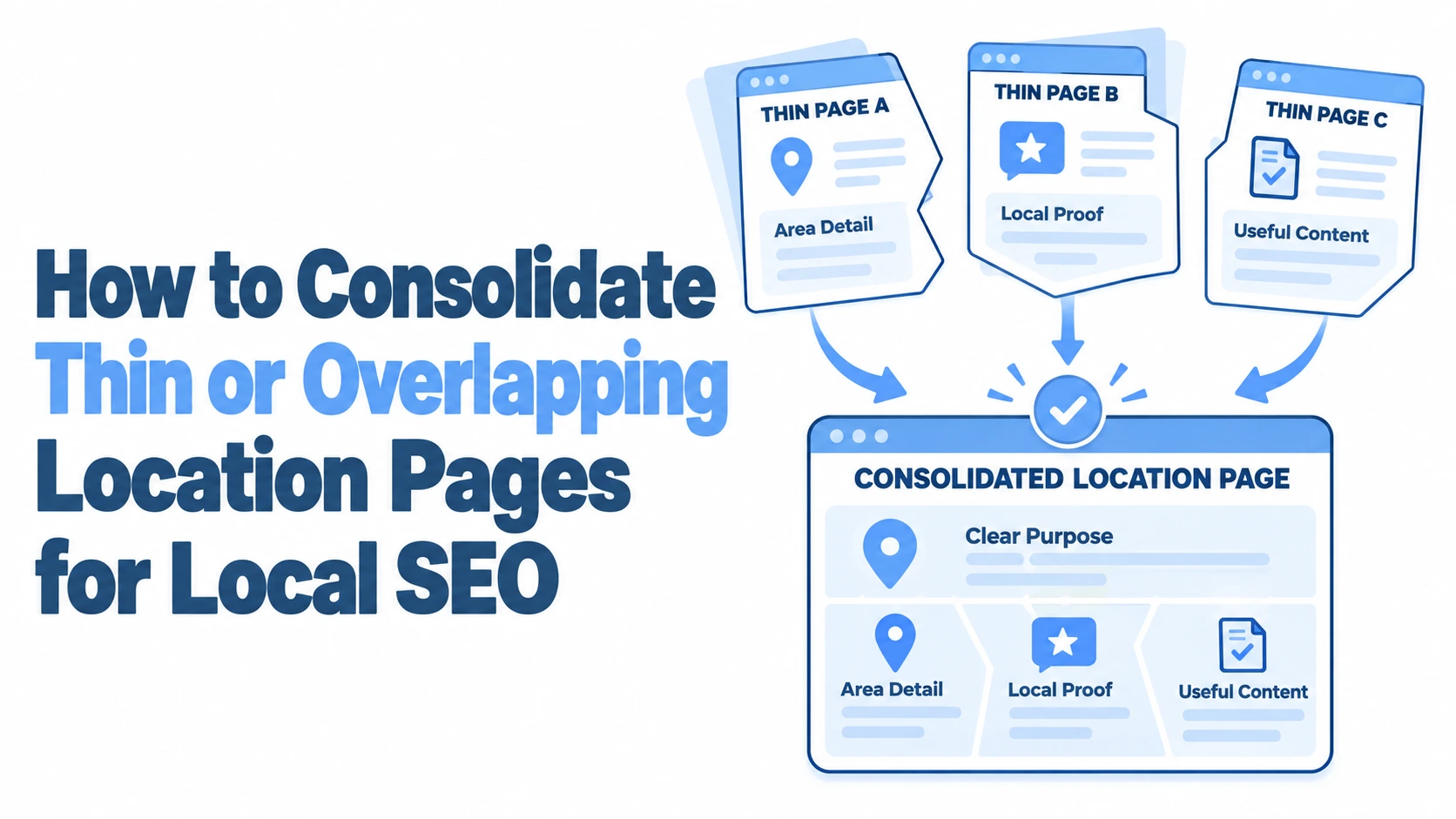
Most local service businesses start with good intentions when they create individual pages for every town, village, and postcode they cover.
A plumber in Manchester might build separate pages for Salford, Stretford, Didsbury, and Chorlton, each with a paragraph or two of near-identical text and a swapped-out place name.
The logic seems sound: more pages, more chances to rank. But Google has grown far too sophisticated for that trick, and the result is usually the opposite of what you’d hope.
Instead of ranking broadly, you end up with a collection of weak pages that compete against each other and collectively underperform.
If you’re trying to work out how to consolidate thin or overlapping location pages to improve your local SEO, you’re asking the right question, and the answer involves more strategy than most people expect.
This guide walks through the full process: from diagnosing the problem to building stronger, consolidated pages that actually earn local visibility.
Understanding the Impact of Thin and Overlapping Content on Local Rankings
Thin location pages are pages that exist primarily to target a geographic keyword but offer little unique value. They typically share the same template, the same service descriptions, and sometimes even the same customer testimonials, with only the town name swapped in. Google’s helpful content system, which has received significant updates through 2025 and into 2026, is specifically designed to identify and demote this kind of content. Pages that exist for search engines rather than users get filtered out of results or pushed so far down they may as well not exist.
The problem compounds when you have dozens of these pages. Each one dilutes the authority that could otherwise be concentrated on fewer, stronger pages. Your internal linking spreads thin. Your crawl budget gets wasted. And from a user’s perspective, landing on a page that says nothing specific about their area erodes trust immediately.
The Risks of Keyword Cannibalisation Between Service Areas
Keyword cannibalisation happens when multiple pages on your site target essentially the same search intent. If you have separate pages for “emergency plumber in Salford” and “emergency plumber in Eccles,” Google has to choose which one to show, and it often chooses neither with any conviction. The search engine may alternate between them, never building consistent ranking signals for either.
This is particularly damaging for local service businesses because Google’s local algorithm already considers proximity. A single strong page covering the broader area (say, “emergency plumber in west Manchester”) can rank for searches from Salford, Eccles, Walkden, and Swinton if it has genuine authority. Two or three weak pages targeting each town individually will almost always lose to a competitor who has one excellent page with real local depth.
How Google Evaluates Local Landing Page Quality
Google’s quality raters guidelines are explicit about what makes a good local page. The page needs to demonstrate genuine local expertise: real case studies from the area, specific information about local conditions or regulations, photos from actual jobs, and content that couldn’t simply be copy-pasted to another location. A page about roofing services in Bristol should mention the challenges of working with Georgian-era properties in Clifton or the specific planning considerations in conservation areas, not just generic roofing advice with “Bristol” inserted.
The local pack (Map Pack) results add another layer. Google cross-references your landing page content with your Google Business Profile data. If your GBP lists one address but you have 40 location pages implying you’re based in 40 different places, the inconsistency weakens your overall local signals rather than strengthening them.
Auditing Your Current Local Page Architecture
Before you consolidate anything, you need a clear picture of what you’re working with. Rushing into merges and redirects without proper analysis is how businesses accidentally tank their rankings for pages that were actually performing well.
Identifying Low-Value Pages with Performance Data
Start in Google Search Console. Filter your performance report by page and look at every location page you’ve built. You’re looking for three things: impressions, clicks, and average position. Pages with fewer than 50 impressions over the past six months are almost certainly dead weight. Pages with impressions but zero or near-zero clicks are being shown but ignored, which is arguably worse because they signal to Google that your content isn’t satisfying search intent.
Export this data into a spreadsheet and sort by clicks, lowest first. You’ll likely find that 80% of your location pages generate fewer than 5% of your total local traffic. Those are your consolidation candidates. Be careful with the remaining 20%, though: some of those pages may be doing real work, and you’ll want to preserve their equity rather than destroy it.
A tool like VisiLocali’s Local Rank Tracker can add another dimension here. Its visual ranking grids show exactly where your business ranks across different points in your service area, making it much easier to spot where you actually have visibility and where your location pages aren’t contributing anything meaningful.
Mapping Proximity and Service Area Overlap
Pull up a map of your service area and plot every location page you have. You’ll often find clusters of pages targeting towns that are only a few miles apart, sometimes within the same local authority district. These clusters are prime consolidation targets because Google already treats them as part of the same local market.
Group your location pages into logical regions. For a business covering Greater Manchester, that might mean grouping Salford, Eccles, and Swinton into a “West Manchester” cluster, while Stockport, Cheadle, and Bramhall form a “South Manchester” cluster. The exact groupings depend on your business, but the principle is the same: identify pages that overlap geographically and compete for the same pool of searchers.
Strategic Consolidation Framework for Multi-Location Businesses
Once you’ve identified which pages to merge, you need a systematic approach. Random deletions and redirects cause more harm than a thoughtful consolidation programme.
Choosing a Primary URL for Merged Content
For each cluster of pages you’re merging, pick the URL with the strongest existing performance. Check which page has the most backlinks (even a handful matters), the highest click-through rate, and the best average position. That page becomes your primary URL: the one that survives and absorbs the content and authority from the others.
If none of the existing URLs are particularly strong, consider whether a new, broader URL makes more sense. For example, if you have /plumber-salford/, /plumber-eccles/, and /plumber-swinton/, none of which rank, a fresh /plumber-west-manchester/ page might be the better foundation. Just be aware that a new URL starts with zero history, so this approach works best when the existing pages have negligible equity anyway.
Implementing Permanent 301 Redirects Correctly
Every page you retire needs a 301 redirect pointing to the new consolidated page. This tells Google and users that the content has permanently moved, and it passes most of the link equity from the old URL to the new one.
Common mistakes to avoid:
- Redirecting all old pages to the homepage instead of the relevant consolidated page
- Creating redirect chains (page A redirects to page B, which redirects to page C)
- Forgetting to update internal links, so your own site still points to old URLs
- Leaving old pages in your XML sitemap after redirecting them
Test every redirect after implementation. Use a tool like Screaming Frog or simply check each old URL in your browser to confirm it lands on the correct destination. One broken redirect can orphan a page and waste whatever authority it had accumulated.
Creating Robust Regional Hub Pages
The consolidated page needs to be substantially better than the thin pages it replaces. This is where most businesses stumble: they merge three weak pages into one slightly-less-weak page and wonder why nothing improves.
A strong regional hub page should include specific mentions of the towns and areas covered, but woven naturally into genuinely useful content. Describe the types of properties common in each area. Reference local landmarks that help customers understand your service zone. Include photos from real jobs in those locations, with proper alt text and captions. If you’ve completed 15 boiler installations in Chorlton this year, say so and show the evidence.
Think of each hub page as a mini resource for customers in that region, not just a keyword target. The page should answer the questions a real person in that area would have: how quickly can you get there, do you know the local building regulations, have you worked on properties like theirs before?
Optimising the New Consolidated Local Landing Page
With your hub pages built and redirects in place, the next step is making sure each consolidated page sends the right signals to both Google and potential customers.
Integrating Unique Local Signals and Case Studies
Generic content with local place names inserted is exactly what you’re trying to move away from. Each consolidated page needs content that could only apply to that specific region. This means investing time in genuine local detail.
Write up brief case studies from jobs in the area. A heating engineer covering south Leeds might describe a tricky installation in a Victorian terrace in Headingley, mentioning the specific challenges of working with older pipework and limited loft access. That kind of detail does two things: it proves to Google that your content is genuinely local, and it reassures the customer reading it that you understand their situation.
Include testimonials from customers in the covered areas, with their permission. Embed Google reviews if possible, as they create a direct connection between your page content and your Google Business Profile. Mention any local partnerships, sponsorships, or community involvement. If you sponsor the Didsbury Cricket Club or you’re a member of the Bristol Chamber of Commerce, that’s a local signal worth including.
Updating Schema Markup for Multiple Service Areas
Your structured data needs to reflect the new page architecture. If a single page now covers multiple towns, your LocalBusiness or Service schema should include the full service area rather than a single location. Use the areaServed property to list each town or region the page covers.
Make sure your schema matches what’s on the page. Google uses structured data as a cross-reference, not a replacement for visible content. If your schema claims you serve Stockport but the page never mentions Stockport, the mismatch can trigger distrust signals. Keep your NAP (name, address, phone number) consistent across schema, page content, and your Google Business Profile.
Aligning Google Business Profile with Consolidated Pages
Your Google Business Profile is the single most important factor in local pack rankings, and it needs to match your new page structure. If you’ve consolidated your website’s location pages, your GBP should reflect the same service area logic.
Update your GBP’s service area to align with your consolidated pages. If you’ve moved from 20 individual town pages to 5 regional hub pages, make sure your GBP’s listed service areas correspond to those regions. The website link on your GBP should point to your most relevant landing page, not a generic homepage or an outdated location page that now redirects.
VisiLocali’s GBP Audit Tool is genuinely useful at this stage. It analyses your profile to identify what might be limiting your performance in local search, then translates those findings into clear recommendations. After a consolidation project, running an audit helps you catch mismatches between your updated website structure and your GBP data: the kind of inconsistencies that quietly undermine your local visibility without any obvious warning signs.
Keep your GBP active with regular posts, fresh photos, and prompt review responses. VisiLocali’s GBP Management Tool can streamline this ongoing work, letting you manage posts, photos, and reviews from one place while monitoring for unexpected profile changes. An active, well-maintained profile reinforces the authority of your consolidated landing pages rather than contradicting them.
Monitoring Post-Consolidation Performance and Local Visibility
Consolidation isn’t a one-day fix. Expect some fluctuation in the first four to eight weeks as Google recrawls your site, processes the redirects, and reassesses your pages. Rankings may dip temporarily before settling into their new positions, and that’s normal.
Track three key metrics weekly during this period. First, monitor your organic impressions in Google Search Console for the consolidated pages. You should see impressions gradually increase as Google recognises the stronger, more authoritative pages. Second, watch your click-through rates: if the new pages are better quality, CTR should improve as users find more relevant content. Third, track your local pack visibility using geo-grid rank tracking, which shows your rankings from multiple points across your service area rather than just from a single postcode.
If a consolidated page isn’t performing after 8-12 weeks, revisit the content. Is it genuinely unique and locally relevant, or did it end up as just another merged page with the same generic text? Sometimes a second round of content improvement is needed, particularly for competitive service areas where your rivals have already invested in quality local pages.
Set up a quarterly review programme to catch any drift. New thin pages have a way of creeping back in, especially if someone on your team creates a quick page for a new area without following the consolidation framework. Document your approach so that future location pages meet the quality standard from the start rather than requiring another round of cleanup later.
The businesses that get the best long-term results from consolidating their local pages are the ones that treat it as a permanent shift in approach, not a one-off project. Fewer, better pages will consistently outperform a sprawl of thin ones, and the gap only widens as Google’s content quality systems become more sophisticated.
If you’re unsure where to start or want to see exactly how your current location pages are performing across your service area, VisiLocali offers a 14-day free trial on any plan. The Local Rank Tracker and GBP Audit tools together give you the data you need to make confident consolidation decisions, backed by a 90-day improvement guarantee. Card details are required at sign-up to prevent trial abuse, but it’s a low-risk way to get clarity on what’s actually working and what needs to change.
