 Skip to content

Most local businesses already have a website and a Google Business Profile.
The hard part isn’t knowing that local SEO matters: it’s figuring out which on-page changes will actually move the needle.
You could spend weeks rewriting meta descriptions, restructuring your site, and adding schema markup, but if you’re working on the wrong things first, you’re burning time you don’t have.
The real question isn’t what to fix, but what to fix first.
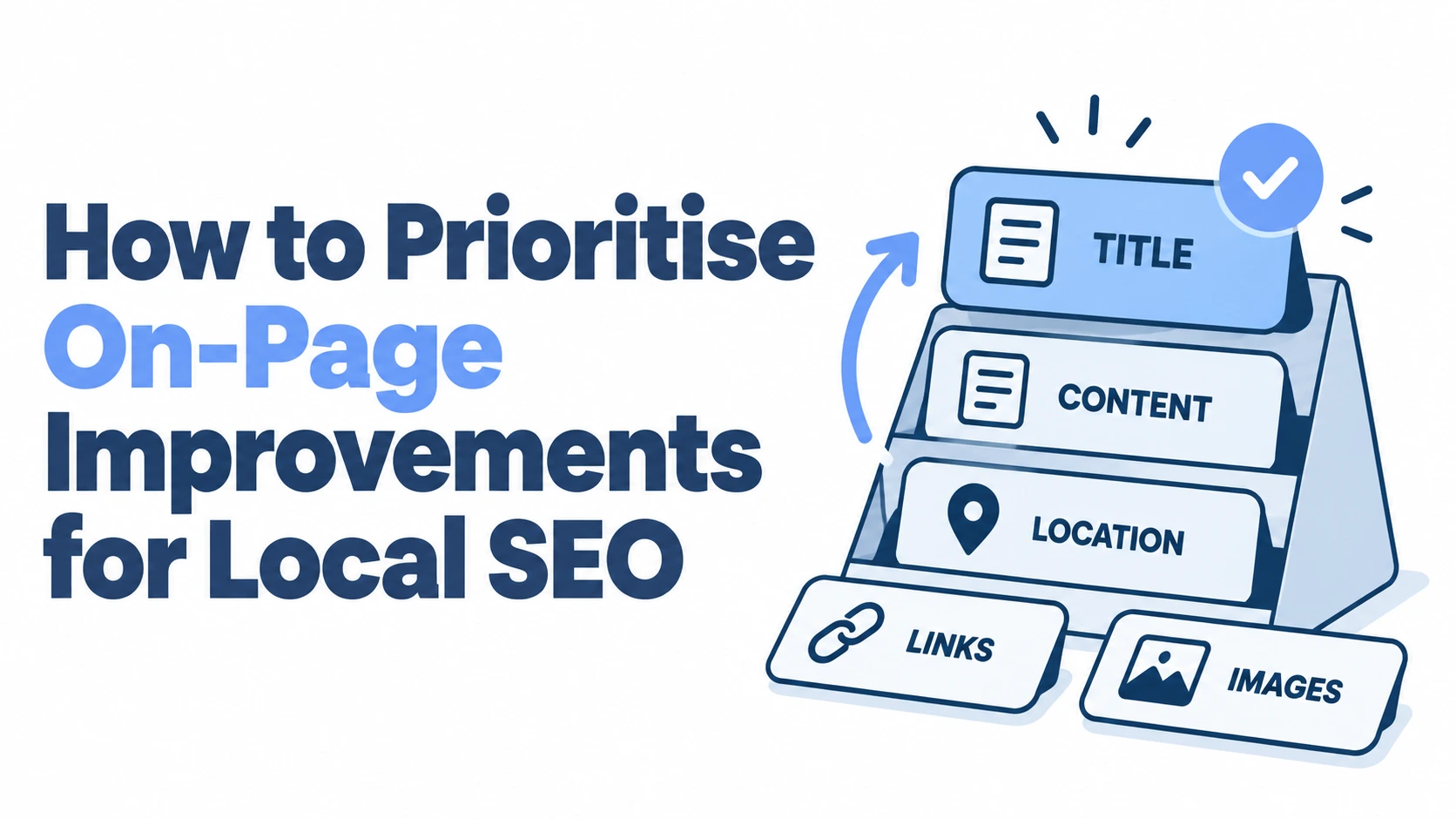
Prioritising on-page improvements for local SEO is less about following a generic checklist and more about understanding where your specific gaps are, then tackling them in the right order.
A plumber in Bristol and an estate agent in Leeds will have completely different weak spots, even if they’re both struggling to appear in the local pack. This guide walks through a practical framework for identifying, ordering, and executing the on-page changes that genuinely improve local visibility, so you’re not just busy: you’re making progress.
The Fundamentals of Local On-Page Prioritisation
On-page local SEO covers everything on your website that signals to Google where you operate, what you do, and why a searcher in your area should trust you. That includes title tags, meta descriptions, header tags, body content, schema markup, NAP (Name, Address, Phone) consistency, internal linking, image alt text, and page speed. The list is long, and that’s exactly the problem: most businesses try to do everything at once and end up doing nothing well.
The smartest approach is to rank your improvements by two factors: impact and effort. A title tag change takes five minutes and can shift your rankings within days. Building out ten unique location pages takes weeks. Both matter, but the order you tackle them in determines how quickly you see results.
Think of it as triage. Start with the elements Google weighs most heavily for local intent: your primary landing pages, NAP data, and title tags. Then move to structural improvements like schema and internal linking. Finally, invest in content depth and user experience refinements. This isn’t a one-time project either. Google’s local algorithm considers freshness and engagement, so your on-page work needs periodic revisiting. The businesses that consistently rank well in the map pack aren’t the ones who did a single optimisation sprint in 2023: they’re the ones who treat it as an ongoing programme of small, targeted improvements.
Auditing Your Current Local Visibility
Before you change anything, you need to know where you actually stand. Too many businesses skip this step and start optimising based on assumptions rather than data. An audit doesn’t need to be complicated, but it does need to cover three areas: your current rankings across your target area, the state of your Google Business Profile, and the on-page health of your website.
For rankings, a standard position check for a handful of keywords isn’t enough. Local search results vary dramatically depending on where the searcher is physically located. Someone searching “emergency locksmith” from the centre of Manchester will see different results than someone three miles away. Tools like VisiLocali’s Local Rank Tracker use visual ranking grids to show exactly where your business appears across different points in your service area, revealing the specific neighbourhoods where you’re strong and where competitors are beating you.
Your Google Business Profile deserves its own audit. Missing categories, incomplete business descriptions, stale photos, and a lack of recent Google Posts all drag down performance. VisiLocali’s GBP Audit Tool analyses these elements and translates findings into clear recommendations rather than dumping raw data on you. It identifies what’s already working, what’s missing, and what to prioritise next.
On the website side, check for basics: are your title tags geo-targeted? Is your NAP consistent across every page? Do you have dedicated pages for each service area? Are your Core Web Vitals passing? Document everything before you start making changes. You’ll want a baseline to measure against, and you’ll avoid the common mistake of “fixing” things that weren’t actually broken.
Optimising High-Impact NAP and Metadata Elements
Your NAP details and metadata are the foundation of local on-page SEO. Get these wrong and everything else you build sits on shaky ground. These are also among the quickest wins available, which is why they belong at the top of your priority list.
Standardising Business Name, Address and Phone Details
Google cross-references your NAP across your website, your Google Business Profile, and third-party directories. Any inconsistency: “St.” versus “Street,” a missing suite number, a landline on your site but a mobile on your GBP: creates friction. Google becomes less confident about your business information, and that uncertainty can cost you positions in the local pack.
Pick one exact format for your business name, address, and phone number, then use it everywhere. Embed it in your site footer, your contact page, and every location-specific landing page. If you’ve recently moved or changed phone numbers, audit your directory listings too. A tool like VisiLocali’s GBP Management Tool helps you monitor your profile for unexpected edits, so incorrect information doesn’t sit live without you noticing. This kind of consistency work isn’t glamorous, but it’s one of the highest-impact, lowest-effort improvements you can make.
Crafting Geo-Targeted Title Tags and Meta Descriptions
Your title tags are still one of the strongest on-page ranking signals for local search. A title like “Professional Plumbing Services” tells Google nothing about where you operate. “Emergency Plumber in Leeds | 24/7 Call-Outs” tells Google exactly who should see this page and gives the searcher a reason to click.
Every key landing page should include your primary service and your target location in the title tag. Keep it under 60 characters where possible. For meta descriptions, focus on click-through rate rather than keyword stuffing. Mention your area, include a specific benefit or differentiator, and add a call to action. Something like “Trusted by over 500 Leeds homeowners. Same-day appointments available: call now” works far harder than a generic summary of your services. Run through your top ten pages and fix titles and descriptions first. You’ll often see ranking movement within two to three weeks.
Structuring Local Landing Pages for Conversion
If you serve multiple areas, your site structure needs to reflect that. A single “Areas We Cover” page with a list of town names isn’t going to cut it. Google wants to see dedicated, substantive pages for each location you serve, and your potential customers want to feel like you actually know their area.
Creating Unique Content for Multiple Locations
Each location page needs at least 400 words of genuinely unique content. That doesn’t mean swapping “Manchester” for “Salford” and calling it done. Reference local landmarks, mention area-specific challenges (hard water issues in certain postcodes, for example), and include testimonials from customers in that area. A roofing company in Glasgow might reference the specific weather patterns that cause slate damage in the West End versus the flat roof issues common in newer Southside developments.
This takes time, which is why it sits lower on the priority list than NAP and metadata fixes. But the payoff is significant. Unique location pages rank for long-tail local queries that your competitors’ generic pages simply can’t target. They also convert better because visitors see content that feels relevant to their specific situation rather than a one-size-fits-all sales pitch.
Integrating Google Maps and Directions
Embedding a Google Map on each location page does two things: it gives users a quick way to find you, and it reinforces your geographic relevance to Google. Use the Google Maps embed for your actual business location, and on service area pages, consider embedding a map centred on the area you’re describing.
Add practical directions too. “We’re a five-minute walk from Bristol Temple Meads station” or “Free parking available on Victoria Road” helps real visitors and signals local relevance. Include a clickable address that opens in the user’s maps app on mobile. These small details compound: each one adds a signal that your business genuinely operates in and serves this specific area.
Leveraging Local Business Schema and Structured Data
Schema markup is the technical layer that helps Google understand your business information in a structured way. For local businesses, the LocalBusiness schema type (and its more specific subtypes like Plumber, Dentist, or RealEstateAgent) tells Google your business name, address, phone number, opening hours, service area, and accepted payment methods in a format it can parse instantly.
Adding schema won’t automatically launch you into the local pack, but it removes ambiguity. When your structured data matches your GBP and your on-page content, Google has three consistent sources confirming the same information. That consistency builds trust in your listing.
You don’t need to be a developer to implement this. Google’s own Structured Data Markup Helper can generate the JSON-LD code, and most modern CMS platforms have plugins that handle it. Focus on getting the basics right first: business name, address, phone, opening hours, and geo-coordinates. Then layer in review markup if you’re collecting reviews on your site, and FAQ schema for any question-and-answer content. Test your implementation with Google’s Rich Results Test tool to confirm everything validates correctly. This is a one-time setup with occasional updates when your business details change: high impact for relatively little ongoing effort.
Enhancing User Experience for Mobile Local Searchers
Over 60% of local searches happen on mobile devices, and Google’s ranking systems reflect that reality. If your site is slow, difficult to use on a phone, or makes it hard to contact you, you’re losing both rankings and customers. Mobile experience isn’t a nice-to-have: it’s a core ranking factor.
Improving Core Web Vitals for Local Speed
Google’s Core Web Vitals measure loading performance, interactivity, and visual stability. For local businesses, the most common issues are oversized images, render-blocking scripts, and slow server response times. Run your key pages through PageSpeed Insights and focus on the specific recommendations it provides.
Compress images to WebP format, defer non-critical JavaScript, and consider a content delivery network if your hosting is slow. A local searcher looking for an emergency electrician isn’t going to wait four seconds for your page to load: they’ll hit back and call whoever appears next. Aim for a Largest Contentful Paint under 2.5 seconds and an Interaction to Next Paint under 200 milliseconds. These aren’t arbitrary numbers: they’re Google’s own thresholds for a “good” experience.
Streamlining Click-to-Call and Contact Functionality
On mobile, the path from search to contact should be as short as possible. Your phone number should be clickable (using a tel: link) and visible without scrolling on every page. If you use a contact form, keep it to three or four fields maximum. Name, phone number, and a brief message is plenty for most service businesses.
Consider adding a sticky call button that follows the user as they scroll. Test your contact page on an actual phone: not just a desktop browser resize, but a real device. Can you complete the enquiry in under 30 seconds? If not, you’re creating unnecessary friction. Every extra tap or scroll between “I need this service” and “I’ve contacted this business” costs you leads. A GP surgery in Sheffield that reduced its mobile contact form from eight fields to three saw enquiry completions increase by over 40% within a month: a reminder that simplicity wins.
Building Authority Through Local Content and Reviews
Once your technical foundations are solid, content and reviews become your primary growth engines. Google’s local algorithm weighs prominence heavily, and prominence comes from two sources: what people say about you (reviews) and what you publish (content).
For reviews, the goal isn’t just volume: it’s recency and quality. A business with 200 reviews but nothing new in six months looks stagnant. Develop a simple programme for requesting reviews after each job or appointment. A text message with a direct link to your Google review page, sent within 24 hours of service, consistently outperforms email requests. Respond to every review, positive or negative. Google has confirmed that responses signal an active, engaged business. VisiLocali’s GBP Management Tool can generate AI-assisted review responses, saving you time while keeping your profile active.
For content, think locally. Blog posts about “how to prepare your boiler for winter” are generic. “How Glasgow homeowners can prepare their boiler for a Scottish winter” targets a specific audience and ranks for local long-tail queries. Cover local events you sponsor, community projects you support, or area-specific advice. This content builds topical and geographic authority simultaneously. Developed by a Local SEO specialist with over 10 years of experience, VisiLocali’s approach reflects this principle: the platform is built around turning data into specific actions rather than leaving you to interpret dashboards on your own.
Measuring Success and Refining Your Local Strategy
Making improvements without measuring their effect is like adjusting a recipe without tasting the food. You need a feedback loop that shows which changes moved the needle and which didn’t.
Track three core metrics on a monthly basis. First, your local pack visibility across your target area: not just a single keyword check, but a grid-based view that shows ranking variations by location. VisiLocali’s Local Rank Tracker provides exactly this, using visual ranking grids to reveal where you’re gaining ground and where gaps remain. Second, track website actions from local visitors: phone calls, form submissions, and direction requests. Third, monitor your Google Business Profile insights for search queries, views, and engagement trends.
When you see a positive shift after a specific change (say, rewriting your title tags or adding location pages), double down on that approach. When something doesn’t move the numbers after six to eight weeks, reassess. Local SEO isn’t static: competitors improve, Google updates its algorithms, and customer behaviour shifts. The businesses that maintain strong local visibility treat this as a quarterly review process, not a one-off project.
Set a calendar reminder every 90 days to re-run your GBP audit, check your Core Web Vitals, and review your ranking grids. This rhythm keeps you ahead of competitors who optimised once and forgot about it. With VisiLocali’s 90-Day Improvement Guarantee, you have the added assurance that if expected progress isn’t materialising, the team will review your account and provide a manual improvement plan.
The businesses that win local search aren’t necessarily the biggest or the ones spending the most on marketing. They’re the ones who understand where their gaps are, fix the highest-impact issues first, and keep refining. Start with your NAP and metadata, build out your location pages, layer in schema and mobile improvements, then feed the engine with fresh content and reviews. Each step compounds on the last.
If you’re ready to stop guessing and start seeing where your local visibility actually stands, VisiLocali offers a 14-day free trial across all plans. It’s a practical way to audit your profile, track your rankings, and get clear recommendations on what to fix next: without committing long-term before you’ve seen the value.
