 Skip to content

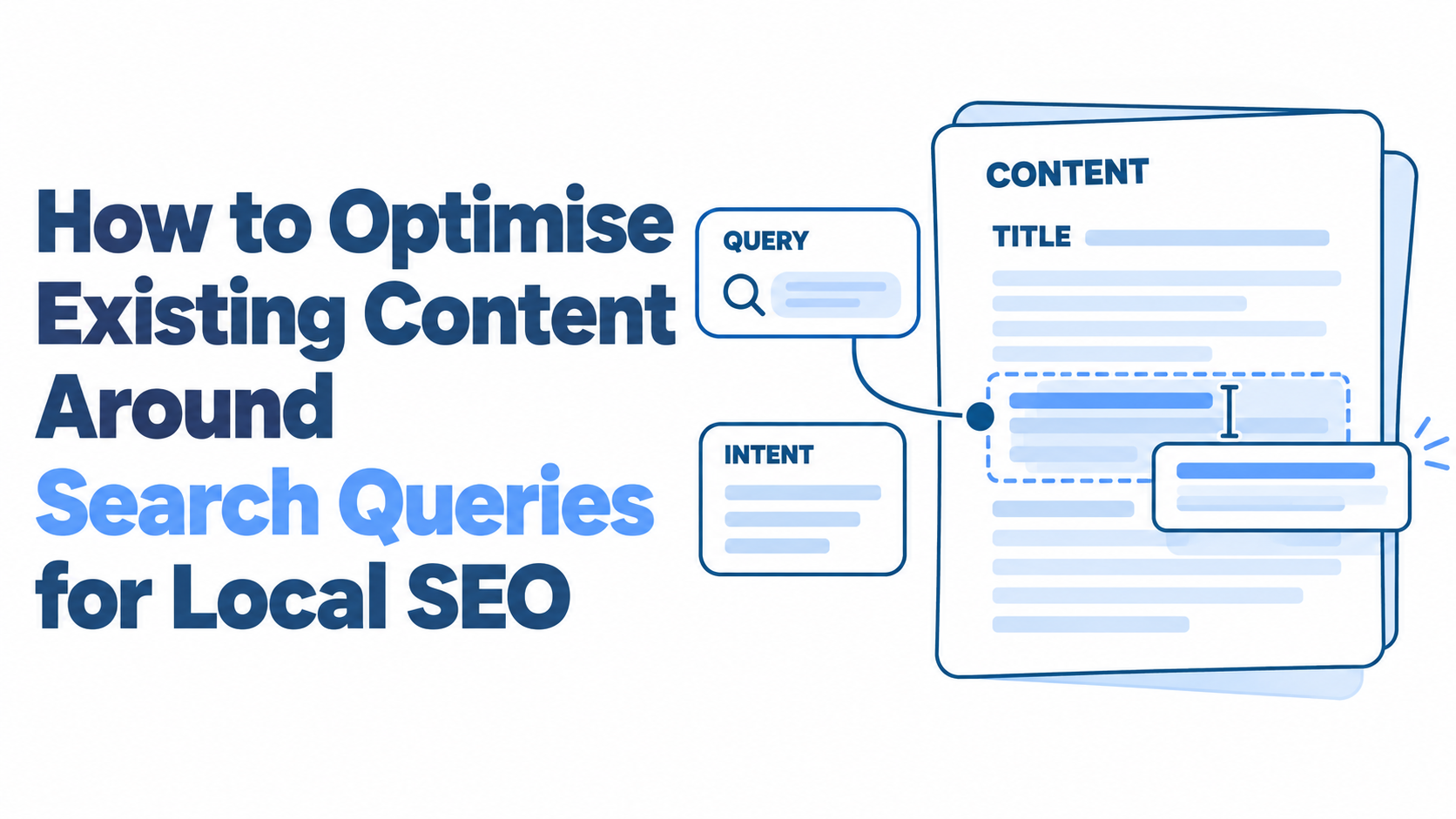
Most local businesses already have a decent website with pages that describe their services, cover their service areas, and maybe even host a blog. The problem is that much of this content was written without a clear understanding of how people actually search for local services. A plumber in Bristol might have a perfectly good “Services” page, but if nobody’s finding it when they type “emergency boiler repair near Clifton,” that page isn’t pulling its weight. The real opportunity for most established businesses isn’t creating more content: it’s reworking what already exists so it aligns with the local search queries real customers are using. Learning how to optimise existing content for local SEO is one of the highest-return activities a small business can invest time in, because you’re building on pages that already have some authority rather than starting from scratch. This guide walks through the practical steps, from identifying which pages need attention to measuring whether your changes actually moved the needle.
The Strategic Importance of Local Content Refreshing
Google’s local algorithm has shifted considerably over the past few years, placing greater emphasis on relevance signals that connect your content to specific locations and services. A page written in 2021 about “kitchen fitting services” without any geographic context is now competing against pages that mention specific neighbourhoods, reference local building regulations, and include structured data that tells Google exactly where the business operates. The gap between these two types of content grows wider every year.
Refreshing existing content is faster and more effective than building new pages for most businesses. Your older pages have already been indexed, may have earned backlinks, and carry domain-level trust signals. Throwing them away to start fresh wastes all of that accumulated value. A 2024 study from Semrush found that updating existing content produced measurable ranking improvements for 65% of the pages analysed, often within weeks rather than months.
There’s a practical benefit too: most local service businesses don’t have the time or budget to produce dozens of new pages every quarter. A focused programme of content refreshing, where you systematically update your best-performing and highest-potential pages with local relevance signals, delivers more visibility per hour of effort than almost anything else you can do on-site.
Identifying Underperforming Assets via Google Search Console
Before you start rewriting anything, you need to know which pages are worth your time. Google Search Console is the starting point here, and specifically the Performance report filtered by search queries containing location terms.
Start by filtering for queries that include your city name, neighbourhood, or “near me” variations. Look for pages that are generating impressions but have low click-through rates: these are pages Google considers somewhat relevant but that aren’t compelling enough to earn clicks. A service page getting 400 impressions per month for “electrician in Leeds” but only 3 clicks is a prime candidate for optimisation.
Next, identify pages ranking in positions 8 through 20 for local queries. These are your quick wins. They’re close enough to page one that targeted improvements can push them into visibility, but they’re not so far down that the effort would be wasted. Sort by average position and look for anything sitting just outside the top results.
Pay attention to pages that rank for local queries you didn’t expect. Sometimes a blog post about a specific project you completed in a particular area starts attracting searches for services in that location. These accidental local pages can become powerful assets with deliberate optimisation. Tools like VisiLocali’s Local Rank Tracker can complement this analysis by showing you exactly where your business appears across a visual grid of your target area, revealing pockets where you’re invisible that Search Console alone won’t surface.
Analysing Local Intent and Geo-Specific Search Queries
Understanding what people actually type (and what they mean by it) is the foundation of any content refresh programme. Local search queries carry specific intent signals that generic keyword research tools often miss.
Distinguishing Between ‘Near Me’ and City-Specific Terms
These two query types behave differently, and your content needs to account for both. “Near me” searches are proximity-driven: Google uses the searcher’s real-time location to determine results, which means your Google Business Profile and its proximity to the searcher matter enormously. City-specific searches like “roofer in Manchester” or “best estate agent Glasgow” give slightly more weight to on-page relevance signals because the searcher has explicitly stated their location intent.
For “near me” queries, your content strategy should focus on reinforcing your physical location through consistent NAP (name, address, phone) data, embedded maps, and location-specific schema markup. For city-specific queries, the content itself needs to demonstrate genuine local expertise: mentioning neighbourhoods, referencing local landmarks, and addressing region-specific concerns.
A GP surgery in Sheffield, for example, might optimise differently for “GP near me” (ensuring their Google Business Profile is complete and accurate) versus “NHS GP accepting patients Sheffield” (creating a dedicated page that addresses this specific question with current availability information).
Mapping User Intent to Service Area Pages
Each service area page on your site should target a distinct cluster of local queries, not just a single keyword. Map out the queries you’ve found in Search Console and group them by location and service type. If you serve multiple areas, each area page needs unique content that goes beyond swapping out the town name.
A locksmith covering West Yorkshire shouldn’t have five identical pages with only “Leeds,” “Bradford,” “Wakefield,” “Huddersfield,” and “Halifax” changed. Each page should reference specific aspects of serving that area: typical property types, common lock brands found in local housing stock, average response times from your base, and any locally relevant details. This is what separates a thin, penalisable doorway page from a genuinely useful service area page.
Infusing Local Semantic Relevance into Existing Body Copy
Once you know which pages to update and which queries to target, the actual rewriting begins. The goal isn’t to stuff location names into every paragraph: it’s to make the content genuinely useful for someone searching in your area.
Start with natural geographic references. If you’re a bathroom fitter in Bristol, mentioning that many Victorian terraces in Redland and Cotham have specific plumbing challenges that affect bathroom renovations is far more valuable than simply repeating “bathroom fitter Bristol” six times. This kind of content signals local expertise to both Google and potential customers.
Weave in references to local regulations, planning considerations, or regional specifics where they’re relevant. A roofing company in Edinburgh might reference the specific building standards that apply to properties in conservation areas, or the particular weather conditions that affect roof longevity in central Scotland. These details serve two purposes: they add genuine value for readers, and they create topical associations that help Google understand your geographic relevance.
Review your existing content for missed opportunities. Many service pages describe what a business does without ever mentioning where they do it or what makes their local market different. Adding two or three paragraphs of locally relevant context to an otherwise generic page can significantly shift its performance for geo-modified queries. Don’t forget to update any outdated information while you’re at it: old pricing, discontinued services, or references to past years all undermine trust.
Optimising Metadata and Headers for Regional Authority
Your page titles, meta descriptions, and header tags are the most concentrated signals you can send about what a page covers and where it’s relevant. Many businesses write these once and never revisit them, which means they’re often generic or outdated.
Page titles should include your primary service and location naturally. “Professional Carpet Cleaning in Newcastle | [Business Name]” works far better than “Our Services | [Business Name].” Keep titles under 60 characters where possible, and front-load the most important terms. Your meta description won’t directly affect rankings, but it heavily influences click-through rates. Write descriptions that speak to local searchers specifically: “Serving homes and businesses across Tyneside since 2014” tells a Newcastle searcher that you’re genuinely local.
For header tags, use your H1 for the primary service-plus-location phrase, and distribute H2s and H3s across the subtopics and areas you cover. If a page discusses multiple service areas, each area section should have its own subheading. This creates a clear content hierarchy that helps Google understand the page’s geographic scope.
Don’t overlook image alt text and file names. Renaming “IMG_4582.jpg” to “kitchen-renovation-chorlton-manchester.jpg” takes seconds but adds another local relevance signal. Apply this across all images on the pages you’re refreshing.
Enhancing On-Page Signals with Structured Data and Maps
Technical on-page signals tell search engines what your content means in a machine-readable format. For local businesses, two elements matter most: schema markup and embedded location evidence.
Implementing LocalBusiness Schema Markup
LocalBusiness schema (and its more specific subtypes like Plumber, Dentist, or RealEstateAgent) helps Google understand your business type, location, operating hours, and service area with precision. If you haven’t implemented this yet, adding it to your key pages is one of the highest-impact technical changes you can make.
The essential properties to include are:
- Business name, address, and phone number (matching your Google Business Profile exactly)
- Geographic coordinates (latitude and longitude)
- Opening hours specification
- Service area definitions
- Price range indicator
- Aggregate rating (if you have reviews on your site)
Use Google’s Rich Results Test to validate your markup after implementation. Errors in schema can prevent it from being processed entirely, so testing is essential rather than optional.
Integrating Interactive Maps and Location Evidence
Embedding a Google Map on your service area pages does more than help visitors find you: it reinforces your geographic relevance to crawlers. Use a map that shows your actual business location or service area, not just a generic city-level pin.
Beyond maps, consider adding other forms of location evidence: photos of your team at recognisable local sites, case studies that reference specific neighbourhoods, or testimonials from customers who mention their area. A testimonial reading “Brilliant service, arrived within 30 minutes to our home in Headingley” carries both social proof and geographic signal.
VisiLocali’s GBP Audit Tool can help identify gaps in your Google Business Profile that might be undermining these on-page efforts. If your profile has inconsistent business information, missing categories, or a sparse photo gallery, even well-optimised website content won’t perform to its potential in local pack results. The audit analyses what’s working and what’s missing, then provides specific recommendations rather than just an abstract score.
Leveraging User-Generated Content and Local Social Proof
Reviews, testimonials, and customer-generated content are among the strongest local ranking signals available, and they’re often underused on business websites. Google’s own documentation confirms that review signals (quantity, velocity, and diversity) influence local pack rankings.
Actively request reviews from satisfied customers and make the process simple. A follow-up text message with a direct link to your Google review page converts far better than a generic “please leave us a review” email. Once you have reviews, don’t let them sit only on Google: feature relevant ones on your service pages, particularly reviews that mention specific locations or services.
Customer case studies are another powerful form of local content. A detailed write-up of a project you completed in a specific area, including before-and-after photos and the customer’s own words, creates a unique page that’s almost impossible for competitors to replicate. These pages naturally attract long-tail local searches and demonstrate genuine expertise.
Consider encouraging customers to share photos of completed work on social media with location tags. This creates a trail of local signals across multiple platforms. You can then embed or reference this content on your own site, creating a virtuous cycle of local social proof. VisiLocali’s GBP Management Tool makes it straightforward to keep this kind of content flowing by helping you create Google Posts from uploaded photos and respond to reviews with AI-assisted replies, reducing the ongoing time commitment significantly.
Measuring Success and Iterating Your Local SEO Strategy
Optimising your existing content isn’t a one-off project: it’s an ongoing programme that requires measurement and adjustment. The businesses that see sustained local visibility gains are the ones that treat content refreshing as a regular activity rather than a box to tick once.
Track these specific metrics after each round of updates:
- Impressions and clicks for local queries in Google Search Console (compare 28-day periods before and after changes)
- Local pack appearances for your target keywords
- Click-through rate changes on updated pages
- Phone calls and direction requests from your Google Business Profile
- Conversion actions on updated service area pages
Give changes at least four to six weeks before drawing conclusions. Local rankings can fluctuate in the short term, and Google may take time to recrawl and reindex updated pages. If a page hasn’t improved after eight weeks, revisit your keyword targeting and check whether competitors have stronger backlink profiles or more complete Google Business Profiles for that area.
A geo-grid rank tracking tool is particularly useful here because it shows your visibility across an entire service area rather than just at a single point. You might find that your updates improved rankings in one part of your city but had no effect in another, which tells you where to focus your next round of content work.
The businesses that get the best results from local content optimisation are the ones that build a repeatable process: identify underperforming pages quarterly, refresh them with updated local signals, measure the impact, and iterate. This systematic approach compounds over time, gradually expanding your visible footprint across your entire service area.
If you’re ready to see exactly where your business ranks across your local area and get specific recommendations for what to improve next, VisiLocali offers a 14-day free trial across all plan tiers. Built by a local SEO specialist with over a decade of experience and backed by a 90-day improvement guarantee, it’s designed to turn local search data into clear next steps rather than leaving you to interpret dashboards on your own.
